
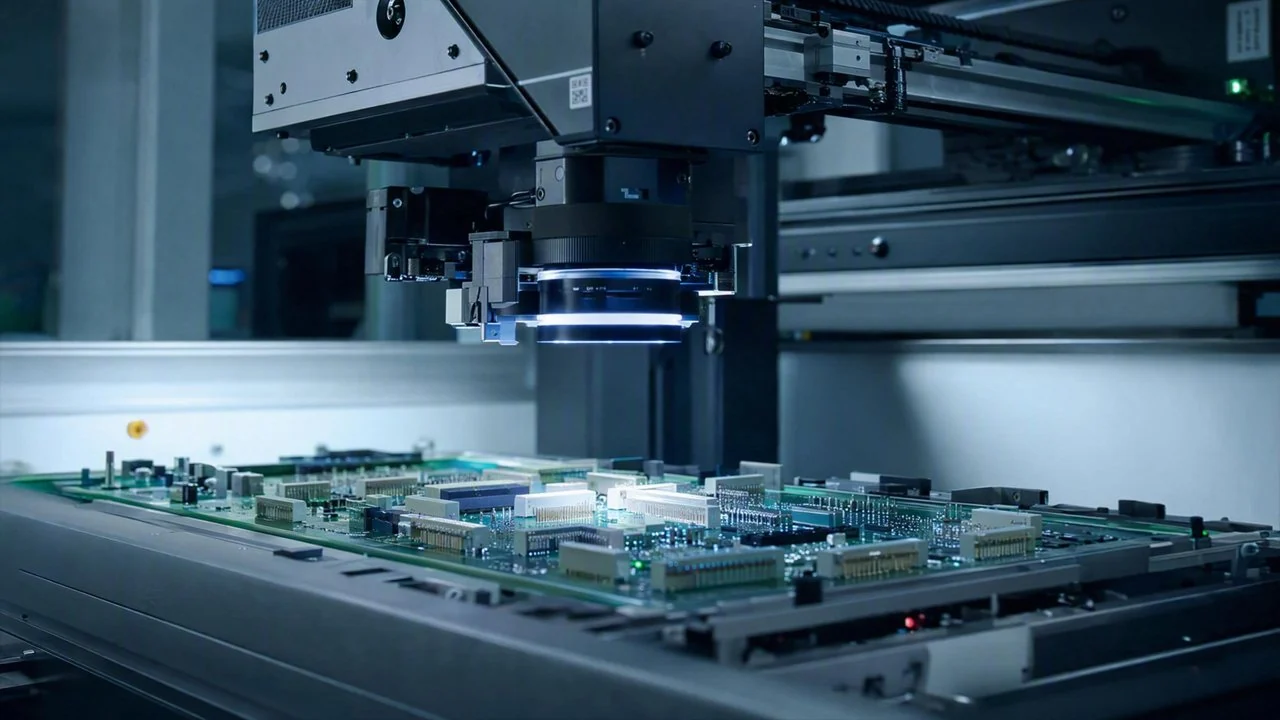
DaoAI AI AOI software system (featuring visual foundation model for feature recognition, 5-minute 0-code programming with one good sample, APDT positive/few-shot learning with 1–20 good samples, semantic false alarm filtering, and SDK/API/Docker support for 100% on-premise deployment) significantly optimizes labor costs by reducing manual re-inspection hours for PCBA connector misassembly from 12 person-hours per hour to 3 person-hours, through high-precision, low-false-alarm automated inspection. In the electronics/PCBA manufacturing sector, as product complexity continuously increases, the assembly quality of PCBAs (Printed Circuit Board Assemblies) directly impacts the performance and reliability of end products. Particularly in connector installation, even minor misalignments, missing components, or model mix-ups can lead to circuit functional failures or even safety hazards. Traditionally, the inspection of such critical defects heavily relies on manual visual inspection. However, human eye fatigue, individual variations, and speed limitations render manual inspection inadequate for high-speed, high-volume production.
DaoAI AI AOI software system (featuring visual foundation model for feature recognition, 5-minute 0-code programming with one good sample, APDT positive/few-shot learning with 1–20 good samples, semantic false alarm filtering, and SDK/API/Docker support for 100% on-premise deployment) significantly optimizes labor costs by reducing manual re-inspection hours for PCBA connector misassembly from 12 person-hours per hour to 3 person-hours, through high-precision, low-false-alarm automated inspection. In the electronics/PCBA manufacturing sector, as product complexity continuously increases, the assembly quality of PCBAs (Printed Circuit Board Assemblies) directly impacts the performance and reliability of end products. Particularly in connector installation, even minor misalignments, missing components, or model mix-ups can lead to circuit functional failures or even safety hazards. Traditionally, the inspection of such critical defects heavily relies on manual visual inspection. However, human eye fatigue, individual variations, and speed limitations render manual inspection inadequate for high-speed, high-volume production. A leading electronics contract manufacturer, whose production line produces hundreds of thousands of PCBAs daily, containing hundreds of different connector models, faces critical challenges in inspecting these connectors for missing components and misassembly.
Pain Points: Why This Hurdle Is Difficult to Overcome
This leading electronics contract manufacturer has long faced multiple challenges in PCBA connector inspection. Firstly, high labor costs and efficiency bottlenecks: production line data shows that the manual inspection team required at least 10-15 experienced inspectors working three shifts to barely keep up with production rhythm, incurring annual labor costs of millions of RMB. Secondly, inspection accuracy and consistency issues: due to the wide variety of connectors, high visual similarity, and the difficulty in quickly and accurately identifying some misassembly defects (such as reverse insertion, missing pins, model mix-ups) by the naked eye, the manual inspection's average false negative rate remained around 0.5%, while the false positive rate reached 3-5%. This directly led to a large amount of secondary re-inspection time; for certain batches, re-inspection time accounted for over 60% of the total inspection time. Finally, low efficiency in new product introduction and changeover: whenever the production line switched to a new PCBA model, manual inspectors needed to relearn a large number of drawings and standards, with training cycles lasting several days or even a week, severely impacting production line flexibility and utilization. These issues are particularly prominent in the current context of the automotive manufacturing industry's pursuit of 'zero defects,' as even minor defects on a PCBA can lead to serious malfunctions in automotive electronic systems, resulting in huge recall costs.
The root cause of these difficulties lies in the inherent complexity of PCBA connector inspection. From a process perspective, connectors are typically small, tightly arranged, and vary in color and material, making them highly susceptible to visual interference under uneven lighting or reflection. From an imaging perspective, traditional 2D visual inspection struggles to effectively distinguish subtle differences in connector 3D structures (e.g., whether pins are fully inserted), while 3D imaging equipment is expensive and complex to process data. Furthermore, connector models are numerous and rapidly updated, making defect patterns a classic 'open-set problem,' where it's impossible to enumerate all possible error forms. Traditional rule-based AOI systems require writing a large number of complex rules for each connector type and defect mode, which is not only time-consuming to program but also struggles to cope with minor appearance variations, leading to persistently high false positive rates. While manual inspection possesses some generalization capabilities, its efficiency, accuracy, and stability are limited, and recruiting experienced inspectors during peak production seasons faces immense pressure, with labor costs continuously escalating, becoming a heavy burden for the sustainable development of enterprises.
Technical Principles
The DaoAI AI AOI software system fundamentally solves the challenges of PCBA connector inspection through its core visual foundation model. Unlike traditional AOI based on rules or shallow machine learning, this system constructs a powerful feature recognition engine through deep learning. It can understand the 'semantic' information of images like the human eye, rather than just simple pixel comparison. Specifically, the DaoAI system, during the training process, uses large-scale unlabeled image data for self-supervised learning, thereby learning rich general visual features to form a 'visual foundation model.' When applied to PCBA connector inspection, this model can automatically identify the edges, shapes, textures, colors, and other features of connectors, and understand their spatial relationships. For instance, for connector reverse insertion or missing pins, the system does not match preset 'bad' samples but establishes a complete set of 'good' criteria by learning the visual features of a large number of 'good' samples. Any area that deviates significantly from the 'good' pattern will be marked as abnormal. This APDT (Anomaly Pattern Detection and Tracking) positive/few-shot learning capability based on 'good' samples allows the DaoAI AI AOI software system to complete model programming in just 5 minutes with only 1–20 good sample images, greatly shortening changeover time and reducing reliance on defect samples.
Compared to traditional methods, the DaoAI AI AOI software system's advantage lies in its excellent generalization ability and robustness. Traditional rule-based AOI often generates a large number of false positives when facing lighting changes, minor scratches, or smudges on product surfaces, leading to immense re-inspection pressure on the production line. The DaoAI system's built-in semantic false alarm filtering mechanism can distinguish true defects from irrelevant disturbances (such as reflections, printing deviations) based on the defect's contextual information and learned good features. For example, a shadow caused by reflection near a connector might be falsely reported as a defect by traditional AOI, but the DaoAI system can recognize that this is merely a lighting effect, thereby effectively reducing the false positive rate. Actual test data shows that on a specific PCBA production line, the DaoAI AI AOI software system reduced the false positive rate by 85%, significantly outperforming traditional AOI systems. Furthermore, the system supports SDK/API/Docker 100% on-premise private deployment, ensuring customer data security and autonomous control of the production line, which is a core capability valued by many leading manufacturers with strict data security requirements. This deployment method also allows customers to seamlessly integrate the DaoAI AI AOI software system into existing production lines and MES systems, achieving deeper levels of automation and data closure.
Typical Application Scenarios
- **PCBA Connector Missing Component Detection**: By learning the standard position and appearance features of connectors on a PCBA, the DaoAI AI AOI system can quickly identify any connector that should be present but is missing. The challenge lies in the wide variation in connector sizes and potential partial obstruction by other components, requiring the system to possess strong feature recognition and occlusion resistance capabilities.
- **PCBA Connector Misassembly (Model Mix-up) Detection**: For connectors with similar appearances but different models, the system can determine if the wrong model has been installed by identifying unique markings, colors, pin counts, or subtle structural differences on the connector. The difficulty lies in distinguishing subtle features and accurately identifying target areas on high-density PCBAs.
- **PCBA Connector Reverse Insertion/Offset Detection**: The system can precisely detect whether a connector is inserted in reverse, tilted, or not fully inserted. This typically requires fine analysis of the geometric morphology of connector pins and housings. The DaoAI system leverages its visual foundation model's understanding of spatial relationships to effectively judge these subtle assembly defects.
- **PCBA Connector Pin Deformation/Missing Detection**: Although a more subtle defect, the system can also identify bent, missing, or damaged pins by learning the integrity, alignment rules, and morphological features of good pins. This demands extremely high image resolution and the model's ability to recognize fine details.
- **PCBA Fastener (Screws/Washers) Missing Component Detection**: Besides connectors, PCBAs also have other fasteners such as screws, washers, and labels. The DaoAI AI AOI system can also be applied to detect missing fasteners, ensuring all auxiliary components are installed according to design requirements.
Case Study
A leading Tier-1 automotive electronics supplier, whose PCBA production line is primarily responsible for manufacturing critical components of automotive ECUs (Electronic Control Units), relied entirely on manual visual inspection for connector detection before adopting the DaoAI AI AOI software system. Prior to implementation, the production line incurred tens of thousands of RMB in rework costs monthly due to connector misassembly or missing components, and recruiting inspectors during peak periods was a significant challenge. After rigorous evaluation, the supplier decided to deploy the DaoAI AI AOI software system. In the initial verification phase, for a specific engine controller PCBA they produced, the DaoAI AI AOI software system completed model training and programming in less than 5 minutes using only 15 good sample images. After going live, the system seamlessly integrated with the production line's MES system, achieving fully automated detection of PCBA connector assembly defects and misassembly. Actual operational data shows that the DaoAI AI AOI software system consistently kept the false negative rate for connector inspection below <0.1%, significantly lower than the 0.5% of manual inspection. Concurrently, due to the effective semantic false alarm filtering mechanism, the false positive rate was dramatically reduced from 3.5% with manual inspection to <0.5%, greatly reducing the workload for manual re-inspection. In this case, a shift that previously required 8 inspectors now only needs 2 operators for minor re-verification, reducing the manual visual re-inspection person-hours on the production line by 75%.
The leading automotive electronics supplier reported that after implementing the DaoAI AI AOI software system, labor costs for the connector inspection segment alone were reduced by 40%, saving over a million RMB annually in labor costs, while significantly improving product quality and production line flexibility.
DaoAI Solutions and Products
The core solution provided by DaoAI to this leading automotive electronics supplier is its DaoAI AI AOI software system. This system ensures excellent detection results and optimized labor costs through the following key capabilities: **Visual foundation model for feature recognition** enables it to deeply understand complex visual information on PCBAs, rather than relying on hard-coded rules; **5-minute 0-code programming with one good sample** greatly simplifies model deployment and changeover processes, allowing the production line to quickly respond to order changes, reducing new product introduction time from days to hours; **APDT positive/few-shot learning (1–20 good samples)** capability addresses the reliance of traditional AI solutions on a large number of defect samples, especially suitable for scenarios with low defect rates where bad samples are difficult to collect; the **semantic false alarm filtering** function significantly reduces the false positive rate by understanding image context, thereby reducing the burden of manual re-inspection and directly lowering labor costs. The DaoAI AI AOI software system supports **SDK/API/Docker 100% on-premise private deployment**, ensuring customer data security and system integration flexibility. Additionally, customers can also consider integrating DaoAI 2D / 3D AI AOI equipment as needed, utilizing self-developed 3D cameras for more precise 3D morphological reconstruction to detect hidden solder joints, coplanarity, or micron-level morphological defects, further enhancing detection dimensions and accuracy. This comprehensive solution enables customers to transform their inspection processes from labor-intensive to technology-intensive, thereby achieving substantial reductions in labor costs and a leap in product quality.
Through the above solution, this automotive electronics supplier achieved significant quantitative results. Production line data shows that after the DaoAI AI AOI software system was implemented, the false negative rate for PCBA connector inspection was reduced to <0.1%, effectively preventing defective products from flowing into downstream processes. Concurrently, the false positive rate was reduced by 85%, significantly decreasing the volume of manual re-inspections, reducing re-inspection person-hours from 12 person-hours per hour to 3 person-hours, directly resulting in a 40% reduction in labor costs. Furthermore, due to the system's 5-minute 0-code automatic programming capability, new product changeover downtime was reduced by 90%, from several hours to tens of minutes, significantly improving production line utilization and overall production efficiency. These achievements are not only reflected in financial data but also enhance the client's competitiveness in the automotive electronics supply chain, accelerating their progress towards the 'zero defect' goal.
FAQ
How does the DaoAI AI AOI software system help companies reduce manual inspection costs?
The DaoAI AI AOI software system automates high-precision inspection, replacing a large amount of repetitive work that relies on human judgment. Its low false positive rate reduces the need for manual re-inspection, while few-shot learning and 0-code programming significantly shorten new product introduction and changeover times. This directly reduces the demand for manual inspectors, lowering overall labor costs. In this case, labor costs were reduced by 40%.
What are the core advantages of the DaoAI AI AOI system over traditional rule-based AOI for PCBA connector inspection?
The DaoAI AI AOI system, based on a visual foundation model, enables semantic understanding and feature recognition, giving it stronger generalization and robustness when facing complex and varied connector defects. It can effectively distinguish true defects from irrelevant interferences like shadows and reflections, significantly reducing false positive rates. Traditional rule-based AOI struggles to adapt to diverse defects and rapid changeovers, and its high false positive rate requires extensive manual re-inspection.
What is the approximate budget for deploying the DaoAI AI AOI software system, and what is the payback period?
The budget for the DaoAI AI AOI software system is influenced by various factors, including production line scale, required inspection accuracy, and integration complexity. We offer flexible licensing models and deployment solutions. The specific payback period depends on the client's current labor costs, losses due to false negatives/positives, and product added value. Typically, in industries with high labor costs and stringent quality requirements, the return on investment period is very rapid. We recommend contacting our sales team for a detailed assessment and to receive a customized quote and ROI analysis.
Full solution for this scenario: the full inspection solution for AI AOI Software · Assembly Missing-Part & Misassembly Detection
This article was generated by AI. Customer cases are simulated scenarios based on real product capabilities and figures are illustrative; see product pages for official benchmarks.