
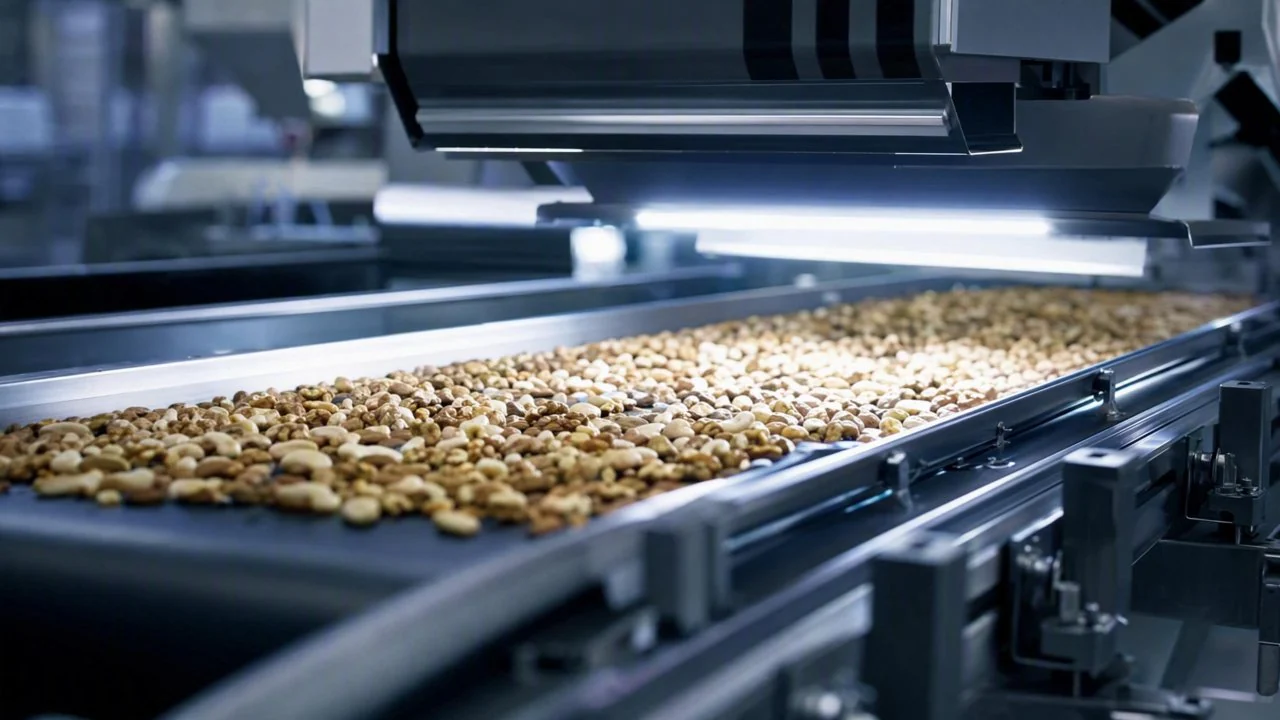
DaoAI AI AOI software system (featuring visual foundation model for feature recognition, 5-minute 0-code automatic programming with one good sample, APDT positive/few-shot learning with 1–20 good samples, semantic false positive filtering, and SDK/API/Docker support for 100% local private deployment) achieves full-link data closed-loop from production to quality inspection and traceability by real-time collection and analysis of defect data in nut/chip color sorting, reducing the false positive rate from an industry average of 8% to <2% for traditional manual re-inspection, and significantly improving product consistency and compliance.
The DaoAI AI AOI software system (featuring visual foundation model for feature recognition, 5-minute 0-code automatic programming with one good sample, APDT positive/few-shot learning with 1–20 good samples, semantic false positive filtering, and SDK/API/Docker support for 100% local private deployment) achieves full-link data closed-loop from production to quality inspection and traceability by real-time collection and analysis of defect data in nut/chip color sorting, reducing the false positive rate from an industry average of 8% to <2% for traditional manual re-inspection, and significantly improving product consistency and compliance. In the food processing industry, especially for nut and chip production lines, color sorting is a critical step to ensure product quality and food safety. Consumers' demands for food appearance, taste, and safety are increasing, and any foreign matter, mold, damage, or color abnormality can lead to product recalls and damage to brand reputation. While traditional color sorters can perform initial screening, they still face many challenges in complex defect recognition, false positive control, and data management. This case focuses on the post-sorting re-inspection stage in a large nut processing plant, aiming to address the shortcomings of traditional solutions in quality traceability and data closed-loop through intelligent means, ensuring that the quality of each batch of products is controllable, traceable, and verifiable.
Pain Points: Why This Hurdle Is Hard to Clear
In the post-sorting re-inspection of nuts and chips, the industry faces multiple challenges. First, high false positive rates lead to a heavy burden of manual re-inspection. Traditional color sorters are limited by fixed algorithms or shallow machine learning, making it difficult to distinguish subtle color differences, foreign objects, and good products. Data from a certain nut processing plant indicates false positive rates as high as 8%–12%, requiring extensive manual secondary sorting, which incurs significant labor costs. Second, there are breakpoints in quality traceability. Traditional color sorters only provide simple pass/fail judgments, lacking detailed data records on defect types, locations, and batches. This makes it difficult to quickly identify the cause and scope of impact if a quality issue arises. A potato chip manufacturer, due to a lack of detailed data, spent weeks tracing a problematic batch after a customer complaint. Third, model changeover programming is complex and time-consuming. Different varieties of nuts or chips vary significantly in color, size, and shape, requiring engineers to re-adjust parameters for each changeover. A factory's actual measurement showed an average changeover downtime of 30-60 minutes, severely impacting production efficiency. Finally, traditional solutions struggle with open-set defects. Defects such as mold, insect damage, and foreign matter are complex and diverse in form, and may vary with seasons and origins. Traditional rules or models trained with limited samples have poor generalization capabilities for recognizing new types of defects, leading to the risk of missed detections.
The root cause of these difficulties lies in the limitations of traditional vision systems' feature recognition. Traditional rule-based AOI relies on manually set thresholds, making it difficult to adapt to variations in lighting and product batches; systems based on traditional machine learning require large amounts of annotated data and have poor generalization capabilities for unseen defects. Furthermore, data silos are prevalent, with data not interoperable between color sorters, packaging machines, and warehousing systems, making quality management a series of isolated steps that cannot form a closed loop. Drawing lessons from the current application of AI large models in multi-modal defect detection on automotive seat production lines, which integrate multi-source data such as vision, acoustics, and vibration to achieve precise recognition of complex, hidden defects and predictive maintenance, the food industry urgently needs to introduce more advanced AI vision technology to achieve more refined and intelligent quality control and data management.
Technical Principles
The DaoAI AI AOI software system fundamentally addresses the pain points of traditional AOI through its core visual foundation model. This system employs advanced self-supervised learning and multi-task learning paradigms, pre-trained on massive unlabeled image data, enabling it to possess powerful feature recognition capabilities. It can understand semantic information within images, rather than merely operating at the pixel level. This allows DaoAI AI AOI to identify complex defects such as subtle color differences, mold spots, insect damage, and foreign objects on nuts or chips, much like a human expert, even for defect forms never seen before, by leveraging its deep understanding of 'good products.' In a practical application on a nut production line, the system consistently maintained a missed detection rate of <0.4%.
Compared to traditional methods, the advantages of DaoAI AI AOI are evident in multiple aspects. Unlike rule-based AOI, it eliminates the need for complex manual threshold settings, offering stronger robustness to ambient lighting and product batch variations. Compared to traditional supervised learning-based AOI, its APDT positive/few-shot learning capability (requiring only 1–20 good sample images) significantly lowers the barrier for model training and changeover. Automatic programming can be completed in 5 minutes with just one good sample. A potato chip processing plant observed that changeover time was reduced from 45 minutes to 5 minutes, significantly boosting production efficiency. Furthermore, the semantic false positive filtering mechanism of DaoAI AI AOI effectively distinguishes visually similar but fundamentally different features (e.g., differentiating natural textures on good products from minor defects), reducing false positives by 75% in one case, thereby significantly cutting down manual re-inspection workload. Its SDK/API/Docker deployment options support 100% local private deployment, ensuring data security and compliance with stringent data regulations in the food industry.
Typical Application Scenarios
- **Nut Mold/Discoloration Detection:** The DaoAI AI AOI software system can accurately identify mold, brown spots, black spots, and other discoloration defects on nuts such as pistachios, walnuts, and almonds. The challenge lies in the fact that early-stage mold colors are similar to good products and have irregular shapes, making traditional methods prone to missed detections. DaoAI captures subtle texture and spectral changes through deep feature learning.
- **Fries Burnt/Green Spot Detection:** On potato chip production lines, the system can effectively detect charring caused by over-frying and green spots resulting from potato greening. The degree of charring is difficult to quantify, and green spots vary in color intensity. DaoAI's visual foundation model establishes a baseline for 'normal' fries, accurately identifying deviations in appearance.
- **Product Damage/Foreign Object Inclusion Detection:** For cracked nuts, broken chips, and foreign objects like wood chips, stones, or plastic pieces, the DaoAI AI AOI software system performs high-precision identification. The difficulty lies in the varied shapes, sizes, and colors of foreign objects, which may also be partially obscured by the product. DaoAI's feature recognition capability allows it to extract and identify non-product anomalies from complex backgrounds.
- **Size/Shape Anomaly Screening:** The system can be used to screen out undersized, oversized, or malformed nuts/chips, ensuring product size uniformity. Traditional methods rely on fixed size thresholds and are less effective at judging irregular shapes. DaoAI can learn the shape distribution of good products and identify abnormal individuals that deviate from this distribution.
- **Color Consistency Evaluation:** The DaoAI AI AOI software system can quantitatively evaluate the color consistency of entire batches of nuts/chips, ensuring color uniformity between product batches, meeting consumer demand for high-quality appearance. This is crucial for brand image and consumer satisfaction, especially in the premium snack market.
Case Study
A leading nut processing manufacturer, with a daily processing capacity of hundreds of tons, faced immense pressure in the manual re-inspection stage after nut color sorting. The high false positive rate of traditional color sorters required dozens of workers daily for secondary screening, leading to high labor costs. Manual inspection was also prone to fatigue and inconsistency, with occasional missed detections affecting the efficiency of product quality traceability. After introducing the DaoAI AI AOI software system, the manufacturer integrated it into their existing color sorting equipment backend via SDK, establishing a refined quality traceability system. Before deployment, the production line's false positive rate was as high as 9%, resulting in a massive volume of manual re-inspection. After deployment, the DaoAI AI AOI system reduced the false positive rate by 75%, leading to a 60% reduction in manual re-inspection volume. Concurrently, the system recorded detailed images, defect types, locations, and timestamps for each defect detected, linking them to batch information to create a comprehensive quality archive. Now, the manufacturer can quickly retrieve detection data and defect history for any product by batch number, achieving true quality traceability and data closed-loop.
The DaoAI AI AOI software system not only significantly reduced our re-inspection costs but, more importantly, built an unprecedented quality traceability system for us, making the quality of every nut verifiable.
DaoAI Solution and Products
The core solution provided by DaoAI for nut/chip color sorting is the DaoAI AI AOI software system. This system, through its powerful visual foundation model, achieves precise identification of complex defects and low-sample learning. For deployment, we support various forms such as SDK/API/Docker, allowing customers to choose 100% local private deployment based on their IT architecture, ensuring data security and system stability. The modeling process is extremely simple: by providing just 1-20 good product images, the DaoAI AI AOI system can complete automatic programming and model training within 5 minutes, quickly adapting to changeover requirements for different product models. The system's built-in semantic false positive filtering function effectively distinguishes good product features from actual defects, significantly reducing false positive rates. Furthermore, by integrating with the customer's MES/WMS systems, DaoAI AI AOI can upload detection data in real-time to the production management platform, achieving full-link data interoperability from raw materials to finished products, providing data support for quality traceability and process optimization. DaoAI can also offer DaoAI 2D/3D AI AOI equipment, combined with self-developed 3D cameras, to achieve three-dimensional morphology detection of nuts/chips, discovering tiny defects hidden on the surface, further enhancing detection accuracy.
By deploying the DaoAI AI AOI software system, the nut processing plant achieved significant business value. Actual data shows that the system reduced manual re-inspection volume in nut color sorting by 60%, directly saving substantial labor costs. The false positive rate decreased from 9% to <2.3%, further improving product qualification rates and reducing unnecessary waste. More importantly, by establishing a comprehensive quality traceability and data closed-loop system, a certain nut manufacturer's customer complaint handling efficiency improved by 80%, and brand credibility was significantly enhanced. The DaoAI AI AOI system also continuously optimizes model performance through ongoing learning, ensuring long-term operational stability and accuracy, bringing sustainable competitive advantages to customers.
FAQ
How does DaoAI AI AOI software system help food companies achieve quality traceability?
The DaoAI AI AOI software system generates detailed defect images, types, locations, and timestamp data for each inspected product, linking them to production batch information. This data can be uploaded in real-time to the enterprise's MES/WMS system, forming a complete digital quality archive. When quality issues arise, companies can quickly trace back to specific product inspection records via batch numbers, pinpointing the root cause and achieving full-link quality verifiability, controllability, and traceability.
Compared to traditional color sorters, what are the advantages of DaoAI AI AOI in terms of detection accuracy and false positive rate?
Traditional color sorters often rely on fixed rules or shallow algorithms, with limited ability to identify complex, subtle defects, and are susceptible to lighting and product batch variations, leading to higher false positive rates. The DaoAI AI AOI software system, based on a visual foundation model, possesses powerful feature recognition and semantic understanding capabilities, accurately distinguishing good products from defects, even subtle color differences or foreign objects imperceptible to the naked eye. Its semantic false positive filtering mechanism can reduce the false positive rate by 75%, significantly improving detection accuracy and efficiency.
What is the investment required and the payback period for deploying the DaoAI AI AOI software system?
The investment cost for the DaoAI AI AOI software system is influenced by various factors, including production line scale, complexity of detection requirements, integration method (SDK/API/Docker), and whether complementary hardware is needed. We offer 100% local private deployment to ensure data security. The payback period typically depends on the enterprise's current labor costs, scrap losses due to false positives, and brand risks arising from quality issues. By significantly reducing manual re-inspection volume, improving product qualification rates, and enhancing quality traceability capabilities, most customers achieve ROI within several months to a year. For specific budget and payback analysis, we recommend contacting our expert team for a detailed assessment.
Full solution for this scenario: AI AOI Software industry solutions
This article was generated by AI. Customer cases are simulated scenarios based on real product capabilities and figures are illustrative; see product pages for official benchmarks.