
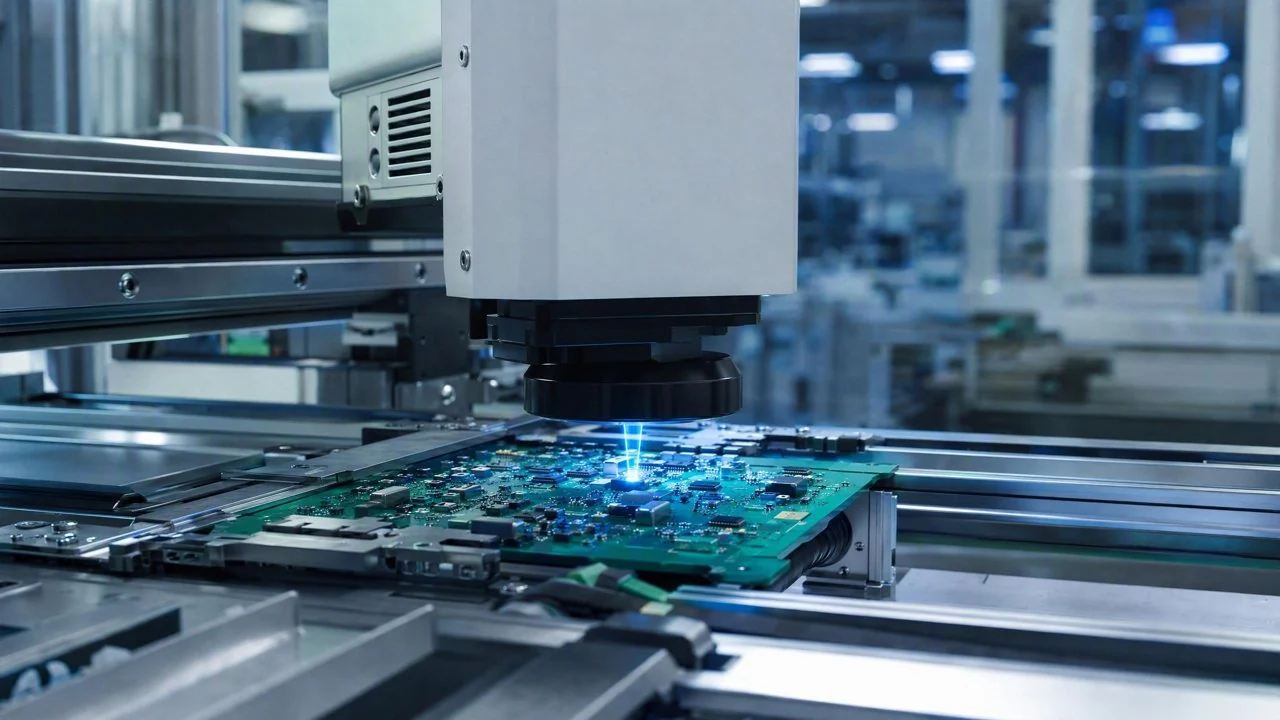
In the rapidly evolving field of electronics manufacturing, quality control on PCBA production lines is a core competitive advantage. DaoAI AI AOI software system (featuring visual foundation models for feature recognition, 5-minute 0-code programming with one good sample, APDT positive/few-shot learning with 1-20 good samples, semantic false alarm filtering, and SDK/API/Docker support for 100% local private deployment) leverages deep learning and semantic false alarm filtering to reduce PCBA component polarity false alarm rates from an industry average of 5% to <0.8% in practical applications. This significant improvement not only optimizes production efficiency but, more critically, its 100% local private deployment capability provides unparalleled data security for customers. Especially with the current trend of multimodal industrial large models driving production line equipment status monitoring and early fault prediction, keeping data on-premises is paramount for protecting enterprise core assets.
In the rapidly evolving field of electronics manufacturing, quality control on PCBA production lines is a core competitive advantage. DaoAI AI AOI software system (featuring visual foundation models for feature recognition, 5-minute 0-code programming with one good sample, APDT positive/few-shot learning with 1-20 good samples, semantic false alarm filtering, and SDK/API/Docker support for 100% local private deployment) leverages deep learning and semantic false alarm filtering to reduce PCBA component polarity false alarm rates from an industry average of 5% to <0.8% in practical applications. This significant improvement not only optimizes production efficiency but, more critically, its 100% local private deployment capability provides unparalleled data security for customers. Especially with the current trend of multimodal industrial large models driving production line equipment status monitoring and early fault prediction, keeping data on-premises is paramount for protecting enterprise core assets. The electronics industry, particularly PCBA manufacturing, demands extremely high standards for product quality and reliability. Among these, component polarity misalignment is a common yet critical defect in the SMT (Surface Mount Technology) process. A simple reversed polarity in an electrolytic capacitor, diode, or IC can lead to the entire circuit board failing, or even cause short circuits and fires. Therefore, precise detection of component polarity before or after reflow soldering on SMT lines is an indispensable step. As PCBAs become increasingly miniaturized and high-density, component package sizes continue to shrink, further increasing detection difficulty.
Pain Points: Why This Hurdle Is So Difficult to Overcome
Detecting component polarity misalignment faces multiple challenges, leading to inefficient traditional inspection solutions. Firstly, there's an extremely high false alarm rate. Conventional rule-based AOI systems typically have a false alarm rate of 3% to 7% for such defects, and even higher for some complex board types. This means that more than half of the “defects” on the production line require manual re-inspection, significantly increasing manual re-inspection hours. Data from a medium-sized PCBA factory shows that polarity misalignment alone consumed approximately 40% of 2-3 experienced operators' daily working hours for re-inspection. Secondly, there's the risk of escapes. Despite high false alarm rates, traditional AOI can still miss subtle polarity markings or reversals in complex backgrounds, leading to defective products flowing into subsequent processes or final products, increasing rework costs and quality risks. Finally, data security and privacy are critical. Especially in the current wave of industrial large models, enterprises increasingly value the worth of production data, but traditional cloud-based AI solutions may face data leakage risks, limiting the utilization of critical production data and failing to meet stringent local deployment requirements.
The root cause of “why it’s difficult” lies in the diversity and complexity of component polarity markings. Different brands and models of components have vastly different polarity marking methods, including notches, dots, lines, bevels, silkscreens, and more. Even the same component may vary slightly across different batches. Traditional rule-based AOI relies on pre-set feature templates and thresholds, making it difficult to adapt to this diversity. It often misidentifies normal markings as reversals or misinterprets background textures as polarity markings. Furthermore, high component density on PCBA boards, variations in lighting conditions, and factors such as component reflections and shadows can interfere with image recognition, further exacerbating false alarms and escapes. In the current context of multimodal industrial large models, while models can process more complex data, their value cannot be fully realized if data cannot be securely circulated and trained locally.
Technical Principles
DaoAI AI AOI software system fundamentally transforms component polarity misalignment detection by introducing visual foundation models for feature recognition. Unlike traditional AOI based on feature extraction and rule matching, the DaoAI Wemio engine learns universal visual features from vast amounts of unlabeled images, developing a deep semantic understanding of objects, textures, and structures. This means it no longer relies on engineers manually setting thresholds or writing complex rules to identify polarity markings. Instead, it judges the “correct” polarity state by comprehensively assessing the component’s overall shape, silkscreen, pins, and surrounding environment, much like the human eye. It only identifies a defect when detecting a combination of features that semantically deviates from a “good sample.” This semantic-level understanding significantly enhances the accuracy of identifying various complex polarity markings.
The DaoAI AI AOI system's advantages over traditional methods are evident: Firstly, in programming efficiency, traditional AOI requires engineers to spend hours or even days writing rules for each new component or board type, whereas the DaoAI AI AOI software system can achieve 0-code automatic programming within 5 minutes with just one good sample, significantly reducing changeover time. Secondly, in learning capability, through APDT (Active Positive Data Training) few-shot learning technology, the model can quickly adapt to new component types and polarity features with only 1–20 good sample images, while traditional methods often require a large number of defect samples to achieve acceptable performance. Most importantly, DaoAI introduces a semantic false alarm filtering mechanism. It doesn't just detect “anomalies” but further determines whether that anomaly truly constitutes a “defect.” For example, for normal components with slightly blurry silkscreens or angular deviations, traditional AOI might trigger a false alarm, but the DaoAI system can recognize that their overall semantic meaning is still good, thereby effectively filtering out numerous false alarms. Production line data shows that after deployment by a leading manufacturer, the false alarm rate for component polarity misalignment decreased from 4.5% to <0.8%. Furthermore, its 100% local private deployment capability, supporting SDK/API/Docker integration, ensures that all production data, model training data, and inference processes are completed on the customer's premises, completely eliminating data security concerns and meeting the stringent compliance requirements of the electronics industry, which is a crucial foundation for the current rollout of multimodal industrial large models.
Typical Application Scenarios
- SMT Pre-Reflow Polarity Inspection: Inspects all polarity-sensitive components, such as electrolytic capacitors, diodes, and ICs, after placement but before reflow soldering. The challenge lies in the wide variety of components, their tiny sizes, and potential solder paste coverage obscuring some markings. DaoAI AI AOI can handle complex backgrounds and partial obstructions to accurately identify polarity.
- SMT Post-Reflow Polarity Inspection: Conducts final polarity verification for all components after reflow soldering. At this stage, components are solidified, and inspection conditions are relatively stable, but challenges like variations in component body color and silkscreen reflections still exist. The DaoAI system uses visual foundation models for semantic understanding of the component body, allowing accurate judgment even when markings are subtle.
- Odd-Form Component Polarity Inspection: For some non-standard packaged odd-form components, polarity markings might be unconventional, sometimes requiring combined judgment with pin orientation. Traditional AOI struggles with programming these, while the DaoAI AI AOI system can quickly adapt to these special cases through few-shot learning.
- Multi-Layer/High-Density Board Polarity Inspection: On space-constrained, densely populated multi-layer PCBAs, adjacent components can cast shadows or create obstructions, affecting inspection accuracy. DaoAI's powerful feature recognition capabilities can extract critical information from complex images, reducing false alarms caused by mutual interference.
- Auxiliary Polarity Verification for Bottom-Side Components (e.g., BGA/QFN): While these components primarily rely on X-Ray or 3D AOI for solder joint inspection, the DaoAI AI AOI software system can serve as an auxiliary tool for preliminary polarity judgment based on exposed package markings or specific pin features, reducing the burden on subsequent complex inspections.
Case Study
A leading Tier-1 electronics manufacturing service provider produces millions of circuit boards monthly, containing numerous polarity-sensitive components. Previously, this manufacturer used traditional rule-based AOI systems for polarity inspection, but persistently high false alarm rates (averaging about 4.8% on this production line) required significant manual effort for secondary re-inspection daily, severely slowing down the production rhythm, with occasional escapes still occurring. Data security was also a key concern for this manufacturer, with strict internal policies limiting the transfer of production data to external cloud platforms. After extensive evaluation, the manufacturer decided to introduce the DaoAI AI AOI software system, requiring 100% local private deployment. The deployment process was very smooth. The DaoAI Wemio team completed system integration via Docker containerization on the customer's existing server cluster. All model training and inference ran within the customer's local network environment, ensuring that data never left the factory. During the initial trial phase, for typical board types, using only 10-15 good sample images for APDT learning, the DaoAI AI AOI system completed model training within 5 minutes. Actual production line data shows that after the DaoAI AI AOI system was deployed, the false alarm rate for component polarity misalignment significantly decreased from an average of 4.8% to <0.7%, and the escape rate remained at a very low level (<0.05%).
In this case, the DaoAI AI AOI software system reduced the false alarm rate for component polarity misalignment by over 85% and ensured absolute security of the customer's core production data through 100% local private deployment.
DaoAI Solutions and Products
DaoAI provided the leading manufacturer with the core DaoAI AI AOI software system, whose capabilities are primarily reflected in the following aspects: Firstly, efficient modeling and programming. Leveraging the powerful generalization capability of visual foundation models, engineers only need to provide one good sample, and the system can complete 0-code automatic programming within 5 minutes, greatly simplifying new product introduction and changeover processes. Secondly, strong learning capabilities. Utilizing the APDT (Active Positive Data Training) few-shot learning mechanism, the model can quickly learn and adapt to new inspection tasks with only 1–20 good samples, especially suitable for multi-variety, small-batch production scenarios. Thirdly, accurate defect identification and semantic false alarm filtering. The DaoAI AI AOI software system not only accurately identifies defects like component polarity misalignment but also employs semantic false alarm filtering technology to effectively distinguish true defects from normal variations, keeping false alarm rates extremely low and significantly reducing manual re-inspection workload. Finally, and the core advantage in this case, is 100% local private deployment. The DaoAI system supports flexible integration into existing customer AOI equipment or MES systems via SDK/API/Docker, with all model training, inference, and data storage performed on the customer's local servers, ensuring sensitive production data never leaves the factory and meeting enterprises' high standards for data sovereignty and information security. Additionally, if customers have higher precision 3D inspection needs, DaoAI 2D/3D AI AOI equipment, with its self-developed 3D camera and 3D morphology reconstruction technology, can be used to inspect hidden solder joints, coplanarity, and other micron-level features, complementing the software system.
Through the above solution, the DaoAI AI AOI software system created significant business value for the customer. In this case, production line data shows that the false alarm rate for component polarity misalignment decreased from 4.8% to <0.7%, a reduction of over 85%, directly reducing manual re-inspection hours by approximately 80%, allowing production operators to focus on more valuable tasks. Changeover time was reduced from several hours to 5 minutes, significantly improving production line flexibility and utilization. More importantly, the 100% local private deployment of the DaoAI Wemio system provided the customer with a robust data security barrier, ensuring its core competitiveness in the Industry 4.0 era and laying a secure and reliable foundation for future data-driven production management based on multimodal industrial large models.
FAQ
How does DaoAI AI AOI software system ensure local private deployment security for PCBA production data?
The DaoAI AI AOI software system supports SDK/API/Docker deployment methods, allowing customers to deploy all model training, inference engines, and production data entirely on local servers or private cloud environments. This means data never leaves the customer's physical or logical boundaries throughout its lifecycle, ensuring absolute security and privacy of sensitive production data and meeting the strict compliance requirements of the electronics industry.
What are the main differences between DaoAI AI AOI software system and traditional rule-based AOI for component polarity misalignment detection?
The DaoAI AI AOI software system leverages visual foundation models for feature recognition, enabling semantic-level understanding rather than relying on engineers to manually write rules or set thresholds. This allows it to better adapt to the diversity of component polarity markings and complex backgrounds, quickly adapt to new board types through APDT few-shot learning, and significantly reduce false alarm rates using semantic false alarm filtering technology, whereas traditional rule-based AOI shows limitations in these areas.
What is the initial investment and budget required for deploying DaoAI AI AOI software system, and what is the approximate payback period?
The deployment cost of the DaoAI AI AOI software system depends on the customer's existing hardware infrastructure, integration scope, and specific production line scale. We offer flexible licensing models and help customers achieve rapid return on investment by optimizing manual re-inspection hours, reducing rework rates, and improving production line utilization. We recommend contacting our sales engineers for a customized solution and detailed quotation, which will be evaluated based on your specific needs.
Full solution for this scenario: AI AOI Software industry solutions · Component Polarity False-Alarm Reduction
This article was generated by AI. Customer cases are simulated scenarios based on real product capabilities and figures are illustrative; see product pages for official benchmarks.