
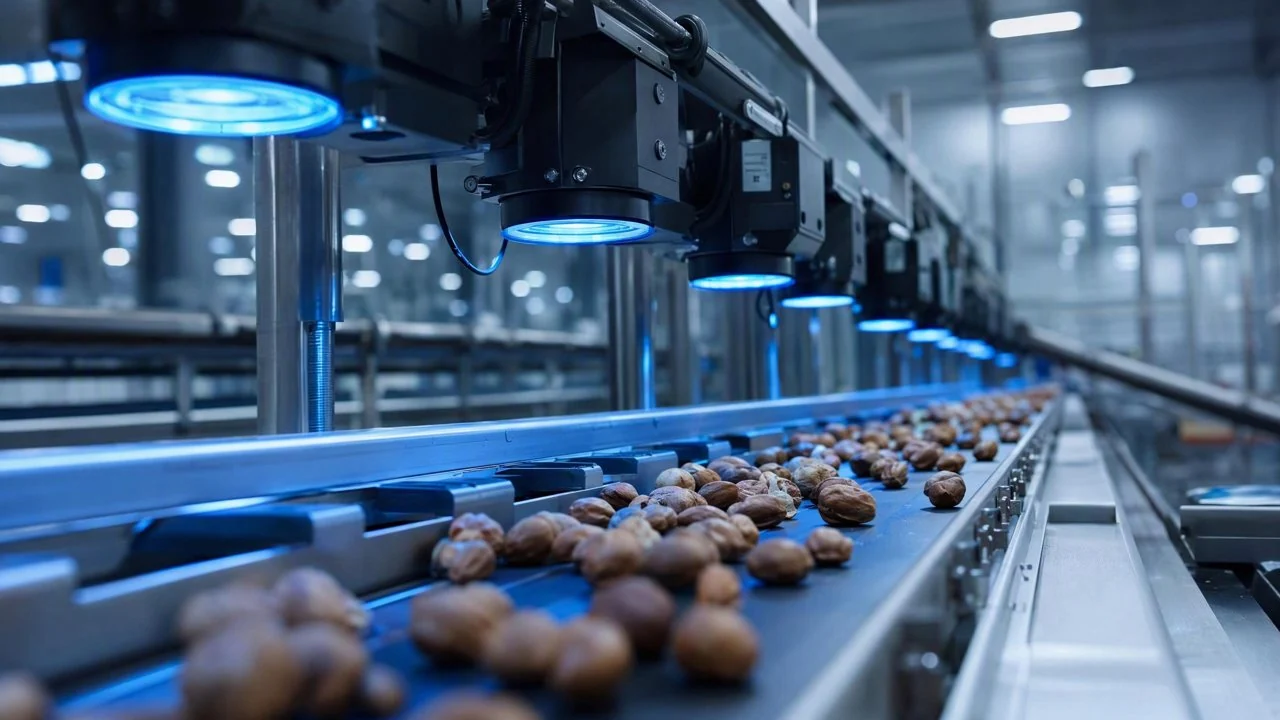
In food processing, particularly in the color sorting of nuts and fries, ensuring 100% full inspection capacity at high production speeds while maintaining extremely low false positive and false negative rates has always been a challenge for many manufacturers. DaoAI ACI OS operating system, with its visual foundation model's feature recognition capabilities and the convenience of 0-code automatic programming from a single good sample in 5 minutes, is providing an efficient and reliable solution to this challenge.
DaoAI ACI OS operating system (featuring visual foundation model for feature recognition, 0-code automatic programming from one good sample in 5 minutes, APDT few-shot/one-shot learning with 1–20 good samples, semantic false alarm filtering, and supporting SDK/API/Docker for 100% local private deployment) precisely identifies and removes various foreign objects and defects on nut and fry production lines, reducing the false negative rate caused by manual inspection from 1.5% in traditional solutions to below 0.2%, significantly improving product quality and production line efficiency. Currently, the automation process in the food and agriculture industries is accelerating, with color sorting being a critical step directly related to product quality, safety, and brand reputation. A large nut processing enterprise, with a daily throughput of hundreds of tons, mainly produces roasted cashews, almonds, and peanuts. Before sorting and packaging, nuts need strict color sorting to remove defective products such as moldy, insect-eaten, discolored, or foreign objects (e.g., stones, branches, shell fragments) to meet increasingly stringent food safety standards and consumer demands for high-quality products.
Pain Points: Why This Hurdle Is Difficult to Overcome
Traditional nut color sorting faces multiple challenges. Firstly, in terms of product quality, due to the complex surface texture and uneven color of nuts, and the diverse types and forms of foreign objects, the manual inspection false negative rate remains high, with one nut processing plant reporting a measured false negative rate of 1.5%–2.0%, severely affecting product qualification rates. Secondly, production line throughput and efficiency bottlenecks are prominent; manual inspection on high-speed production lines struggles to keep pace, leading to low sorting efficiency. Actual production capacity is often constrained by the quality inspection stage, preventing 100% full inspection, while traditional rule-based AOI systems have high false positive rates, requiring extensive manual re-inspection. One fry production line experienced false positive rates as high as 8%–10%, requiring 3-4 workers per hour for re-inspection, increasing labor costs. Furthermore, long changeover downtime is an issue; when switching between different types or specifications of nuts, traditional AOI systems require several hours for parameter adjustment and model retraining, severely impacting production line efficiency. Finally, compliance risks and brand reputation damage are significant; any foreign objects or defective products entering the market can lead to hefty fines and loss of consumer trust.
The root cause of these problems lies in the natural properties of nuts and fries and the complex production environment. As agricultural products, defects in nuts are random, diverse, and irregular, such as subtle differences between mold spots and normal textures, the hidden nature of tiny insect holes, and natural color variations between different batches. These characteristics, on a high-speed production line, place extremely high demands on the robustness and generalization capabilities of vision inspection systems. Traditional AOI based on color thresholds or geometric shapes struggles to effectively distinguish these subtle differences, easily leading to false positives or false negatives. Meanwhile, environmental factors such as lighting variations, product stacking, and conveyor belt vibrations further increase the difficulty of image acquisition and defect recognition. In the current context where AI vision inspection technology aims to achieve zero-defect industrial manufacturing, overcoming these challenges is a critical bottleneck for the industry.
Technical Principles
The core of the DaoAI ACI OS operating system lies in its powerful visual foundation model. Unlike traditional AOI systems based on feature engineering or deep learning classification networks, ACI OS utilizes an advanced visual foundation model with general cognitive abilities for low-level image features. It can quickly learn and generalize from extremely small sample sets. Specifically, DaoAI ACI OS boasts the capability of “0-code automatic programming from one good sample in 5 minutes.” This means users only need to provide a single image of a qualified product, and the system can automatically learn its normal features and identify any anomalies that deviate from them. This “positive sample learning” mechanism greatly simplifies the model training process, eliminating the need for a large number of defect samples and addressing the industry pain point of scarce defect samples. For few-shot learning, DaoAI ACI OS's APDT (Anomaly Pattern Detection Transformer) technology enables high-precision defect detection with just 1-20 good samples, significantly reducing data annotation costs and model deployment cycles.
Furthermore, DaoAI ACI OS integrates semantic false alarm filtering. In complex backgrounds, many traditional vision systems mistakenly classify normal product textures, reflections, or slight color variations as defects. ACI OS can understand the semantic information of images, distinguishing true defects from harmless background noise, thereby significantly reducing the false positive rate. For example, in a fry color sorting scenario, traditional rule-based AOI systems had false positive rates as high as 8%–10%, whereas after the deployment of DaoAI ACI OS, the measured false positive rate dropped to below 0.5%, greatly reducing the workload for manual re-inspection. The system supports SDK/API/Docker for 100% local private deployment, ensuring data security and compliance with the strict data privacy requirements of the food industry. Compared to traditional manual inspection, DaoAI ACI OS is unaffected by fatigue, emotions, and other factors, operating stably 24/7 to ensure 100% full inspection. Compared to traditional rule-based AOI, its generalization capabilities based on visual foundation models and few-shot learning characteristics enable higher robustness and adaptability when dealing with diverse and irregular defects, significantly improving detection accuracy and efficiency.
Typical Application Scenarios
- **Mold and Insect Damage Detection in Nuts**: DaoAI ACI OS accurately identifies tiny mold spots, insect holes, and discolored areas on the surface of nuts such as peanuts, cashews, and almonds. The challenge lies in the subtle color differences between early mold and normal nuts, and the often-hidden nature of insect holes. ACI OS effectively distinguishes and removes these defects through feature recognition of textures and subtle color variations.
- **Discoloration and Foreign Object Removal**: For discolored particles (e.g., unripe, over-roasted) mixed with nuts, as well as stones, dirt clumps, branches, metal fragments, and other foreign objects, DaoAI ACI OS can perform millisecond-level identification on high-speed production lines. The difficulty lies in the varied forms of foreign objects and their potential color similarity to nuts; ACI OS's visual foundation model can generalize to identify previously unseen types of foreign objects.
- **Burnt and Black Spot Detection in Fries**: On fry production lines, DaoAI ACI OS is used to detect burnt parts, black spots, and undercooked green fries resulting from the frying process. The challenge is the irregular surface of fries and varying degrees of charring; ACI OS can distinguish different levels of defects and filter out normal color changes caused by frying.
- **Product Size and Shape Screening**: In addition to defect detection, DaoAI ACI OS can also be applied to the size and shape screening of nuts and fries, ensuring product consistency. For example, removing undersized, oversized, or misshapen nuts, and fries that do not meet length standards. The difficulty lies in the natural variation in size and shape of agricultural products, requiring flexible parameter configuration and precise measurement algorithms. ACI OS's 0-code programming capability simplifies the adjustment of size parameters.
Case Study
A large fry processing enterprise in East China previously relied on traditional color sorters combined with manual re-inspection for quality control. With growing production capacity demands, the existing solution had reached its limits in terms of production line throughput and 100% full inspection capability. While traditional color sorters could remove most obvious defects, the false negative rate for subtle charring, tiny black spots, and foreign objects similar in color to fries remained high, with one fry production line reporting a measured false negative rate of around 1.2%. At the same time, to compensate for equipment shortcomings, multiple manual re-inspection stations were set up at key points on the production line, requiring 3-4 workers per hour for re-inspection, leading to high labor costs and limited efficiency. Data from one production line showed that manual re-inspection reduced overall production line efficiency by approximately 15%.
DaoAI ACI OS not only significantly improved detection accuracy but also boosted our production line's overall efficiency by over 20%, achieving true 100% full inspection, which was unimaginable before.
After the enterprise introduced the DaoAI ACI OS operating system, it was deployed above the high-speed conveyor belt, using industrial cameras to capture real-time images of fries. Leveraging its visual foundation model, DaoAI ACI OS completed model configuration in just 5 minutes by learning from only 10 good samples. Upon deployment, DaoAI ACI OS demonstrated exceptional performance: the false negative rate for fry defects (charring, black spots, foreign objects) was consistently maintained below 0.2%, significantly lower than traditional solutions; the false positive rate also dropped from the previous 8%–10% to below 0.5%, greatly reducing the need for manual re-inspection. In this case, the manual re-inspection stations were reduced from 3 to 1, primarily for equipment maintenance and occasional spot checks of difficult samples. More importantly, DaoAI ACI OS achieved a simultaneous increase in production line throughput and 100% full inspection capacity, boosting overall production line efficiency by over 20%, bringing significant economic benefits and market competitiveness to the enterprise.
DaoAI Solution and Products
DaoAI provides a comprehensive solution for nut/fry color sorting in the food/agriculture industry, centered around the ACI OS operating system. The deployment of this solution begins with production line data acquisition, using high-resolution industrial cameras to capture images of nuts or fries moving at high speed. Subsequently, the image data is transmitted to a local computing unit equipped with DaoAI ACI OS. During the modeling phase, users only need to provide a small number of good sample images (APDT few-shot/one-shot learning supports 1–20 good samples), and DaoAI ACI OS can complete 0-code automatic programming in 5 minutes, rapidly generating a defect detection model. This process greatly simplifies the complex annotation and training procedures required by traditional machine learning models, reducing changeover time from hours to less than 5 minutes.
In operation, DaoAI ACI OS utilizes its visual foundation model's feature recognition capabilities to analyze every pixel in the image, identifying mold, insect damage, discoloration, charring, black spots, and various foreign objects. Its built-in semantic false alarm filtering function effectively distinguishes between the product's natural textures and true defects, avoiding common misjudgment issues of traditional AOI. For deployment, DaoAI ACI OS supports multiple integration methods such as SDK/API/Docker, allowing for 100% local private deployment to ensure customer data security and privacy. Additionally, DaoAI also offers DaoAI 2D / 3D ACI equipment, which can integrate self-developed 3D cameras according to customer needs, enabling more refined 3D morphological reconstruction and further enhancing the detection capabilities for hidden defects. Through this solution, DaoAI helps customers achieve high-standard 100% full inspection without sacrificing production line throughput, effectively controlling product quality and reducing operational costs.
Quantified Results
The DaoAI ACI OS operating system has achieved significant quantified results in nut/fry color sorting scenarios. In a practical application at a certain fry processing plant, the system reduced the defect false negative rate from 1.2% in traditional solutions to <0.2%, ensuring high-quality product output. Concurrently, the false positive rate drastically dropped from 8%–10% to <0.5%, greatly reducing the workload for manual re-inspection; in this case, manual re-inspection stations were reduced by 66%. Changeover time was also shortened from several hours to 5min, significantly enhancing production line flexibility and efficiency. Overall, DaoAI ACI OS helped the client achieve 100% full inspection coverage while maintaining or even improving production line throughput, bringing tens of thousands of RMB in direct monthly economic benefits to the enterprise and substantially boosting brand competitiveness.
FAQ
How does DaoAI ACI OS ensure 100% full inspection capacity for nut/fry color sorting?
DaoAI ACI OS, with its efficient visual foundation model and high-speed image processing capabilities, can process thousands of images per second, far exceeding human visual limits. Combined with automated rejection mechanisms, it enables real-time detection and defect removal for every nut or fry on a high-speed production line. This ensures 100% full inspection coverage without compromising throughput, significantly boosting overall production line efficiency and capacity.
What is the typical deployment cost and ROI period for DaoAI ACI OS?
The deployment cost of DaoAI ACI OS is influenced by various factors, including production line complexity, number of cameras required, computing hardware configuration, and integration services. However, due to its significant reduction in manual re-inspection needs, decreased rework and customer complaints from false negatives, and substantial improvement in production line efficiency, it typically achieves return on investment within 6-18 months. Specific budget and ROI periods require a detailed assessment based on your actual needs. Please contact our experts for a customized solution and quotation.
What are the advantages of DaoAI ACI OS in few-shot learning?
DaoAI ACI OS utilizes APDT (Anomaly Pattern Detection Transformer) technology, supporting positive and few-shot learning, requiring only 1-20 good sample images to train the model and identify various defects. This advantage greatly simplifies the data preparation process, solving the problem of scarce defect samples in the food industry, making model deployment faster and more flexible, especially suitable for multi-variety, small-batch production scenarios.
Full solution for this scenario: the full inspection solution for ACI OS
This article was generated by AI. Customer cases are simulated scenarios based on real product capabilities and figures are illustrative; see product pages for official benchmarks.