
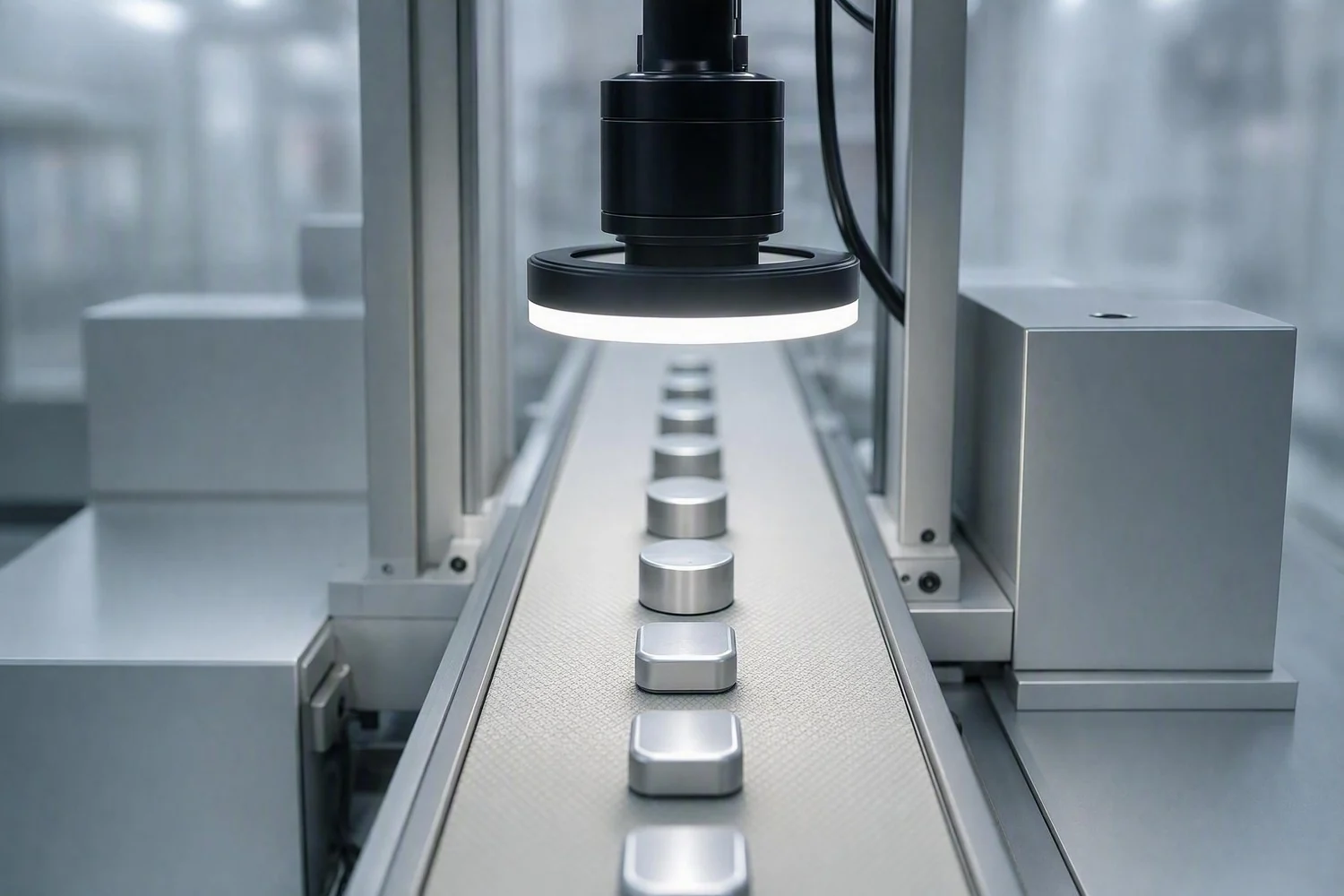
For inline full inspection of new energy battery electrode coating, DaoAI 3D ACI equipment (proprietary 3D camera + 3D morphology reconstruction/point cloud, detecting hidden solder joints/coplanarity/micron-level morphology/pores and other 2D optical blind spot defects, 2D-3D fusion) leverages deep learning and high-precision 3D imaging to significantly reduce the false negative rate for electrode coating defects from 0.8% with conventional AOI to 0.08%, while achieving 100% inline full inspection that perfectly matches production line throughput.
With the booming development of the global new energy industry, power batteries, as its core component, are subject to increasingly stringent requirements for production processes and product quality. Among them, electrode coating, a critical front-end process in battery manufacturing, directly determines the battery's energy density, cycle life, and safety. Any tiny coating defect, such as uneven coating, scratches, bubbles, foreign objects, edge damage, or abnormal thickness, can lead to reduced battery performance or even safety hazards. A leading new energy battery manufacturer is facing the challenge of achieving 100% inline full inspection of electrode coating at high production speeds to ensure product quality and optimize production efficiency. Traditional sampling inspection or reliance on 2D optical inspection can no longer meet the industry's extreme pursuit of “zero defects.”
Pain Points: Why This Hurdle is Difficult to Overcome
Achieving 100% inline full inspection of new energy battery electrode coating at high throughput faces multiple challenges. Firstly, **high false negative rates**: Traditional 2D AOI equipment has inherent blind spots when detecting electrode coating defects that are low-contrast, lack distinct 3D morphological features, or are hidden within the coating (e.g., micron-level pores, slight coating depressions, edge warping, or tiny foreign objects in overlapping areas). This results in an observed false negative rate of around 0.8% on actual production lines, failing to effectively identify all potential quality risks. Secondly, **high false positive rates and heavy manual re-inspection burden**: Due to the complex surface texture and uneven reflectivity of electrode sheets, 2D vision systems are susceptible to ambient light and material properties, generating a large number of false alarms. This leads to a significant workload for manual re-inspection; before implementing DaoAI 3D ACI, a particular production line required 4-6 quality inspectors daily for re-inspection, severely slowing down overall inspection efficiency. Thirdly, **the contradiction between production line throughput and 100% inspection capacity**: New energy battery production lines typically operate at extremely high speeds, for example, a leading manufacturer's electrode coating line throughput can reach 80-120 meters/minute. Traditional inspection equipment often struggles to simultaneously guarantee inspection accuracy and 100% coverage at high throughput. This means that to ensure quality, companies sometimes have to sacrifice some production capacity or lower inspection standards, which is unacceptable in a highly competitive market. These pain points directly affect production efficiency, manufacturing costs, and product reliability, becoming key bottlenecks limiting high-quality battery production.
The root cause of these difficulties lies in the complexity of the electrode coating process, the physical properties of the coating material (e.g., slurry viscosity, rheology), and dynamic changes during high-speed coating. These factors collectively lead to the diversity, randomness, and micron-level scale of defects. At the same time, traditional 2D visual imaging is limited by the planar information of illumination and viewing angle, unable to obtain 3D morphological features such as depth and height of defects, and has limited ability to identify three-dimensional defects. In the current trend of AI vision inspection achieving zero-defect manufacturing, relying solely on 2D images for feature extraction and defect classification can no longer meet the new energy battery industry's pursuit of ultimate quality. DaoAI believes that to achieve true zero-defect manufacturing, it is essential to break through the limitations of traditional 2D vision, integrate 3D information, and combine advanced AI algorithms to achieve precise and comprehensive online inspection at high throughput.
Technical Principles
The core technology of DaoAI 3D ACI equipment lies in its self-developed high-speed, high-precision 3D camera and advanced 3D morphology reconstruction algorithms, combined with a powerful 2D-3D fusion defect detection engine. This equipment utilizes multi-line laser scanning technology to perform line-by-line scanning of the high-speed moving electrode surface at high throughput, synchronously acquiring millions of point cloud data points. Through DaoAI's proprietary 3D point cloud reconstruction algorithm, this raw data is processed in real-time to reconstruct a high-precision 3D morphological model of the electrode surface, with micron-level accuracy (for example, actual measurements on a production line show accuracy up to ±2µm). This enables the equipment to accurately capture thickness variations, surface undulations, edge warping, and tiny air bubbles hidden under the coating—defects that are difficult for traditional 2D vision to detect. For instance, for slight coating unevenness below 50µm, DaoAI 3D ACI can reliably identify it.
Compared with traditional inspection methods, the advantages of DaoAI 3D ACI equipment are significant. Traditional rule-based AOI (Automated Optical Inspection) primarily relies on preset thresholds and geometric rules to identify defects, leading to higher false positive and false negative rates for complex and varied electrode coating defects, with time-consuming changeover programming. Manual visual inspection, on the other hand, is limited by human eye fatigue, subjective judgment, and the inability to perform 100% full inspection at high throughput. DaoAI 3D ACI, however, fuses texture and color information from 2D images with morphology and height information from 3D point clouds, providing a richer and more comprehensive data dimension for AI defect recognition models. Its built-in DaoAI ACI OS operating system utilizes the feature recognition capabilities of vision foundation models, combined with APDT few-shot self-training technology. It requires only 1-20 good samples to complete 0-code programming and model training within 5 minutes, significantly shortening changeover time and achieving higher detection rates and lower false positive rates. For example, in practical applications, DaoAI 3D ACI increased the detection rate of electrode coating defects to 99.92%.
Typical Application Scenarios
- **Coating Thickness and Uniformity Inspection**: DaoAI 3D ACI equipment can perform high-precision 3D scanning of electrode coatings, real-time measurement of coating thickness, and generate thickness distribution maps. This solves the pain point of traditional methods that could only sample or could not accurately assess local thickness differences, effectively detecting defects such as uneven coating, localized thickening, or thinning, ensuring micron-level uniformity of the electrode.
- **Surface Scratches and Indentations Inspection**: During high-speed production, electrode surfaces are prone to scratches and indentations. 2D vision struggles to identify these defects under poor lighting or when the defect depth is shallow. DaoAI 3D ACI, through 3D morphological analysis, can identify even micron-level depressions or protrusions based on height differences, avoiding missed detections caused by surface reflections.
- **Bubbles and Foreign Objects Inspection**: Bubbles generated during coating or tiny foreign objects (e.g., metal fragments, fibers) mixed in are serious safety hazards for batteries. These defects may be hidden within the coating or on the surface, and 2D images struggle to capture their true form. DaoAI 3D ACI, using point cloud data, can accurately identify these 3D structural anomalies, with a unique advantage in reconstructing the morphology of internal pores.
- **Edge Damage and Burrs Inspection**: The integrity of electrode edges is crucial for battery winding and subsequent processes. Traditional 2D vision is susceptible to background interference when identifying edge burrs or slight damage. DaoAI 3D ACI can precisely reconstruct the 3D profile of electrode edges, identifying tiny edge cracks, burrs, or irregular deformations, ensuring edge quality.
- **Coplanarity and Warpage Inspection**: After coating or drying, electrode sheets may exhibit overall or local warpage, affecting subsequent stacking/winding accuracy. The 3D morphology reconstruction capability of DaoAI 3D ACI can assess the overall coplanarity of the electrode, identifying subtle warpage deformations, which is critical for ensuring the reliability of battery assembly.
Case Study
A leading new energy battery manufacturer, a flagship enterprise in the industry, is known for its high-throughput, high-capacity electrode coating production lines. However, in its pursuit of ultimate quality and zero-defect manufacturing, it faced the dilemma that traditional 2D AOI could not achieve both 100% full inspection and low false negative rates at high throughput. Before introducing DaoAI 3D ACI equipment, the 2D AOI system on this production line, when operating at high speed, had an average false negative rate of about 0.8% for electrode coating defects. This meant that a significant number of potentially defective products still entered subsequent processes daily, increasing the risk of rework and scrap. At the same time, due to a relatively high false positive rate, 4-6 quality inspectors were required daily for prolonged manual re-inspection, which was inefficient and costly. Production line data showed that manual re-inspection led to an approximate 5% decrease in overall production line efficiency.
After the deployment of DaoAI 3D ACI equipment, this battery manufacturer's electrode coating line achieved unprecedented inspection efficiency and quality breakthroughs, with a sharp drop in false negative rates and full assurance of production line throughput.
To address this pain point, the manufacturer collaborated with DaoAI, introducing multiple sets of 3D ACI equipment deployed at critical inspection points on the electrode coating line. The deployment process was efficient and smooth; the DaoAI engineering team completed hardware installation and initial debugging in just 3 days without stopping the production line. Thanks to the APDT few-shot learning capability of the DaoAI ACI OS operating system, model training used only 15 good samples and completed core defect model programming and deployment within 5 minutes. After going live, production line data showed that the DaoAI 3D ACI equipment successfully achieved 100% inline full inspection of electrode coating while meeting the production line throughput of 120 meters/minute. Actual operating data indicated that DaoAI 3D ACI significantly reduced the false negative rate for electrode coating defects from 0.8% to 0.08%, an improvement of 90% in detection accuracy, while also reducing the false positive rate by 85%. This drastically reduced the workload for manual re-inspection. Now, the production line only requires 1-2 quality inspectors for spot checks and anomaly handling, leading to a significant reduction in labor costs and a 4.5% increase in overall production line efficiency.
Micro Chain DaoAI Solutions and Products
DaoAI provides a comprehensive solution for new energy battery electrode coating inline full inspection, centered around its 3D ACI equipment. This equipment integrates DaoAI's self-developed high-speed 3D camera and powerful 3D morphology reconstruction capabilities, enabling real-time, high-precision acquisition of 3D point cloud data from the electrode surface. Combined with 2D-3D fusion technology, DaoAI 3D ACI can comprehensively detect defects that traditional 2D optical inspection cannot identify, such as micron-level pores, coating depressions, edge warping, and uneven thickness. In terms of implementation, DaoAI offers end-to-end services from equipment selection and system integration to algorithm model deployment. For modeling, thanks to the DaoAI ACI OS operating system, customers do not need deep learning expertise; using the APDT few-shot self-training function, only a small number of good sample images (1-20) are required to complete 0-code model programming in a short time (5 minutes). For changeover, the DaoAI 3D ACI system supports rapid switching between different types of electrode inspection tasks, greatly improving production line flexibility. Deployment methods are flexible, supporting SDK/API/Docker, and enabling 100% on-premises private deployment to ensure customer data security. Through DaoAI 3D ACI, customers can achieve true zero-defect manufacturing, ensuring the excellent quality and safety of new energy battery products. Additionally, DaoAI SkyVision can serve as an auxiliary, providing real-time monitoring of the production line environment to further enhance overall production safety and efficiency.
The application of DaoAI 3D ACI equipment has brought significant quantifiable results and business value to new energy battery manufacturers. The solution not only reduced the false negative rate for electrode coating defects from a conventional level of 0.8% to 0.08%. This means that for every 10,000 electrode sheets produced, 72 fewer products with potential defects enter the market. Simultaneously, DaoAI 3D ACI successfully achieved 100% inline full inspection on high-throughput production lines, ensuring that the quality of every electrode sheet is strictly controlled, effectively improving product consistency and reliability. The significant reduction in false positive rates led to an 85% decrease in manual re-inspection workload, substantially saving labor costs. Furthermore, rapid changeover capability (5 minutes 0-code changeover) and on-premises private deployment further enhance production line flexibility and data security, building a solid quality defense line and production efficiency advantage for customers.
FAQ
How does DaoAI 3D ACI equipment ensure 100% full inspection at high throughput?
DaoAI 3D ACI equipment utilizes a self-developed high-speed 3D camera and optimized 3D morphology reconstruction algorithms to scan and analyze electrode sheets at extremely high frame rates and data processing speeds, generating high-precision 3D point cloud data in real-time. Combined with an efficient 2D-3D fusion AI defect recognition model, it ensures comprehensive and accurate inspection of every electrode sheet at production line throughputs of 120 meters/minute or even higher, without missing any potential defects.
What are the core advantages of DaoAI 3D ACI equipment compared to traditional 2D AOI for new energy electrode inspection?
The core advantage of DaoAI 3D ACI equipment lies in its 3D inspection capability, which can detect defects that 2D AOI cannot, such as micron-level pores, coating depressions, edge warping, and uneven thickness—all 3D morphological defects. Furthermore, its 2D-3D fusion technology, combined with the few-shot learning capability of DaoAI ACI OS, significantly reduces false negative and false positive rates, and greatly shortens model training and changeover times, improving overall inspection accuracy, efficiency, and flexibility.
What is the budget required to deploy DaoAI 3D ACI equipment, and what is the typical payback period?
The specific budget for DaoAI 3D ACI equipment depends on the client's production line scale, inspection requirements, integration complexity, and desired configuration. We offer customized solutions to ensure optimal return on investment. Generally, considering the comprehensive benefits such as reduced false negative rates, decreased false positive rates, savings in manual re-inspection costs, and improved production line efficiency, most clients achieve a return on investment within 6-18 months. For specific quotes and detailed payback analysis, we recommend scheduling a consultation with our experts.
Full solution for this scenario: the full inspection solution for 3D ACI Equipment · Inline Electrode Coating Inspection
This article was generated by AI. Customer cases are simulated scenarios based on real product capabilities and figures are illustrative; see product pages for official benchmarks.