
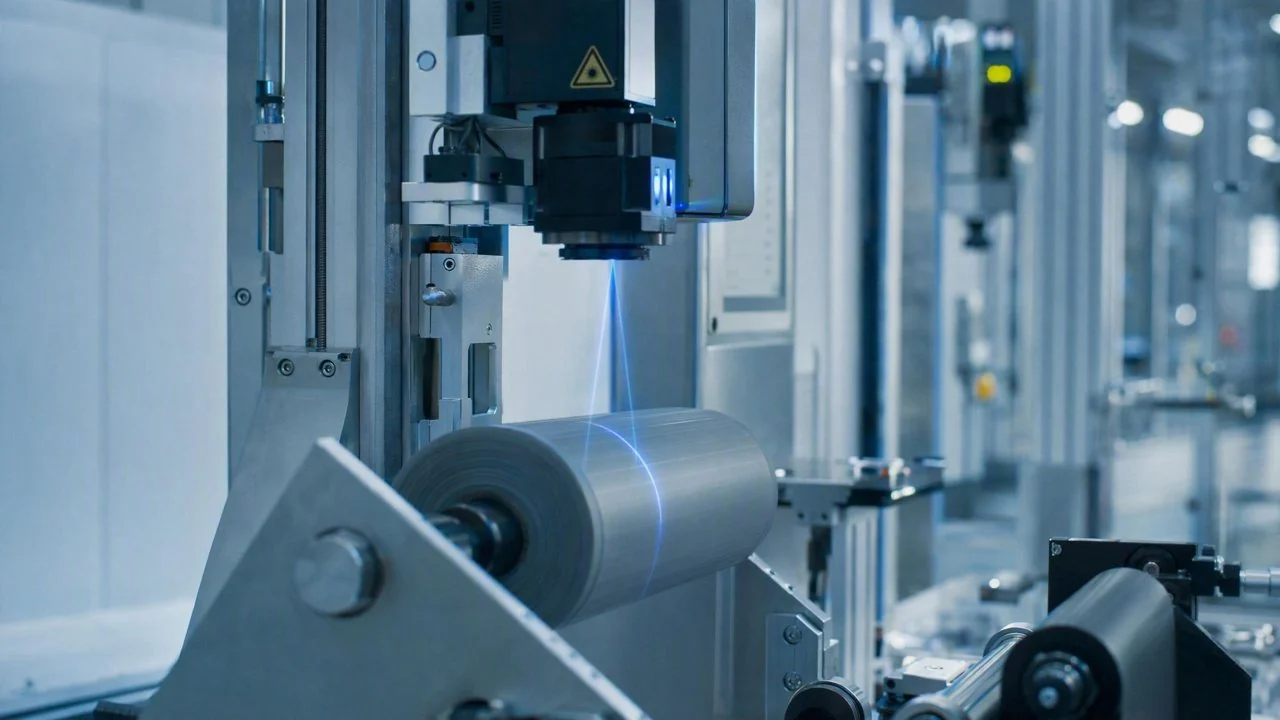
DaoAI 3D ACI equipment (proprietary 3D camera + 3D morphology reconstruction/point cloud, detecting hidden solder joints/coplanarity/micron-level morphology/voids and other 2D optical blind spot defects, 2D-3D fusion) significantly reduces changeover downtime for new energy battery winding/stacking anode/cathode alignment inspection from an average of 2 hours to 5 minutes through its unique zero-code programming and rapid changeover mechanism, substantially improving efficiency and flexibility in high-mix, low-volume production.
One of the core processes in new energy battery manufacturing is cell winding or stacking, where precise alignment of anodes, cathodes, and separators is critical. This directly impacts battery energy density, cycle life, and safety performance. With the rapid development of the new energy vehicle market, battery manufacturers face challenges of diversified product models and accelerated iteration, especially in R&D prototyping, small-batch customization, and high-mix co-line production scenarios. How to quickly respond to different cell sizes, structures, and material combinations while maintaining high-precision quality inspection has become a key bottleneck limiting capacity and cost. Traditional inspection solutions often struggle to balance speed and accuracy, particularly when dealing with frequent product changeovers, leading to long production line downtime and high debugging costs, severely affecting production efficiency. DaoAI 3D ACI equipment provides an efficient and flexible solution for the industry in this context.
Pain Points: Why This Hurdle Is Difficult to Overcome
In new energy battery winding/stacking alignment inspection, traditional solutions face multiple challenges. First, frequent product changeovers in high-mix, low-volume production lead to excessive production line downtime. Traditional rule-based AOI equipment or manual visual inspection requires time-consuming parameter adjustments or personnel training for each new product, with changeover programming often taking several hours, reducing production line utilization by 15%−20%. Second, micron-level alignment deviations, edge defects, wrinkles, and potential voids during the winding/stacking process demand extremely high inspection accuracy. These defects are often inconspicuous in 2D images or even in optical blind spots, leading to high false-negative rates, averaging 1.5%−2.5%, directly impacting battery yield. Third, with advancements in battery technology, new forms such as irregularly shaped batteries and solid-state batteries are constantly emerging. Their complex structures and new materials require higher generalization capabilities from inspection algorithms, which traditional solutions struggle to adapt to, resulting in higher false-positive rates and an approximately 30% increase in manual re-inspection costs.
The root cause of these difficulties is that traditional 2D imaging technology cannot acquire deep 3D information, rendering it incapable of assessing key parameters such as height, morphology, and coplanarity, thus failing to effectively identify tiny defects hidden beneath planar images. At the same time, rule-based programming methods lack intelligent generalization capabilities, requiring engineers to manually write and debug a large amount of code for each changeover, which is time-consuming and laborious. Faced with the trend of deep application of large AI models in automotive manufacturing quality inspection, how to combine advanced AI technology with 3D inspection to achieve extreme improvement in defect detection rates and significant shortening of product development cycles is an urgent issue for the industry.
Technical Principles
DaoAI 3D ACI equipment fundamentally addresses these pain points through its proprietary high-precision 3D camera and advanced 3D morphology reconstruction technology. The equipment employs structured light or laser triangulation principles to rapidly acquire high-density point cloud data from the surface of the object under inspection, reconstructing 3D morphology with sub-micron level precision in real-time. This means the equipment not only sees the 2D contour and color information of the object but also “perceives” its height, depth, volume, and microscopic surface morphology. For example, for cell winding alignment, even in areas that appear normal in 2D images, DaoAI 3D ACI can precisely identify tiny edge misalignments, changes in wrinkle height, or localized bulges caused by internal voids by analyzing 3D point cloud data, reducing the false-negative rate to <0.4%.
Compared to traditional rule-based 2D AOI, the greatest advantage of DaoAI 3D ACI lies in its 2D-3D fusion inspection capability and AI vision foundation models. The equipment fuses textural details from 2D images with depth information from 3D morphology to make more comprehensive and accurate defect judgments. More importantly, combined with the DaoAI ACI OS, the equipment supports “5-minute 0-code automatic programming with one good sample” and APDT positive/few-shot learning (1–20 good samples), greatly simplifying new product introduction and changeover processes. This deep learning-based intelligent programming allows the equipment to learn defect features from a small number of samples, enabling intelligent identification and generalization of complex defects without manual writing of complex rules, thereby shortening changeover programming time from hours with traditional solutions to just 5 minutes, significantly enhancing production line flexibility.
Typical Application Scenarios
- **Anode and Cathode Alignment Precision Inspection:** Precisely measuring the lateral and longitudinal alignment deviations of anodes, cathodes, and separators during winding or stacking. DaoAI 3D ACI utilizes 3D morphological data for high-precision edge extraction and fitting, achieving sub-millimeter level alignment measurement even with reflective materials or minor burr interference, effectively identifying short-circuit risks due to poor alignment.
- **Electrode Edge Defects and Wrinkle Detection:** Detecting burrs, damage, cracks, wrinkles, indentations, and other micron-level morphological defects on electrode edges. These defects are often difficult to detect in 2D images due to insufficient contrast or viewing angle limitations, but through 3D morphology reconstruction, DaoAI equipment can clearly capture these tiny geometric deformations.
- **Coating Uniformity and Thickness Consistency:** While this case primarily focuses on alignment, 3D AOI also plays a crucial role in the coating process. Before alignment, 3D AOI can inspect the thickness, flatness, and presence of agglomeration or exposed foil defects in the electrode coating layer. Through 3D data, precise quantification of coating thickness deviations can be achieved, ensuring electrochemical performance uniformity.
- **Welding Area Defect Detection (e.g., Tab Welding):** In battery assembly, the quality of welding between tabs and busbars is critical for battery performance. DaoAI 3D ACI equipment can detect 2D blind spot defects such as weld spot height, coplanarity, voids, insufficient solder, and false welds. Especially for hidden solder joints, 3D morphology reconstruction provides critical quality assessment data. This is as important as alignment inspection, as welding defects can lead to localized overheating or increased resistance.
- **Cell Surface Foreign Objects and Contamination:** Detecting tiny foreign objects, particles, or stains on the surface of wound cells. These foreign objects can cause internal short circuits or performance degradation of the battery. DaoAI 3D ACI, combined with its high-resolution imaging and AI algorithms, can effectively identify and locate these subtle surface defects.
Case Study
A leading manufacturer specializing in high-performance power battery R&D and production frequently needed to switch between different cell models to meet customized and high-mix, low-volume market demands. In the winding/stacking alignment inspection process, the manufacturer had long been troubled by the lengthy changeover times of traditional 2D AOI and slow new product introduction cycles. Each product changeover required senior engineers to spend an average of 2 hours on program debugging and parameter optimization, leading to prolonged production line downtime, directly impacting order delivery cycles and production costs. Especially in the R&D phase, such high-frequency changeovers further slowed down product development progress.
After introducing DaoAI 3D ACI equipment, the situation significantly improved. With the zero-code programming capability of the DaoAI ACI OS, the manufacturer's production line operators only needed to place one good sample in the inspection area, and the system could automatically complete the generation and calibration of the inspection program within 5 minutes. For new products, only 1–20 good sample images were needed for few-shot learning to quickly deploy the model. After deployment, the manufacturer's changeover downtime was drastically reduced from an average of 2 hours to 5 minutes, an increase in changeover efficiency of nearly 96%. Simultaneously, leveraging the precise 3D morphology detection capabilities of DaoAI 3D ACI, the false-negative rate for alignment deviations decreased from the previous 1.8% to <0.5%, significantly improving cell yield and consistency. This not only accelerated the time-to-market for new products but also brought considerable cost savings and market competitiveness to the manufacturer.
“DaoAI 3D ACI has completely transformed our inspection efficiency in high-mix, low-volume production. The changeover issue, which used to be our biggest headache, can now be handled in minutes, truly making our production line flexible.”
DaoAI Solution and Products
The DaoAI 3D ACI solution for the new energy battery industry is centered on the deep integration of its proprietary 3D camera hardware and the DaoAI ACI OS. Our 3D ACI equipment integrates a high-resolution 3D imaging module, capable of stable and rapid acquisition of high-quality 3D point cloud data, ensuring the ability to perceive micron-level defects. Combined with the DaoAI ACI OS, we have achieved the core advantage of “zero-code quick changeover for high-mix, low-volume production.” The system incorporates a built-in visual foundation model with powerful feature recognition capabilities, allowing users to configure inspection tasks through an intuitive graphical interface without professional vision programming knowledge. For new products, only a small number of good samples are needed for APDT positive/few-shot learning to quickly train high-precision inspection models, compressing changeover programming time from hours to less than 5 minutes. DaoAI 3D ACI supports 100% local private deployment, ensuring customer data security and production stability, while integrating with existing MES/SCADA systems for closed-loop data management and quality traceability.
Through the deployment of DaoAI 3D ACI equipment, customers in the new energy battery winding/stacking alignment inspection segment have gained significant business value. Changeover programming time was reduced by 96%, greatly enhancing production line flexibility and utilization. The false-negative rate for alignment deviations decreased by 72.2%, leading to a significant improvement in cell yield and consistency, reducing rework and scrap costs. Simultaneously, due to the intelligent recognition capabilities of AI algorithms, the false-positive rate was effectively controlled, reducing the workload of manual re-inspection. These quantifiable results not only optimized production processes but also improved product quality, enhancing the customer's core competitiveness in a fiercely competitive market. DaoAI is committed to providing reliable and efficient quality inspection solutions for intelligent manufacturing through leading AI vision technology.
FAQ
How does DaoAI 3D ACI equipment achieve zero-code quick changeover?
DaoAI 3D ACI equipment achieves zero-code quick changeover by combining its proprietary high-precision 3D camera with the DaoAI ACI OS. The system incorporates a built-in visual foundation model and utilizes APDT positive/few-shot learning technology. By simply providing 1–20 good sample images, the system can automatically generate and optimize inspection programs within minutes, eliminating the need for manual coding or complex parameter adjustments, greatly simplifying new product introduction and production line changeover processes.
What are the advantages of 3D ACI compared to traditional 2D AOI in new energy battery inspection?
Compared to traditional 2D AOI, the core advantage of DaoAI 3D ACI lies in its ability to acquire and analyze the 3D morphological information of the object under inspection. This means it can detect defects in 2D optical blind spots, such as micron-level morphological changes, voids, coplanarity, etc., which are difficult to find in 2D images. Through 2D-3D fusion inspection, DaoAI equipment provides more comprehensive and accurate defect judgments, significantly reducing false-negative rates and improving inspection accuracy and reliability.
What are the costs and return on investment (ROI) period for deploying DaoAI 3D ACI equipment?
The deployment cost of DaoAI 3D ACI equipment is influenced by specific configurations, inspection requirements, and integration complexity. While the initial investment may be higher than traditional 2D AOI, the return on investment is significant. By drastically reducing changeover time, improving product yield (lowering false-negative and false-positive rates), reducing manual re-inspection costs, and accelerating new product time-to-market, the equipment typically achieves ROI within a relatively short period. For specific quotes and detailed ROI analysis, we recommend scheduling a consultation with our experts.
Full solution for this scenario: New-energy batteries industry solutions
This article was generated by AI. Customer cases are simulated scenarios based on real product capabilities and figures are illustrative; see product pages for official benchmarks.