
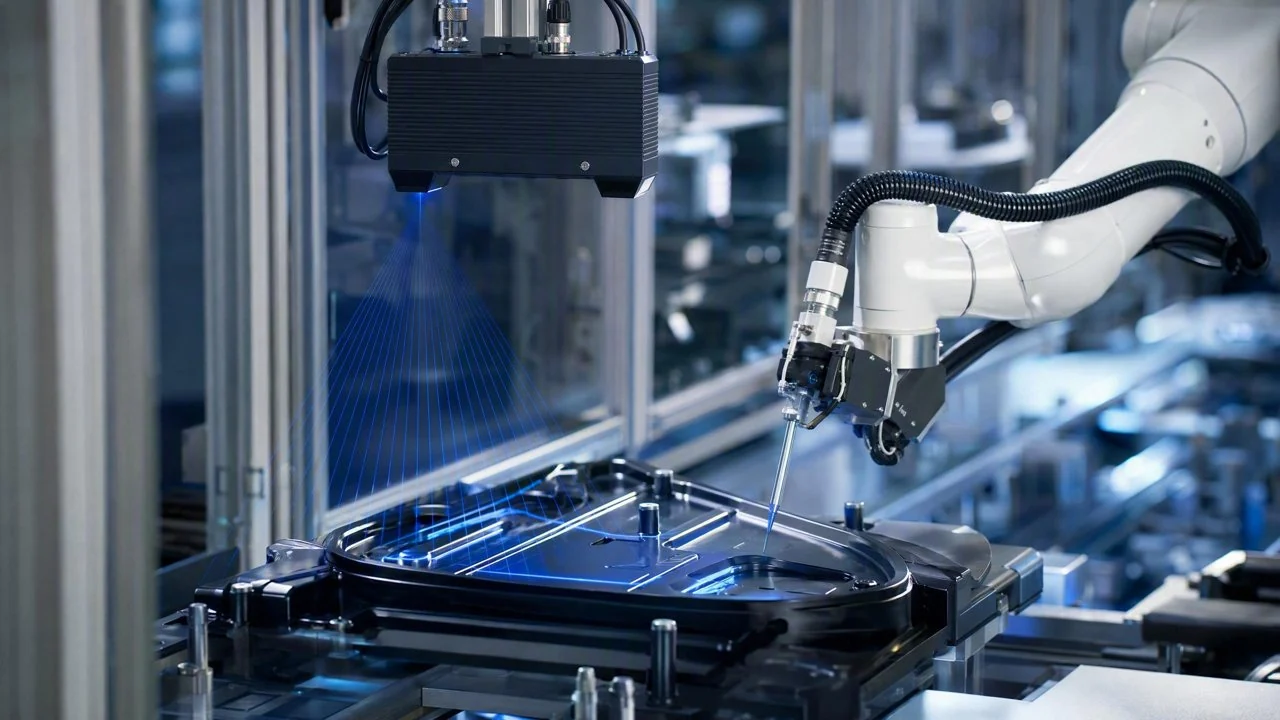
DaoAI 3D ACI equipment (proprietary 3D cameras + 3D morphology reconstruction/point cloud, detecting hidden solder joints/coplanarity/micron-level morphology/pores and other 2D optical blind spot defects, with 2D-3D fusion) significantly enhances product quality and production efficiency by reducing the missed detection rate for various defects in automotive component sealant dispensing from an industry average of 1.5% to <0.4% through high-precision 3D morphology reconstruction and AI intelligent analysis.
In automotive manufacturing, the sealing performance of components directly impacts vehicle durability, safety, and user experience. Whether it's pipeline seals in the engine bay, anti-corrosion strips on body welds, or waterproof seals for headlights and windows, dispensing quality is crucial. These processes typically employ automated robots for precise dispensing, but due to material properties, environmental fluctuations, equipment wear, or program deviations, minor defects such as broken beads, overflow, underfill, air bubbles, uneven width, or insufficient height can still occur. Especially on complex curved surfaces or in confined spaces, these defects are often difficult for traditional vision inspection systems to effectively identify, posing potential risks for subsequent assembly and overall vehicle performance. A leading automotive Tier-1 supplier, specializing in sealing components for automotive electronic control unit housings, has extremely high demands for dispensing quality, where any minor defect could lead to product failure and subsequent recall risks.
Pain Points: Why This Challenge Is Difficult to Overcome
Quality inspection of automotive component sealant dispensing faces multiple challenges, leading to persistently high missed detection rates in traditional solutions, typically around 1.5%, sometimes even higher. Firstly, the complex physical properties of dispensing materials, such as translucency, high reflectivity, or strong light absorption, often result in artifacts or insufficient contrast in 2D vision, making bead contours blurry and difficult to accurately assess continuity, width, and height. Secondly, fast production cycles demand that online inspection systems complete high-precision image acquisition and analysis within extremely short times, where any delay can impact production efficiency. Traditional 2D AOI is often limited by its imaging principles, unable to acquire the true 3D morphology of the sealant bead. Its capability to detect critical parameters like height and volume is limited, leading to a higher missed detection rate for hidden defects such as underfill, pores, and collapse. While manual inspection can compensate for some defects, it suffers from fatigue due to long hours of repetitive work, high variability in standards among inspectors, poor stability, and low efficiency, resulting in high manual re-inspection labor costs. Furthermore, with the integration of industrial vision and digital twin scenarios, customer demand for high-precision 3D model reconstruction and real-time data synchronization is growing. Traditional solutions struggle to provide the fine-grained 3D data required for these new demands, making real-time path correction and quality traceability for dispensing challenging.
Delving into the root causes, the difficulty in capturing dispensing defects primarily stems from several aspects: First, “lack of 3D information.” Traditional 2D vision only captures planar images, unable to perceive critical 3D features such as bead height, volume, and cross-sectional shape. For instance, a bead surface might appear flat, but internally there could be voids or poor adhesion—these “hidden defects” leave no trace in 2D images and are typical 2D optical blind spots. Second, “material optical property interference.” Common automotive sealants like silicone and polyurethane often have reflective or diffuse reflective surfaces, coupled with ambient lighting effects, leading to highlights, shadows, or uneven textures in 2D images that interfere with defect identification. Third, “diverse and minute defect morphologies.” Micron-sized air bubbles, subtle breaks in the bead, slight collapses, or overflows are small, irregularly shaped, and often resemble normal bead textures, posing significant challenges for traditional rule-based algorithms. Fourth, “complex curved surfaces and edge detection.” On complex automotive component structures, sealant beads are often dispensed along curved surfaces or sharp edges, causing image distortion and making it difficult for traditional algorithms to accurately extract features and perform quantitative analysis.
Technical Principles
DaoAI 3D ACI equipment fundamentally resolves the limitations of traditional 2D vision in dispensing inspection through its core proprietary 3D camera and 3D morphology reconstruction technology. The system employs high-precision laser triangulation or structured light projection principles, combined with multi-view image acquisition, to obtain sub-micron level point cloud data of the dispensed surface. This point cloud data is processed by DaoAI's advanced 3D morphology reconstruction algorithms, which can accurately restore the true 3D geometric model of the sealant bead, including all critical morphological information such as its height, width, volume, and cross-sectional profile. By acquiring complete 3D data, DaoAI 3D ACI equipment can “penetrate” 2D optical blind spots, effectively detecting various micron-level and even sub-micron defects such as underfill, overflow, air bubbles, collapse, bead breaks, uneven width, and height deviations. For example, internal air bubbles or local collapses within a bead might appear normal in a 2D image, but after 3D morphology reconstruction, the volume and depth changes of these defects become clearly visible in the 3D model, allowing for precise identification. Furthermore, the system integrates 2D image texture and color information, achieving deep 2D-3D fusion detection, further enhancing the detection rate and the ability to identify complex defects.
Compared to traditional inspection methods, DaoAI 3D ACI equipment offers significant advantages. Traditional rule-based AOI relies on preset geometric thresholds and grayscale features, which have poor adaptability to subtle variations in bead morphology or complex defect patterns, high false positive rates, and almost no generalization capability for new defect types. Manual inspection is limited by human eye precision and fatigue, unable to achieve 100% online full inspection, and its results are highly subjective. DaoAI 3D ACI equipment, however, combines deep learning with 3D data analysis. Its DaoAI ACI OS can train robust defect detection models rapidly using APDT (Adaptive Positive Data Training) positive/few-shot learning, requiring only a small number of good samples (1–20 images). This model can autonomously learn the normal morphological features of the sealant bead and identify various abnormal patterns, effectively detecting even previously unseen defect types. Concurrently, through semantic false positive filtering, the system intelligently distinguishes between true defects and non-critical texture variations, reducing the false positive rate by over 90%. This capability, based on real 3D data and AI intelligent analysis, enables DaoAI 3D ACI equipment to far surpass traditional solutions in detection rate, reduction of missed detections, false positive rate, inspection speed, and adaptability, ensuring extreme reliability in automotive component sealant quality.
Typical Application Scenarios
- **Automotive Electronic Module Sealant Inspection:** After sealant application on housings of automotive electronic modules like ECUs and BMS, DaoAI 3D ACI equipment can precisely detect bead width, height, continuity, air bubbles, breaks, and presence of overflow or underfill. The challenge lies in typically thin beads located on irregular edges, with extremely high waterproof and dustproof requirements for electronic modules, where any minor defect could lead to internal circuit shorting due to moisture.
- **Headlight/Window Glass Edge Sealant Inspection:** For sealant between headlights or window glass and the car body frame, DaoAI 3D ACI can detect bead uniformity, presence of gaps, collapses, or local bulges. These beads are often long and highly curved, with some areas potentially in blind spots, making traditional 2D coverage difficult, while 3D morphological data provides a complete representation.
- **Engine/Transmission Oil Sealant Inspection:** On the mating surfaces of engine or transmission casings, sealant preventing oil leaks is crucial. DaoAI 3D ACI can inspect bead integrity, height consistency, and the presence of minute pores or depressions, ensuring the reliability of the oil seal. The difficulty lies in oil seals typically being dark-colored, and the inspection environment potentially having oil stains or reflections, posing challenges for imaging quality and algorithm robustness.
- **New Energy Battery Pack Sealant Inspection:** The sealing integrity of new energy vehicle battery packs directly impacts battery safety and lifespan. DaoAI 3D ACI equipment is used to inspect sealant at battery module or pack connections, ensuring continuity, absence of air bubbles or breaks, and precisely measuring bead height and width against design standards to prevent thermal runaway risks.
Deployment Case Study
A leading automotive Tier-1 supplier, primarily producing housings for automotive electronic control units, had critical demands for the reliability of its sealant dispensing process. Previously, the supplier relied on manual visual inspection combined with a few 2D AOI devices for sampling, but facing increasing production capacity and stringent quality requirements, the traditional solution’s missed detection rate averaged around 1.8%. This resulted in approximately 2000 products per month flowing downstream with sealing defects, leading to significant rework costs and potential quality recall risks. To address this pain point, the manufacturer introduced DaoAI 3D ACI equipment for 100% online full inspection. In the initial phase of the project, the DaoAI engineering team collaborated closely with the client, utilizing the DaoAI ACI OS to quickly train detection models with a small number of good samples (approximately 10 images) and optimizing them for the client's specific dispensing materials and defect patterns. The entire system deployment and debugging took only one week, quickly integrating into the existing production line.
After deployment, DaoAI 3D ACI equipment demonstrated exceptional performance. Through real-time high-precision 3D morphology reconstruction, the system accurately identified micron-level underfill, air bubbles, and localized collapses that were previously difficult for 2D vision and manual inspection to detect. Data showed that the system successfully reduced the missed detection rate for sealant dispensing defects to <0.35%, representing a reduction of over 80% compared to traditional solutions. Concurrently, due to its semantic false positive filtering capability, the false positive rate was also significantly reduced, decreasing manual re-inspection volume by 75%, substantially alleviating the burden on quality inspection personnel and shortening the original 4 hours of daily manual re-evaluation time to less than 1 hour. Furthermore, DaoAI 3D ACI equipment provides detailed 3D defect data, assisting client engineers in analyzing dispensing process parameters to achieve process optimization and real-time correction of robot dispensing paths, thereby improving product quality stability at the source.
“DaoAI 3D ACI equipment not only solved our long-standing missed detection challenges but also provided invaluable 3D data, allowing us to gain deeper insights into and optimize our dispensing processes, which is crucial for enhancing the market competitiveness of our products.” — Quality Director, a leading automotive Tier-1 supplier
DaoAI Solutions and Products
DaoAI's core solution for automotive component sealant dispensing is based on its proprietary 3D ACI equipment. This equipment integrates high-precision 3D cameras and a powerful computing platform, capable of real-time generation and analysis of 3D point cloud data from dispensed parts. Through DaoAI's unique 2D-3D fusion technology, the system leverages 3D morphological data to detect height, volume, and other 3D defects, while also incorporating texture and color information from 2D images for supplementary detection of planar defects, ensuring comprehensive and accurate inspection. For defect modeling, the DaoAI ACI OS utilizes visual foundation models, supporting APDT (Adaptive Positive Data Training) positive/few-shot learning. Operators only need to upload 1–20 good sample images, and the system can complete 0-code automatic programming and model training within 5 minutes, quickly adapting to the dispensing inspection needs of different component models. For multi-variety, small-batch production, this rapid changeover capability significantly reduces downtime. The system supports 100% local private deployment, with all data remaining on-site, ensuring client data security and autonomous control over production processes.
DaoAI 3D ACI equipment also boasts powerful data traceability and analysis capabilities, able to link inspection results with product serial numbers to form complete quality records, supporting the automotive industry's stringent quality traceability systems. Coupled with the unified foundation of the DaoAI World model, the system possesses semantic understanding and cross-scenario generalization capabilities, continuously learning from production line feedback to enhance inspection intelligence. Furthermore, the system can be integrated with robotic systems, providing real-time feedback of inspection results to guide robots in online correction of dispensing paths, forming a “brain-eye-body” closed-loop control that further improves dispensing accuracy and yield. Through these comprehensive capabilities, DaoAI 3D ACI equipment not only boosts inspection efficiency but also delivers significant business value to clients through precise defect identification and data-driven process optimization, ensuring ultra-high quality in automotive component sealant dispensing.
FAQ
What types of dispensing defects does DaoAI 3D ACI equipment primarily target?
DaoAI 3D ACI equipment primarily targets various micron-level defects in automotive component sealant dispensing, including bead breaks, overflow, underfill, air bubbles, collapse, uneven width, insufficient height, and internal voids—defects often in 2D optical blind spots. Through 3D morphology reconstruction, it accurately quantifies the true geometric dimensions and integrity of the sealant bead, ensuring comprehensive inspection.
What are the core advantages of DaoAI 3D ACI equipment compared to traditional 2D AOI or manual inspection?
The core advantages lie in its 3D inspection capability and AI intelligent analysis. Traditional 2D AOI cannot acquire bead height and volume information, leading to high missed detection rates for hidden defects; manual inspection is inefficient and unstable. DaoAI 3D ACI, with its proprietary 3D cameras and 3D morphology reconstruction, precisely detects defects in 2D optical blind spots, combined with AI algorithms to achieve high detection rates, reduced missed detections, and supports rapid changeovers and data traceability.
What is the approximate cost investment for deploying DaoAI 3D ACI equipment?
The cost investment for DaoAI 3D ACI equipment varies depending on specific configurations, inspection cycle times, integration complexity, and client requirements. We offer flexible hardware and software solutions and support 100% local private deployment. We recommend contacting our sales engineers with your detailed production line needs and inspection specifications for a customized solution and precise quotation, along with an assessment of the return on investment period.
Full solution for this scenario: the full inspection solution for Automotive / parts · 100% Inline 3D Inspection & Path Correction for Automotive Glue Dispensing
This article was generated by AI. Customer cases are simulated scenarios based on real product capabilities and figures are illustrative; see product pages for official benchmarks.