
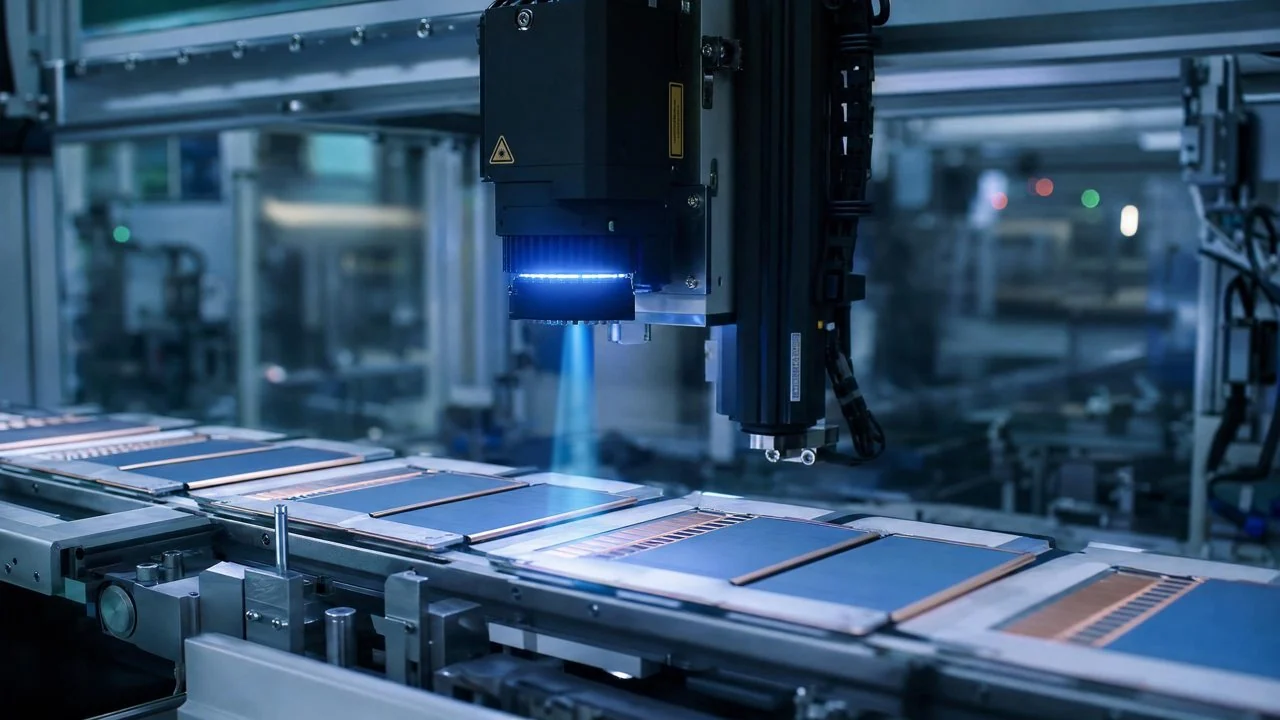
DaoAI 3D ACI equipment (featuring proprietary 3D camera + 3D morphology reconstruction/point cloud, capable of detecting hidden solder joints/coplanarity/micron-level morphology/pores, and other 2D optical blind spot defects, with 2D-3D fusion) performs online full inspection of new energy battery electrode coatings. This reduces the manual inspection omission rate from a typical 1.5% to <0.4% and significantly cuts labor costs in the re-inspection process, achieving a dual improvement in production quality and efficiency.
In the critical electrode coating process of new energy battery manufacturing, quality control directly impacts battery performance, safety, and lifespan. This stage primarily involves the uniform coating of active materials, conductive agents, and binders to form electrode sheets with specific thickness and density. Due to the high speed, wide format, and diverse, minute defect types of electrode coating, traditional sampling or manual visual inspection can no longer meet the high consistency and zero-defect requirements of modern battery production. A leading battery manufacturer faced increasing demands for detecting micron-level defects such as uneven coating, micro-cracks, and pores on their production lines. They particularly sought automated solutions to replace high-intensity, fatigue-prone manual inspection, addressing rising labor costs and talent turnover.
Pain Points: Why This Hurdle Is Difficult to Overcome
The leading manufacturer encountered multiple challenges in online inspection of electrode coating. Firstly, **high omission rates**: traditional manual inspection on high-speed production lines typically resulted in omission rates exceeding 1.5% for micron-level defects. Human eyes are prone to fatigue and misjudgment, especially for subtle uneven coating, edge defects, or internal pores. Secondly, **exorbitant labor costs**: to ensure a certain inspection coverage, production lines required a large number of inspection workers on shifts. High-intensity, repetitive work led to high personnel turnover and training costs, with annual labor cost increases averaging around 15% per production line. Thirdly, **significant inspection blind spots**: 2D optical inspection, limited by its principles, cannot accurately acquire 3D information like height and depth. It struggles with hidden pores within the coating, abnormal protrusions or depressions in microscopic morphology, and coplanarity defects, leading to numerous false positives and omissions. This resulted in significant human effort expended in the re-inspection stage, with **re-inspection hours accounting for up to 30%**. Finally, **difficulty in data traceability**: the lack of detailed defect data made it challenging to support process optimization and yield improvement, failing to meet the increasingly stringent quality traceability compliance requirements of the new energy battery industry.
The root cause of these difficulties lies in the **complex optical properties of electrode materials** (e.g., reflection, uneven absorption) and the **minute, three-dimensional nature of the defects themselves**. For instance, pores formed by bursting tiny bubbles during coating have significant depth information that impacts battery performance, but 2D images only capture their planar projection, failing to determine their true morphology. Concurrently, fast production cycles and complex environments demand high stability and anti-interference capabilities from inspection equipment. Traditional rule-based AOI systems suffer from high false positive rates when dealing with diverse and complex defect features, while the efficiency and accuracy of manual inspection are limited by human physiological constraints, making it difficult to achieve zero-defect quality control. This has led to a bottleneck in quality improvement at this stage.
Technical Principles
The core competitiveness of DaoAI 3D ACI equipment lies in its **proprietary 3D camera and advanced 3D morphology reconstruction technology**. The equipment employs multi-view structured light projection combined with high-precision camera arrays. By projecting encoded gratings and capturing their deformation on the electrode surface, it precisely calculates the 3D coordinates of each pixel, thereby reconstructing high-precision point cloud data of the electrode surface. This point cloud data contains complete 3D morphological information of the electrode, with micron-level accuracy. For complex defects in new energy battery electrode coating, DaoAI deeply integrates deep learning models with 3D point cloud data, building multi-modal defect recognition algorithms. The model can directly learn the geometric features of defects (such as height, depth, volume) from 3D point clouds and, through 2D-3D fusion technology, combine 2D image texture and color information to achieve precise identification of defects like uneven coating, micro-cracks, pores, and foreign objects. Compared to traditional 2D AOI, which relies solely on surface grayscale or color differences, DaoAI 3D ACI can effectively penetrate 2D optical blind spots, identifying defects that are deep-seated or have inconspicuous morphological features.
Compared to traditional manual inspection and rule-based 2D AOI, DaoAI 3D ACI equipment demonstrates significant advantages. Manual inspection is limited by human eye fatigue, subjective judgment, and high production line speeds, resulting in high omission rates and low efficiency. While rule-based AOI offers high automation, it often requires engineers to manually adjust numerous rule parameters when dealing with diverse, non-standardized micron-level defects, leading to high false positive rates and complex changeover programming. In contrast, DaoAI 3D ACI, leveraging its powerful AI visual foundation model, can achieve 0-code automatic programming within 5 minutes through **APDT positive/few-shot learning** (requiring only 1–20 good samples), rapidly adapting to new products or defect types. Its **semantic false positive filtering** function can effectively identify and eliminate pseudo-defects caused by material characteristics or environmental interference, reducing false positive rates by 75% and significantly decreasing the workload of subsequent manual re-inspection. This combination of deep learning and 3D vision enables DaoAI to elevate defect detection rates to near zero-defect levels in complex manufacturing scenarios, while substantially reducing reliance on human labor.
Typical Application Scenarios
- **Coating Uniformity Inspection**: Performs 3D morphology reconstruction and analysis of the electrode surface coating thickness, density, and uniformity. The challenge lies in the difficulty of accurately assessing micron-level thickness deviations with 2D images. DaoAI 3D ACI directly measures coating height through point cloud data, precisely identifying localized unevenness, streaks, and waves, ensuring consistency in battery electrochemical performance.
- **Surface Pores and Micro-cracks Detection**: Identifies pores, holes, and micro-cracks on the electrode coating surface and in shallow internal layers. Traditional 2D images struggle to distinguish between surface stains and genuine pores and cannot perceive crack depth. DaoAI 3D ACI accurately differentiates and quantifies pore depth and crack geometry using 3D point cloud depth information and morphological features, preventing omissions that could lead to potential battery internal short circuits.
- **Foreign Object and Contamination Detection**: Identifies tiny foreign objects, particles, and fibers adhering to the electrode surface. These foreign objects can cause internal short circuits or performance degradation in batteries. DaoAI 3D ACI not only identifies foreign object contours through 2D images but also uses 3D morphology to determine their height and adhesion status, avoiding misinterpreting electrode textures as foreign objects.
- **Edge Defects and Burrs Detection**: Checks the neatness of electrode edges and the presence of burrs, material shortages, or overflows. Edge defects can affect subsequent slitting and winding processes and even lead to safety hazards. DaoAI 3D ACI precisely measures the 3D dimensions of edge contours, identifying tiny edge irregularities and burrs, ensuring the geometric accuracy of the electrode.
- **Coplanarity and Flatness Detection**: Evaluates the overall flatness and local coplanarity of the electrode. Especially for large electrodes, slight warping or wrinkles may not be obvious in 2D images but can severely impact battery assembly and performance. DaoAI 3D ACI, through global 3D morphology analysis, accurately quantifies flatness deviations of the electrode, ensuring its stability and consistency in subsequent processes.
Case Study
A tier-1 new energy battery manufacturer, with its production base in East China, had long faced challenges in the electrode coating process, including low efficiency of manual visual inspection, high omission rates, and continuously rising labor costs. To address this, the manufacturer introduced DaoAI 3D ACI equipment, deploying it on their high-speed electrode coating production line. During the initial implementation, the DaoAI engineering team collaborated closely with the client, utilizing their DaoAI ACI OS for rapid modeling. By collecting a small amount of good electrode data (**only 15 good samples**) and combining it with expert knowledge of the electrode coating process, the core defect detection model was trained within 5 minutes. In the initial testing phase, DaoAI 3D ACI demonstrated excellent detection capabilities for micron-level pores, coating streaks, and other defects. Before deployment, the production line required 8 inspection workers on three shifts for visual inspection and re-inspection, with monthly labor costs alone amounting to hundreds of thousands of yuan; simultaneously, the average omission rate for manual inspection was 1.5%, leading to some defective products flowing downstream, increasing rework and scrap costs. After deployment, DaoAI 3D ACI successfully replaced 60% of manual inspection tasks, **reducing the number of required inspection workers from 8 to 3**, significantly lowering the labor costs of the production line. Concurrently, the equipment's **defect detection rate increased to 99.6%**, the omission rate was reduced to <0.4%, and the false positive rate decreased by 75%. This not only improved product quality but also substantially reduced human input in the re-inspection process, with **re-inspection hours decreasing by 60%**. The client highly recognized the performance of DaoAI 3D ACI equipment and plans to expand its application to more production lines.
“DaoAI 3D ACI not only solved our electrode coating omission problem but, more importantly, it greatly alleviated our production line's labor pressure and costs, truly achieving cost reduction and efficiency improvement through intelligent manufacturing.” — Production Director, a leading battery manufacturer
DaoAI Solutions and Products
DaoAI's core solution for new energy battery electrode coating online full inspection centers on its proprietary 3D ACI equipment. This device integrates a high-resolution 3D camera with a high-performance image processing unit, conducting high-speed 3D scanning of the electrode surface to generate high-precision point cloud data in real-time. This data is then processed by the DaoAI ACI OS, which incorporates DaoAI's unique AI visual foundation model, boasting powerful feature recognition capabilities and few-shot learning advantages. Customers only need to provide a small number of good samples, and the system can complete defect model training and deployment in a very short time, enabling 0-code rapid changeover. DaoAI 3D ACI equipment supports 2D-3D fusion detection, utilizing both planar texture information and 3D morphological data of the electrode to achieve comprehensive perception and precise identification of complex defects, effectively compensating for the blind spots of traditional 2D optical inspection. Furthermore, DaoAI offers 100% on-premise private deployment options, ensuring that customer production data and intellectual property remain secure within their premises, meeting the stringent data security requirements of the industry. The entire solution not only provides efficient and accurate detection capabilities but also fundamentally transforms the traditional electrode coating inspection's over-reliance on manual labor through automation and intelligence, ultimately reducing operational costs.
By deploying DaoAI 3D ACI equipment, customers have realized significant business value. In terms of quality, the defect detection rate increased to 99.6%, and the omission rate decreased to <0.4%, greatly enhancing product quality consistency and reliability. In terms of efficiency and cost, the demand for manual visual inspection was substantially reduced, with **re-inspection hours decreasing by 60%**, directly lowering the labor costs of the production line, saving millions of yuan in labor expenses annually. DaoAI 3D ACI's rapid changeover capability (5min 0-code programming) also significantly reduced production line downtime and improved production flexibility. Moreover, the detailed defect data generated by the system provides valuable insights for customer process optimization, helping them continuously improve yield and enhance market competitiveness. DaoAI firmly believes that through deep learning model optimization, AI visual inspection can elevate defect detection rates to zero-defect levels in complex manufacturing scenarios, safeguarding the high-quality development of the new energy battery industry.
FAQ
What is the fundamental difference between DaoAI 3D ACI equipment and traditional 2D AOI?
The fundamental difference of DaoAI 3D ACI lies in its proprietary 3D camera, which can acquire three-dimensional morphological information of the object, whereas traditional 2D AOI can only capture planar images. This means 3D ACI can detect defects in 2D optical blind spots such as depth, height, and coplanarity, like the true depth of pores or micron-level morphological protrusions/depressions. Combined with AI deep learning algorithms, it achieves more precise and comprehensive defect recognition, significantly reducing false positives and omissions.
What is the budget required to deploy DaoAI 3D ACI equipment, and what is the typical payback period?
The specific budget for DaoAI 3D ACI equipment depends on the client's production line scale, required inspection precision, integration complexity, and desired functional modules. We do not provide fixed quotes but offer customized solutions based on actual needs. Considering its significant benefits in reducing labor costs, improving yield, and decreasing rework and scrap, the typical investment payback period is usually within 12-24 months. Please contact our sales team for a detailed assessment and quotation.
What specific types of defects can DaoAI 3D ACI detect in the electrode coating process?
In the electrode coating process, DaoAI 3D ACI equipment can precisely detect various defects, including but not limited to: uneven coating (e.g., thickness deviation, streaks, waves), surface pores (with depth identification), micro-cracks, foreign object contamination (e.g., tiny particles, fibers), edge defects (e.g., burrs, material shortages, overflows), and overall electrode coplanarity and flatness anomalies. Through 2D-3D fusion technology, these defects can be identified and quantified with high precision.
Full solution for this scenario: New-energy batteries industry solutions · Inline Electrode Coating Inspection
This article was generated by AI. Customer cases are simulated scenarios based on real product capabilities and figures are illustrative; see product pages for official benchmarks.