
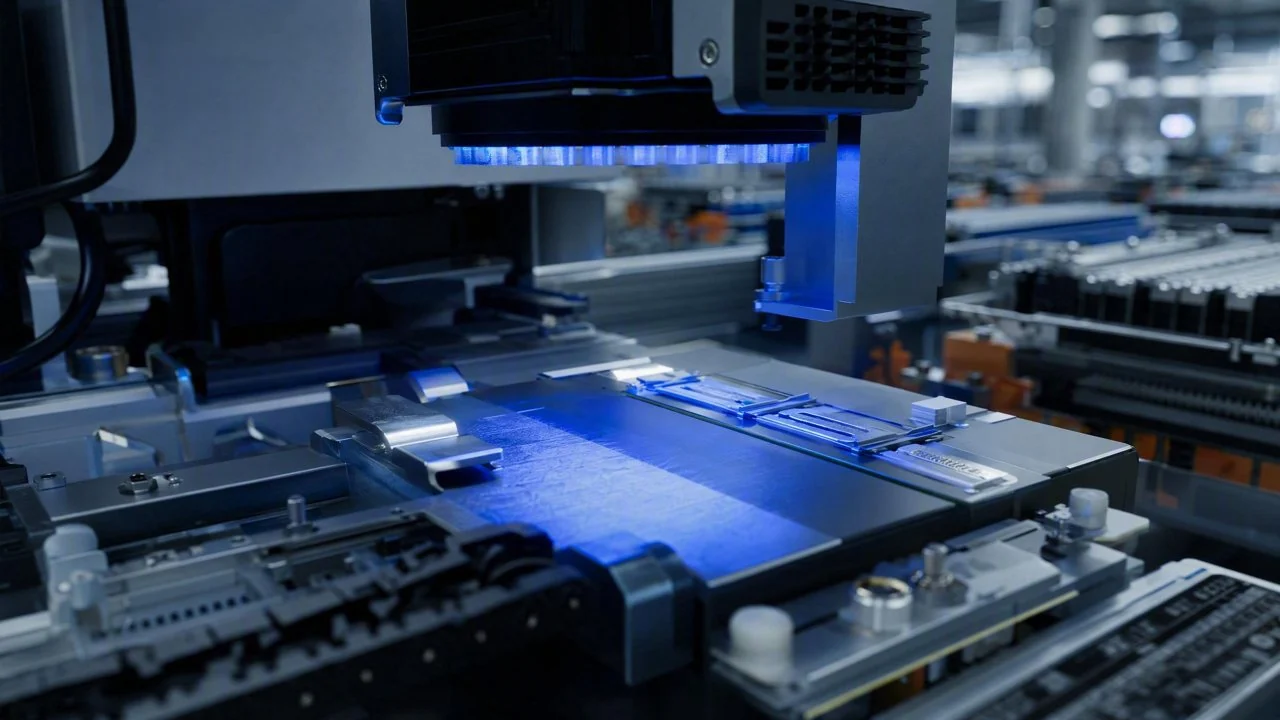
DaoAI 3D ACI equipment (featuring self-developed 3D cameras + 3D morphology reconstruction/point clouds, detecting hidden solder joints/coplanarity/micron-level morphology/voids, and other 2D optical blind spot defects, with 2D-3D fusion) leverages on-premises private deployment to reduce the missed detection rate of new energy battery tab welding defects from a traditional 1.5% to <0.3%, while ensuring absolute security of critical production data for clients, effectively addressing data sovereignty and compliance challenges.
New energy batteries, as the core driving force of the global energy transition, have manufacturing processes whose precision and reliability directly impact battery performance, lifespan, and even safety. Among these, tab welding is one of the critical steps in battery production, directly affecting the battery's internal resistance, charge-discharge efficiency, and cycle life. With the explosive growth of the electric vehicle and energy storage markets, battery manufacturers face increasingly stringent quality standards and production capacity pressures. Traditional 2D vision inspection solutions often struggle with the complex 3D morphological defects of tab welding, especially hidden defects like burrs, cold welds, internal voids in solder joints, and coplanarity deviations, which are blind spots for 2D optical inspection. DaoAI, understanding the industry's pain points, has developed its 3D ACI equipment specifically for the new energy battery sector. This equipment aims to comprehensively improve the accuracy and efficiency of tab welding quality inspection through advanced 3D detection technology combined with intelligent AI algorithms. Furthermore, its on-premises private deployment capability meets the high demands of leading battery manufacturers for production data security and compliance.
Pain Points: Why This Hurdle Is Hard to Clear
In the new energy battery tab welding process, traditional inspection solutions face multiple challenges. Firstly, there's a **high missed detection rate**, especially for common tab welding defects such as tiny burrs, internal cold welds or voids in solder joints, and coplanarity deviations in the welding area. 2D vision, lacking depth information, often misinterprets these as normal surface textures or misses them entirely. According to feedback from a leading battery manufacturer, the missed detection rate for such defects using traditional 2D AOI solutions was as high as 1.5%–2.0%, severely impacting product consistency. Secondly, the **false alarm rate remains high**. The tab surface may have non-defective textures or color variations due to welding processes or material properties, which traditional rule-based AOI struggles to differentiate, leading to a large number of good products being flagged as defective. This necessitates an average of 4–6 hours of manual re-inspection per day, adding an extra 15%–20% to operational costs. Furthermore, **data security and compliance risks** are increasingly prominent. With the rise of AI quality inspection large models, data, as the 'fuel' for training models, has become particularly important. However, many battery manufacturers, especially Tier-1 suppliers, are highly sensitive to production data (such as welding parameters, defect images, good sample images, etc.), fearing data leakage if uploaded to the cloud or non-compliance with strict industry data sovereignty regulations. This concern has made them hesitant to adopt AI solutions that rely on cloud computing power or data storage, limiting the introduction of advanced technologies.
The root cause of these problems lies in the complex physical characteristics of the tab welding process. For instance, different metal materials have varying reflectivities, and the welding area may exhibit high reflectivity or specular effects, interfering with optical imaging. The solder joint morphology itself has 3D complexity, such as the protrusion, depression, and slope changes of the weld bead, as well as internal structural defects like voids and incomplete fusion. These cannot be fully characterized by a single 2D grayscale image. Traditional rule-based AOI struggles to adapt to this complexity and diversity, while manual visual inspection is limited by fatigue, subjectivity, and efficiency, unable to meet the 100% full inspection demands of high-throughput production lines. DaoAI recognizes that to address these pain points, breakthroughs must be made in both 3D imaging and localized deployment.
Technical Principles
The core advantage of DaoAI 3D ACI equipment lies in its self-developed 3D camera and advanced 3D morphology reconstruction technology. The equipment employs the principle of multi-frequency structured light projection, projecting a series of encoded structured light patterns onto the surface of the object under test, and capturing them from different angles with high-resolution cameras. These captured images are processed by DaoAI's unique 3D morphology reconstruction algorithm, which precisely reconstructs micron-level 3D point cloud data of the tab welding area. Based on this high-precision point cloud data, the DaoAI AI engine can quantitatively analyze the geometric dimensions, coplanarity, weld height, width, volume, and microscopic surface morphology (such as burr height, cold weld depression, void depth, and diameter) of the solder joints. Compared to traditional 2D AOI, which relies solely on 2D features from grayscale or color images, DaoAI 3D ACI can acquire complete 3D spatial information, thereby effectively identifying hidden defects that are difficult to detect in 2D images, reducing the missed detection rate for tab welding to <0.3%.
Furthermore, the 2D-3D fusion detection mechanism of DaoAI 3D ACI equipment combines the rich texture information of 2D color images with the precise geometric information of 3D morphology data. Through deep learning algorithms, multi-modal feature fusion is performed, further enhancing the robustness and accuracy of defect identification. For deployment strategy, DaoAI supports 100% on-premises private deployment, where all data processing, model training, and inference are completed on the client's local servers, with data never leaving the factory. This fundamentally eliminates data leakage and compliance risks, meeting the requirements of clients with extremely high demands for data security. This deployment method not only improves data security but also avoids reliance on external networks, ensuring the stability and real-time performance of system operation, which is particularly advantageous in complex or restricted industrial environments.
Typical Application Scenarios
- **Tab Burr Detection:** Tiny metal burrs generated during welding can cause battery short circuits. Traditional 2D vision struggles to accurately quantify their height. DaoAI 3D ACI equipment, through 3D morphology reconstruction, can precisely measure the height and volume of burrs, identifying micron-level burr defects to ensure smooth, foreign-object-free tab edges.
- **Cold Weld and False Weld Detection:** Cold welds or false welds are key factors leading to increased battery internal resistance and reduced performance. These defects often manifest as internal voids or poor contact within the solder joint, which are difficult to assess from 2D images. The DaoAI 3D ACI can effectively identify cold welds and false welds by analyzing the continuity and integrity of the solder joint's 3D morphology, as well as anomalies in weld depth and volume.
- **Solder Joint Coplanarity Detection:** The coplanarity of the tab-to-busbar weld is a crucial indicator for ensuring uniform current distribution and preventing localized overheating. DaoAI 3D ACI equipment can precisely measure the planarity deviation of the solder joint surface, ensuring all solder joints are within the same plane, avoiding poor contact due to insufficient coplanarity.
- **Weld Void and Crack Detection:** Voids and micro-cracks generated during welding are potential failure points. These defects are typically located within or on the surface of the weld and are tiny in size. Through high-precision 3D point cloud data, DaoAI 3D ACI can perform detailed 3D scanning and analysis of the weld, identifying and quantifying these micron-level internal defects.
- **Solder Joint Morphology Consistency Detection:** Battery production demands extremely high consistency in solder joints. DaoAI 3D ACI can perform comprehensive measurement and statistical analysis of key geometric parameters such as weld width, height, and shape, ensuring that solder joint morphology across different batches and locations meets design standards, thereby enhancing overall product quality stability.
Case Study
A leading domestic Tier-1 new energy battery supplier faced severe quality challenges in its tab welding production line. Their previous traditional 2D AOI solution performed poorly in detecting tab burrs and cold welds, with the missed detection rate consistently around 1.5%. What concerned them even more was their inability to upload sensitive production data to the cloud for AI model training and inference, due to increasingly stringent data security and compliance requirements. This prevented them from adopting more advanced AI inspection technologies. Upon learning that DaoAI 3D ACI equipment supports 100% on-premises private deployment, the manufacturer decided to implement this solution. Through close collaboration between the project team and the client, DaoAI engineers completed the deployment of the DaoAI ACI OS on the client's local servers. Using APDT positive/few-shot learning technology, they programmed and trained the tab welding defect detection model with only 15 good samples in 5 minutes. After deployment, the DaoAI 3D ACI equipment successfully reduced the missed detection rate for defects like burrs and cold welds at the tab welding quality gate to <0.3%. Concurrently, through semantic false alarm filtering, the volume of manual re-inspection was reduced by 65%. The client highly praised the excellent performance and data security of DaoAI 3D ACI under local deployment, acknowledging that it not only significantly improved product quality but also resolved their long-standing data compliance issues.
DaoAI 3D ACI's on-premises private deployment is not just a technological breakthrough, but a firm commitment to client data sovereignty and security.
DaoAI Solutions and Products
DaoAI 3D ACI equipment, as the core product in this case, integrates self-developed 3D cameras and advanced AI vision algorithms. Through 3D morphology reconstruction technology, it achieves comprehensive and precise detection of new energy battery tab welding defects. Its core capability lies in acquiring micron-level 3D morphological data of object surfaces, identifying 2D optical blind spot defects, and combining 2D-3D fusion algorithms to significantly enhance detection accuracy and robustness. In terms of deployment, DaoAI supports 100% on-premises private deployment, including the DaoAI ACI OS, DaoAI World world model (a unified foundation for semantic understanding, cross-scenario generalization, and continuous learning), and all model training and inference services. This ensures that clients' sensitive production data remains within their enterprise firewall, never leaving the factory, thereby meeting strict data security and compliance requirements. Furthermore, DaoAI offers various integration methods such as SDK/API/Docker, facilitating quick integration of its AI quality inspection capabilities into existing production systems for automated, intelligent quality control. For model building, the DaoAI ACI OS supports 0-code automatic programming with just one good sample in 5 minutes, combined with APDT positive/few-shot learning (requiring only 1–20 good samples), significantly shortening model development cycles and changeover times, saving clients substantial time and labor costs.
The implementation of DaoAI 3D ACI equipment brings significant business value to new energy battery manufacturers. By reducing the missed detection rate of tab welding defects to <0.3%, it effectively prevents defective products from flowing downstream, greatly improving the overall quality and reliability of battery products. Concurrently, the significant reduction in false alarm rates (manual re-inspection volume reduced by 65%) minimizes unnecessary re-inspection steps, optimizes production line efficiency, and frees up valuable human resources. Most importantly, 100% on-premises private deployment ensures the absolute security of critical enterprise data, eliminating data leakage concerns and allowing clients to confidently embrace advanced AI quality inspection technologies, accelerating their intelligent transformation. By providing this solution that combines high performance with high security, DaoAI offers robust assurance for the high-quality development of the new energy battery industry.
FAQ
How does DaoAI 3D ACI equipment ensure data security?
DaoAI 3D ACI equipment supports 100% on-premises private deployment. This means all production data (including images, inspection results, model training data, etc.) is stored on the client's local servers and is not uploaded to the cloud. Data processing, model training, and inference are all completed within the client's enterprise firewall, completely eliminating data leakage risks from both technical and physical perspectives, meeting strict industry standards for data security and privacy.
What are the advantages of DaoAI 3D ACI over traditional 2D AOI for detecting tab welding defects?
Traditional 2D AOI can only acquire planar image information and has limited capability in detecting 3D morphological defects such as burr height, internal voids in cold welds, and solder joint coplanarity. DaoAI 3D ACI utilizes self-developed 3D cameras and 3D morphology reconstruction technology to obtain micron-level high-precision 3D point cloud data. Combined with 2D-3D fusion algorithms, it can accurately identify defects in 2D optical blind spots, significantly improving the optimization of missed detection and false alarm rates.
What is the approximate investment required to deploy DaoAI 3D ACI equipment?
The investment cost for DaoAI 3D ACI equipment is influenced by various factors, including specific inspection requirements (e.g., accuracy, throughput), complexity of production line integration, and whether customized features are needed. We offer flexible software and hardware configuration options to provide clients with the most cost-effective solutions. A specific quote requires an evaluation based on your detailed needs. Please contact our sales team for a customized solution and accurate pricing.
Full solution for this scenario: the full inspection solution for New-energy batteries · Tab Welding Quality Gate
This article was generated by AI. Customer cases are simulated scenarios based on real product capabilities and figures are illustrative; see product pages for official benchmarks.