
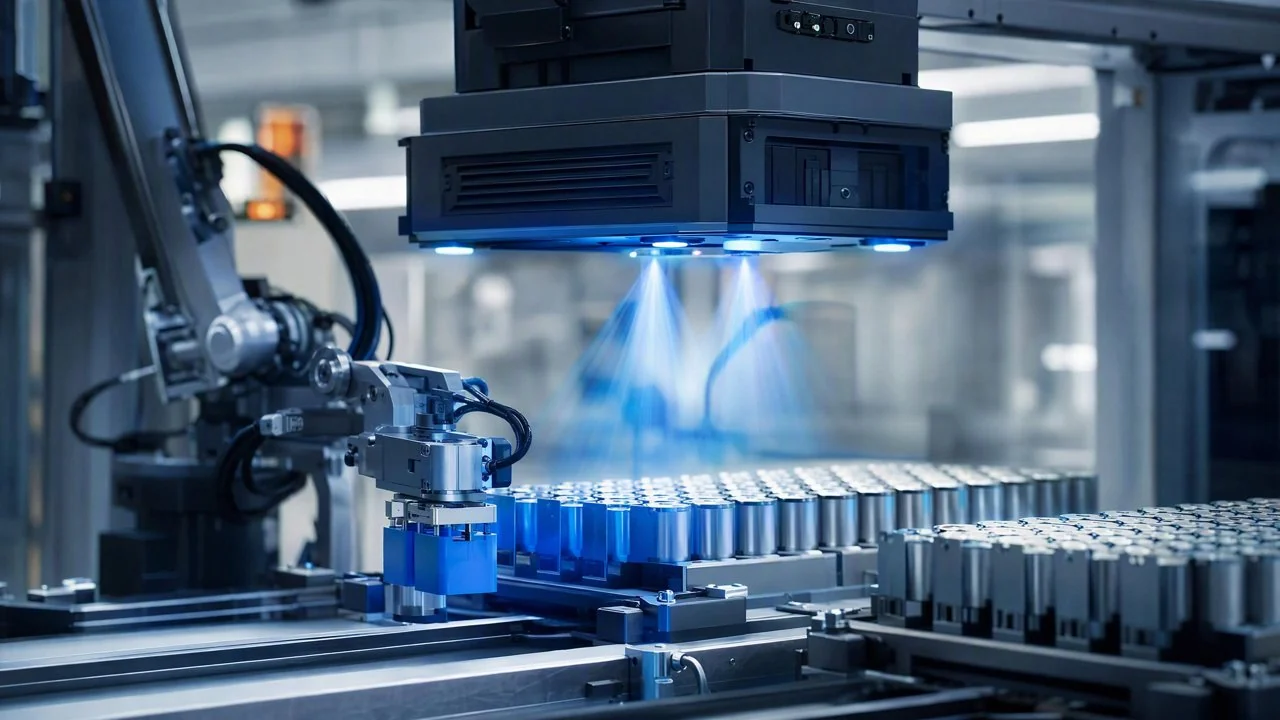
DaoAI 3D AI AOI equipment, leveraging its self-developed 3D camera and 3D morphology reconstruction technology, has reduced the false negative rate of traditional X-ray CT solutions to below 0.2% in new energy battery winding/stacking anode-cathode alignment inspection. It also supports 100% local private deployment, providing customers with ultimate data security. In the core processes of new energy battery manufacturing, especially winding and stacking alignment, alignment precision directly impacts battery energy density, cycle life, and safety. As battery technology iterates, the tolerance for micron-level defects continues to decrease, posing significant challenges for traditional inspection methods. This case study will delve into how DaoAI, through technological innovation, helps customers achieve zero-defect goals while ensuring data security.
DaoAI 3D AI AOI equipment (self-developed 3D camera + 3D morphology reconstruction/point cloud, detects hidden solder joints/coplanarity/micron-level morphology/pores and other 2D optical blind spot defects, 2D-3D fusion) leverages deep learning models and high-precision 3D imaging to dramatically reduce the false negative rate in new energy battery winding/stacking anode-cathode alignment processes from an industry norm of 0.8%~1.2% to below 0.2%, while ensuring all production data operates securely in a locally privately deployed environment. The winding and stacking of new energy batteries are critical steps determining battery performance and safety, where precise alignment of anode and cathode materials is paramount. Any slight misalignment, localized deformation, or foreign matter can lead to internal short circuits, capacity degradation, or even thermal runaway. On the production line of a leading new energy battery manufacturer, strict inspection of cell winding alignment, edge flatness, and the presence of micro-bubbles or foreign matter was conducted to ensure product quality met the most stringent standards. The application of DaoAI 3D AI AOI equipment aims to address the limitations of traditional inspection methods in these complex scenarios, especially against the backdrop of increasingly stringent data security compliance, by providing a solution that is both efficient and secure.
Pain Points: Why This Hurdle Is Difficult to Overcome
In new energy battery winding/stacking alignment inspection, customers face multiple pain points. Firstly, although traditional X-ray CT equipment can penetrate internal structures, its detection rate for micron-level localized deformations, slight wrinkles on electrode edges, or tiny bubbles still has blind spots, with observed false negative rates often between 0.8% and 1.2%. Secondly, X-ray CT image analysis and defect classification heavily rely on the experience of professional engineers, leading to significant time consumption for manual re-inspection. Production line data indicates that approximately 2-3 hours per shift are spent on re-inspecting suspected defects, severely impacting production rhythm and efficiency. Thirdly, as battery energy density increases, the tolerance for defects approaches zero, demanding higher precision and robustness from inspection systems. More importantly, leading manufacturers have extremely high requirements for the security and privacy of core production data, which traditional cloud-based deployment solutions struggle to meet due to their data-out-of-factory compliance needs. The root cause of these challenges lies in the complexity of battery materials, the diversity and microscopic nature of defects, and the stringent demands for real-time, precise inspection at high production speeds.
In terms of imaging, traditional X-ray CT images, while providing penetration, suffer from information loss due to 2D projection. Micron-sized protrusions, indentations, or subtle interlayer misalignments in 3D morphology may not appear distinct in 2D projections, leading to false negatives. At the algorithm level, rule-based traditional machine vision struggles to adapt to subtle changes in battery materials and processes, exhibiting poor model generalization and requiring frequent parameter adjustments. DaoAI observes that, especially as AI visual inspection moves towards a zero-defect goal, the realization of real-time feedback and predictive maintenance relies on higher-dimensional, more refined data acquisition and analysis capabilities, as well as the data security and responsiveness brought by localized deployment.
Technical Principles
DaoAI 3D AI AOI equipment fundamentally resolves the limitations of traditional 2D optical and X-ray CT by integrating a self-developed high-precision 3D camera with advanced 3D morphology reconstruction technology. The equipment, powered by the Wemio engine, acquires complete 3D point cloud data of the inspected object, precisely reconstructing the micron-level morphology of the battery electrode surface. By subjecting this high-density point cloud data to deep learning analysis, DaoAI AI AOI can identify defects that are difficult for traditional methods to detect, such as tiny rolled edges on electrode sheets, localized bulging, interlayer bubbles, and subtle electrode misalignments that are not easily distinguishable in X-ray CT images. Unlike traditional rule-based AOI that relies on engineers manually setting thresholds, DaoAI 3D AI AOI employs APDT positive/few-shot learning, requiring only 1–20 good samples to complete model training, significantly reducing changeover time to 5 minutes and effectively increasing the detection rate.
In terms of data processing, DaoAI 3D AI AOI achieves 2D-3D fusion inspection, simultaneously utilizing the texture details of high-resolution 2D images and the height information from 3D morphology data. This fusion allows the system to understand defect characteristics more comprehensively. For instance, 2D images can capture color anomalies or contamination on the electrode surface, while 3D data precisely quantifies their height or depth. Compared to traditional manual visual inspection, DaoAI 3D AI AOI possesses sub-micron level detection accuracy and extremely high repeatability, avoiding errors caused by human eye fatigue and subjective judgment. For security, the DaoAI 3D AI AOI solution supports 100% local private deployment, with all data processing and AI model inference completed within the customer's intranet environment, ensuring sensitive production data never leaves the factory and meeting the customer's most stringent data security and compliance requirements.
Typical Application Scenarios
- **Winding/Stacking Alignment Inspection:** DaoAI 3D AI AOI equipment precisely measures the lateral and longitudinal alignment deviation of anode and cathode sheets during winding or stacking, identifying micron-level misalignments. The challenge lies in real-time pose capture and accurate morphology reconstruction at high speeds.
- **Electrode Edge Defect Detection:** Detects defects such as burrs, rolled edges, damage, or wrinkles on the electrode edges. These defects might be blurry in 2D images due to lighting or angle, but 3D morphology data can clearly quantify their height and form.
- **Surface Micro-bulges Caused by Internal Bubbles/Foreign Matter:** While X-ray CT can visualize internal bubbles, for slight surface bulges caused by tiny internal bubbles or foreign matter, DaoAI 3D AI AOI equipment can accurately identify and quantify these micron-level surface anomalies through 3D morphology reconstruction.
- **Surface Morphology Anomalies Caused by Coating Non-uniformity:** Detects defects in the electrode coating layer such as uneven thickness, streaks, particles, or shrinkage cavities. DaoAI 3D AI AOI can evaluate the flatness and consistency of the coating layer through height data analysis, which are critical indicators for battery internal resistance and performance.
Case Study
A leading manufacturer specializing in high-end power batteries, prior to adopting DaoAI 3D AI AOI equipment in its new energy battery winding process, primarily relied on X-ray CT combined with manual re-inspection for alignment and internal defect detection. Production line data showed that the traditional solution had a false negative rate hovering around 0.9%, with occasional misses, especially for complex defects such as slight rolled edges on electrode sheets and surface bulges caused by tiny bubbles. Simultaneously, due to data security requirements, all inspection data had to be processed locally, and manual re-inspection was inefficient, with only about 200 suspected defect re-inspections per hour. To meet increasing production capacity and stricter quality standards, and to ensure core technical data remained within the factory, the manufacturer decided to introduce the DaoAI 3D AI AOI solution.
The DaoAI team implemented a 100% private deployment of the 3D AI AOI software system and its self-developed 3D camera on the customer's local servers via SDK / API / Docker. After deployment, the system not only reduced the false negative rate to 0.18% but also significantly decreased the workload of manual re-inspection. Production line data indicated that with the assistance of DaoAI 3D AI AOI, the manual re-inspection burden was reduced by approximately 85%, saving substantial labor costs. More importantly, all inspection data and AI model training processes were completed within the customer's intranet, completely eliminating the risk of data leakage and ensuring the security of the enterprise's core intellectual property. The customer stated that DaoAI 3D AI AOI's local private deployment model was one of the key factors in their choice of this solution, perfectly aligning with their dual goals of data security and efficient production.
"DaoAI 3D AI AOI's local private deployment not only addressed our urgent need for core production data security but also achieved a qualitative leap in inspection precision and efficiency, providing a solid guarantee for our zero-defect production goals."
DaoAI Solutions and Products
DaoAI's 3D AI AOI solution for the new energy battery industry is centered around its self-developed 3D camera integrated with the Wemio engine. This 3D camera can acquire high-frame-rate, high-precision 3D point cloud data of inspected objects and perform 3D morphology reconstruction using advanced algorithms. The Wemio engine, as its powerful AI visual foundation model, supports APDT positive/few-shot learning, allowing customers to complete model training and changeover within 5 minutes with only 1-20 good samples, greatly enhancing production line flexibility. The DaoAI 3D AI AOI software system supports various deployment methods such as SDK / API / Docker, enabling 100% local private deployment to ensure that customers' core data never leaves the factory, meeting data security and compliance requirements. Furthermore, DaoAI also offers the DaoAI AI AOI software system, which can be integrated with existing 2D AOI equipment to achieve 2D-3D fusion inspection, further enhancing the comprehensiveness and accuracy of defect identification.
In practice, the DaoAI team provides end-to-end services from initial evaluation, solution design, equipment integration to post-maintenance. By integrating with existing MES/SCADA systems, DaoAI 3D AI AOI can achieve real-time uploading and traceability of inspection data, providing data support for predictive maintenance and the goal of zero defects in the manufacturing process. For example, through long-term analysis of inspection data, the system can identify correlations between subtle fluctuations in process parameters and defect types, thereby enabling real-time feedback and optimization of the production process. In this case, DaoAI 3D AI AOI equipment significantly reduced the false negative rate of new energy battery winding alignment to 0.18%, decreased manual re-inspection hours by 85%, and shortened changeover time to 5 minutes, significantly improving overall production line efficiency and data security.
FAQ
How does DaoAI 3D AI AOI equipment ensure data security in new energy battery production?
DaoAI 3D AI AOI equipment supports 100% local private deployment. All data acquisition, processing, AI model training, and inference occur within the customer's internal network environment, ensuring that data never leaves the factory. This completely eliminates external data leakage risks and meets stringent enterprise data security and compliance requirements.
What is the approximate cost and deployment timeline for DaoAI 3D AI AOI equipment?
The cost of DaoAI 3D AI AOI equipment primarily depends on specific configurations, inspection cycle times, and integration complexity. We offer flexible deployment options like SDK/API/Docker for rapid integration with existing production lines. The typical deployment period ranges from several weeks to a few months. We recommend scheduling an expert consultation via our official website for a customized quote and implementation plan based on your specific needs.
How does DaoAI 3D AI AOI handle micron-level morphological defects that are challenging for X-ray CT to detect?
DaoAI 3D AI AOI equipment is equipped with a self-developed high-precision 3D camera that acquires complete 3D point cloud data of object surfaces, enabling micron-level morphology reconstruction. Combined with the Wemio engine's deep learning algorithms, it accurately identifies defects such as rolled electrode edges, localized bulges, and surface micro-protrusions caused by interlayer bubbles, which are difficult to distinguish in 2D projections from traditional X-ray CT. This 2D-3D fusion inspection significantly enhances detection rates.
Full solution for this scenario: 3D AI AOI Equipment industry solutions · New-Energy Battery Module Weld Misalignment Detection
This article was generated by AI. Customer cases are simulated scenarios based on real product capabilities and figures are illustrative; see product pages for official benchmarks.