
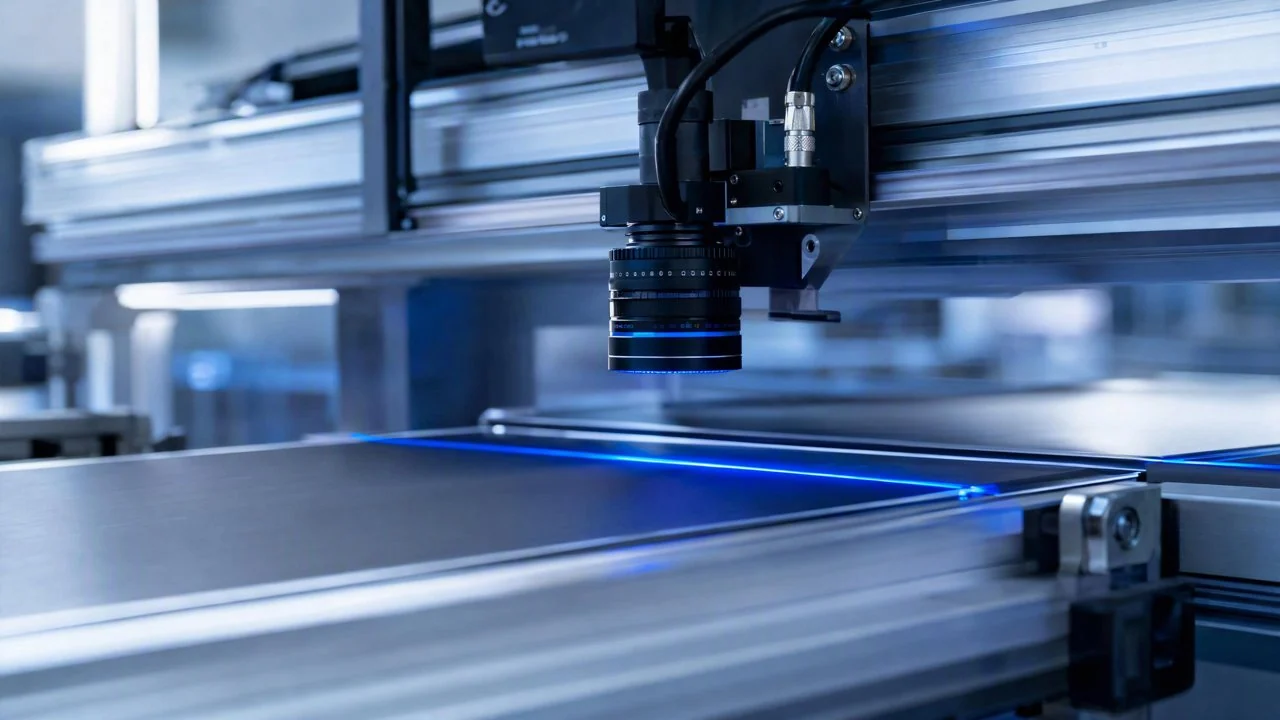
DaoAI 3D AI AOI equipment (self-developed 3D camera + 3D morphology reconstruction/point cloud, detecting hidden solder joints/coplanarity/micron-level morphology/voids and other 2D optical blind spot defects, 2D-3D fusion) leverages multimodal data and advanced algorithms in new energy battery anode coating inline inspection, boosting critical defect quality traceability efficiency by 65% and effectively supporting production line optimization and early warning.
New energy batteries, as the core of electric vehicles and energy storage systems, directly determine the market competitiveness of terminal products regarding their performance and safety. Among the many steps in battery manufacturing, anode coating is one of the key processes determining battery consistency and energy density. Any minor deviation in coating quality, such as uneven coating thickness, surface scratches, particle agglomeration, air bubbles, or edge defects, can lead to increased internal resistance, capacity degradation, or even safety hazards. Traditional offline sampling or 2D optical inline inspection often struggles to comprehensively capture these micron-level surface morphology defects and deep-seated hidden dangers, making it even harder to achieve precise defect localization and full lifecycle quality traceability. In the context of rapid battery industry iteration and increasingly stringent quality requirements, this has become a bottleneck limiting production capacity improvement and product reliability.
Pain Points: Why This Hurdle Is Difficult to Overcome
In the new energy battery anode coating process, existing inspection solutions face multiple challenges. Firstly, traditional 2D AOI equipment, limited by its planar imaging principle, has a leakage detection rate as high as 3.5% when inspecting micron-level 3D morphology defects such as uneven coating thickness, deep air voids, and coating peeling, and has limited ability to identify tiny burrs and wrinkles at the coating edges. Secondly, due to the lack of depth information in 2D images, precise defect localization and quantitative analysis are insufficient, leading to a huge workload for manual re-inspection. Production line data indicates that a leading manufacturer used to deploy 8-10 inspection workers daily for re-inspection, with a false positive rate maintaining around 12%, severely hindering production efficiency. Furthermore, when defects occur, the lack of effective multi-dimensional data support makes it difficult to quickly trace back to specific batches, equipment parameters, or even raw materials, leading to lengthy defect root cause analysis, typically taking several hours or even days to initially pinpoint the problem, severely impacting rapid production line adjustment and optimization, and rendering early warning of equipment failures ineffective. Finally, with the development of battery technology, new coating materials and processes are constantly emerging. Traditional rule-based AOI systems have complex changeover programming, usually requiring 2-4 hours, making them difficult to adapt to high-frequency production line switching demands.
The root cause of these difficulties lies in the complexity of anode materials (e.g., mixtures of positive and negative electrode materials, binders, conductive agents), dynamic changes during the high-speed coating process, and the diversity and minuteness of defect morphologies. Traditional vision systems struggle to acquire stable, high-precision 3D data during high-speed movement and lack intelligent analysis capabilities to effectively extract deep correlations between defects and process parameters from massive data. Especially in the current context where multimodal industrial large models are gaining attention, how to integrate 3D morphology data with 2D textures, production process parameters, and other information to build a data closed-loop capable of achieving early equipment fault warning and production line optimization is an urgent problem for the industry to solve.
Technical Principles
The core of DaoAI 3D AI AOI equipment lies in its self-developed high-precision 3D camera and advanced 3D morphology reconstruction algorithms, combined with 2D-3D fusion technology, which breaks through the blind spots of traditional 2D optical inspection. The equipment adopts high-frequency structured light projection technology, acquiring high-density point cloud data of the anode surface through multi-angle projection and synchronous acquisition during high-speed movement. These point cloud data are subjected to real-time micron-level 3D morphology reconstruction by DaoAI's independently developed edge computing unit, accurately restoring the true undulations, thickness variations, particle distribution, and other details of the anode surface. Compared to traditional rule-based AOI which relies solely on 2D grayscale or color information, DaoAI 3D AI AOI can directly quantify 3D parameters such as coating thickness, void depth, and scratch height, thereby effectively detecting hidden defects that are difficult to identify in 2D images. For instance, in actual production lines, DaoAI 3D AI AOI can reduce the leakage detection rate for anode coating to <0.4%, significantly outperforming pure 2D solutions.
Furthermore, DaoAI 3D AI AOI integrates the DaoAI AI AOI software system, which, based on the feature recognition capabilities of visual foundation models, uses APDT (Auto-Programming & Data Training) positive sample/few-shot learning. It requires only 1-20 good samples to complete 0-code automatic programming within 5 minutes, greatly shortening changeover time. More importantly, this system can deeply fuse 3D morphology data with 2D image data, and improve defect judgment accuracy through multimodal feature extraction and semantic false positive filtering. By precisely quantifying the 3D features of defects, DaoAI 3D AI AOI provides reliable underlying data support for subsequent quality traceability and data closed-loop, an advantage unparalleled by traditional manual visual inspection or rule-based AOI.
Typical Application Scenarios
- **Coating Thickness and Uniformity Inspection:** DaoAI 3D AI AOI precisely measures the real-time thickness distribution of anode coatings through 3D morphology reconstruction, identifying local thin, thick, or uneven areas to ensure battery internal resistance consistency. The challenge lies in stable micron-level thickness measurement during high-speed motion.
- **Surface Scratch and Foreign Object Detection:** The equipment can capture tiny scratches, pits, and protruding foreign objects on the anode surface, even if their depth or height is only a few microns. Traditional 2D solutions often miss these due to insufficient contrast. DaoAI 3D AI AOI clearly presents these morphological features using its high-precision 3D point cloud data.
- **Air Void and Agglomerate Detection:** Microscopic air voids or particle agglomerates may exist within or on the surface of the anode coating, which are significant factors for battery performance degradation and safety hazards. DaoAI 3D AI AOI effectively identifies and quantifies these 3D structural defects through depth information, whereas 2D images might only show blurry spots.
- **Edge Defect and Burr Detection:** Uneven coating, burrs, or wrinkles at the anode edges can lead to battery short circuits. DaoAI 3D AI AOI performs high-precision 3D contour scanning of the edges, accurately identifying and measuring these minute deformations.
- **Coating Peeling and Crack Detection:** Local peeling or micro-cracks due to poor adhesion between the coating and substrate are potential quality issues. DaoAI 3D AI AOI analyzes the continuity of 3D morphology to detect these subtle deformations and fractures, providing a more reliable basis for judgment.
Implementation Case Study
A leading manufacturer specializing in high-performance power batteries faced severe quality traceability challenges in its anode coating process. Previously, their production line relied on traditional 2D AOI combined with manual visual inspection. Although 2D AOI could identify some surface defects, it had a high leakage detection rate for 3D morphology defects such as uneven coating thickness and deep air voids, and could not provide precise 3D coordinates and quantitative data for defects. When quality issues were reported by downstream processes, the traceability team had to spend significant time manually reviewing production records and limited 2D images to initially pinpoint possible problematic batches. The average traceability cycle was 4-8 hours, severely impacting problem resolution efficiency and production rhythm. To address this pain point, the manufacturer introduced DaoAI 3D AI AOI equipment for inline full inspection of anode coating.
After deployment, the DaoAI 3D AI AOI system, with its high-precision 3D morphology reconstruction capabilities, not only improved the overall detection rate of anode coating defects to 99.7%, but more importantly, it generated a complete data package for each detected defect, including 3D coordinates, morphological parameters (e.g., depth, height, area), and 2D texture information. This data was uploaded in real-time to the factory's MES system and linked with production batches, equipment parameters, and operator information. When a quality anomaly occurred, the traceability team could precisely retrieve the 3D image of the defect and all relevant production data within minutes via the defect ID, achieving rapid localization from defect discovery to root cause analysis. Production line data shows that in this case, quality traceability efficiency improved by 65%, with the average traceability time reduced from 4-8 hours to 1-2 hours. Furthermore, the DaoAI AI AOI software system, through APDT few-shot learning, reduced new product changeover time from 2 hours to less than 5 minutes, greatly enhancing the flexibility of the production line.
DaoAI 3D AI AOI is not just inspection equipment; it's an intelligent hub for quality management, transforming defect data into traceable, analyzable assets, building a robust data closed-loop for new energy battery manufacturing.
DaoAI Solutions and Products
The DaoAI 3D AI AOI solution, centered on its self-developed 3D camera and advanced algorithms, brings revolutionary quality management upgrades to the new energy battery anode coating process. Our DaoAI 3D AI AOI equipment integrates high-precision structured light cameras and high-speed image processing units, capable of achieving inline full inspection of thousands of anode sheets per minute and generating high-resolution 3D point cloud data. Within the DaoAI AI AOI software system, this data undergoes precise defect recognition and classification through the powerful feature recognition capabilities of visual foundation models, combined with APDT (Auto-Programming & Data Training) positive sample/few-shot learning technology. This means customers do not need to write complex code; they can quickly train high-performance inspection models with just a small number of good samples. The DaoAI 3D AI AOI system supports 100% on-premise private deployment, ensuring all production data remains within the factory, meeting strict customer requirements for data security and privacy. Furthermore, the system can be seamlessly integrated into existing MES/WMS/SCADA systems via standard interfaces, uploading inspection data and defect reports in real-time, providing core support for quality traceability and data closed-loop across the entire production line.
Combining with the current hot trend of multimodal industrial large models, DaoAI 3D AI AOI not only provides high-precision defect detection but also fuses this 3D morphology data with 2D texture information and production process parameters (such as coating speed, baking temperature, slurry viscosity, etc.) to build a multimodal data lake. On this basis, the DaoAI World Model can facilitate deeper semantic understanding and cross-scenario generalization in the future, enabling early warning of equipment failures, intelligent optimization suggestions for process parameters, and even production line-level predictive maintenance. This not only significantly reduces leakage detection and false positive rates, but more importantly, DaoAI 3D AI AOI gives 'life' to defect data, transforming it from isolated anomalies into valuable, traceable, analyzable, and optimizable assets, truly achieving a closed-loop quality management from 'problem discovery' to 'problem resolution' to 'problem prevention'. Through the DaoAI 3D AI AOI equipment, a leading new energy battery manufacturer achieved a significant improvement in quality traceability efficiency by 65%, strongly supporting the market competitiveness of its high-end battery products.
FAQ
What traditional challenges can DaoAI 3D AI AOI equipment solve in anode coating inline inspection?
DaoAI 3D AI AOI equipment, through its self-developed 3D camera and 3D morphology reconstruction technology, effectively solves traditional 2D AOI's difficulties in detecting micron-level 3D morphology defects such as uneven thickness, deep air voids, surface scratches, and edge burrs. It provides precise quantitative data, significantly reducing false negative rates and improving detection accuracy and efficiency.
How does DaoAI 3D AI AOI achieve quality traceability and data closed-loop?
DaoAI 3D AI AOI generates a complete data package for each detected defect, including 3D coordinates, morphological parameters, and 2D texture information, which is uploaded in real-time to the MES system and linked with production data. When quality issues arise, it enables rapid localization of the defect source, achieving a quality traceability and data closed-loop from discovery to analysis and resolution, improving traceability efficiency.
How are the deployment cost and ROI of DaoAI 3D AI AOI equipment evaluated?
The deployment cost of DaoAI 3D AI AOI equipment is influenced by factors such as production line scale, customization requirements, and integration complexity. The ROI period typically depends on comprehensive benefits like improved production efficiency, saved labor costs, enhanced product yield, and avoided quality incidents. We provide detailed ROI analyses; please contact our sales team for a customized quote and evaluation.
Full solution for this scenario: 3D AI AOI Equipment industry solutions · Inline Electrode Coating Inspection
This article was generated by AI. Customer cases are simulated scenarios based on real product capabilities and figures are illustrative; see product pages for official benchmarks.