
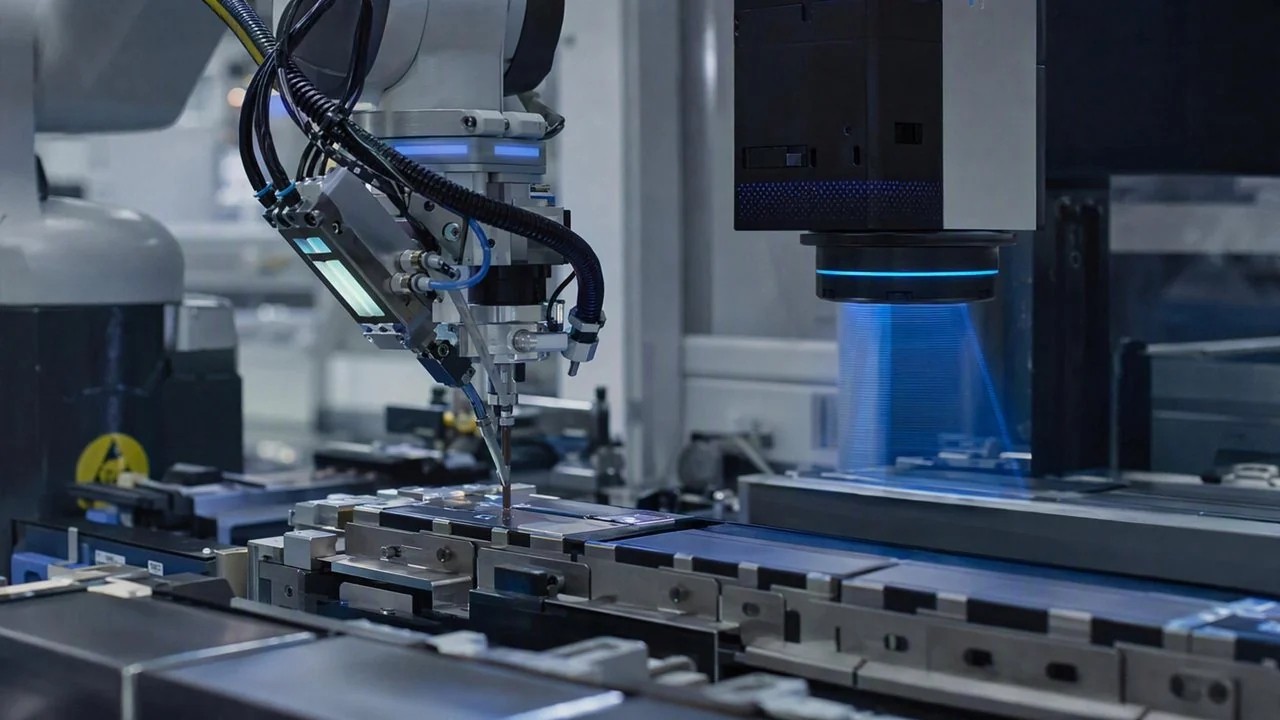
DaoAI 3D AI AOI equipment (featuring proprietary 3D cameras + 3D morphology reconstruction/point clouds, detecting hidden solder joints/coplanarity/micron-level morphology/voids and other 2D optical blind spot defects, with 2D-3D fusion) leverages its zero-code rapid retooling capability to reduce changeover downtime for new energy battery electrode tab welding production lines from an average of 45 minutes to less than 15 minutes, significantly enhancing flexibility and efficiency for high-mix, low-volume production.
In new energy battery manufacturing, electrode tab welding is a critical process, directly impacting the battery's electrical performance and safety stability. As market demands for battery energy density, range, and safety continuously increase, coupled with the growing need for diversified battery pack models in the electric vehicle market, battery production lines face increasingly complex challenges associated with high-mix, low-volume production. Traditional inspection solutions often require significant time and human effort for parameter adjustment and model training during frequent changeovers, severely limiting the production line's flexible manufacturing capabilities. Particularly in ultrasonic welding, a high-precision assembly process, micron-level defects such as burrs, cold welds, and abnormal solder joint morphology are not only difficult to effectively identify with traditional 2D vision but also impose stringent requirements on the efficiency of the inspection system's changeover.
Pain Points: Why This Hurdle Is Hard to Clear
Quality inspection of new energy battery electrode tab welding faces multiple challenges. Firstly, there is **long changeover downtime**. Production line data from a mid-sized battery module manufacturer shows that for different types of battery tabs, each line changeover requires experienced engineers to manually adjust parameters, re-collect data, and train models, taking an average of up to 45 minutes. This significantly reduces Overall Equipment Effectiveness (OEE), especially in high-mix, low-volume production where such downtime losses are particularly pronounced. Secondly, **high false alarm and escape rates persist**. Traditional 2D AOI has an escape rate of up to 5% for subtle burrs, internal cold welds, and abnormal solder joint coplanarity—all 3D morphological defects resulting from ultrasonic welding. Furthermore, the false alarm rate for non-defective solder joint surface textures can reach 8%, necessitating extensive manual re-inspection, which increases manual re-judgment working hours by 20%. Finally, there is a **contradiction between inspection accuracy and efficiency**. Ultrasonic welding itself features concentrated energy and complex solder joint morphology. Micron-level morphological changes in the electrode tab welding area, such as slight depressions, protrusions, or uneven edges, pose potential risks to battery performance. Traditional vision inspection solutions, while pursuing high accuracy, often sacrifice throughput, making it difficult to meet high-speed production demands, and their ability to identify micron-level defects is limited.
The root cause of these pain points lies in the inherent complexity of the process and the limitations of traditional inspection technologies. Ultrasonic welding achieves molecular-level metal bonding through high-frequency vibration, resulting in irregular 3D solder joint morphologies. Different material combinations (e.g., aluminum tabs with copper foil) respond differently to ultrasonic energy, easily leading to subtle morphological defects. Traditional 2D optical inspection can only acquire planar grayscale information, failing to capture critical 3D features such as solder joint height variations, internal voids, and weld depth, thus creating “optical blind spots.” Moreover, traditional rule-based or deep learning AOI systems require extensive image acquisition and annotation for new products during changeovers, leading to long model training cycles that are incompatible with the flexible demands of high-mix, low-volume production.
Technical Principles
DaoAI 3D AI AOI equipment fundamentally solves the challenges of electrode tab welding defect detection through its proprietary high-precision 3D cameras and advanced 3D morphology reconstruction algorithms. This equipment utilizes multi-view structured light or laser triangulation technology to rapidly acquire complete 3D point cloud data of the inspected object, enabling micron-level morphology reconstruction of the electrode tab solder joint surface. Unlike traditional 2D vision which only analyzes grayscale images, DaoAI 3D AI AOI can directly quantify 3D dimensions, height, volume, coplanarity, and other parameters of the solder joint, accurately identifying subtle burrs, depressions or protrusions caused by cold welds, and irregular weld seams that are imperceptible to the naked eye. For instance, for solder joint voids or cold welds, the system can detect minute morphological anomalies within or on the surface of the solder joint, reducing the escape rate to <0.4% compared to traditional solutions.
Crucially, DaoAI 3D AI AOI is equipped with the DaoAI AI AOI software system, whose core lies in the feature recognition capabilities of its visual foundation models and APDT (Adaptive Pre-trained Detector) few-shot self-learning technology. This means that when encountering new electrode tab models, users only need to provide a small number (1–20) of good samples, and the system can complete zero-code automatic programming and rapid model adaptation within 5 minutes. This “one good sample in 5 minutes” ultra-fast changeover capability completely revolutionizes the traditional AOI model that requires hours or even days for model training. Simultaneously, by integrating 2D-3D fusion inspection technology, the system not only identifies 3D morphological defects but also accounts for color and texture anomalies in 2D images, greatly enhancing the comprehensiveness and robustness of inspection, effectively reducing both false alarm and escape rates. This DaoAI system supports 100% on-premise private deployment, ensuring customer data security and independent operation of the production line.
Typical Application Scenarios
- **Electrode Tab Burr Detection:** For tiny burrs generated at the edge of the electrode tab or around the solder joint after ultrasonic welding, DaoAI 3D AI AOI uses 3D morphology reconstruction to accurately identify and quantify the burr's height, length, and distribution, preventing short circuits caused by burrs puncturing the separator. Traditional 2D vision often misjudges or misses due to interference from lighting and shadows.
- **Solder Joint Cold Weld and Void Detection:** By analyzing 3D morphological data from within or on the surface of the solder joint, it precisely identifies solder joint collapse, voids, or poor bonding caused by cold welds. DaoAI 3D AI AOI can detect internal structural defects inaccessible to traditional 2D, effectively improving the reliability of solder joint quality.
- **Solder Joint Coplanarity and Morphology Consistency Detection:** For multi-point or continuous welded electrode tabs, DaoAI 3D AI AOI can measure the relative height differences of all solder joints, ensuring coplanarity meets design requirements and evaluating overall solder joint morphology consistency to prevent stress concentration or poor contact caused by abnormal morphology.
- **Weld Seam Width and Depth Detection:** For weld seams formed by ultrasonic welding, the system can accurately measure the width, depth, and flatness of the weld seam edges, ensuring welding strength and sealing meet standards, avoiding performance degradation due to non-standard weld seam dimensions.
- **Electrode Tab Deformation and Warpage Detection:** During welding, high temperatures and stress can cause slight deformation or warpage of the electrode tab. DaoAI 3D AI AOI, through full-field 3D scanning, can precisely capture the overall morphological changes of the electrode tab, timely detecting and warning of potential structural defects.
Implementation Case Study
A mid-sized new energy battery module manufacturer located in East China, whose production lines cover various models of power batteries and energy storage batteries, frequently faced product changeovers in the electrode tab welding process. Previously, this manufacturer used a combination of traditional 2D AOI and manual visual inspection for quality control. Production line data showed that each changeover required at least 45 minutes for adjusting camera parameters and training inspection models, leading to low production efficiency. Furthermore, due to the insufficient ability of 2D vision to identify subtle burrs and cold welds in electrode tab welding, the product escape rate hovered around 3%, and the false alarm rate was as high as 7%. This necessitated two quality inspectors spending up to 6 hours daily on manual re-inspection, not only increasing operational costs but also slowing down the overall production rhythm. To address these pain points, the manufacturer introduced DaoAI 3D AI AOI equipment for fully automated inspection at the electrode tab welding quality gate.
"The zero-code retooling capability of DaoAI 3D AI AOI has completely transformed our production model. Now, changeovers are as simple as switching preset parameters, greatly enhancing the flexibility and efficiency of our production line."
After deployment, DaoAI 3D AI AOI demonstrated exceptional performance. In this case, the changeover downtime for the electrode tab welding production line was drastically reduced from an average of 45 minutes to less than 15 minutes, cutting changeover time by over 70%. Concurrently, DaoAI 3D AI AOI, with its high-precision 3D inspection capabilities, successfully reduced the escape rate for electrode tab welding defects to <0.5%, and the false alarm rate decreased to <1.5%. This meant a significant reduction in the need for manual re-inspection; the manual re-judgment working hours on this production line were reduced by over 85%, substantially saving labor costs and accelerating product shipment speed. While ensuring high inspection accuracy, the DaoAI system also perfectly adapted to the production line's takt time requirement of 100ms/piece, achieving a balance of high efficiency and high quality.
DaoAI Solutions and Products
The core solution provided by DaoAI for new energy battery electrode tab welding defect detection is the 3D AI AOI equipment. This equipment integrates DaoAI's self-developed high-speed, high-precision 3D cameras, capable of completing 3D data acquisition of the solder joint area in milliseconds. Combined with the DaoAI AI AOI software system, its built-in visual foundation model can recognize general features of the solder joint area. Users only need to select regions via drag-and-drop on the touch interface and use one-click learning with good samples (1-20 images) to quickly build the inspection model, achieving zero-code automatic programming. This “one good sample in 5 minutes” rapid changeover capability is a core advantage of DaoAI 3D AI AOI, especially suitable for high-mix, low-volume production scenarios. The system supports 2D-3D fusion inspection, ensuring comprehensive coverage of both planar and volumetric defects. Deployment methods are flexible, offering SDK/API/Docker interfaces, and supporting 100% on-premise private deployment to ensure data security and independent line operation. Furthermore, DaoAI World model serves as a unified foundation, continuously learning from production line feedback to enhance the model's generalization capabilities and adaptability, ensuring long-term stable and efficient system operation.
DaoAI 3D AI AOI equipment, through the combination of standardized hardware and intelligent software, significantly simplifies the deployment and maintenance of traditional AOI systems. In the new energy battery electrode tab welding scenario, DaoAI 3D AI AOI can not only effectively detect various defects such as burrs, cold welds, and coplanarity anomalies but also, through its unique zero-code changeover mechanism, reduce production line changeover downtime from an average of 45 minutes with traditional solutions to less than 15 minutes, achieving a significant increase in capacity. The successful application of this DaoAI system at a mid-sized battery module manufacturer demonstrates its immense business value in improving production efficiency, reducing operational costs, and ensuring product quality. DaoAI remains committed to providing customers with smarter, more efficient, and easier-to-use industrial AI vision solutions, assisting in the transformation and upgrading of intelligent manufacturing.
FAQ
How does DaoAI 3D AI AOI achieve “zero-code rapid retooling”?
DaoAI 3D AI AOI is equipped with the DaoAI AI AOI software system, centered on pre-trained visual foundation models and APDT few-shot self-learning technology. When the production line needs to switch product models, users do not need to write any code. They simply provide 1-20 good samples of the new product on the touch interface, and the system automatically learns the new product's features and quickly generates an inspection model within 5 minutes, significantly reducing changeover time.
What advantages does 3D AI AOI equipment offer over traditional 2D AOI for electrode tab welding inspection?
DaoAI 3D AI AOI utilizes proprietary 3D cameras and 3D morphology reconstruction technology to acquire real height variations, volume, and other 3D information of solder joints. This enables it to detect defects that 2D cannot identify, such as internal cold welds, micron-level burr heights, and coplanarity anomalies—defects in optical blind spots. This significantly improves detection rates and reduces false alarm rates. Additionally, 2D-3D fusion inspection ensures comprehensiveness.
How can I estimate the budget for deploying DaoAI 3D AI AOI equipment?
The budget for DaoAI 3D AI AOI equipment is influenced by various factors, including production line speed, required inspection accuracy, integration complexity, and the need for customized functions. We offer flexible configuration options to meet different customer needs. For a detailed quote and return on investment analysis, we recommend scheduling a one-on-one consultation with our experts, who will provide a precise assessment based on your specific production line conditions.
Full solution for this scenario: the full inspection solution for 3D AI AOI Equipment · Tab Welding Quality Gate
This article was generated by AI. Customer cases are simulated scenarios based on real product capabilities and figures are illustrative; see product pages for official benchmarks.