
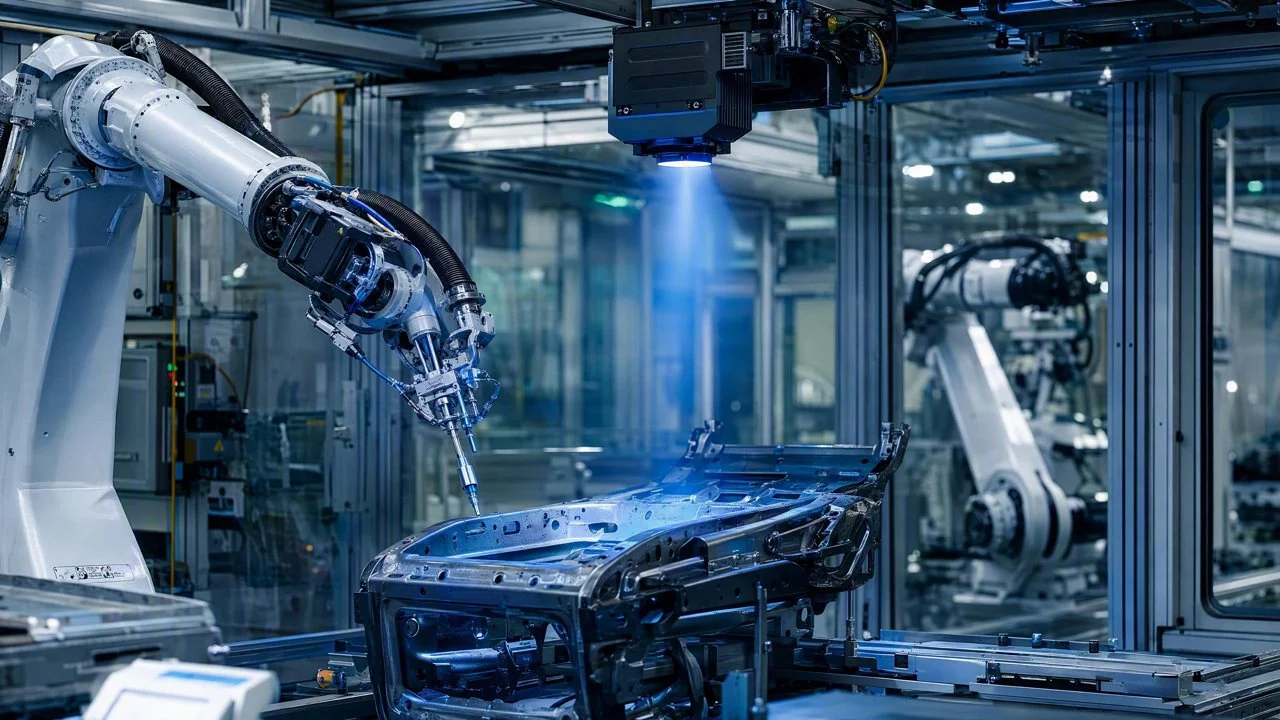
DaoAI 3D AI AOI equipment (proprietary 3D camera + 3D morphology reconstruction/point cloud, detecting hidden solder joints/coplanarity/micron-level morphology/voids and other 2D optical blind spot defects, 2D-3D fusion) leverages high-precision 3D morphological data and advanced AI algorithms to reduce false positive rates in automotive component sealant inspection from an average of 8% to below 2%, significantly decreasing manual re-inspection workloads compared to traditional solutions.
In automotive component manufacturing, the application of adhesives and sealants is a critical process for ensuring product functionality, durability, and safety. Particularly in scenarios demanding high sealing performance, such as anti-corrosion coatings for seat frames or sealing strips before foam filling, the quality of adhesive application directly impacts long-term product reliability. However, traditional 2D vision inspection solutions often struggle with complex adhesive geometries, reflective materials, and lighting interference, leading to frequent missed detections and false positives. In the automotive industry, as large AI models increasingly drive optimization in production quality inspection, there is a growing demand for intelligent, precise, and low false-positive inspection systems. DaoAI 3D AI AOI equipment is specifically designed to address these challenges. By integrating 2D and 3D vision technologies, it brings revolutionary improvements to automotive component sealant inspection, particularly excelling in reducing false positive rates and alleviating the burden of manual re-inspection.
Pain Points: Why This Challenge Is So Difficult
In automotive component sealant inspection, traditional solutions face multiple challenges. Firstly, high false positive rates. Production line data shows that traditional 2D AOI systems typically have false positive rates between 5% and 10% in sealant inspection. This means that for every 1000 workpieces inspected, 50 to 100 are incorrectly identified as defective, requiring significant human resources for secondary re-inspection. Secondly, substantial manual re-inspection hours. Internal data from a leading automotive component supplier indicates that manual hours spent on re-inspecting sealant defects amount to over 200 hours daily, severely slowing down production line takt time. Furthermore, traditional solutions often have high rates of missed detections for subtle defects and complex geometries, especially at the start and end points of adhesive beads, corners, and internal air bubbles within the adhesive, which are 2D optical blind spots difficult to identify effectively. Over time, these can lead to product quality issues and compliance risks.
The root cause of these difficulties lies in the complex and variable physical properties of the adhesive itself. During curing, the adhesive may shrink or flow, leading to uneven edges or inconsistent heights. Its surface materials can be both reflective and matte, posing high demands on lighting and image acquisition. Moreover, minor deviations in adhesive path, uneven bead width, breaks, overflows, and voids often appear as blurry edges or light/shadow variations in 2D images, making them easily confused with normal features. Particularly in automotive seat manufacturing, adhesive application often occurs on complex curved surfaces or in confined spaces, where traditional 2D vision struggles to obtain accurate 3D information, making defect feature extraction extremely challenging. In this context, relying solely on 2D images for judgment leads to high false positive rates and persistent risks of missed detections, becoming a bottleneck for smart manufacturing upgrades.
Technical Principles
The core advantage of DaoAI 3D AI AOI equipment lies in its proprietary 3D camera combined with 3D morphology reconstruction technology. This equipment precisely constructs high-density point cloud data of the inspected workpiece surface by projecting multi-angle structured light and acquiring images with high-speed cameras, achieving micron-level 3D morphology restoration. Compared to traditional 2D vision, which relies on grayscale or color information, the DaoAI 3D AI AOI system can directly obtain geometric features of the adhesive such as height, width, volume, and cross-sectional profile. This enables more precise judgment of defects like overflow, breaks, insufficient adhesive, voids, and uneven bead width. For instance, a minor deviation in adhesive height might appear as only a brightness change in a 2D image, but in a 3D point cloud, it manifests as a clear height variation, preventing false positives.
Unlike traditional rule-based AOI that relies on manual threshold setting and feature extraction, DaoAI 3D AI AOI is equipped with the DaoAI AI AOI software system. This system is based on a visual foundation model and features APDT positive/few-shot learning capabilities, requiring only 1–20 good samples for model training, significantly reducing changeover time. By analyzing 3D morphological data with deep learning algorithms, the system can learn and identify the normal range of adhesive shape variations and automatically filter out pseudo-defects caused by lighting, reflections, or background noise, thereby suppressing false positive rates to extremely low levels. Furthermore, the DaoAI system supports 2D-3D fusion inspection, combining 2D image information for supplementary judgment in areas where 3D data might not fully cover, ensuring comprehensive and accurate inspection. Production line test data shows that the DaoAI 3D AI AOI system has reduced false positive rates by over 75% in complex sealant application scenarios, significantly outperforming traditional methods.
Typical Application Scenarios
- **Automotive Seat Frame Adhesive Inspection:** Inspecting sealant beads at welded joints or connections of seat frames to ensure continuity, width, and height compliance, preventing corrosion. The challenge lies in the adhesive possibly adhering to complex welded structures, where traditional 2D is susceptible to occlusion and reflection.
- **Engine/Gearbox Gasket Sealant Inspection:** Performing 100% online inspection of sealant applied to critical components like engine cylinder heads and oil pans, identifying breaks, overflows, air bubbles, and uneven bead width. This demands extremely high inspection precision to prevent fluid leakage, where the micron-level morphology detection capability of DaoAI 3D AI AOI plays a crucial role.
- **Car Body Weld Seam Sealant Inspection:** Checking the quality of sealant applied to car body weld seams, including bead uniformity, continuity, width, height, and the presence of voids or shrinkage, ensuring the car body's dustproof and waterproof performance. The difficulty lies in the complex car body structure, long inspection paths, and the possibility of similar colors between sealant and car body.
- **Interior Trim Assembly Adhesive Inspection:** Inspecting adhesive application for automotive interior parts (e.g., dashboards, door panels) to ensure bonding strength and aesthetic quality. DaoAI 3D AI AOI can identify subtle overflows or insufficient adhesive, preventing impact on subsequent assembly and user experience.
- **Battery Pack Sealant Inspection:** The sealing performance of new energy vehicle battery packs is vital. DaoAI 3D AI AOI can perform high-precision inspection of sealant between battery pack housing and cover, preventing liquid ingress that could lead to short circuits or thermal runaway, ensuring battery safety.
Implementation Case Study
A leading automotive component supplier, whose main business is providing seat assemblies to several well-known automotive brands, had long faced high false positive rates and immense re-inspection pressure in the anti-corrosion adhesive application process for seat frames. Their original inspection solution, a traditional 2D machine vision system, maintained an average false positive rate of about 8.5% after deployment. This necessitated significant additional labor for manual re-inspection daily, severely impacting production efficiency. Manual re-inspection was not only time-consuming and labor-intensive but also prone to missed detections due to subjective judgment. Production line data indicated that monthly re-inspection labor costs due to false positives amounted to hundreds of thousands of RMB.
To address this pain point, the client introduced DaoAI 3D AI AOI equipment for online adhesive inspection. In the initial phase of the project, the DaoAI engineering team collaborated closely with the client, leveraging the APDT few-shot learning capability to rapidly train and deploy the model using only 15 good samples. Upon system go-live, the results were immediate and impactful. Production line data showed that the DaoAI 3D AI AOI system successfully reduced the false positive rate for adhesive defects to 1.8%, with detection rates consistently above 99.6%. This meant that the number of workpieces requiring manual re-inspection daily plummeted by over 75%, significantly easing the burden on operators. Furthermore, the system also achieved effective detection of 2D optical blind spot defects such as microscopic voids and uneven adhesive height, improving overall product quality. In this case, the successful application of DaoAI 3D AI AOI equipment not only substantially reduced operating costs but also enhanced the client's competitiveness in the automotive supply chain.
With DaoAI 3D AI AOI equipment, we reduced the false positive rate for adhesive inspection from 8.5% to 1.8%, cutting manual re-inspection volume by over 75%. This significantly boosted production line efficiency and product quality, marking a successful implementation of smart manufacturing in real production.
DaoAI Solutions and Products
The DaoAI 3D AI AOI solution centers around its proprietary 3D camera and the DaoAI AI AOI software system. This solution supports 100% on-premise private deployment, ensuring client data security within the facility. During implementation, the DaoAI engineering team customizes the inspection station and lighting solutions based on the client's specific adhesive process, takt time, and product characteristics. The modeling process is highly automated; leveraging the DaoAI AI AOI software system's 0-code automatic programming and APDT few-shot learning, basic model construction typically takes only 5 minutes after collecting a small number of good samples. For production line changeovers, the system supports rapid switching of inspection parameters, reducing downtime to mere minutes and greatly enhancing production line flexibility.
Beyond the core 3D AI AOI equipment, DaoAI can also provide the DaoAI Robot Vision system, enabling real-time correction and guidance for adhesive application paths, forming a closed-loop 'brain-eye-body' intelligent manufacturing process. Through the DaoAI World foundation model, a unified platform, the system possesses semantic understanding and cross-scenario generalization capabilities, allowing it to continuously learn and optimize from production line feedback, constantly improving detection accuracy and robustness. DaoAI is committed to bringing more efficient and intelligent quality inspection solutions to the automotive component industry through technological innovation, assisting clients in achieving lean production and high-quality development. The deployment of this solution supports various forms such as SDK / API / Docker, making it easy to integrate with existing MES/SCADA systems.
Through the deployment of DaoAI 3D AI AOI equipment, this automotive component supplier achieved significant business value in the adhesive inspection segment. Specific quantified results include: false positive rates reduced from 8.5% to below 1.8%, detection rates stable above 99.6%, and manual re-inspection volume decreased by over 75%, thereby saving substantial labor costs annually. Furthermore, changeover time was shortened from several hours to under 5 minutes, significantly enhancing production line flexibility. These improvements not only optimized production efficiency but also elevated the quality of final products and customer satisfaction, effectively mitigating potential quality risks and recall costs that might arise from adhesive defects.
FAQ
What are the fundamental differences between DaoAI 3D AI AOI equipment and traditional 2D AOI?
DaoAI 3D AI AOI equipment features a proprietary 3D camera that acquires three-dimensional morphological data of the workpiece surface using structured light technology, allowing precise measurement of height, volume, and contour. Traditional 2D AOI, however, can only capture planar grayscale or color images. This enables the 3D system to effectively identify 2D optical blind spot defects, such as internal voids in adhesives, micron-level height differences, or defects under reflective materials, significantly enhancing the comprehensiveness and accuracy of inspection, especially for complex geometries and transparent/reflective materials.
What is the approximate budget and timeline for deploying the DaoAI 3D AI AOI system?
Deployment budget and timeline vary depending on specific application scenarios, required inspection precision, integration complexity, and production line scale. DaoAI offers various deployment options, from SDK/API to complete equipment, supporting local private deployment. Initial evaluations typically take a few weeks, while system implementation generally requires 1-3 months. Specific pricing is customized based on client requirements. We recommend contacting our sales team for a detailed consultation, and we will provide a professional solution and quote.
How does DaoAI 3D AI AOI ensure low false positive rates and reduce the burden of manual re-inspection?
DaoAI 3D AI AOI ensures low false positive rates through two core mechanisms: Firstly, its high-precision 3D camera captures true geometric information, avoiding pseudo-defects caused by shadows and reflections in 2D images. Secondly, the DaoAI AI AOI software system utilizes APDT few-shot learning algorithms based on visual foundation models and semantic false positive filtering technology. It learns the normal range of adhesive morphology variations and intelligently identifies and suppresses false positives, significantly reducing the number of workpieces requiring manual re-inspection due to system misjudgment, thereby greatly alleviating the manual re-inspection burden.
This article was generated by AI. Customer cases are simulated scenarios based on real product capabilities and figures are illustrative; see product pages for official benchmarks.