
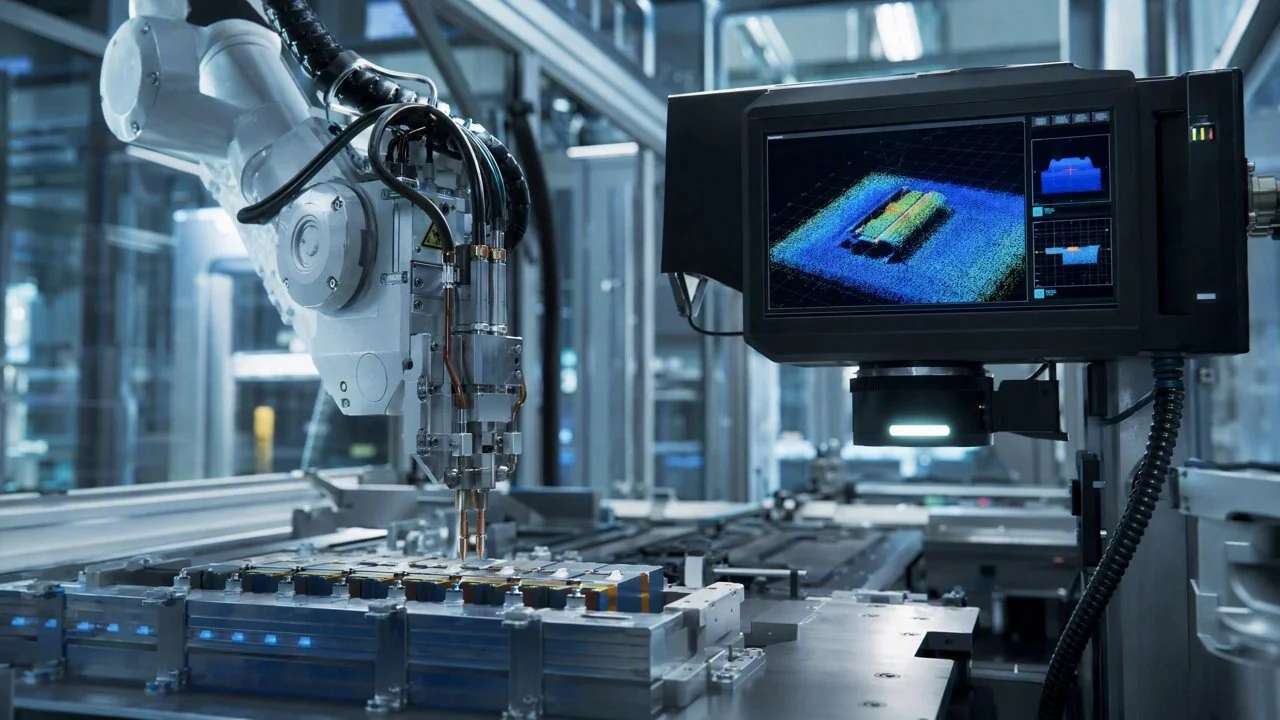
In new energy battery manufacturing, tab welding is a critical process, with its quality directly impacting battery performance and safety. Traditional inspection methods often struggle with complex defects such as tiny burrs and internal cold welds in tab welding, leading to difficulties in quality traceability and hindering fine-grained production management. WeLinkirt's DaoAI 3D AI AOI equipment (featuring proprietary 3D cameras + 3D morphology reconstruction/point clouds, detecting hidden solder joints/coplanarity/micron-level morphology/voids and other 2D optical blind spot defects, with 2D-3D fusion) utilizes deep learning and high-precision 3D inspection to reduce the defect escape rate in new energy battery tab welding from the traditional solution's 1.2% to <0.4%, significantly enhancing product consistency and quality traceability.
In new energy battery manufacturing, tab welding is a critical process that determines the battery's electrochemical performance, safety, and cycle life. Any minute welding defect, such as burrs, cold welds, solder joint depressions, or foreign objects, can lead to internal short circuits, overheating, or even thermal runaway, posing serious threats to product safety. However, traditional 2D optical inspection often falls short when dealing with such complex defects involving 3D morphology, which are susceptible to lighting and material influences, creating inherent blind spots. WeLinkirt's DaoAI 3D AI AOI equipment (featuring proprietary 3D cameras + 3D morphology reconstruction/point clouds, detecting hidden solder joints/coplanarity/micron-level morphology/voids and other 2D optical blind spot defects, with 2D-3D fusion) utilizes deep learning and high-precision 3D inspection to reduce the defect escape rate in new energy battery tab welding from the traditional solution's 1.2% to <0.4%, significantly enhancing product consistency and quality traceability. Especially in the current trend of industrial manufacturing pursuing zero-defect production, precise control over welding quality and comprehensive lifecycle data closure management have become key for new energy battery manufacturers to enhance their core competitiveness.
Pain Points: Why This Hurdle Is Difficult to Overcome
In the new energy battery tab welding process, traditional inspection solutions face multiple challenges: Firstly, **high escape rates**. Data from a mid-sized battery module factory showed that using traditional 2D AOI combined with manual re-inspection still resulted in an escape rate of up to 1.2% for tab cold welds and tiny burrs, leading to potential batch quality issues. Secondly, **persistently high false alarm rates**. Due to factors like reflective tab surfaces and irregular solder joint morphology, traditional rule-based AOI often yielded false alarm rates above 8%, leading to a surge in manual re-inspection hours, averaging 4-6 hours per production line daily, severely dragging down production efficiency. Furthermore, **lack of effective quality traceability mechanisms**. Traditional solutions cannot deeply associate inspection results with production parameters and batch information, making it difficult to quickly locate problematic batches and root causes in case of customer complaints, resulting in recall risks and damage to brand reputation. Finally, **insufficient inspection accuracy**. For micron-level changes in solder joint morphology, voids, and internal cold welds, traditional 2D vision cannot provide sufficient 3D depth information, creating inspection blind spots. These challenges collectively hinder new energy battery manufacturers from achieving fine-grained quality management and zero-defect goals in their production processes.
The root causes of these dilemmas are: process-wise, tab welding is affected by various factors such as temperature, pressure, and material batches, leading to diverse and concealed defect types; imaging-wise, tab materials (e.g., aluminum, copper) have high reflectivity, making it difficult for traditional 2D cameras to effectively suppress specular reflections and shadows, resulting in low image contrast and challenging feature extraction. Moreover, battery production lines operate at fast cycles, leaving short time windows for inspection, making manual visual inspection prone to fatigue and inefficiency. In the wave of business model innovation where "AI vision inspection achieves zero-defect production," the limitations of traditional methods are becoming increasingly prominent, urgently requiring smarter and more precise inspection technologies to break the deadlock.
Technical Principles
WeLinkirt's DaoAI 3D AI AOI equipment fundamentally solves the challenges of tab welding inspection through its core technologies: proprietary high-precision 3D cameras and 3D morphology reconstruction algorithms. The equipment employs multi-frequency structured light projection technology, combined with high-resolution industrial cameras, to capture multiple images of the tab solder joint surface. Advanced phase unwrapping algorithms then precisely reconstruct micron-level 3D morphology point cloud data of the solder joint. This method allows for obtaining true height, volume, and flatness information of the solder joint, completely overcoming the limitations of 2D images being affected by lighting, reflections, and color.
Compared to traditional rule-based AOI and manual visual inspection, the advantages of WeLinkirt's DaoAI 3D AI AOI are: Firstly, it can detect defects in 2D optical blind spots, such as tiny voids inside solder joints, solder joint collapse due to cold welds, and micron-level burrs at the edge of weld seams. These defects are often obscured or difficult to distinguish in 2D images. Secondly, the WeLinkirt DaoAI AI AOI software system incorporates advanced deep learning algorithms. By training on a large number of good and defective samples, it can automatically learn and identify various complex defect features, achieving high-precision, low-false-alarm intelligent judgments. For example, in a practical application with a leading battery manufacturer, WeLinkirt's DaoAI 3D AI AOI increased the defect detection rate for tab welding to 99.6% while reducing the false alarm rate by over 85%. Furthermore, the system supports 2D-3D fusion inspection, combining high-resolution 2D image texture and color information with 3D morphological data to achieve more comprehensive defect identification and classification, ensuring the robustness and accuracy of inspection.
Typical Application Scenarios
- **Tab Welding Burr Detection:** Addresses tiny metal splashes or burrs that may occur during laser welding, which could lead to internal short circuits in the battery. WeLinkirt's DaoAI 3D AI AOI equipment precisely measures the height, volume, and distribution of burrs using 3D point cloud data, detecting burrs smaller than 20 microns, effectively avoiding missed detections caused by shadows or background interference in traditional 2D images.
- **Cold Weld/False Weld Detection:** Cold welds or false welds at the connection point between the tab and the busbar are primary causes of abnormal internal resistance and performance degradation in batteries. WeLinkirt's DaoAI 3D AI AOI identifies defects such as solder joint collapse, insufficient penetration, or weld seam fractures by analyzing the height, flatness, and continuity of the weld. Traditional methods struggle to assess internal bonding conditions based solely on surface features.
- **Solder Joint Coplanarity and Flatness Inspection:** For multi-point welded tabs, the coplanarity and overall flatness between solder joints are crucial for uniform current distribution. WeLinkirt's DaoAI 3D AI AOI can perform 3D morphological measurements of the entire welding area, calculating the relative height differences between solder joints, ensuring coplanarity within ±10 microns, and preventing stress concentration and early failure due to unevenness.
- **Weld Seam Void and Crack Detection:** Voids and tiny cracks generated during welding are potential failure points. WeLinkirt's DaoAI 3D AI AOI utilizes 3D point cloud reconstruction technology to discover minute pits and cracks on the weld seam surface, and even combines image enhancement algorithms to identify deeper defects that are often indistinguishable in 2D images due to insufficient contrast.
- **Solder Joint Foreign Object and Contamination Detection:** The welding area may contain dust, oil, or other foreign objects that affect welding quality. WeLinkirt's DaoAI 3D AI AOI, through high-resolution 3D imaging, can identify tiny particles and abnormal attachments on the solder joint surface, ensuring the cleanliness of the welding area.
Case Study
A leading domestic new energy battery manufacturer faced persistent challenges with high escape rates and manual re-inspection pressure in its tab welding process. Traditional 2D AOI equipment struggled to effectively identify micron-level burrs and cold weld defects, leading to an average monthly rework rate of up to 0.8%, coupled with a lack of effective quality traceability data. This resulted in long investigation cycles and high costs in case of market complaints. To address this pain point, the manufacturer introduced WeLinkirt's DaoAI 3D AI AOI equipment. After a month of on-site deployment and model training, production line data showed that after the implementation of WeLinkirt's DaoAI 3D AI AOI, the escape rate for tab welding defects significantly decreased from 1.2% to <0.4%, and the false alarm rate drastically dropped from over 8% to <1.5%. More importantly, the system achieved real-time correlation of inspection data with product batches and production parameters, establishing a complete quality traceability chain. When an early performance degradation was observed in a certain batch of batteries, the manufacturer was able to quickly pinpoint abnormal welding parameters during a specific period through the detailed inspection data provided by WeLinkirt's DaoAI 3D AI AOI, and consequently optimized the process, reducing the rework rate by 25%.
WeLinkirt's DaoAI 3D AI AOI has enabled us to achieve 'transparent' management of tab welding quality. Defects are nowhere to hide, and quality traceability is well-founded. This is a crucial step in our journey towards zero-defect production.
WeLinkirt Solutions and Products
WeLinkirt's core solution for new energy battery tab welding scenarios centers around its proprietary 3D AI AOI equipment, combined with the DaoAI AI AOI software system, to build an intelligent quality inspection platform that integrates high-precision detection, intelligent recognition, and data closure. The equipment uses a unique proprietary 3D camera to collect 3D morphological data and leverages the semantic understanding and cross-scenario generalization capabilities of WeLinkirt's DaoAI World model to accurately identify various defects such as tab solder burrs, cold welds, voids, and coplanarity issues. For model building, the WeLinkirt DaoAI AI AOI software system supports APDT positive sample/few-shot learning, requiring only 1–20 good product images to complete 0-code automatic programming within 5 minutes, significantly reducing changeover downtime. For deployment, the system supports 100% on-premise private deployment, ensuring that customer production data never leaves the factory, meeting strict data security and compliance requirements. Furthermore, WeLinkirt can also provide DaoAI robot vision solutions, linking inspection results with robots to achieve automatic sorting of defective products or guiding subsequent repairs, further enhancing automation.
Through the WeLinkirt DaoAI 3D AI AOI solution, customers not only gain micron-level defect detection capabilities but, more importantly, establish a data closed-loop management system from detection to traceability and feedback optimization. Production line data shows that this solution stabilizes the escape rate of tab welding defects at <0.4% and reduces the false alarm rate by over 85%, significantly cutting down manual re-inspection hours and improving overall production efficiency. Concurrently, comprehensive quality data provides a scientific basis for process optimization, helping customers move towards their zero-defect production goals. In this case, the customer's rework rate decreased by 25% due to timely detection and correction of process issues.
FAQ
What are the fundamental differences between WeLinkirt's DaoAI 3D AI AOI equipment and traditional 2D AOI for new energy battery tab welding inspection?
The core of WeLinkirt's DaoAI 3D AI AOI equipment lies in its proprietary 3D camera and 3D morphology reconstruction technology. Unlike traditional 2D AOI, which only captures planar images, our equipment can precisely reconstruct 3D point cloud data of solder joints, thereby detecting defects in 2D optical blind spots such as burrs, cold welds, and voids. This provides more comprehensive morphological information, significantly improving the detection rate and accuracy of micron-level defects, and effectively reducing false alarms through AI deep learning.
How long does it typically take to deploy WeLinkirt's DaoAI 3D AI AOI equipment, and what are the requirements for modifying existing production lines?
The deployment cycle for WeLinkirt's DaoAI 3D AI AOI equipment is relatively short, usually completing hardware installation and initial debugging within 1-2 weeks. Our DaoAI AI AOI software system supports APDT few-shot learning, where the modeling process only requires 1-20 good product images and 5 minutes for 0-code automatic programming, greatly reducing changeover and model training time. For existing production lines, we offer flexible integration solutions compatible with various loading/unloading methods, minimizing modifications to current line layouts to ensure rapid deployment.
What is the approximate cost and return on investment (ROI) period for WeLinkirt's DaoAI 3D AI AOI equipment?
The cost investment for WeLinkirt's DaoAI 3D AI AOI equipment varies based on specific customer requirements (such as detection accuracy, cycle time, and complexity of production line integration). However, our solution can significantly reduce escape rates, mitigate recall risks and brand damage from defective products entering the market, and substantially cut down manual re-inspection hours and rework rates. Typically, in large new energy battery manufacturing enterprises, by improving yield rates, reducing operational costs, and avoiding quality risks, the ROI period can be achieved within 12-18 months. For specific quotations and ROI assessments, we recommend contacting our sales team for a customized solution.
This article was generated by AI. Customer cases are simulated scenarios based on real product capabilities and figures are illustrative; see product pages for official benchmarks.