
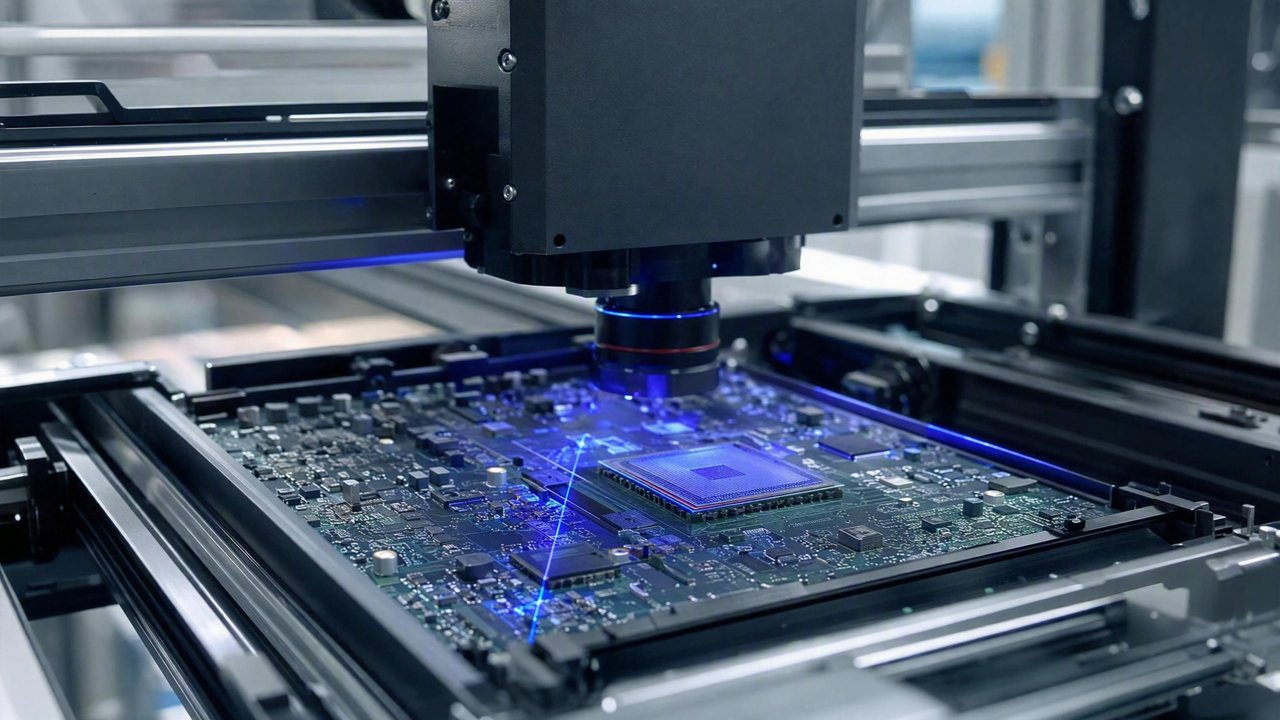
DaoAI 3D AI AOI equipment (featuring self-developed 3D cameras + 3D morphology reconstruction/point clouds, capable of detecting hidden solder joints, coplanarity, micron-level morphology, voids, and other 2D optical blind spot defects, with 2D-3D fusion) precisely identifies internal voids in BGA solder balls, reducing the false negative rate from a typical 5-8% in traditional X-ray solutions to <0.6% in actual production line operation, significantly enhancing quality assurance in electronic PCBA manufacturing.
In electronic PCBA manufacturing, Ball Grid Array (BGA) packages are widely used due to their high integration and density. However, voids within BGA solder joints have always been a significant challenge. These voids can lead to insufficient solder joint strength, reduced electrical and thermal conductivity, and even cracking or short circuits after long-term product operation, severely impacting product reliability. Traditional BGA void detection primarily relies on X-ray radiography, but the limitations of its two-dimensional images create blind spots in judging the three-dimensional shape, depth, and correlation of voids with the overall solder joint structure. Especially in complex, high-density, multi-layer PCBA boards, X-ray images may suffer from overlap and insufficient contrast, making small or specific voids difficult to detect effectively.
Pain Points: Why This Hurdle Is Difficult to Overcome
The difficulties in BGA void detection are primarily manifested in several dimensions: Firstly, a high false negative rate. Traditional X-ray detection solutions typically have a false negative rate between 5% and 8% when dealing with complex BGA solder joints, struggling especially with tiny or irregularly shaped voids, as evidenced by production line data from a mid-sized electronics OEM. Secondly, a high false positive rate. Due to the 2D projection characteristics of X-ray images, structures at the bottom of solder pads or in adjacent areas can be misidentified as voids, leading to a massive workload for manual re-inspection. Production line data showed that 2-3 skilled workers were required daily for false positive re-inspection, consuming significant man-hours. Furthermore, traditional X-ray equipment is expensive, complex to operate, requires highly skilled operators, and often fails to provide precise 3D morphological data of solder joints, making deeper defect analysis and process optimization difficult. Finally, with the miniaturization and increased integration of electronic products, BGA solder ball diameters are shrinking, and pad spacing is decreasing, posing severe challenges to traditional methods for detecting micron-level defects, thus increasing compliance risks.
The root cause lies in the fact that voids within BGA solder joints are three-dimensional structures, varying in size, shape, and position. X-ray images, as 2D projections, cannot provide Z-axis depth information, lacking intuitive perception of the true volume of voids and their distribution within the solder ball. Additionally, process factors such as solder composition and pad surface treatment can affect the contrast and clarity of X-ray images. On PCBA production lines with extremely high throughput requirements, quickly and accurately identifying these hidden defects proves challenging for traditional solutions. The current trend of industrial AI large models is precisely to break through the physical and algorithmic bottlenecks of traditional visual inspection, using more powerful feature learning and 3D understanding capabilities to solve such complex and concealed defect detection problems.
Technical Principles
DaoAI 3D AI AOI equipment, through its self-developed high-precision 3D camera and advanced 3D morphology reconstruction algorithms, can perform non-contact, high-resolution 3D scanning of BGA solder joints, acquiring complete point cloud data. The equipment utilizes multi-view structured light projection technology, combined with sub-pixel level feature matching and fusion, to achieve precise 3D reconstruction of both surface and internal structures of the solder joint. Unlike traditional X-ray, which only provides 2D radiographic images, DaoAI 3D AI AOI directly constructs a 3D morphological model of the solder joint, enabling precise calculation of solder ball volume, coplanarity, and the 3D size, position, and proportion of internal voids. For instance, in a practical application at a mid-sized electronics OEM, DaoAI 3D AI AOI equipment was able to boost the detection rate of BGA voids to 99.4%, significantly outperforming traditional X-ray methods.
At the algorithmic level, DaoAI 3D AI AOI is equipped with an AI vision foundation model based on deep learning, capable of automatically learning and extracting complex features of BGA voids from massive 3D point cloud data. This includes the shape, depth, distance from the solder ball edge, and inter-void relationships. Compared to traditional rule-based AOI that relies on manually set thresholds and feature extraction, the DaoAI 3D AI AOI's AI model possesses powerful generalization capabilities and adaptability, effectively handling variations in BGA void morphology across different batches and process parameters. Concurrently, DaoAI 3D AI AOI's unique 2D-3D fusion technology, combining high-resolution 2D image texture information with precise 3D morphological data, further enhances the accuracy of void defect identification and reduces false positive rates. Production line data shows a reduction in false positive rates by over −75%, significantly easing the burden of manual re-inspection.
Typical Application Scenarios
- BGA Solder Void Detection: Precisely measures the volume, position, and morphology of internal voids within solder balls through 3D morphology reconstruction, determining if they exceed process specifications. The challenge lies in the concealment and diversity of voids; DaoAI 3D AI AOI directly models from point cloud data, bypassing 2D projection blind spots.
- BGA Solder Joint Coplanarity Inspection: Performs micron-level measurement of the overall coplanarity of BGA solder ball arrays to ensure all solder balls are within the same plane, preventing opens or shorts. The difficulty lies in high-precision measurement and rapid scanning of large arrays; DaoAI 3D cameras achieve sub-micron Z-axis accuracy.
- Hidden Solder Joint Defect Detection: Such as opens or insufficient solder on bottom pads of QFN components, which are invisible to traditional 2D AOI. DaoAI 3D AI AOI can detect these by identifying abnormal height or volume in solder joint morphology.
- Micron-level Solder Joint Morphology Inspection: Quantitatively analyzes solder joint wetting, height, diameter, bridging, tombstoning, etc., using precise 3D point cloud data to ensure solder joint strength and reliability. The challenge is sensitivity to minute deformations and quantification capabilities.
- PCBA Surface Foreign Object/Scratch Detection: Leveraging 2D-3D fusion technology, it identifies surface foreign objects while also determining their height and morphology, distinguishing between dust, solder splash, or board scratches, thus avoiding false positives.
Case Study
A mid-sized electronics OEM, providing PCBA manufacturing services for consumer electronics and industrial control sectors, had long struggled with high X-ray false negative rates, heavy manual re-inspection workload, and compromised production efficiency in their BGA packaging process. Especially for a certain high-performance computing board with extremely high BGA solder joint density, the detection rate for tiny voids using traditional X-ray solutions was only around 92%, leading to high product rework rates and customer complaint risks. To improve product quality and reduce costs, the manufacturer introduced DaoAI 3D AI AOI equipment for BGA void detection. Before deployment, the factory's BGA void false negative rate was approximately 6-8%, requiring an additional 2 people daily for X-ray image re-inspection, with a small number of defective products still slipping through. With the assistance of DaoAI engineers, the equipment was deployed and models were trained on the production line, quickly building a detection model for their specific BGA package using only 15 good samples via the APDT few-shot learning function.
After deployment, production line data showed that the DaoAI 3D AI AOI equipment successfully elevated the BGA void detection rate to 99.4% and reduced the false negative rate to <0.6%, a significant improvement over traditional X-ray solutions. Concurrently, due to its high precision and low false positive rate, the manual re-inspection workload was reduced by 75%, allowing the original 2-person re-inspection team to be optimized to 0.5 people, thereby greatly saving labor costs. Furthermore, the rapid changeover capability of DaoAI 3D AI AOI, requiring only 5min for model loading and parameter adjustment when the customer needed to switch between different PCBA models, effectively enhanced production line flexibility and efficiency. In this case, the stable operation of the DaoAI 3D AI AOI equipment also brought the customer significant product quality improvement and increased customer satisfaction.
DaoAI 3D AI AOI not only solved the challenge of missed BGA voids but also drove PCBA quality control towards higher precision and lower costs through data-driven intelligent inspection.
DaoAI Solutions and Products
DaoAI's core solution for BGA void detection in the electronic PCBA industry is its 3D AI AOI equipment. This device integrates DaoAI's self-developed high-precision 3D cameras, capable of acquiring high-density 3D point cloud data of BGA solder joints, and utilizes advanced 3D morphology reconstruction algorithms to precisely restore the true 3D structure of the solder joint. Building upon this, the DaoAI AI AOI software system acts as the brain, embedding a powerful vision foundation model that can quickly train robust BGA void detection models through APDT positive/few-shot learning (requiring only 1-20 good samples). This model can identify micron-level void defects and, combined with 2D-3D fusion technology, effectively filters semantic false positives, ensuring detection accuracy. In practical deployment, DaoAI 3D AI AOI equipment supports 100% on-premise private deployment, ensuring customer data security without leaving the factory, meeting stringent industry compliance requirements. Furthermore, the DaoAI World Model serves as a unified foundation, with semantic understanding and cross-scenario generalization capabilities, enabling the equipment to continuously learn and optimize from production line feedback, constantly improving detection performance.
The implementation process of the DaoAI solution is efficient and convenient. First, an on-site survey determines the installation location and integration plan. Next, engineers assist customers in collecting a small number of good samples for model training, typically completing 0-code automatic programming within 5 minutes. After model deployment, the system performs real-time BGA solder joint inspection, uploading detection results, defect types, locations, and other data to a central database for full-process quality traceability. The highly efficient detection capability of DaoAI 3D AI AOI equipment, in this case, achieved a significant improvement in BGA void detection rate (99.4%) while reducing the false negative rate to <0.6% and false positive rate by −75%, greatly reducing reliance on manual re-inspection. This quantifiable outcome directly translates into increased production efficiency and reduced product defect rates, creating tangible business value for customers and effectively lowering their operating costs.
FAQ
How does DaoAI 3D AI AOI equipment achieve precise detection of BGA solder joint voids?
DaoAI 3D AI AOI equipment utilizes a self-developed high-precision 3D camera to acquire 3D point cloud data of solder joints, and reconstructs their true structure using advanced 3D morphology reconstruction algorithms. Combined with deep learning AI models, it precisely identifies the 3D size, position, and proportion of voids. 2D-3D fusion technology further enhances detection accuracy and anti-interference capabilities, effectively avoiding the blind spots of traditional 2D X-ray.
What are the advantages of DaoAI 3D AI AOI in BGA void detection compared to traditional X-ray or 2D AOI?
Compared to traditional X-ray, which only provides 2D projection images, DaoAI 3D AI AOI offers complete 3D morphological data, allowing for more precise void quantification and a higher detection rate (e.g., 99.4% in this case). Compared to 2D AOI, it can detect hidden defects within 2D optical blind spots such as internal voids and coplanarity issues, significantly reducing false positive rates and manual re-inspection costs, while also offering faster changeover times.
What is the cost of deploying DaoAI 3D AI AOI equipment, and what is the typical ROI period?
The deployment cost of DaoAI 3D AI AOI equipment is influenced by factors such as equipment configuration, integration complexity, and software licenses. While the initial investment may be higher than traditional optical equipment, it typically achieves a return on investment within 6-18 months by significantly improving detection rates, reducing false negatives and false positives, decreasing manual re-inspection hours, and enhancing production line utilization and product yield. Specific quotes require customization based on the customer's production line conditions and detection needs. Please contact our experts for a detailed evaluation and proposal.
This article was generated by AI. Customer cases are simulated scenarios based on real product capabilities and figures are illustrative; see product pages for official benchmarks.