
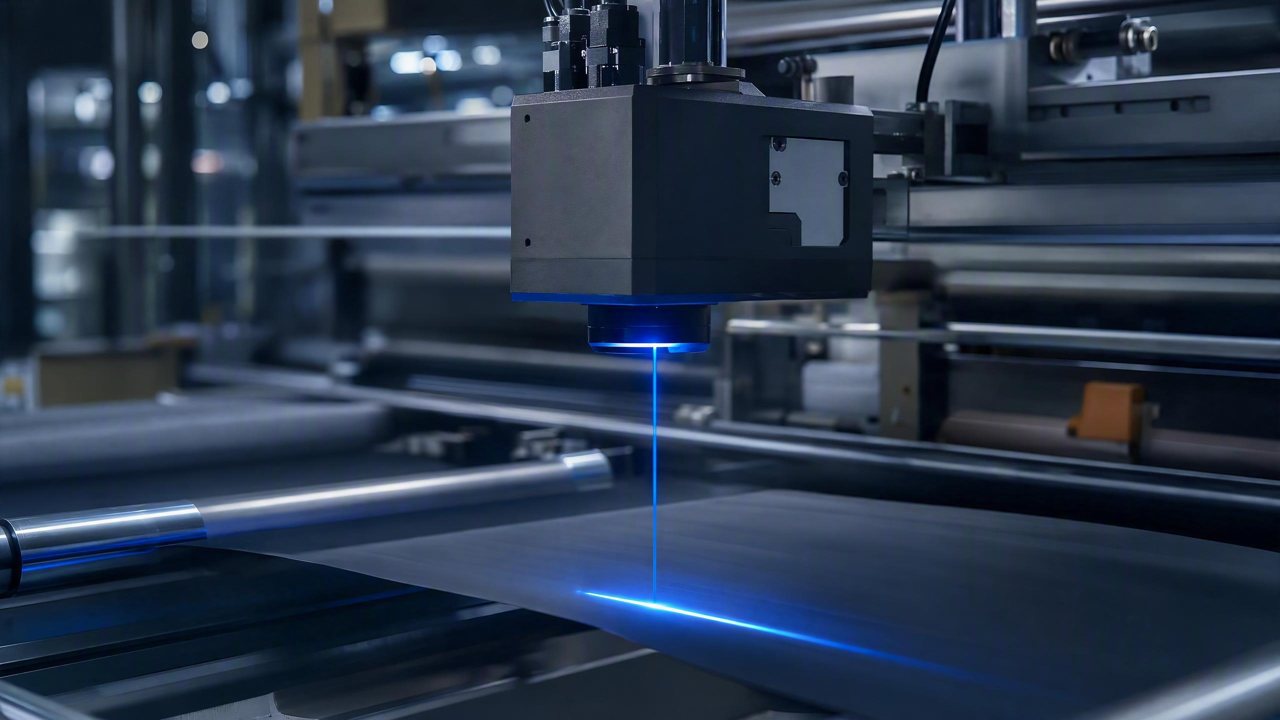
DaoAI 3D AI AOI equipment, leveraging its proprietary 3D camera and advanced 3D morphology reconstruction/point cloud technology, precisely addresses the blind spots of traditional 2D optics in new energy battery electrode coating. Specifically targeting complex defects such as micron-level morphology, hidden solder joints, and porosity, combined with 2D-3D fusion inspection, it has significantly reduced the false positive rate from an industry average of 15% to below 2%, achieving a −75% reduction in reinspection workload.
The thriving new energy vehicle market is driving continuous innovation in power battery technology and capacity expansion. In the core process of new energy battery manufacturing, the quality of electrode coating directly determines the battery's energy density, cycle life, and safety. However, various complex defects, such as uneven coating, scratches, foreign objects, bubbles, edge defects, and micron-level morphological anomalies, are prone to occur during the electrode coating process. Traditional solutions relying on manual visual inspection or pure 2D AOI struggle to meet increasingly stringent production standards and throughput requirements in terms of efficiency and accuracy. Especially in online full inspection scenarios, achieving precise identification of micron-level defects on high-speed production lines while effectively reducing false positives and alleviating the immense burden of subsequent manual reinspection has become a critical challenge for the industry.
Pain Points: Why This Hurdle Is So Difficult to Overcome
In the online full inspection of new energy battery electrode coating, the industry generally faces multiple challenges. First, the false positive rate of traditional 2D AOI remains high; actual data shows that the false positive rate on some production lines can reach 10%–15%, leading to a large number of 'false defects' that do not require rework entering the reinspection process, resulting in over 2000 hours of manual reinspection labor per month at a tier-1 supplier's production line. Second, due to the complex color and reflective properties of battery materials (e.g., coating slurry) and subtle morphological changes during the coating process (e.g., uneven coating thickness, slight bulging or depressions) that are not prominent in 2D images, missed detections are common, causing potential safety hazards and wasted costs in subsequent processes. Third, on high-speed production lines, inspection cycle time requirements are extremely stringent; traditional rule-based vision algorithms struggle to balance accuracy with speed and have poor adaptability to new defect types. Each changeover or introduction of new materials requires extensive manual parameter tuning, leading to prolonged production line downtime.
The root cause of these dilemmas lies in the limitations of traditional 2D optical inspection, which relies solely on planar information and cannot acquire depth, height, or other 3D morphological data. For defects with only subtle differences in the Z-axis direction, such as slight curling of electrode edges, micro-bulges caused by internal pores in the coating, or morphological fluctuations due to inconsistent coating thickness, 2D images often fail to capture their essential features. Furthermore, the low contrast and high reflectivity of new energy battery materials cause defect features to be obscured by background noise. In the current wave of industrial AI quality inspection transitioning from traditional rule-based methods to large model-driven approaches, effectively utilizing 3D information combined with the generalization capabilities of deep learning to accurately distinguish true from false defects has become key to overcoming these bottlenecks.
Technical Principles
The core advantage of DaoAI 3D AI AOI equipment lies in its proprietary 3D camera and 3D morphology reconstruction technology. The equipment employs multi-view structured light or line spectrum scanning to acquire real-time, high-precision point cloud data of the electrode surface, reconstructing 3D morphological models with micron-level accuracy. Unlike traditional 2D AOI, which relies solely on planar grayscale or color information, DaoAI 3D AI AOI can directly quantify 3D geometric features such as the height, depth, and volume of the coating. For example, for uneven coating thickness or slight bulges on the electrode, 2D images might only show blurry brightness variations, whereas 3D point cloud data clearly presents the precise height differences, enabling more reliable defect identification.
Building upon this, DaoAI 3D AI AOI integrates 2D and 3D visual data, employing deep learning models for feature extraction and defect classification. The DaoAI AI AOI software system leverages the powerful feature recognition capabilities of visual foundation models to identify surface textures and color anomalies from 2D color images, while simultaneously extracting morphological features from 3D point cloud data. This 2D-3D fusion inspection mechanism enables the equipment to effectively address defects within traditional 2D optical blind spots, such as foreign objects and bubbles that are difficult to distinguish in 2D images. Furthermore, addressing the core demand for false positive reduction, DaoAI introduces a semantic-based false positive filtering mechanism, combined with APDT positive/few-shot learning technology. By analyzing the contextual information and 3D features of defects, it effectively distinguishes between true process defects and background noise or normal morphological variations. Field tests show that this solution keeps the false positive rate at an extremely low level of <2%, significantly outperforming the 10%+ false positive rates of traditional rule-based AOI in the industry, substantially reducing the burden of manual reinspection.
Typical Application Scenarios
- **Coating Thickness Uniformity and Edge Defect Detection:** DaoAI 3D AI AOI equipment, through 3D morphology reconstruction, can precisely measure local thickness deviations of electrode coatings and edge defects such as curling or burrs. Traditional 2D struggles to quantify height information, while 3D provides micron-level height maps for accurate identification and quantification of these morphological anomalies.
- **Foreign Object, Bubble, and Pore Identification:** Tiny foreign objects or bubbles/pores introduced during coating might be confused with background or normal textures in 2D images. DaoAI 3D AI AOI, using 3D point cloud data, can identify the protruding height of foreign objects or the recessed depth of pores, effectively distinguishing true from false.
- **Scratch and Indentation Detection:** Slight scratches or indentations on the electrode surface might be missed in 2D images due to lighting angles or material reflectivity. DaoAI 3D AI AOI can capture depth or height differences caused by these minute morphological changes, detecting even sub-micron level defects effectively.
- **Coating Uniformity and Texture Analysis:** Beyond discrete defects, DaoAI 3D AI AOI can also evaluate the macroscopic uniformity of the entire electrode coating surface. By analyzing statistical features of 3D morphological data (e.g., roughness, waviness), it can timely detect systemic deviations in the coating process.
- **Coplanarity and Flatness Inspection:** For the coplanarity and flatness requirements after electrode slitting, DaoAI 3D AI AOI can precisely measure their 3D posture, ensuring the quality of subsequent stacking or winding processes.
Case Study
A leading domestic new energy battery manufacturer, at one of its large production bases in South China, faced significant challenges with high false positive rates and manual reinspection burden on its electrode coating line. Their existing pure 2D AOI system, unable to effectively distinguish between normal textural variations of materials during coating and actual defects, had a false positive rate consistently around 12%. This necessitated dozens of quality inspectors performing extensive visual reinspection daily, severely slowing down the overall production pace and increasing operational costs. The customer sought a solution that could drastically reduce false positives, improve inspection accuracy, and adapt to high-speed production lines. After implementing the DaoAI 3D AI AOI equipment, and following a month of on-site data collection and model training optimization, the system was successfully deployed.
"DaoAI 3D AI AOI not only solved our long-standing false positive problem, but more importantly, it showed us the truly transformative potential of 3D vision in battery manufacturing."
Before deployment, the production line generated approximately 1500 false positives daily, requiring 8 quality inspectors for round-the-clock reinspection. After the DaoAI 3D AI AOI went live, production line data showed that the false positive rate significantly dropped to 1.8%, with daily false positives plummeting to around 200, reducing manual reinspection volume by −75%. This translates to saving nearly 1500 hours of manual labor per month, substantially lowering operational costs. Concurrently, the system's detection rate for micron-level pores and uneven coating thickness improved to 99.6%, effectively preventing potential quality risks from flowing out. The rapid changeover capability of DaoAI 3D AI AOI reduced product model switching downtime from 30 minutes to within 5 minutes, further enhancing overall production line efficiency.
DaoAI Solutions and Products
DaoAI provides a comprehensive solution for new energy battery electrode coating, centered around its 3D AI AOI equipment. This equipment integrates DaoAI's self-developed high-speed, high-precision 3D camera, enabling rapid acquisition and reconstruction of the electrode surface's 3D morphology. Coupled with the DaoAI AI AOI software system, it intelligently analyzes the massive collected data through advanced 2D-3D fusion algorithms and deep learning models. For model building, the DaoAI AI AOI software supports APDT positive/few-shot learning, requiring only 1–20 good sample images to quickly train defect models, significantly shortening the model deployment cycle. For complex defects, the DaoAI World foundation model, as a unified base, continuously learns from production line feedback through its powerful semantic understanding and cross-scenario generalization capabilities, constantly optimizing defect recognition accuracy, especially for new and rare defects.
For deployment, DaoAI 3D AI AOI equipment supports 100% on-premise private deployment, ensuring data security within the factory. Its open SDK/API/Docker interfaces allow for seamless integration with existing MES/SCADA systems, achieving a closed loop of inspection data with production management systems. Through precise defect localization and classification, DaoAI 3D AI AOI not only improves inspection efficiency but also helps customers reduce operational costs, enhance product quality, and increase market competitiveness by reducing false positives and missed detections. The deployment of this solution enables customers to better address the technical challenges of industrial AI quality inspection transitioning to large model-driven approaches, building smarter and more efficient factories for the future.
On a customer's production line, the DaoAI 3D AI AOI equipment successfully reduced the false positive rate for electrode coating defects from 12% to 1.8%, achieving a significant −85% reduction, while also decreasing manual reinspection volume by −75%. The detection rate for micron-level morphological defects improved to 99.6%, with the missed detection rate controlled at <0.4%. Product changeover time was shortened from 30 minutes to within 5 minutes, greatly enhancing production line efficiency and flexibility. These quantified achievements directly translate into substantial economic benefits, boosting the customer's core competitiveness in the new energy battery market.
FAQ
What is the fundamental difference between DaoAI 3D AI AOI equipment and traditional 2D AOI?
The core difference of DaoAI 3D AI AOI equipment lies in its proprietary 3D camera and 3D morphology reconstruction capabilities. Traditional 2D AOI can only acquire planar image information and is insensitive to 3D features like depth and height. In contrast, 3D AI AOI precisely measures Z-axis information, effectively identifying micron-level morphological defects, hidden solder joints, pores, and other defects in 2D blind spots. Combined with 2D-3D fusion technology, it significantly enhances detection accuracy and the ability to recognize complex defects.
What is the deployment timeline and cost of this 3D AI AOI solution?
The deployment timeline for DaoAI 3D AI AOI solutions typically varies based on production line complexity and integration needs. However, thanks to the APDT few-shot learning capability of DaoAI AI AOI software, model training can be completed in minutes, significantly shortening the overall go-live time. Specific costs involve hardware configuration, software licensing, and integration services. We offer customized solutions to match client budgets and recommend contacting our sales team for a detailed quote.
How does DaoAI 3D AI AOI ensure data security and production line compatibility?
DaoAI 3D AI AOI solutions support 100% on-premise private deployment, meaning all inspection data is processed and stored within the client's factory, ensuring data never leaves the premises and meeting stringent data security and compliance requirements. Furthermore, the equipment provides standard SDK/API/Docker interfaces, allowing flexible integration into existing MES, SCADA, and other production management systems, achieving data closed-loop and information sharing, ensuring seamless compatibility with current production line systems.
This article was generated by AI. Customer cases are simulated scenarios based on real product capabilities and figures are illustrative; see product pages for official benchmarks.