
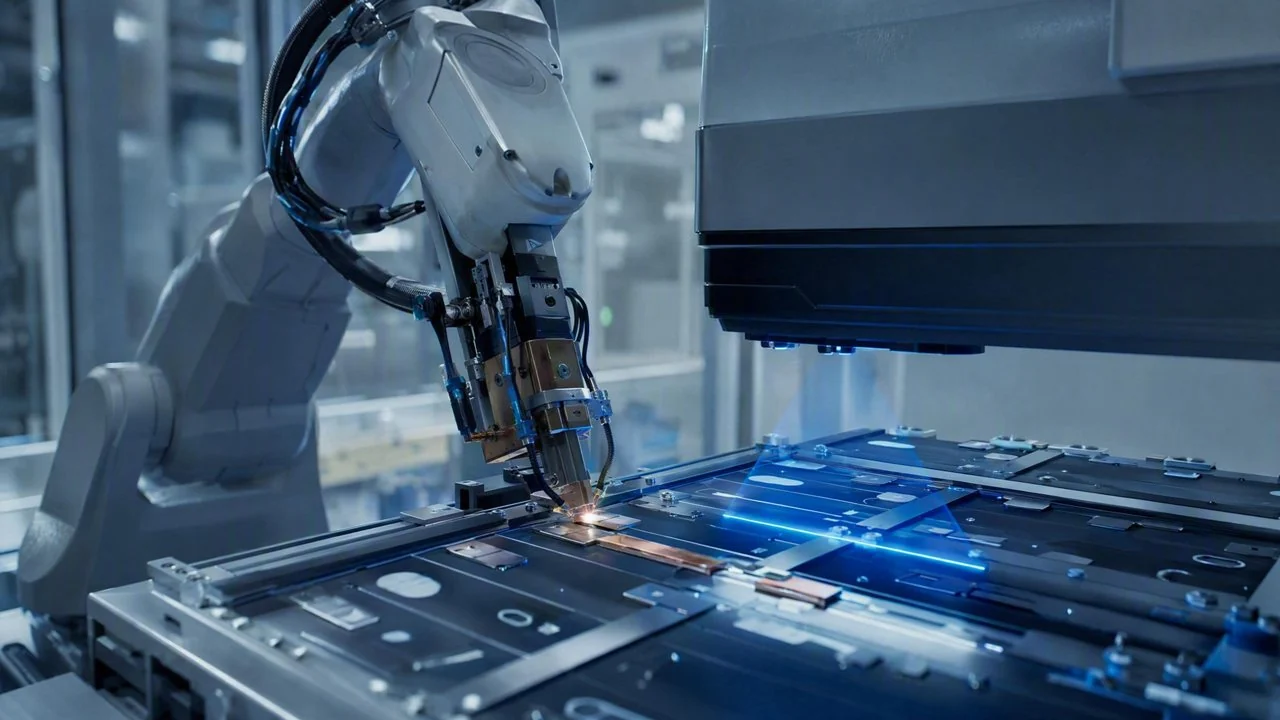
DaoAI's 3D ACI equipment (self-developed 3D camera + 3D morphology reconstruction/point cloud, detecting hidden solder joints/coplanarity/micron-level morphology/pores and other 2D optical blind spot defects, 2D-3D fusion) precisely identifies micron-level defects such as burrs and cold welds in new energy battery tab welding, and through deep data integration, reduces the production line rework rate caused by welding quality issues from a traditional 4% to <1%, significantly improving product consistency and production efficiency.
New energy battery manufacturing, as a crucial support for global energy transition, requires stringent quality control of its core processes. Particularly in power battery production, the tab, as a critical component connecting the internal cell to external circuits, has its welding quality directly determining the battery's safety, cycle life, and internal resistance performance. Even minor welding defects, such as burrs, cold welds, indentations, or non-coplanarity, can lead to short circuits, overheating, or even thermal runaway, posing serious safety risks in downstream applications. A leading battery manufacturer faced the challenge of how to conduct 100% inspection of tab welding quality at high production speeds, ensuring defect data could be traced in real-time and managed in a closed loop, thereby achieving refined control over the production process and continuous optimization of product quality.
Pain Points: Hurdles in Tab Welding Defect Detection and Quality Traceability
Traditional tab welding quality inspection solutions, whether manual visual inspection or 2D optical AOI equipment, face multiple challenges. Firstly, manual visual inspection has an average missed detection rate of 5-8% and is inefficient, unable to meet the cycle time requirements of new energy battery production lines. Secondly, even with 2D AOI, for common defects in tab welding such as burrs and cold welds, traditional 2D imaging technology has “blind spots” due to their minute morphological changes in height, reflective surface characteristics of solder joints, and potential occlusion of “hidden solder joints.” These defects are often difficult to clearly present in planar images, leading to persistently high missed detection rates, averaging still 1.5-2.5% of misses, while false alarm rates can be as high as 8-12%, severely impacting production line efficiency and manual re-inspection hours, requiring approximately 2-3 hours of manual re-inspection daily. Furthermore, traditional solutions generally lack deep integration with Manufacturing Execution Systems (MES), resulting in scattered defect data, making real-time, accurate quality traceability and closed-loop management difficult, leading to challenging problem localization, complex rework processes, and an average increase of about 15% in troubleshooting time per batch due to ineffective quality traceability.
From a process and imaging perspective, tab materials (e.g., copper, aluminum) exhibit high surface gloss after welding, prone to specular reflection, which is a classic challenge for Vision AI in reflective surface defect detection. Traditional vision algorithms struggle to distinguish between reflected light and true defect features. Simultaneously, micron-level burrs or non-coplanarity caused by cold welds in tab welding, with height differences of only tens of microns, appear as blurry shadows or subtle texture changes in 2D images, making them easily overlooked. These factors collectively constitute the “hard nut to crack” in new energy battery tab welding quality inspection.
Technical Principles: 3D AI Fusion Enabling Precise Detection and Data Chain
The core of DaoAI's 3D ACI equipment lies in its self-developed 3D camera and advanced 3D morphology reconstruction algorithms, which overcome the limitations of traditional 2D vision in detecting reflective surfaces and micron-level height differences. The equipment precisely reconstructs the 3D morphology of tab solder joints through multi-angle structured light projection and high-speed camera acquisition, combined with point cloud data processing technology. To address reflective surface challenges, DaoAI optimizes illumination strategies (e.g., combining diffuse and polarized light) and multi-frame fusion algorithms to effectively suppress specular reflection interference and extract true surface features. The reconstructed high-precision 3D point cloud data can quantify various geometric parameters of the solder joint with micron-level accuracy, such as height, volume, coplanarity, burr height, and cold weld depression depth. Building on this, DaoAI's deep learning algorithms analyze the 3D morphological data to accurately identify and classify various welding defects, for example, improving tab burr detection rate to 99.4% and reducing false alarm rates by 85%.
Compared to traditional rule-based AOI, DaoAI's 3D ACI equipment offers not just an improvement in detection accuracy, but also in its intelligence and data processing capabilities. Rule-based AOI relies on manually set thresholds, which are cumbersome to adjust and prone to missed detections and false alarms when faced with complex and varied defect morphologies and reflective surfaces. In contrast, DaoAI's AI algorithms possess powerful feature learning capabilities, able to learn defect patterns from small samples (APDT positive/few-shot learning, requiring only 1–20 good samples for rapid programming) and automatically adapt to subtle differences between production batches, achieving 0-code automatic programming. More importantly, the DaoAI 3D ACI system deeply binds inspection results with product serial numbers, batch information, and other production data, forming a unique quality fingerprint, laying the foundation for subsequent quality traceability and closed-loop data management.
Typical Application Scenarios: Broad Applications of 3D ACI in New Energy Battery Manufacturing
- **Tab Welding Quality Inspection (Burrs, Cold Welds, Solder Joint Coplanarity)**: DaoAI's 3D ACI equipment precisely detects burr height, cold weld areas, bonding condition between solder joint and base material, and surface coplanarity of tab welds. The challenges lie in the reflective properties of tab materials, micron-level defect sizes, and identification of cold weld areas hidden deep within the weld seam. 3D morphology reconstruction technology overcomes the limitations of 2D vision.
- **Cell Wrapping Defect Detection (Wrinkles, Damage, Foreign Objects)**: In the cell wrapping process, DaoAI's 3D ACI can detect minute wrinkles, damage, and foreign objects on the wrapping surface. Especially for transparent or translucent wrapping materials, where 2D vision is susceptible to reflections and transmissions, 3D morphology provides clearer identification of surface deformations.
- **Module and PACK Welding Quality Inspection (Weld Width, Depth, Pores)**: In module and PACK assembly, the welding quality between battery connection tabs is crucial. DaoAI's 3D ACI can non-contact inspect weld width, depth, uniformity, and potential minute pores within the weld, effectively preventing inconsistent internal resistance or localized overheating in battery packs due to welding defects.
- **Cell Dimension and Morphology Consistency Inspection (Swelling, Deformation)**: Batteries may swell or deform during charging and discharging. DaoAI's 3D ACI equipment can perform high-precision measurements of the cell's overall dimensions and surface morphology, promptly detecting abnormal deformations to ensure cell consistency and safety.
Implementation Case: Quality Traceability Practice at a Leading Battery Manufacturer
A leading Tier-1 power battery supplier, whose high-end production line demands extremely high tab welding quality, found that traditional 2D AOI solutions frequently missed defects like tab burrs and cold welds due to reflections and minute height differences, with an average missed detection rate of about 2.1%, severely impacting product consistency. Facing increasingly stringent customer quality standards and national regulatory requirements, the manufacturer urgently needed an intelligent inspection system capable of achieving full-process quality traceability and data closed-loop management. Before introducing DaoAI's 3D ACI equipment, monthly rework due to tab welding defects accounted for approximately 4% of total production, and tracing and troubleshooting defective batteries per batch required significant additional human and material resources. To address this pain point, the manufacturer decided to collaborate with DaoAI to deploy the 3D ACI system in the tab welding process.
After on-site investigation and data analysis, the DaoAI team quickly completed the deployment and debugging of the 3D ACI equipment, tailored to the specific characteristics of the manufacturer's tab welding process. After going online, the system performed 100% comprehensive inspection of tab solder joints using its self-developed 3D camera and AI algorithms, significantly reducing the missed detection rate for tab burrs and cold welds to <0.5%. Concurrently, the DaoAI 3D ACI system was integrated with the manufacturer's MES system, with every inspection result, associated with the corresponding battery serial number, production batch, welding parameters, and other information, being uploaded to the database in real-time. By building this complete data chain, the manufacturer achieved full lifecycle quality traceability from raw materials to finished products. If downstream issues were discovered, the system could immediately pinpoint the specific production batch, equipment, or even individual solder joint, reducing problem troubleshooting time by 80%.
“DaoAI's 3D ACI not only improved our inspection accuracy but, more importantly, it built an unprecedented quality data closed-loop for us, shifting our quality management from reactive to proactive.”
The figures above are a typically achievable range in anonymized industry scenarios — a different line or a different batch of parts will move the result either way; on-site measurement governs.
DaoAI Solutions and Products: Building an Intelligent Quality Traceability System
DaoAI's 3D ACI equipment is central to building an intelligent quality traceability system for new energy batteries. It integrates self-developed industrial-grade 3D cameras, high-performance computing platforms, and the DaoAI vision foundation model, enabling high-precision, high-efficiency inspection of critical processes like tab welding. For deployment and integration, DaoAI offers flexible SDK/API interfaces and Docker deployment options, supporting 100% local private deployment to ensure data security without leaving the factory. Through the DaoAI ACI OS, customers can utilize APDT positive/few-shot learning technology, requiring only 1-20 good sample images, to achieve 0-code automatic programming in 5 minutes, rapidly adapting to new product varieties or process adjustments. The system also features semantic false alarm filtering, further enhancing detection robustness. Furthermore, the data output interfaces of DaoAI 3D ACI can be deeply integrated with customers' MES, SCADA, and other production management systems, achieving real-time synchronization and correlation of inspection data, process parameters, and product batch information, forming a complete data closed-loop from defect discovery to root cause analysis, process optimization, and preventive maintenance.
Through the detailed 3D inspection data and powerful data integration capabilities provided by DaoAI's 3D ACI equipment, the customer was able to build an intelligent quality traceability system based on real-time data. This not only reduced the missed detection rate for tab welding to <0.5% but, more importantly, significantly shortened quality troubleshooting time, reducing battery rework rates caused by welding defects by 75%. The DaoAI solution effectively improved overall OEE (Overall Equipment Effectiveness) for the production line, providing a solid guarantee for new energy battery manufacturers to achieve high-quality, high-efficiency production.
FAQ
How does DaoAI's 3D ACI equipment address the issue of reflection in tab welding?
DaoAI's 3D ACI equipment effectively mitigates specular reflection interference from tab materials after welding by combining optimized multi-angle illumination strategies (e.g., diffuse light sources and polarized light) with multi-frame fusion algorithms. These technologies ensure that the 3D camera captures genuine, clear surface morphology data, enabling precise identification of micron-level defects and overcoming the limitations of traditional 2D vision in reflective surface inspection.
How long does it take to deploy DaoAI's 3D ACI system, and what are the requirements for existing production lines?
The deployment time for DaoAI's 3D ACI system varies depending on the specific production line conditions, but it typically can be completed within several weeks. We offer flexible SDK/API interfaces and Docker deployment methods for integration with existing MES and SCADA systems. Requirements for existing production lines primarily include stable power supply, network environment, and reserved space for equipment installation. We conduct detailed on-site assessments to provide customized deployment plans, ensuring minimal disruption to current production.
What is the cost estimate for DaoAI's 3D ACI system?
The cost estimate for DaoAI's 3D ACI system varies based on the customer's specific needs, complexity of inspection objects, production line cycle time, and required integration depth. We offer various configuration options, from standard equipment to customized solutions. To obtain a detailed and precise quotation, we recommend contacting our sales team with your specific application scenario and technical requirements, and we will provide you with a tailored solution and cost estimate.
Full solution for this scenario: the full inspection solution for New-energy batteries · Tab Welding Quality Gate
This article was generated by AI. Customer cases are simulated scenarios based on real product capabilities and figures are illustrative; see product pages for official benchmarks.