
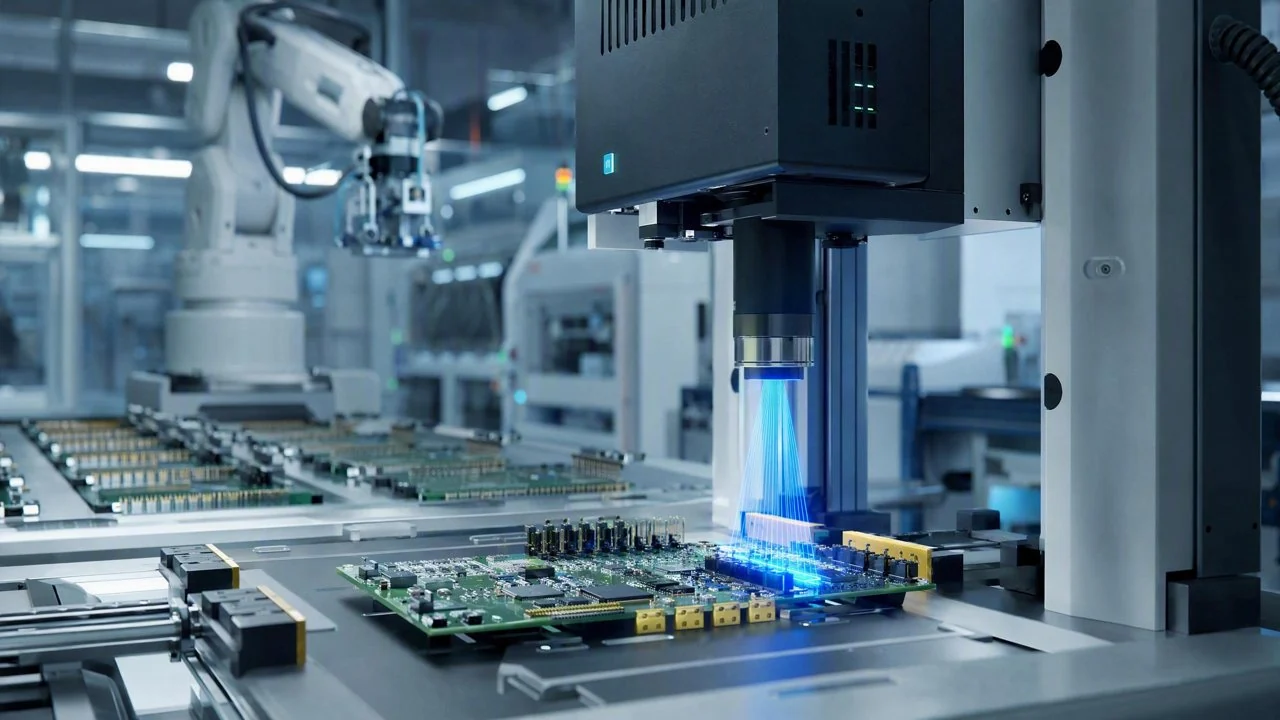
DaoAI 3D ACI equipment, leveraging self-developed 3D cameras and 3D morphology reconstruction, accurately detects pin header/connector coplanarity in the electronics PCBA industry, reducing the false negative rate from 1.2% to <0.4% compared to traditional methods, significantly improving product quality and production efficiency.
In the electronics PCBA industry, the coplanarity of pin headers and connectors is a critical indicator for ensuring reliable electrical connections and long-term product stability. As electronic products trend towards miniaturization and high-density integration, the number of connector pins increases, spacing decreases, and coplanarity requirements become increasingly stringent. Any slight deviation in coplanarity can lead to cold solder joints, short circuits, or even functional failure, posing a serious threat to product reliability. Traditional 2D optical inspection has inherent blind spots when dealing with such 3D morphological defects, making it difficult to provide precise height information. DaoAI 3D ACI equipment, with its self-developed 3D camera and 3D morphology reconstruction technology, fundamentally solves this problem. Through 2D-3D fusion inspection, it reduces the false negative rate for pin header/connector coplanarity from 1.2% using traditional methods to <0.4%, ensuring stable delivery of high-quality products.
Pain Points: Why This Hurdle Is Difficult to Overcome
The PCBA industry faces multiple challenges in pin header/connector coplanarity inspection. Firstly, there's the issue of detection accuracy. Traditional 2D AOI relies on contrast analysis and cannot effectively acquire pin height information. When confronted with minor pin bending or warping, which are coplanarity defects, the false negative rate often exceeds 1.2%. Secondly, there's a high false alarm rate, especially when there are non-coplanarity defects such as scratches, slight oxidation, or solder splatter on the pin surface. 2D vision easily misidentifies these as coplanarity issues, leading to increased manual re-inspection hours, averaging 2-3 hours per shift for re-evaluation, severely impacting production throughput. Thirdly, with accelerated product iteration, connector models are numerous, and traditional rule-based AOI changeover programming is complex, taking several hours or even half a day, resulting in high production line downtime costs. Finally, for some military, automotive electronics, or medical device manufacturers with extremely high data security requirements, uploading production data to the cloud for analysis or model training is an unacceptable risk. On-premises private deployment becomes their primary consideration for compliance and data sovereignty, yet most advanced AI vision solutions rely on cloud services.
The root cause of these difficulties lies in the fact that coplanarity defects of connector pins are inherently 3D morphological problems. Their micron-level deformations are not obvious in 2D images or are susceptible to interference from lighting and shadows. Traditional vision algorithms struggle to accurately extract tiny height differences from complex backgrounds. At the same time, while industrial large vision models offer disruptive advantages in complex defect identification and generalization capabilities, their deployment model must adapt to the security needs of specific industries. Without on-premises deployment capabilities, even the most advanced technology is difficult to implement in data-sensitive enterprises. DaoAI is committed to providing solutions that balance advanced technology with data security in this context.
Technical Principles
The core of DaoAI's 3D ACI equipment is its self-developed 3D camera system and advanced 3D morphology reconstruction algorithms. This system employs multi-frequency phase-shifting profilometry or laser triangulation, projecting structured light and capturing its deformation on the object's surface to precisely calculate the 3D coordinates of each point, thereby reconstructing high-precision point cloud data. Compared to traditional 2D optical inspection, which only acquires planar grayscale information, DaoAI 3D ACI can obtain real height, tilt angle, and coplanarity information of pins at a micron level. Combined with the powerful AI vision foundation model of the DaoAI Wemio engine, it can perform deep learning and feature recognition on this high-dimensional data, identifying defects in traditional 2D optical blind spots, such as subtle pin warpage, bending, or solder joint collapse, elevating coplanarity detection accuracy to the sub-micron level.
Compared to traditional rule-based AOI or pure 2D ACI, the advantage of DaoAI 3D ACI lies in its 2D-3D fusion detection capability. 2D images are used for rapid positioning and identification of planar features, while 3D data is used for precise measurement and analysis of 3D morphological defects. This fusion strategy not only enhances the comprehensiveness and accuracy of detection but also significantly reduces the false alarm rate. For example, for minor scratches on the pin surface, 2D vision might generate a false alarm, but 3D data will show that its height morphology is normal, thus avoiding misjudgment. Furthermore, the APDT few-shot learning capability of the DaoAI Wemio engine requires only 1-20 good samples to quickly train models, significantly shortening changeover time to less than 5 minutes, far superior to the several-hour programming cycle of traditional AOI. Most importantly, the DaoAI 3D ACI solution supports 100% on-premises private deployment, with all data processed within the customer's internal network, ensuring data never leaves the factory, meeting the highest data security requirements, which many traditional cloud-based AI solutions cannot match.
Typical Application Scenarios
- **Pin Header/Connector Coplanarity Detection:** This is one of the core applications of DaoAI 3D ACI. The equipment uses high-precision 3D imaging to accurately measure the Z-axis height of each pin and calculate its coplanarity relative to the reference plane. The challenges include dense pins, strong reflections, and micron-level height deviations. The DaoAI solution can effectively address these challenges, ensuring each pin is within tolerance.
- **BGA/LGA Solder Ball Coplanarity and Collapse Detection:** For BGA or LGA packages, solder ball coplanarity is crucial. 3D ACI can accurately measure the consistency of solder ball heights and identify defects such as collapse, missing balls, or bridging. While traditional 2D solutions can only infer from outer contours, DaoAI 3D ACI provides real 3D morphological data.
- **QFN/QFP Pin Warpage and Deformation Detection:** Pins of QFN and QFP packages are prone to warpage or deformation after reflow soldering, affecting welding quality. DaoAI 3D ACI can precisely quantify the lift height and bending angle of pins, promptly detecting potential soldering defects.
- **SMT Component Placement Height and Tilt Detection:** Besides connectors, the placement height and tilt of other SMT components (e.g., chips, capacitors, resistors) also affect product performance. DaoAI 3D ACI can perform 3D measurements on these components, ensuring their correct posture on the PCB, avoiding cold solder joints or electrical performance issues due to improper placement.
- **Solder Joint Morphology and Void Detection:** 3D imaging can also deeply analyze the 3D morphology of solder joints, such as solder volume, wetting angle, solder joint fullness, and internal voids. These are difficult for 2D vision to accurately assess, and DaoAI 3D ACI provides a more comprehensive solder joint quality evaluation.
Case Study
A leading domestic industrial control equipment manufacturer, as a Tier-1 supplier, had extremely high requirements for connector coplanarity in its PCBA products and strict on-premises deployment requirements for production data security. Previously, the manufacturer used a combination of traditional 2D AOI and manual inspection for pin header/connector coplanarity detection. However, facing increasingly complex connector designs and stringent quality standards, the false negative rate of traditional 2D AOI remained high, averaging 1.2%, especially struggling to detect slight pin warpage. Simultaneously, with a 2D false alarm rate of 8%-10%, 2-3 workers per shift spent significant time on secondary re-inspection, severely slowing down the production pace. More critically, they could not accept uploading any production data to external cloud platforms, rendering most advanced AI vision solutions on the market unable to meet their compliance requirements.
DaoAI 3D ACI equipment, deployed on-premises, not only reduced the pin header/connector coplanarity false negative rate to <0.4% but also ensured that all sensitive production data remained in-house, providing the customer with an integrated solution that balances high performance with data sovereignty.
To address these pain points, the manufacturer introduced DaoAI 3D ACI equipment with 100% on-premises private deployment. DaoAI's engineering team deployed the complete software and hardware system at the customer's production line. All AI model training and inference ran on local servers, with data remaining entirely within the factory. After deployment, the DaoAI 3D ACI system, utilizing its self-developed 3D camera and 3D morphology reconstruction technology, accurately captured micron-level height information of the pins. Combined with the powerful AI algorithms of the Wemio engine, it effectively identified coplanarity defects that traditional 2D AOI struggled with. The customer reported that after the DaoAI 3D ACI system went live, the false negative rate for pin header/connector coplanarity significantly dropped to <0.4%, and the false alarm rate was reduced by 75% or more, greatly reducing the workload of manual re-inspection. Concurrently, the APDT few-shot learning function of the DaoAI Wemio engine shortened new product changeover time from the original 2-3 hours to less than 5min, significantly enhancing the flexibility and efficiency of the production line.
DaoAI Solutions and Products
DaoAI provided the customer with a core solution based on its 3D ACI equipment. This equipment integrates DaoAI's self-developed high-precision 3D camera, capable of acquiring precise 3D morphological data of the PCBA surface, especially the pin header/connector pins, in real-time. Through advanced 3D morphology reconstruction algorithms, the system constructs high-density point clouds, providing rich and accurate depth information for subsequent AI analysis. The DaoAI Wemio engine, as the AI core, is deployed on the customer's local server, employing a visual foundation model for feature recognition. Combined with APDT positive sample/few-shot learning technology, it requires only a minimal number of good samples (1-20 images) to complete model training, enabling 0-code rapid changeover. For pin header/connector coplanarity detection, DaoAI 3D ACI equipment can precisely measure the Z-axis height of each pin and use AI algorithms to determine if it falls within the preset coplanarity tolerance, effectively identifying defects such as warpage, bending, and collapse.
In terms of deployment, the DaoAI 3D ACI solution supports 100% on-premises private deployment in SDK, API, or Docker formats. This means that all sensitive production data, model training processes, and inference computations are completed within the customer's internal network, with data never being uploaded to external clouds. This completely eliminates data leakage or compliance risks, meeting the needs of manufacturers with extremely high data security requirements. Furthermore, DaoAI also offers the DaoAI ACI OS, whose semantic false alarm filtering function can effectively reduce false alarms caused by non-defect factors, further improving detection efficiency. The entire solution implementation process is efficient, typically completing integration and debugging within a few days, quickly entering production. The DaoAI 3D ACI equipment not only solves the blind spot problem of traditional 2D optical inspection but also guarantees customer data sovereignty through localized deployment, providing a new paradigm of intelligent quality inspection with high performance and high security.
Through DaoAI's 3D ACI equipment and accompanying solutions, the customer achieved significant business value improvements. Their pin header/connector coplanarity false negative rate decreased from 1.2% to <0.4%, greatly enhancing product quality reliability. The false alarm rate was reduced by 75% or more, saving substantial manual re-inspection hours, approximately 2 inspectors per shift, significantly lowering operating costs. New product changeover time was shortened from several hours to less than 5min, greatly improving production line flexibility and efficiency, effectively addressing the challenges of multi-variety, small-batch production. Most importantly, 100% on-premises private deployment ensured the absolute security of customer production data, met their strict compliance requirements, and eliminated the risk of data leakage, building a robust data security barrier for the enterprise. The DaoAI 3D ACI solution not only solved technical challenges but also created immeasurable value for the customer in terms of data security.
FAQ
How does DaoAI 3D ACI equipment ensure data security?
DaoAI 3D ACI equipment supports 100% on-premises private deployment. This means that all production data, AI model training, and inference are completed within the customer's internal network and servers, with data never being uploaded to any external cloud platform. This deployment method fundamentally eliminates the risk of data leakage, ensuring customers have complete control and sovereignty over sensitive production data, meeting the needs of high-security industries such as military and automotive electronics.
What are the advantages of 3D ACI over traditional 2D AOI in detecting connector coplanarity?
Traditional 2D AOI cannot obtain Z-axis height information, making it difficult to accurately judge coplanarity defects of connector pins. DaoAI 3D ACI equipment, through its self-developed 3D camera and 3D morphology reconstruction technology, can acquire real height, tilt angle, and other micron-level 3D data of pins. Combined with AI algorithms, it precisely identifies coplanarity defects such as warpage and bending. This significantly reduces the false negative rate, improves detection accuracy and reliability, and reduces manual re-inspection due to false alarms.
What is the cost structure of DaoAI 3D ACI equipment?
The cost of DaoAI 3D ACI equipment primarily includes hardware (self-developed 3D camera, industrial PC, etc.), software licensing (Wemio engine, AI models), and on-site deployment and service fees. The specific quotation will vary based on factors such as the customer's production line scale, detection accuracy requirements, integration complexity, and whether customized development is needed. We recommend scheduling an expert consultation so we can provide a detailed solution and quote based on your specific needs.
Full solution for this scenario: Electronics / PCBA industry solutions
This article was generated by AI. Customer cases are simulated scenarios based on real product capabilities and figures are illustrative; see product pages for official benchmarks.