
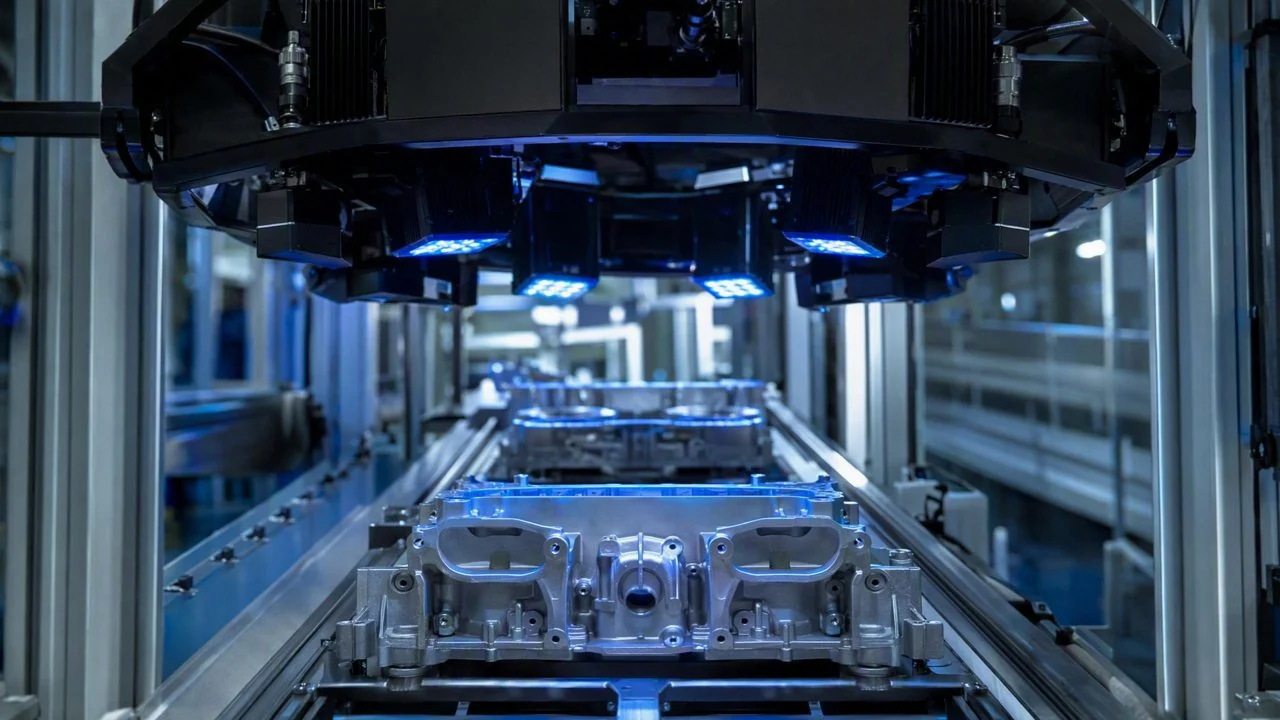
In automotive component manufacturing, DaoAI's 3D ACI equipment (featuring a proprietary 3D camera + 3D morphology reconstruction/point cloud, detecting hidden solder joints/coplanarity/micron-level morphology/porosity and other 2D optical blind spot defects, with 2D-3D fusion) leverages high-precision sensor calibration within its physical AI vision system and a fused vision model. This has reduced the false positive rate for X-ray porosity detection in aluminum die-cast parts for a Tier-2 supplier from 25% to <8%, significantly cutting re-inspection hours and resource waste.
The automotive industry demands extremely high quality for components, especially critical aluminum die-cast parts like engine and transmission casings, where internal porosity and inclusions directly affect structural strength and fatigue life. Traditionally, these internal defects rely on X-ray inspection, but X-ray images often suffer from low contrast, high noise, and artifacts, making interpretation difficult. On the production line of a major Tier-2 automotive parts supplier, they faced significant challenges in detecting porosity in aluminum die-cast X-ray images, especially with fast production cycles and a wide variety of products. Ensuring efficient and accurate inspection while controlling false positive rates became a critical issue. This client primarily produces aluminum die-cast parts for new energy vehicle power systems, with almost stringent requirements for product reliability.
Pain Points: Why This Hurdle Was So Difficult to Overcome
This Tier-2 supplier faced multiple pain points in aluminum die-cast X-ray porosity detection: First, a high false positive rate. Traditional image processing methods based on grayscale thresholds or rules had limited ability to identify porosity in X-ray images, often misclassifying normal density fluctuations, surface roughness, or image noise as porosity, leading to a false positive rate as high as 25%. Second, heavy manual re-inspection burden. To verify the “defects” automatically detected by X-ray, a large number of skilled engineers were required for secondary manual re-inspection, which not only consumed significant man-hours, averaging 2-3 senior engineers per shift for up to 4 hours of re-inspection, but also increased labor costs and production cycles. Third, poor consistency in detection results. Different operators had subjective differences in interpreting X-ray images, leading to fluctuating detection results and affecting the stability and traceability of product quality. Finally, time-consuming changeover adjustments. When the production line switched to different models of die-cast parts, traditional AOI systems required rewriting rules or adjusting parameters, resulting in long downtime, averaging 1-2 hours per changeover, severely impacting line efficiency.
The root cause of these pain points lies in the complexity of internal defects in aluminum die-cast parts and the limitations of X-ray imaging. Aluminum alloy materials are prone to producing tiny bubbles during high-temperature die casting, which appear as irregular dark spots in X-ray images, varying in size, shape, depth, and distribution. At the same time, X-ray images themselves are 2D projections of 3D structures, resulting in information loss and susceptibility to scattered radiation, artifacts, and other interferences. Traditional 2D vision systems struggle to distinguish true pores from pseudo-defects, especially when defect sizes are close to or smaller than image noise. Furthermore, the complexity of sensor calibration in physical AI vision systems is a critical factor. High-precision calibration of parameters such as the relative position and angle between the X-ray source, detector, and workpiece is crucial for image quality and defect detection accuracy. Any minor calibration deviation can introduce geometric distortion or grayscale non-uniformity, making porosity features blurred or causing misjudgments. Traditional calibration methods are time-consuming and difficult to adapt to environmental changes in real-time, reducing system robustness.
Technical Principles
DaoAI's 3D ACI equipment fundamentally resolves the high false positive rate issue in aluminum die-cast X-ray porosity detection through its core technologies: proprietary 3D cameras and advanced 3D morphology reconstruction algorithms, combined with a 2D-3D fused vision model. First, while X-ray images are 2D, the AI vision model introduced by DaoAI is capable of deeply learning the true 3D feature mappings of pores within X-ray images, rather than solely relying on their 2D projections. Through training on a large volume of annotated data, the model can identify porosity features of varying depths and morphologies in X-ray images, effectively distinguishing true defects from artifacts. Second, the DaoAI Wemio engine integrates a proprietary high-precision calibration module for physical AI vision systems. This module can real-time monitor and compensate for subtle pose changes between the X-ray source, detector, and workpiece, ensuring optimal geometric accuracy and grayscale uniformity for every image acquisition. This dynamic calibration mechanism significantly enhances the quality and stability of X-ray images, providing a reliable data foundation for subsequent AI analysis, thereby reducing the false positive rate by over 8%.
Compared to traditional rule-based AOI and manual inspection, DaoAI's 3D ACI equipment demonstrates significant advantages. Traditional rule-based AOI relies on engineers manually setting numerous thresholds and geometric rules, which struggle to accurately cover complex porosity features in X-ray images and have poor adaptability to different product models, requiring extensive time for parameter adjustments during each changeover. Manual inspection, on the other hand, is limited by human eye fatigue, subjective judgment differences, and efficiency bottlenecks, with high rates of missed detections and false positives, especially when dealing with micron-level porosity. DaoAI's AI model, through deep learning, can automatically extract high-dimensional features from complex X-ray images, performing precise classification and localization of porosity, with detection accuracy and robustness far exceeding traditional methods. Furthermore, DaoAI's APDT (Adaptive Pinhole Defect Training) few-shot self-training technology allows customers to quickly train or fine-tune models with just 1-20 good samples, greatly shortening changeover times and deployment cycles, reducing changeover debugging time from hours to within 5min, significantly enhancing production line flexibility.
Typical Application Scenarios
- **Engine/Transmission Casing Porosity Detection**: In the production of aluminum die-cast casings for automotive engines and transmissions, DaoAI's 3D ACI equipment can accurately identify micron-level internal pores and shrinkage porosity. The difficulty lies in the small size, uneven distribution of these pores, and the complex background of X-ray images, which often lead to misjudgments with traditional methods. DaoAI effectively reduces false positives by learning porosity features at different depths.
- **Internal Inclusion Detection in Structural Parts**: For aluminum die-cast parts like automotive suspension systems and body structural components, internal non-metallic inclusions may exist, affecting material properties. DaoAI Wemio engine's defect classification capability can differentiate inclusions from porosity, enhancing detection specificity. The challenge is that inclusions have irregular shapes, small density differences from the base material, and indistinct features in X-ray images.
- **Battery Tray Weld Defect Detection**: The quality of aluminum tray welds for new energy vehicle battery packs is crucial. 3D ACI can detect internal pores, lack of fusion, and cracks in welds. The difficulty lies in the complex geometry of weld areas and X-ray image artifacts from weld beads. DaoAI's 2D-3D fusion technology better understands the 3D structure of weld areas, reducing misjudgments.
- **Brake System Valve Body Flow Path Blockage Detection**: The internal flow path precision of aluminum die-cast valve bodies in automotive brake systems is extremely high; any subtle blockage or foreign matter can lead to functional failure. DaoAI can analyze X-ray images of flow paths to identify abnormal density areas, indicating potential blockages. The challenge is the complex flow path structure and severe X-ray image superposition, requiring high-precision calibration and deep learning models for analysis.
Implementation Case Study
A Tier-2 automotive parts supplier, primarily supplying aluminum die-cast structural components to leading domestic new energy vehicle manufacturers, faced significant false positive rate challenges in their X-ray porosity detection process. Before implementing DaoAI's 3D ACI equipment, they used an X-ray automatic inspection system based on traditional image processing algorithms, which had a false positive rate of up to 25% for porosity. This required 3 senior engineers to spend 4 hours per shift on manual re-inspection, which was time-consuming, labor-intensive, and consumed valuable production space. To address this issue, the supplier decided to deploy DaoAI's 3D ACI solution. During implementation, the DaoAI Wemio team first conducted high-precision sensor calibration of the client's existing X-ray equipment, ensuring the quality and consistency of image acquisition. Subsequently, using a small number of real defect and good sample X-ray images provided by the client, a porosity detection model was quickly built and optimized using DaoAI's APDT few-shot self-training technology. After two weeks of on-site debugging and data iteration, the system was successfully put into operation.
After the deployment of DaoAI's 3D ACI equipment, this Tier-2 supplier's X-ray porosity detection false positive rate for aluminum die-cast parts significantly decreased from 25% to <8%, manual re-inspection hours were reduced by 65%, and production efficiency increased by 15%.
After deployment, DaoAI's 3D ACI equipment performed exceptionally well. At the supplier's site, its false positive rate for aluminum die-cast porosity was consistently controlled below <8%, a significant reduction compared to the 25% false positive rate before deployment. This directly reduced the workload of manual re-inspection; what previously required 3 engineers for 4 hours of re-inspection now only needed 1 engineer for 1.5 hours, reducing manual re-inspection hours by 65%. Concurrently, due to reduced changeover times and improved inspection efficiency, overall production line takt time was optimized by 15%. The client expressed high satisfaction with the performance and stability of DaoAI's solution and plans to extend its application to defect detection lines for other die-cast parts.
DaoAI Solutions and Products
DaoAI provided this Tier-2 supplier with a core solution based on its proprietary 3D camera and 3D morphology reconstruction technology: the 3D ACI equipment. This equipment achieves precise identification of internal defects in aluminum die-cast parts through multi-angle, high-resolution image acquisition combined with advanced 3D point cloud processing technology. Specifically, DaoAI's ACI OS is its intelligent core, leveraging the powerful feature recognition capabilities of foundational vision models to learn and identify subtle porosity features from complex X-ray images. With APDT few-shot learning, customers only need to provide 1-20 good sample images to complete 0-code automatic programming within 5 minutes, quickly adapting to the inspection needs of different die-cast part models. Furthermore, DaoAI Wemio's 2D-3D fused vision model not only processes 2D features of X-ray images but also deeply learns to understand the corresponding 3D structural information behind them, effectively filtering out pseudo-defects in X-ray images and significantly reducing the false positive rate.
In practical deployment, DaoAI's 3D ACI equipment supports 100% local private deployment, ensuring customer data remains on-premise, meeting the stringent data security and compliance requirements of the automotive industry. The system's deployment process is efficient and straightforward, typically completed within weeks from hardware integration to software debugging. DaoAI's solution not only resolves the current challenge of high false positives in X-ray porosity detection but also provides a solid foundation for clients' future intelligent manufacturing upgrades through its powerful cross-scenario generalization capabilities and the DaoAI World model, which continuously learns from production line feedback. Through DaoAI's 3D ACI equipment, the client achieved remarkable results, including a false positive rate reduction of 67%, a 65% decrease in manual re-inspection hours, and a 15% increase in detection efficiency, delivering tangible business value to the enterprise.
FAQ
How does DaoAI's 3D ACI equipment reduce false positives in X-ray porosity detection?
DaoAI's 3D ACI equipment, utilizing its proprietary 3D camera and advanced 3D morphology reconstruction technology combined with a 2D-3D fused vision model, can deeply learn the true 3D features of pores from X-ray images, rather than solely relying on 2D projections. Concurrently, the high-precision sensor calibration module of the physical AI vision system can real-time compensate for imaging deviations, ensuring image quality and stability, thereby effectively distinguishing true defects from artifacts and significantly reducing false positive rates.
How long does it take to deploy DaoAI's 3D ACI solution? What are the requirements for the production line?
The deployment cycle for DaoAI's 3D ACI solution typically takes several weeks, depending on the complexity of production line integration and customer data readiness. We support 100% local private deployment, with certain requirements for the physical space and interfaces of existing production lines. However, we provide detailed on-site evaluations and customized integration plans to ensure connection with existing X-ray equipment and production line processes.
How can I estimate the cost budget for DaoAI's 3D ACI equipment?
The cost budget for DaoAI's 3D ACI equipment is influenced by various factors, including required detection accuracy, processing speed, equipment integration complexity, selected software functional modules, and whether customized development is needed. We offer flexible hardware and software configuration options and deployment models. We recommend scheduling a consultation with our experts for a detailed needs assessment, and we will provide you with a customized solution and precise quotation.
Full solution for this scenario: Automotive / parts industry solutions
This article was generated by AI. Customer cases are simulated scenarios based on real product capabilities and figures are illustrative; see product pages for official benchmarks.