
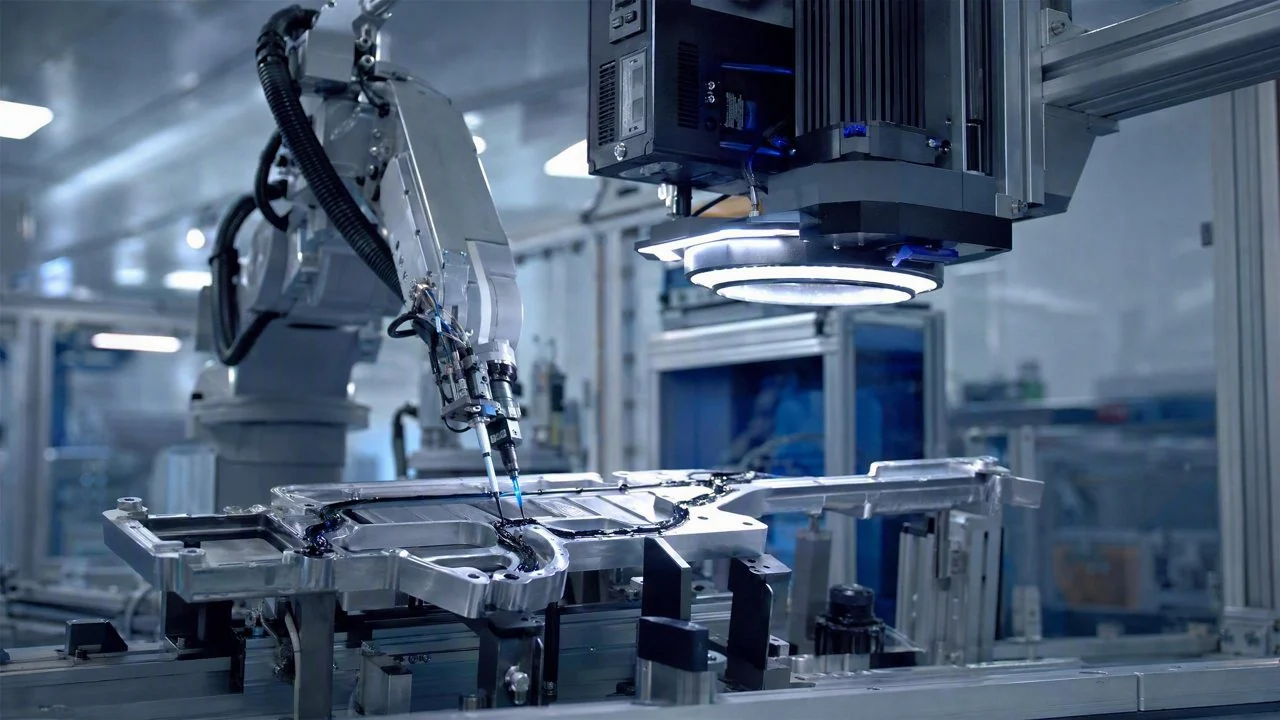
For automotive component dispensing/sealing, DaoAI's 3D ACI equipment (proprietary 3D camera + 3D morphology reconstruction/point cloud, detecting hidden solder joints/coplanarity/micron-level morphology/voids, etc., 2D optical blind spot defects, 2D-3D fusion) reduces the dispensing inspection escape rate from 0.8% with traditional methods to <0.05% by integrating 2D-3D vision and AI deep learning, ensuring zero escapes for critical defects and production safety. In automotive manufacturing, sealing and dispensing are crucial processes for ensuring product performance and lifespan. Whether it's engine block sealant, body seam sealer, or battery pack potting adhesive, the quality of application directly impacts the vehicle's waterproofing, dustproofing, NVH (Noise, Vibration, and Harshness) performance, and even structural safety. With the trend towards intelligent and electrified vehicles, the demands for dispensing precision and consistency are increasingly stringent, especially in the sealing and thermal adhesive application of new energy vehicle battery packs, where any minor defect can lead to severe consequences.
A leading automotive component supplier faced challenges where traditional inspection methods struggled to meet high-standard dispensing quality requirements, urgently needing to improve the detection rate of critical defects and eliminate escape risks.
Pain Points: Why This Hurdle Was So Difficult
The leading automotive component supplier faced multiple pain points in the dispensing inspection process. Firstly, **high escape rates** persisted; traditional 2D vision or manual inspection had an average escape rate of around 0.8% for minor defects such as tiny air bubbles, broken glue lines, overflow, misalignment, or insufficient height. This meant approximately 80 defective products out of every 10,000 still moved downstream, leading to high rework costs and potential recall risks. Secondly, **elevated false positive rates** were common; due to ambient light variations, product surface reflections, and glue line color differences, traditional 2D vision systems often had false positive rates of 5-8%, resulting in numerous good products being misidentified, increasing manual re-inspection burden and production line downtime. Thirdly, **long inspection cycles and complex changeovers** were problematic; each product changeover required reprogramming and debugging, taking several hours or even half a day, severely impacting the flexibility of multi-variety, small-batch production. Finally, **lack of 3D information created inspection blind spots**; traditional 2D vision could not accurately capture the stereoscopic morphology of the glue line, leaving it helpless against 3D defects such as insufficient glue line height, uneven width, or internal voids, which were core reasons for escapes.
The root cause of these challenges lies in the complexity of dispensing and the limitations of traditional inspection technologies. Dispensing materials often exhibit translucent, highly reflective, or matte characteristics, resulting in low contrast and blurry edges in 2D images, making them highly susceptible to ambient light. Crucially, key 3D features of glue lines, such as height, width, and cross-sectional shape, cannot be directly quantified by 2D images. Traditional rule-based AOI struggles to adapt to subtle changes in glue line morphology, while manual inspection suffers from human fatigue and inconsistency. Furthermore, the challenges of sensor calibration for physical AI vision systems in industrial settings exacerbate inspection difficulties; any deviation in parameters like camera-to-workpiece angle, distance, or light source intensity can degrade 3D reconstruction accuracy, thereby affecting accurate defect identification. Therefore, an inspection solution capable of precisely acquiring 3D morphology, resisting environmental interference, and possessing deep learning capabilities became an imperative.
Technical Principles
DaoAI's 3D ACI equipment effectively addresses the aforementioned pain points through its unique technological combination. Its core lies in its **proprietary high-precision 3D camera and advanced 3D morphology reconstruction technology**. The 3D camera employs the structured light projection principle, projecting specific patterns of light onto the surface of the object under test. By analyzing the deformation of the light pattern on the object's surface, it accurately calculates the 3D coordinates of each point using triangulation, thereby reconstructing a complete 3D point cloud data of the glue line. This enables the DaoAI equipment to acquire micron-level morphological information such as the height, width, volume, and cross-sectional shape of the glue line, completely overcoming the blind spots of 2D vision regarding 3D information. For instance, internal voids in the glue line can be identified through point cloud density analysis and surface undulation detection; insufficient glue line height can be directly judged by quantifying its Z-axis data. DaoAI's 3D ACI equipment achieves a detection rate of over 99.95% for dispensing inspection through precise 3D data.
Compared to traditional methods, DaoAI's 3D ACI equipment offers significant advantages. Traditional 2D AOI relies on edges, colors, and other features in grayscale or color images, making it susceptible to light, reflections, and shadows, and unable to acquire depth information, leading to higher escape rates for 3D defects. Manual inspection is inefficient, inconsistent, and prone to fatigue. In contrast, DaoAI's equipment not only provides high-precision 3D data but also integrates the DaoAI ACI OS. This system, based on advanced vision foundation models and APDT (Adaptive Positive Data Training) few-shot learning technology, requires only 1-20 good samples to complete 0-code automatic programming within 5 minutes, quickly adapting to different glue line types and defect patterns. Its semantic false positive filtering function effectively reduces false positive rates, achieving inspection performance unmatched by traditional AOI. Furthermore, DaoAI's equipment also possesses path correction capabilities, allowing real-time feedback of detected dispensing deviations to robots for micro-adjustments of the dispensing path, enabling closed-loop control and further enhancing dispensing quality.
Typical Application Scenarios
- **Automotive Battery Pack Sealant Inspection:** In the potting and sealing of new energy vehicle battery packs, DaoAI's 3D ACI equipment can detect defects such as glue line height, width, continuity, air bubbles, overflow, and broken glue, ensuring the battery pack's waterproof/dustproof rating and thermal management performance. The challenge lies in the often thin and complex shape of the glue lines, requiring extremely high precision for 3D reconstruction.
- **Engine Block/Transmission Sealant Inspection:** Inspecting the quality of sealant application on engine or transmission mating surfaces, including uniformity, thickness, and presence of missing or overflowing glue. These components often have rough, unevenly reflective surfaces, making it difficult for traditional 2D to accurately identify tiny defects.
- **Vehicle Body Seam Sealant Inspection:** Comprehensive inspection of sealant at vehicle body seams to ensure the vehicle's NVH performance and corrosion resistance. The difficulty lies in the complex geometry of welds, where glue lines are often in grooves or on curved surfaces, requiring high-precision 3D data for accurate judgment.
- **Interior Component Bonding Adhesive Inspection:** Inspecting the application of bonding adhesive for automotive interior parts (e.g., dashboards, door panels) to ensure strong adhesion and aesthetic quality. Such glue lines may be similar in color to the background or located in confined areas, which DaoAI equipment can effectively handle.
- **Electronic Module Potting Compound Inspection:** Inspection of internal potting compounds for automotive electronic control units (ECUs), sensors, etc., to ensure their insulation, moisture-proof, and shock-resistant properties. The challenge is that potting compounds may completely cover circuit boards, requiring translucent or high-precision morphological recognition of internal structures or surface defects.
Case Study
A Tier-1 automotive component supplier in East China, primarily manufacturing automotive electronic modules and powertrain components, used a combination of traditional 2D visual AOI equipment and manual re-inspection for a critical sealing component after the dispensing process. However, due to the complex product structure and fine glue lines, the traditional 2D vision had an escape rate of up to 0.7% for insufficient glue line height and tiny air bubbles, resulting in approximately 1500 defective products per month flowing downstream, causing serious quality risks and rework costs. Manual re-inspection was inefficient, and the false positive rate reached 6%, further exacerbating the production line burden. To thoroughly address these issues, the supplier introduced DaoAI's 3D ACI equipment.
With the assistance of the DaoAI engineering team, the equipment was successfully deployed on the production line. By integrating the DaoAI ACI OS, the model training was completed with only a minimal number of good samples. After going live, DaoAI's 3D ACI equipment significantly improved the detection rate of dispensing defects, performing exceptionally well in detecting 3D defects such as glue line height and width consistency, air bubbles, and broken glue. Before deployment, the client had approximately 5-8 escaped defects per shift, with a false positive rate as high as 6%. Post-deployment, DaoAI's 3D ACI equipment successfully reduced the escape rate to <0.05%, essentially achieving zero escapes, and lowered the false positive rate by 85% to <1%. Concurrently, the equipment also integrated a robot linkage function to provide real-time correction for detected glue line path deviations, ensuring dispensing precision and consistency. This not only greatly enhanced product quality but also significantly reduced rework and manual re-inspection costs, improving overall production line efficiency.
DaoAI's 3D ACI equipment not only reduced our dispensing escape rate from 0.7% to almost zero, but more importantly, it provided us with unprecedented confidence and control over product quality.
DaoAI Solutions and Products
DaoAI's 3D ACI equipment is the core of this solution, providing high-precision point cloud data through its proprietary 3D camera and 3D morphology reconstruction technology, thereby enabling comprehensive inspection of glue line height, width, volume, continuity, and internal defects (such as voids). The DaoAI ACI OS acts as the brain, utilizing advanced vision foundation models and APDT (Adaptive Positive Data Training) few-shot learning technology, supporting 0-code rapid programming and quick changeovers for multi-variety, small-batch production, greatly reducing production line debugging time. This system also possesses powerful semantic understanding and false positive filtering capabilities, ensuring high detection rates while keeping false positive rates extremely low. Through various deployment methods such as SDK/API/Docker, DaoAI's solution supports 100% local private deployment, ensuring customer data security remains on-premises. Furthermore, the equipment can be integrated into the factory's MES/SCADA system to achieve closed-loop traceability of inspection data and production data, providing data support for quality management and process optimization. The dispensing guidance function within DaoAI's Robotic Vision product line can also work in closer coordination with the 3D ACI equipment to further optimize dispensing precision and efficiency.
The application of DaoAI's 3D ACI equipment has brought significant business value to automotive component manufacturers. By reducing the dispensing inspection escape rate to <0.05%, it effectively prevents defective products from entering the market, significantly mitigating recall and warranty risks. Simultaneously, the 85% reduction in false positive rates considerably decreases the workload of manual re-inspection, freeing up valuable human resources. Moreover, the 5-minute quick changeover capability allows enterprises to flexibly respond to market demand changes, support multi-variety, small-batch production models, and enhance overall production efficiency and market competitiveness. The DaoAI solution not only improves product quality but also optimizes production processes, achieving cost reduction and efficiency gains.
FAQ
What is the core difference between DaoAI's 3D ACI equipment and traditional 2D AOI for dispensing inspection?
The core advantage of DaoAI's 3D ACI equipment lies in its proprietary 3D camera and 3D morphology reconstruction capabilities. Traditional 2D AOI can only acquire planar image information and cannot accurately detect 3D defects such as glue line height, width, volume, or internal voids. Our equipment provides micron-level precision 3D point cloud data, combined with AI deep learning, offering significantly superior detection rates and escape reduction for 3D defects compared to 2D solutions.
What are the typical deployment time and cost for this 3D ACI equipment?
Deployment time typically varies based on production line complexity and integration requirements, usually completed within 2-4 weeks for standard scenarios. Regarding cost, DaoAI offers flexible hardware and software configuration options, with specific pricing depending on the required inspection precision, number of cameras, software modules, and integration level. We recommend scheduling an expert consultation, and we will provide a customized quote and detailed proposal based on your specific needs to ensure maximum return on investment.
How does DaoAI's 3D ACI ensure zero escapes and high detection rates for dispensing inspection?
DaoAI ensures zero escapes and high detection rates through multiple mechanisms. Firstly, high-precision 3D cameras provide comprehensive 3D morphological data, eliminating 2D vision blind spots. Secondly, the DaoAI ACI OS uses advanced vision foundation models and APDT few-shot learning to accurately identify tiny, irregular defects with strong generalization capabilities. Furthermore, the system continuously optimizes model performance through continuous learning and semantic false positive filtering, ensuring the reliability and stability of inspection results, thereby reducing the escape rate to an extremely low level.
Full solution for this scenario: Automotive / parts industry solutions · 100% Inline 3D Inspection & Path Correction for Automotive Glue Dispensing
This article was generated by AI. Customer cases are simulated scenarios based on real product capabilities and figures are illustrative; see product pages for official benchmarks.