
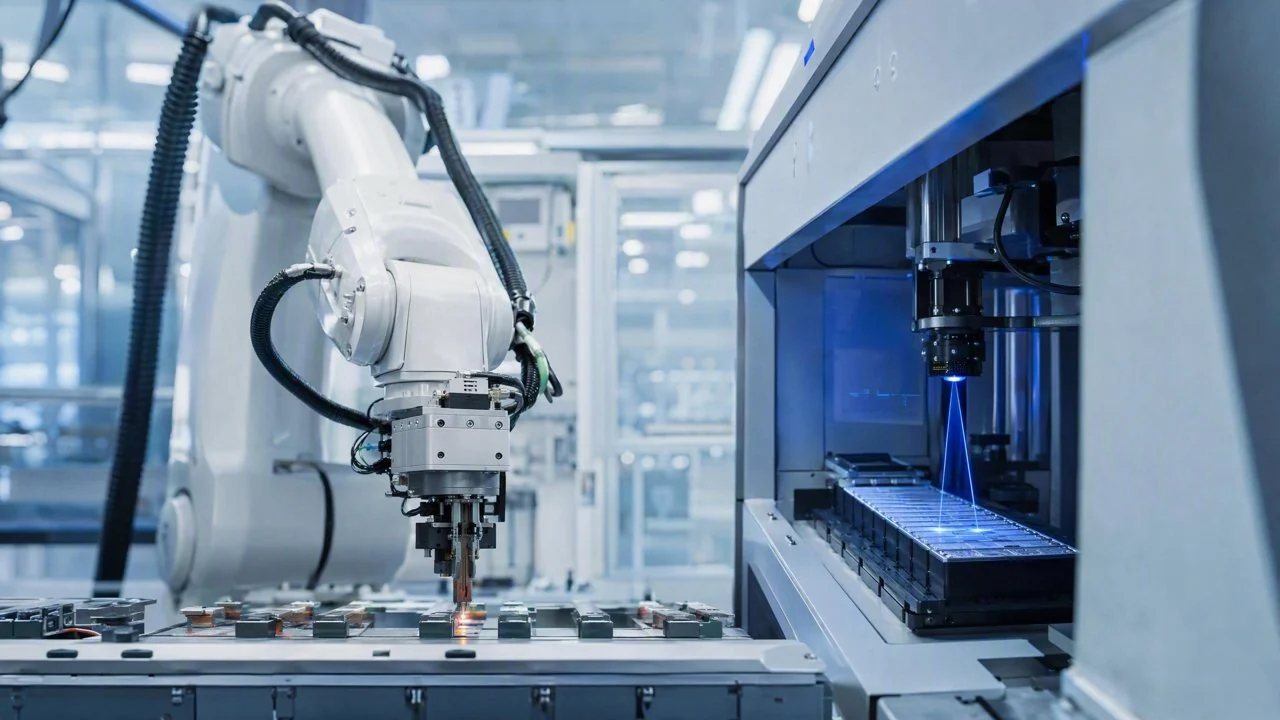
DaoAI's 3D ACI equipment (featuring proprietary 3D cameras + 3D morphology reconstruction/point cloud, capable of detecting hidden solder joints, coplanarity, micron-level features, porosity, and other 2D optical blind spot defects, with 2D-3D fusion) precisely identifies defects and significantly reduces false positives, cutting re-inspection volume in new energy battery tab welding by 75%, thereby substantially improving production line efficiency and quality control.
In the quality gate for new energy battery tab welding, DaoAI's 3D ACI equipment (featuring proprietary 3D cameras + 3D morphology reconstruction/point cloud, capable of detecting hidden solder joints, coplanality, micron-level features, porosity, and other 2D optical blind spot defects, with 2D-3D fusion) precisely identifies defects and significantly reduces false positives, cutting re-inspection volume in new energy battery tab welding by 75%, thereby substantially improving production line efficiency and quality control. As core components of electric vehicles and energy storage systems, the performance and safety of new energy batteries directly depend on every detail in the manufacturing process. Tab welding is one of the critical steps in battery manufacturing, connecting the cell to external circuits, and its quality directly affects the battery's internal resistance, charge-discharge efficiency, and cycle life. Any minor burr, cold solder joint, porosity, or morphological anomaly can lead to battery performance degradation or even safety incidents. A leading battery module supplier, during its expansion, faced significant challenges in tab welding quality inspection, especially in maintaining a high detection rate while effectively controlling false positive rates to avoid unnecessary re-inspection and resource waste, which became a pressing core issue.
Pain Points: Why This Hurdle Is So Difficult to Overcome
In the quality inspection of new energy battery tab welding, traditional solutions face multiple challenges, leading to persistently high false positive rates that severely impact production line efficiency. Firstly, due to the often complex geometries and micron-level details of tab solder joints, traditional 2D AOI struggles to acquire accurate 3D information. This limits the precision in identifying defects such as solder burrs, cold solder joints, and porosity, potentially leading to a miss detection rate exceeding 0.5%, while false positive rates often hover between 5% and 10%. This means that for every 1000 solder joints inspected, 50 to 100 false positives might occur, requiring extensive manual re-inspection, consuming valuable human resources and time, with manual re-inspection sometimes accounting for up to 30% of total inspection time.
Secondly, after laser welding, tab materials (such as aluminum, nickel, etc.) form complex reflections and textures on the surface. Especially under varying lighting angles, 2D images are highly susceptible to shadows and highlights, further exacerbating false positives. Moreover, with the iteration of battery technology, tab solder joints are becoming smaller, thinner, and denser, posing nanometer-level challenges for inspection accuracy. Traditional rule-based vision or 2D AI algorithms based on limited samples lack generalization capabilities when faced with these tiny, irregular, and variable defects. They struggle to adapt to rapid line changeovers and multi-variety, small-batch production demands, leading to long downtime for each changeover and affecting overall production line rhythm. In the context of domestic substitution, achieving precise and efficient detection of these micron-level or even sub-micron-level defects while simultaneously reducing false positive rates is one of the core technical challenges in current industrial AI vision.
Technical Principles
DaoAI's 3D ACI equipment fundamentally overcomes the limitations of traditional 2D inspection through its proprietary 3D camera and advanced 3D morphology reconstruction technology. This equipment utilizes multi-frequency phase-shifting structured light technology, combined with high-resolution industrial cameras, to rapidly acquire complete 3D point cloud data of solder joints with sub-micron accuracy. By reconstructing the 3D morphology from the point cloud data, we obtain true geometric information of the solder joint, such as height, volume, coplanarity, and slope, rather than solely relying on 2D grayscale or color information. For instance, cold solder joints or porosity might only appear as brightness anomalies in 2D images, but 3D data clearly reveals their depression depth or internal voids, thus preventing misjudgments. The DaoAI ACI OS, integrated into the DaoAI 3D ACI, features a built-in visual foundation model that supports APDT positive-sample/few-shot learning. It requires only 1–20 good samples to achieve 0-code automatic programming within 5 minutes, quickly adapting to new defect types and product models, significantly improving changeover efficiency.
Compared to traditional rule-based AOI, DaoAI's 3D ACI no longer relies on engineers manually setting complex thresholds and geometric rules; instead, it automatically learns defect features through deep learning algorithms. This method exhibits stronger robustness to lighting variations, product surface textures, and material reflections, significantly reducing false positive rates. Compared to 2D AI-only solutions, DaoAI's 3D ACI's 2D-3D fusion detection capability combines texture and color information from 2D images with morphological features from 3D data for more comprehensive judgments. For example, a tiny burr might be indistinct in a 2D image, but its protrusion height is clear in 3D data; conversely, a color change due to surface oxidation requires 2D image assistance. This fusion mechanism enables DaoAI's 3D ACI to achieve a detection rate of over 99.7% for hidden solder joints, micron-level morphological anomalies, and other 2D optical blind spot defects, while simultaneously reducing the false positive rate to <1.5%, significantly outperforming traditional industry solutions.
Typical Application Scenarios
- **Tab Solder Burr Detection:** DaoAI's 3D ACI utilizes 3D morphological data to precisely measure the protrusion height and volume of solder joint edges, identifying micron-level burrs. Traditional 2D inspection is susceptible to shadow interference, making it difficult to distinguish real burrs from surface textures, whereas 3D data provides unbiased geometric information.
- **Cold Solder and Pseudo Solder Detection:** For cold solder joints leading to weak bonding or pseudo solder causing poor contact, DaoAI's 3D ACI analyzes the 3D contour and height variations of the solder joint to detect depressions, collapses, or irregular morphologies, which are depth-related information difficult to capture in 2D images.
- **Solder Joint Coplanarity Detection:** In multi-row tab welding, ensuring all solder joints are on the same plane is crucial. DaoAI's 3D ACI can precisely calculate the Z-axis height of each solder joint, evaluate overall coplanarity, and identify tilts or unevenness exceeding tolerance, ensuring the stability of electrical connections.
- **Solder Joint Porosity and Crack Detection:** Internal pores or surface micro-cracks generated during welding are critical defects affecting battery performance and safety. DaoAI's 3D ACI, leveraging its high-resolution 3D reconstruction capability, can identify tiny holes and cracks on the solder joint surface that might be overlooked or misidentified as surface textures in 2D images.
Case Study
A leading Tier-1 supplier of new energy batteries faced significant challenges in tab welding inspection when expanding its battery module production line. Due to a wide variety of products and frequent changeovers, their existing 2D AOI system had a false positive rate as high as 8%–10%, requiring substantial manual re-inspection daily, severely slowing down the production line rhythm, and struggling to meet the demands of rapid new product introduction. The client introduced DaoAI's 3D ACI equipment. Before deployment, the client's production line, due to high false positive rates, required 4 quality inspectors for 8 hours of manual re-inspection daily, with re-inspection volume accounting for about 8% of the total inspection, and occasional miss detections. With the assistance of the DaoAI team, by collecting a small number of good samples (only 15 images), the DaoAI ACI OS completed model training and deployment within 10 minutes. After deployment, DaoAI's 3D ACI successfully reduced the false positive rate to below 2%, and the re-inspection volume consequently decreased by 75%.
“The application of DaoAI's 3D ACI has not only significantly reduced our false positive rate but also freed up a large amount of human labor, allowing our quality inspection team to focus on higher-value work. This is not just an equipment upgrade, but a revolution in our production model.” — Production Manager, a leading Tier-1 New Energy Battery Supplier
DaoAI Solutions and Products
DaoAI's core solution for the new energy battery tab welding quality gate is its 3D ACI equipment, based on its proprietary 3D camera and 3D morphology reconstruction technology. This equipment integrates the DaoAI ACI OS, leveraging the powerful feature recognition capabilities of its visual foundation model to achieve rapid deployment with “one good sample, 5 minutes, 0-code automatic programming.” Through the APDT positive-sample/few-shot learning mechanism, even when facing complex and variable tab solder joint defects, high-precision model training can be completed with just 1–20 good samples, greatly shortening changeover time from several hours to within 10 minutes, ensuring the production line rhythm remains unaffected. DaoAI's 3D ACI equipment supports 100% local private deployment, with data remaining on-site, meeting strict client requirements for data security and compliance. Furthermore, DaoAI World as a unified foundation model supports semantic understanding and cross-scenario generalization, continuously learning from production line feedback to optimize inspection models, ensuring long-term operational stability and accuracy.
By deploying DaoAI's 3D ACI solution, the client achieved significant business value. Firstly, the false positive rate decreased by 75%, directly reducing a large amount of manual re-inspection work, saving 3 quality inspectors per shift, and effectively controlling labor costs. Secondly, the miss detection rate was reduced to <0.3%, ensuring stable and reliable product quality, and mitigating risks of rework, recalls, and brand reputation damage due to defective products. Changeover time was shortened to 10min, enhancing production line flexibility and enabling quick responses to market demand changes. Overall, DaoAI's 3D ACI solution not only improved inspection accuracy and efficiency but also brought tangible economic benefits and competitive advantages to new energy battery manufacturers by reducing false positive rates and easing the re-inspection burden.
FAQ
What are the core advantages of DaoAI's 3D ACI equipment compared to traditional 2D AOI for new energy battery tab welding inspection?
DaoAI's 3D ACI utilizes a proprietary 3D camera and 3D morphology reconstruction technology, enabling it to acquire true 3D geometric information of solder joints. This addresses the blind spots of 2D AOI, which cannot detect hidden solder joints, coplanarity, micron-level features, and porosity. Coupled with 2D-3D fusion detection and AI algorithms, it significantly reduces false positive rates, improves detection rates, and supports rapid programming with few samples, adapting to complex and varied battery tab welding scenarios.
What is the typical cost and return on investment (ROI) period for deploying DaoAI's 3D ACI solution?
Deployment costs primarily depend on production line scale, required equipment quantity, and customization needs. While initial investment may be higher than traditional 2D AOI, by significantly reducing false positive rates, minimizing manual re-inspection, improving production line rhythm, and increasing product yield, the ROI period typically falls within 6-18 months. Specific quotes and ROI calculations require evaluation based on the client's actual situation; we recommend scheduling an expert consultation for a detailed proposal.
How does DaoAI's 3D ACI ensure data security and production line integration?
DaoAI's 3D ACI supports 100% local private deployment, meaning all inspection data is processed and stored within the client's factory, ensuring data never leaves the premises and meeting stringent data security and compliance requirements. For production line integration, the equipment provides standardized SDK/API/Docker interfaces, allowing integration with existing MES/SCADA systems for data closed-loop management and remote monitoring, ensuring smooth deployment.
Full solution for this scenario: New-energy batteries industry solutions · Tab Welding Quality Gate
This article was generated by AI. Customer cases are simulated scenarios based on real product capabilities and figures are illustrative; see product pages for official benchmarks.