
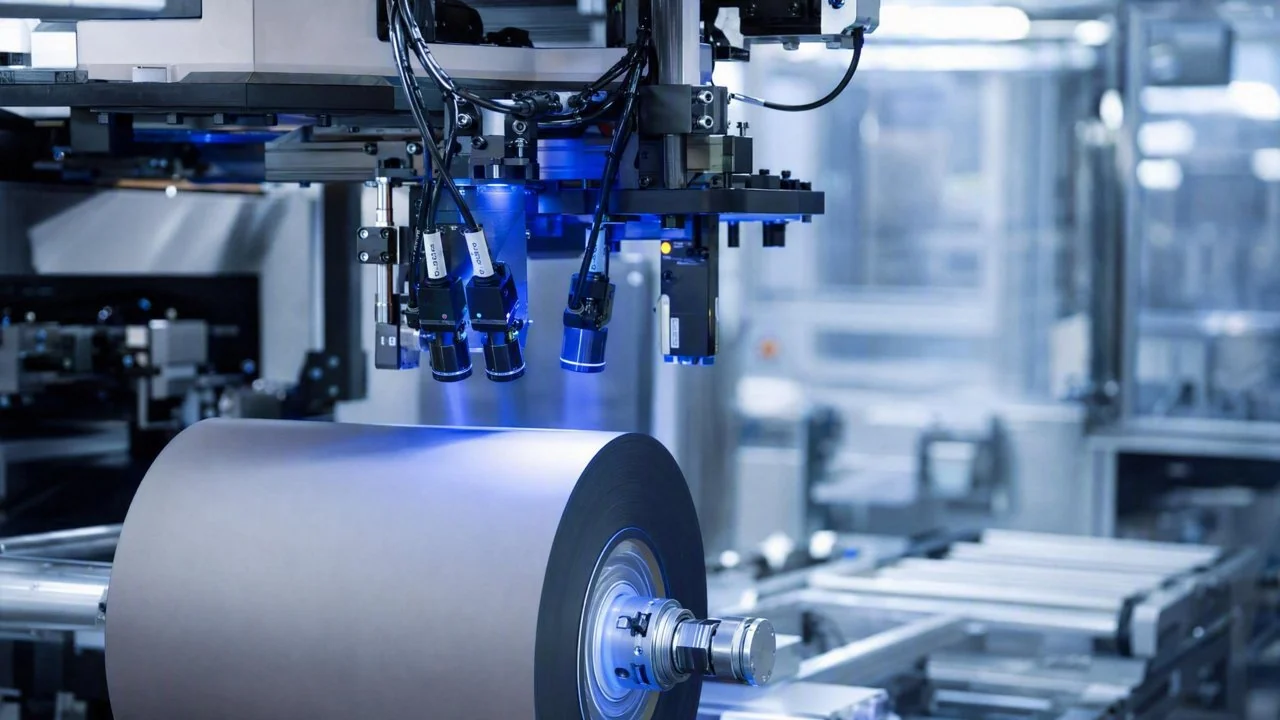
DaoAI 3D ACI equipment, leveraging proprietary 3D cameras and 3D morphology reconstruction, has reduced changeover times from hours to under 5 minutes in new energy battery winding/stacking anode-cathode alignment, achieving zero-code rapid changeover and flexible inspection for multi-variety small-batch production, significantly enhancing production line efficiency and product quality.
DaoAI 3D ACI equipment, utilizing proprietary 3D cameras and 3D morphology reconstruction, has reduced traditional changeover times from hours to under 5 minutes in new energy battery winding/stacking anode-cathode alignment. This achieves zero-code rapid changeover and flexible inspection for multi-variety small-batch production, significantly boosting line efficiency and product quality. As the core of electric vehicles and energy storage systems, the precision of new energy battery manufacturing directly determines battery performance, safety, and cycle life. Winding or stacking is a critical step in cell manufacturing, where anode and cathode materials require precise alignment to prevent short circuits, capacity degradation, and localized overheating. Traditionally, non-destructive testing methods like X-ray CT have been widely used in this segment, but their high cost, slow cycle time, and reliance on operator expertise make them inadequate for the growing demand for multi-variety small-batch production. The client's challenge was how to drastically reduce changeover times between different cell models while maintaining nanometer-level alignment precision, adapting to rapid product iteration cycles in the market.
Pain Points: Why This Hurdle Is So Difficult to Overcome
The inspection challenges for new energy battery winding/stacking anode-cathode alignment primarily manifest in several dimensions: First, **high precision requirements**, with alignment deviations typically at the micron or even sub-micron level, which traditional 2D optical inspection struggles to capture. Second, **difficulty in detecting hidden defects**; while X-ray CT can penetrate materials, its equipment cost is high, and image processing is complex, making it difficult to achieve full production line inspection. Third, **inefficient changeovers**, where traditional AOI systems or X-ray CT equipment require several hours for parameter adjustment, calibration, and program writing when facing different sizes and material formulations of cells, leading to long production line downtime. This is particularly problematic in multi-variety small-batch production, where changeover downtime accounts for a significant portion, directly increasing unit costs and limiting overall production line cycle time. Finally, there is the **urgency for domestic substitution**, as high-end precision inspection equipment has long relied on imports, incurring high procurement costs, slow after-sales response, and supply chain security risks, necessitating domestically controlled solutions.
The root causes of these difficulties lie in: at the process level, the physical properties of anode and cathode materials (e.g., reflectivity, transparency) and minute deformations during winding/stacking pose challenges for high-precision visual inspection; at the imaging level, traditional 2D cameras cannot acquire depth information, making it difficult to accurately determine 3D alignment deviations or micron-level morphological defects, while X-ray CT's image resolution and contrast are poor for certain light element materials; at the algorithm level, traditional rule-based algorithms struggle to adapt to material and size diversity, making manual programming for changeovers time-consuming and labor-intensive. Today's industry focus on the domestic substitution path and core technological challenges in nanometer-level precision inspection highlights the necessity and urgency of overcoming these technical barriers. DaoAI understands these pain points and is committed to providing high-quality domestic alternative solutions through its proprietary technology.
Technical Principles
The core of DaoAI's 3D ACI equipment lies in its proprietary 3D camera and advanced 3D morphology reconstruction technology, integrated with the DaoAI ACI OS. We use multi-view structured light projection and image acquisition, applying the principle of triangulation to precisely reconstruct the 3D point cloud data of the object under inspection, achieving micron-level accuracy. This point cloud data contains complete 3D morphological information of the object's surface, enabling effective detection of defects within 2D optical blind spots, such as minor misalignment of anode and cathode materials, edge warping, or even internal pores or local thickness anomalies. Unlike traditional 2D AOI, which can only judge planar defects by grayscale or color differences, DaoAI 3D ACI can directly quantify morphological deviations in 3D space, such as coplanarity, height differences, and volume, thereby achieving more precise alignment inspection.
Compared to traditional X-ray CT, DaoAI 3D ACI offers significant advantages. Firstly, 3D ACI uses optical imaging, avoiding X-ray radiation, making it safer and more environmentally friendly, with equipment costs significantly lower than X-ray CT. Secondly, DaoAI's ACI OS, based on visual foundation models and APDT few-shot learning capabilities, allows users to provide only 1-20 good samples, enabling the system to complete model training and achieve zero-code automatic programming within 5 minutes. This contrasts sharply with traditional rule-based AOI, which requires engineers to spend hours or even days writing complex rules, and X-ray CT's complex image reconstruction and analysis processes. This zero-code rapid changeover capability is key for DaoAI 3D ACI to address the challenges of multi-variety small-batch production, drastically reducing downtime associated with traditional changeover methods and greatly improving production line flexibility and utilization.
Typical Application Scenarios
- **Anode and Cathode Misalignment Detection:** During winding or stacking, detecting micron-level misalignment of anode and cathode edges. DaoAI 3D ACI precisely measures the relative positions between different electrode sheets through high-precision 3D point cloud reconstruction, identifying and quantifying lateral and longitudinal alignment deviations, which are difficult for traditional 2D vision to accurately determine.
- **Edge Warping and Wrinkle Detection:** Electrode sheets may exhibit edge warping or surface wrinkles during winding or stacking, defects that can cause uneven internal stress in the battery, affecting performance. DaoAI 3D ACI can identify and quantify these minute 3D deformations through morphology reconstruction, ensuring electrode sheet flatness.
- **Coating Thickness Uniformity Analysis:** While dedicated inspection exists for the coating process, a secondary check of coating thickness uniformity in the electrode sheet edge area before winding/stacking can prevent alignment difficulties or subsequent short-circuit risks due to local thickness anomalies. DaoAI 3D ACI can use its 3D morphological data to assist in analyzing local thickness variations.
- **Multi-layer Stacking Coplanarity Detection:** In stacked cells, the overall coplanarity of multiple stacked electrode sheets is crucial. Any unevenness in a single layer can lead to poor internal battery contact. DaoAI 3D ACI can detect the overall flatness and local coplanarity of multi-layer material stacks, ensuring stable cell structure.
- **Micro Bubble and Foreign Object Detection:** During winding/stacking, micro bubbles or foreign objects may adhere to the electrode sheet surface. These defects can be difficult to detect in 2D images due to low contrast or occlusion. DaoAI 3D ACI's 3D information provides richer features, combined with AI algorithms, to identify these micron-level foreign objects, enhancing detection robustness.
Deployment Case Study
A leading new energy battery manufacturer faced challenges in expanding its high-nickel ternary lithium battery production line, specifically with mixed-line production of various cell types (prismatic, cylindrical, pouch). Their traditional X-ray CT inspection equipment had changeover times of up to 3-4 hours, severely impacting production cycle times and failing to meet the growing demand for multi-variety small-batch orders. The client urgently needed a solution that offered rapid changeover, ensured inspection accuracy, and demonstrated domestic substitution capabilities. Upon introducing DaoAI's 3D ACI equipment, we initially piloted it on the winding alignment process for their prismatic cells. Before deployment, changing cell models on this line required engineers to manually adjust X-ray CT parameters, scan paths, and configure complex image analysis software, with each changeover taking at least 3 hours. This resulted in nearly a full shift's production loss daily due to changeovers. Furthermore, the traditional solution's detection rate for micron-level edge warping was inadequate.
The DaoAI team thoroughly assessed the client's existing production line and deployed our 3D ACI equipment. Leveraging the APDT few-shot learning capability of the DaoAI ACI OS, engineers only needed to provide about 10 good cell images. The system then completed new product model training and deployment within 5 minutes. After deployment, the manufacturer's changeover time was drastically reduced from an average of 3 hours to less than 5 minutes, representing a changeover efficiency improvement of over 97%. Concurrently, DaoAI's 3D ACI equipment consistently achieved a detection rate of over 99.7% for defects such as anode/cathode misalignment and minor warping, with a false negative rate controlled to <0.3%, significantly exceeding client expectations. This successful case not only resolved the client's immediate challenges but also laid the groundwork for DaoAI's subsequent deployment across other production lines at the manufacturer's facilities.
The zero-code rapid changeover capability of DaoAI's 3D ACI equipment has truly enabled flexible production for our line, compressing changeover times from hours to minutes. This is a new improvement in a multi-variety small-batch order model.
DaoAI Solution and Products
The core solution provided by DaoAI is based on its proprietary 3D ACI equipment, which integrates high-precision 3D cameras and powerful 3D morphology reconstruction algorithms capable of acquiring complete 3D data of the object under inspection. Combined with the DaoAI ACI OS, we achieve a fully automated process from data acquisition to defect identification, classification, and judgment. For rapid changeover and multi-variety small-batch production, DaoAI's ACI OS plays a crucial role: its APDT positive sample/few-shot learning technology allows users to quickly train high-precision models with only a minimal amount of good sample data (1-20 images), without writing any code. This means that when the production line needs to switch to manufacturing different cell models, operators do not require complex programming or parameter adjustments; they simply learn the good samples of the new product, completing the changeover within minutes and significantly reducing downtime. Furthermore, the system supports 100% local private deployment, ensuring customer data security and compliance with strict industry requirements for data privacy.
DaoAI's 3D ACI equipment not only delivers outstanding inspection capabilities but also provides a new solution for the new energy battery industry with its extreme ease of use and flexible production capabilities. In addition to the core 3D ACI equipment, DaoAI can also offer the DaoAI World model as a unified foundation, enabling semantic understanding and cross-scenario generalization, continuously learning from production line feedback to optimize inspection performance. This closed-loop learning mechanism ensures that the system can quickly adapt and improve detection accuracy when confronted with new defect types. Through these technologies, DaoAI helps clients significantly reduce production interruptions caused by changeovers, enhance overall production line efficiency, and ensure product quality, thereby maintaining a leading position in fierce market competition.
FAQ
How to choose between DaoAI 3D ACI equipment and traditional X-ray CT for new energy battery inspection?
DaoAI 3D ACI equipment primarily detects surface and near-surface morphological defects, such as alignment deviations, warping, and micron-level pores, through optical 3D reconstruction. It offers high precision, no radiation, rapid changeover, and low cost, making it ideal for full-line inspection and multi-variety small-batch production. X-ray CT, on the other hand, excels at detecting internal battery structural defects like deep pores or internal fractures, but it's costly and slow. The choice depends on specific defect types, inspection precision, production line cycle time, and budget. DaoAI's solution can achieve efficient domestic substitution for most surface defect inspection scenarios.
What is the principle behind DaoAI 3D ACI equipment's zero-code rapid changeover?
DaoAI 3D ACI equipment's zero-code rapid changeover is attributed to its integrated DaoAI ACI OS. This system utilizes advanced APDT few-shot learning technology and visual foundation models. Users do not need to write complex inspection rules or code; they simply provide a small number (1-20) of images of good products for different models. The system then autonomously learns and builds high-precision inspection models. When the production line needs to switch to a different product, it only requires loading the corresponding model or learning a few good samples of the new product, completing the changeover within minutes. This significantly reduces the debugging time of traditional AOI equipment, greatly enhancing production line flexibility and efficiency.
What is the budget and timeline for deploying DaoAI 3D ACI equipment?
The budget and timeline for deploying DaoAI 3D ACI equipment vary depending on the specific application scenario, inspection requirements, production line integration complexity, and equipment configuration. Typically, we provide customized solutions and detailed quotations based on the client's production line layout, existing automation level, and the types of defects and precision required. From initial communication to equipment installation, debugging, and model deployment, it usually takes several weeks to several months. We encourage clients to schedule a consultation with our sales engineers to receive a personalized assessment and accurate cost and time estimates, ensuring the solution is optimized and fits your budget.
Full solution for this scenario: the full inspection solution for New-energy batteries
This article was generated by AI. Customer cases are simulated scenarios based on real product capabilities and figures are illustrative; see product pages for official benchmarks.