
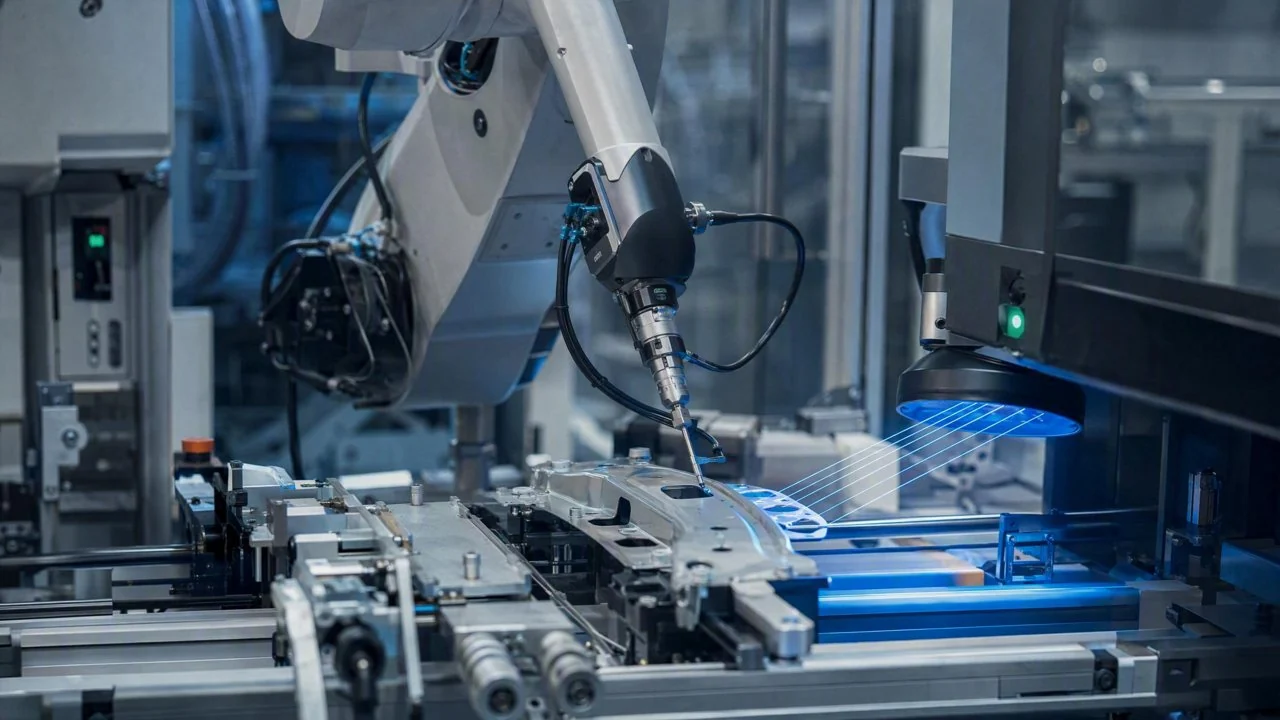
DaoAI 3D ACI equipment (proprietary 3D camera + 3D morphology reconstruction/point cloud, detecting hidden solder joints/coplanarity/micron-level morphology/voids and other 2D optical blind spot defects, 2D-3D fusion) significantly accelerated online inspection speed in automotive component dispensing lines by over 2.5 times through high-speed 3D data acquisition and AI intelligent analysis, ensuring 100% full inspection without impacting production throughput, and reducing false negatives to below 0.2%.
In automotive component manufacturing, dispensing and sealing are critical processes for ensuring product performance, safety, and durability. Whether it's engine blocks, transmission housings, battery pack modules, or body structure sealing, the quality of dispensing directly impacts multiple functions such as leak prevention, dust protection, sound insulation, and vibration damping. With the proliferation of new energy vehicles and the trend towards lightweighting, there are increasing demands on dispensing materials, process precision, and inspection methods. Traditionally, the detection of such dispensing defects heavily relied on manual visual inspection or 2D vision-based rule inspection. However, on high-speed production lines, due to complex 3D geometries, reflective properties of the adhesive, and stringent production throughput requirements, ensuring 100% full inspection without slowing down production has been a significant industry challenge. DaoAI 3D ACI equipment is transforming this landscape by significantly enhancing the efficiency and quality of online inspection for automotive component dispensing lines through high-speed 3D data acquisition and AI intelligent analysis.
Pain Points: Why This Hurdle is Difficult to Overcome
The dispensing and sealing processes in automotive components present multiple complex challenges for inspection systems, making it difficult for traditional solutions to meet production demands. Firstly, there's a **conflict between production throughput and full inspection capacity**: On automotive production lines, which often operate at sub-second cycle times, traditional 2D vision or manual inspection often cannot complete 100% comprehensive inspection of complex dispensing paths within the limited time, leading to high sampling rates and a significant risk of potential defects flowing into subsequent processes. Secondly, **the complexity and concealment of defect types**: Dispensing defects include not only easily observable types like broken beads, overflow, air bubbles, uneven width, and insufficient thickness, but also micron-level depressions, internal delamination, poor adhesion, and other 3D morphological defects that are difficult for 2D vision to capture, as well as hidden defects like voids and impurities within the adhesive, all of which severely impact sealing performance. Thirdly, **interference from material properties**: Adhesive materials often exhibit high reflectivity, semi-transparency, or colors similar to the background, making them prone to misjudgment or missed detection in 2D images, especially for dispensing in complex curved surfaces or deep cavities, where traditional light sources and algorithms struggle to achieve stable imaging and analysis. Finally, **high costs of re-inspection and rework**: Once defects escape, they can lead to component scrap, recalls, or even safety incidents, with repair, recall, and brand reputation losses far exceeding initial investments.
The root cause of these pain points lies in the fact that traditional 2D vision systems essentially only acquire planar grayscale information, rendering them incapable of handling 3D information such as depth and height. When dispensing paths are complex and adhesive morphology varies, issues like shadows, reflections, and insufficient contrast in 2D images severely interfere with detection. Furthermore, industrial AI vision systems face particular challenges in sensor calibration and data interpretation in complex environments, such as with adhesive materials, requiring an automated solution capable of precise 3D morphology capture and intelligent analysis. Traditional AOI often relies on manually setting numerous rules, which are highly prone to false positives or negatives when facing subtle morphological variations, and tooling changeovers are time-consuming. Manual visual inspection is not only inefficient but also highly subjective and inconsistent, making it impossible to meet the 100% inspection demands of high-speed production lines.
Technical Principles
DaoAI 3D ACI equipment fundamentally addresses the limitations of traditional 2D vision, centered on its **proprietary high-precision 3D camera and advanced 3D morphology reconstruction technology**. The equipment employs multi-angle structured light or laser triangulation principles to rapidly acquire point cloud data of the inspected object. Through precise sensor calibration algorithms, multiple frames of images or point cloud data are fused to reconstruct a complete 3D morphological model of the dispensed area, with micron-level accuracy. This process is unaffected by the color or reflective properties of the adhesive, directly acquiring real height, volume, width, and other geometric information, thereby effectively avoiding the inherent blind spots of 2D vision in adhesive inspection. Building upon this, the DaoAI engine integrates deep learning algorithms to intelligently analyze the reconstructed 3D point cloud data. It can automatically learn and identify the 3D features of good dispensing and quickly and accurately detect various 3D defects such as broken beads, overflow, voids, depressions, and uneven width. For example, internal voids within the adhesive can be identified by analyzing the density and microscopic surface morphology changes of the point cloud data; for micron-level depressions or insufficient thickness, direct quantitative judgment is made using height information. Compared to traditional rule-based AOI, DaoAI 3D ACI equipment offers the advantage of not requiring manual setting of complex thresholds and rules. Instead, its APDT few-shot self-training function allows model training with only 1–20 good samples, significantly reducing programming and debugging time, and enhancing generalized detection capabilities for complex, variable defects. Compared to manual inspection, DaoAI 3D ACI offers a qualitative leap in consistency, speed, and accuracy, enabling 100% comprehensive, objective, and traceable online inspection, with inspection cycle times highly matched to production line throughput, ensuring it does not become a production bottleneck. DaoAI 3D ACI equipment can suppress false negatives to <0.2%, effectively guaranteeing product quality.
Furthermore, DaoAI 3D ACI equipment supports 2D-3D fusion inspection. This means it can not only utilize 3D data for high-precision morphological analysis but also combine 2D image texture and color information for supplementary detection of specific defects (e.g., foreign objects, color anomalies), forming a more comprehensive defect recognition capability. This fusion solution further enhances defect detection rates and anti-interference capabilities while ensuring high-speed inspection, demonstrating excellent performance in complex environments like automotive dispensing.
Typical Application Scenarios
- **Engine/Transmission Housing Sealant Inspection**: Detects whether the sealant bead on the housing joint surface is continuous, uniform in width, consistent in height, and free from defects such as broken beads, overflow, air bubbles, or depressions. The difficulty lies in the adhesive often being located in deep cavities or curved surfaces, with material color potentially close to the background, making it challenging for traditional 2D vision to accurately determine its 3D morphology.
- **Battery Pack Module Dispensing Inspection**: The sealing of new energy vehicle battery packs is crucial, requiring inspection of the quality of thermal paste and sealant applied between modules or on cooling plates. The difficulty lies in complex adhesive paths and micron-level requirements for thickness, width, and uniformity, while also needing to meet extremely high production cycle times.
- **Automotive Body Structure Weld Seam Sealant Inspection**: Applying sealant to spot welds or laser weld seams on the car body to enhance corrosion resistance and sound insulation. DaoAI 3D ACI equipment can detect whether the bead completely covers the weld seam, and if there is peeling, breakage, or insufficient width. The difficulty lies in the uneven surface of the weld seam area and the adhesive adhering to complex geometric structures.
- **Interior/Exterior Trim Bonding Dispensing Inspection**: Such as adhesive dispensing for dashboards, door panels, sunroofs, etc., to ensure bonding strength and aesthetic quality. Inspects the continuity, width, height of the adhesive path, and whether there is overflow affecting appearance. The difficulty lies in the combination of multiple materials and strict requirements for aesthetic defects.
- **Path Correction and Quality Closed-Loop**: In addition to defect detection, the high-precision 3D data acquired by DaoAI 3D ACI equipment can be used for real-time evaluation of dispensing path deviations. For example, when a deviation in bead position or width from the standard is detected, the system can feed this deviation data back to the dispensing robot, enabling real-time correction of the dispensing path, forming a quality closed-loop, and further improving dispensing accuracy and yield.
Case Study
A leading domestic Tier-1 automotive component supplier faced severe challenges in the thermal paste dispensing process for new energy vehicle battery pack cooling plates. Their production line required a cycle time of 120 components per minute, but traditional manual visual inspection and 2D vision-based rule AOI solutions could only achieve an inspection speed of 40-50 components per minute, far from meeting the 100% full inspection requirement, leading to reliance on sampling. This not only increased the risk of missed defects but also incurred significant manual re-inspection hours, with an average of 2-3 quality inspectors dedicated to re-inspection daily. More critically, due to the semi-transparent nature of the thermal paste and complex 3D paths, traditional 2D vision had a false negative rate of over 0.8% for micron-level defects such as uneven thickness and air bubbles, directly impacting the battery pack's heat dissipation performance and safety.
After implementing DaoAI 3D ACI equipment, the manufacturer achieved 100% full inspection on the dispensing line, with inspection speed increasing by 2.5 times, false negatives reduced to <0.2%, and annual savings in quality inspection labor costs exceeding 200,000 RMB.
To overcome this bottleneck, the supplier introduced DaoAI 3D ACI equipment. During deployment, DaoAI engineers optimized the system for their specific thermal paste material and dispensing process. Using the APDT few-shot self-training function, model training was completed with just 15 good samples, and line integration and debugging were finished in less than 30 minutes. After going live, DaoAI 3D ACI equipment achieved a high-speed inspection of 125 components per minute, perfectly matching the production line throughput and successfully enabling 100% full inspection. Simultaneously, thanks to its precise 3D morphology reconstruction and intelligent AI analysis capabilities, the detection rate for micron-level defects increased to over 99.8%, false negatives decreased to <0.2%, and false positives were controlled below 0.5%. The production line no longer required additional re-inspection personnel, saving over 200,000 RMB annually in quality inspection labor costs alone, while significantly improving product quality and customer satisfaction.
DaoAI Solutions and Products
The core solution provided by DaoAI for automotive component dispensing and sealing inspection is its **DaoAI 3D ACI equipment**. This equipment integrates DaoAI's proprietary high-speed, high-precision 3D camera and a powerful 3D morphology reconstruction engine, capable of acquiring 3D point cloud data of the dispensed area with extreme speed and accuracy. Based on this data, combined with the DaoAI ACI OS, leveraging its visual foundation models and APDT few-shot self-training function, customers only need to provide a small number of good samples (1–20 images) to complete 0-code automatic programming in 5 minutes, quickly deploying detection models. This system can not only detect various defects that are difficult for traditional 2D vision to find, such as micron-level depressions, voids, uneven thickness, etc., but also analyze geometric deviations of the dispensing path in real-time. It can also be integrated with robot control systems to achieve online correction of dispensing paths, forming a closed-loop intelligent manufacturing process. DaoAI 3D ACI equipment supports 100% local private deployment, ensuring customer data security within the factory.
In addition to the core 3D ACI equipment, DaoAI also offers a range of complementary products and capabilities to further enhance the flexibility and scalability of the solution. For example, the DaoAI Robot Vision system can collaborate with the 3D ACI equipment to provide 6D pose guidance for dispensing robots, ensuring dispensing precision; the DaoAI World Model, as a unified AI foundation, imbues the system with stronger semantic understanding and cross-scenario generalization capabilities, allowing it to continuously learn and optimize from production line feedback. These capabilities collectively build a complete solution from detection to correction, from single-point optimization to full-process intelligence, helping automotive component manufacturers achieve higher quality dispensing and sealing while maintaining production line throughput. DaoAI 3D ACI equipment shortens product changeover time to within 5min, significantly improving the flexibility of the production line.
FAQ
How does DaoAI 3D ACI equipment guarantee production throughput?
DaoAI 3D ACI equipment, through its proprietary high-speed 3D camera and optimized 3D morphology reconstruction algorithms, can complete data acquisition and analysis at extremely high frame rates and processing speeds. Combined with the fast inference capability of the DaoAI AI engine, the system can perform 100% comprehensive inspection of complex dispensing paths within seconds or even sub-seconds, ensuring full compatibility with the high-speed production cycles of the automotive industry without becoming a bottleneck, thus achieving efficient online full inspection.
What are the advantages of 3D ACI equipment over traditional 2D AOI for dispensing inspection?
Compared to traditional 2D AOI, which only acquires planar information, DaoAI 3D ACI equipment can reconstruct the complete 3D morphology of the dispensed material, directly obtaining geometric data such as height, volume, and width. This means it can detect micron-level depressions, uneven thickness, internal voids, and other defects that 2D vision cannot identify. It is also unaffected by surface properties like adhesive reflection or color variations, significantly improving detection accuracy, stability, and defect coverage, especially suitable for dispensing inspection on complex 3D structures.
What is the budget required to deploy DaoAI 3D ACI equipment?
The budget for DaoAI 3D ACI equipment depends on the specific application scenario, required inspection accuracy, complexity of production line integration, and desired functional modules (e.g., whether it includes robot vision linkage, path correction, etc.). We offer flexible configuration options to meet diverse customer needs. We recommend contacting our sales engineers; after providing detailed requirements, we will offer a customized solution and precise quotation, along with an evaluation of the return on investment period.
Full solution for this scenario: the full inspection solution for Automotive / parts · 100% Inline 3D Inspection & Path Correction for Automotive Glue Dispensing
This article was generated by AI. Customer cases are simulated scenarios based on real product capabilities and figures are illustrative; see product pages for official benchmarks.