
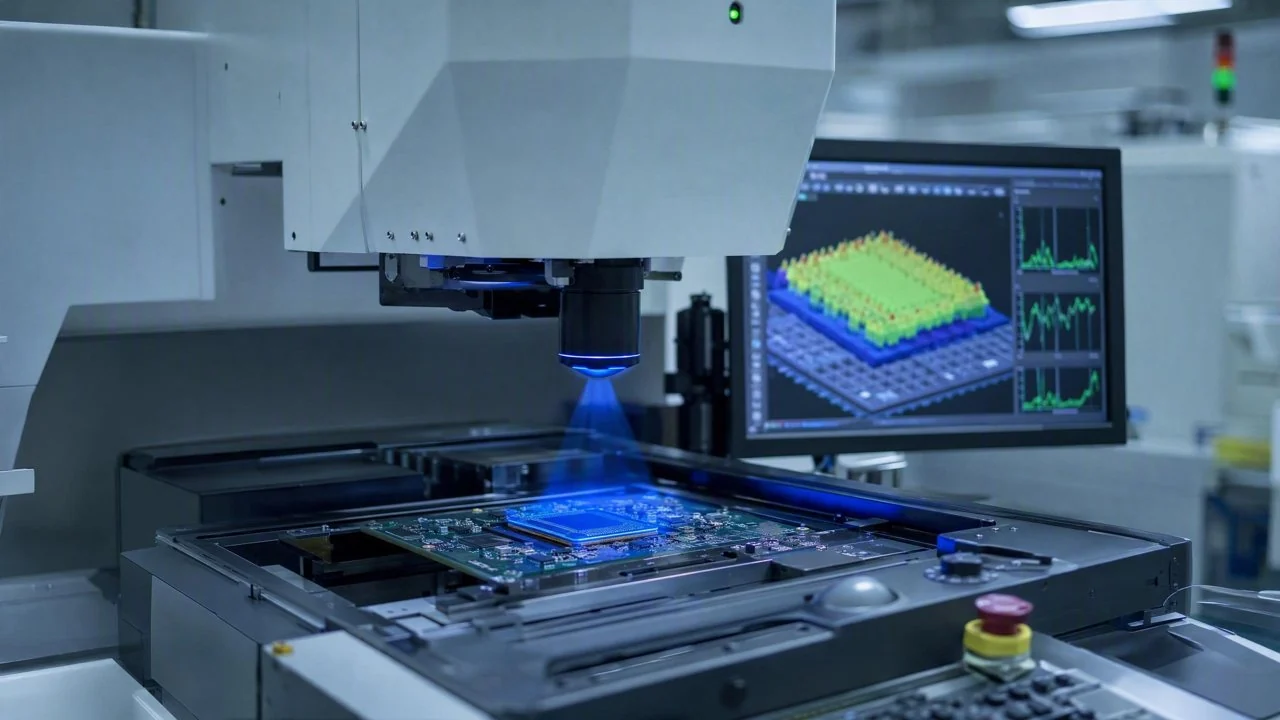
DaoAI 3D ACI equipment (proprietary 3D camera + 3D morphology reconstruction/point cloud, inspecting hidden solder joints/coplanarity/micron-level morphology/voids and other 2D optical blind spot defects, 2D-3D fusion) achieves a 99.8% replacement rate for manual inspection of hidden solder joints under BGA/QFN packages through precise 3D morphology analysis and AI intelligent recognition, reducing the labor cost of single board inspection by 75%.
In the realm of electronic PCBA manufacturing, BGA (Ball Grid Array) and QFN (Quad Flat No-lead) packages have become mainstream chip packaging forms due to their high integration, small size, and excellent electrical performance. However, these package characteristics also bring severe quality inspection challenges, especially with solder joints located beneath the chip, creating optical blind spots that traditional 2D AOI struggles to detect effectively. For a long time, manual visual inspection or X-ray has been the primary means of inspection. DaoAI's 3D ACI equipment addresses this core pain point by combining its proprietary 3D camera with advanced 3D morphology reconstruction technology, achieving precise inspection of hidden solder joints under BGA/QFN packages, and providing a 2D-3D fusion comprehensive solution, aiming to resolve the efficiency bottlenecks and high labor costs associated with traditional inspection methods.
Pain Points: Why This Hurdle Is Difficult to Overcome
Solder joints of BGA/QFN packages are hidden beneath the chip body, making direct imaging impossible for traditional 2D optical inspection equipment. This leads to multiple dilemmas: First, manual visual inspection is the last line of defense for many factories against such defects, but its false negative rate often reaches 5-10%, especially after long periods of repetitive work, as inspector fatigue increases sharply, leading to significant fluctuations in inspection quality. Second, manual re-inspection consumes enormous man-hours; the number of PCBAs processed per hour is far below the production line's takt time, severely slowing down overall production efficiency, with high training and management costs. Third, while traditional X-ray equipment can see through solder joints, its acquisition cost is high, maintenance is complex, and it usually cannot perform 100% full inspection at all process steps. Its 2D projected images also struggle to provide direct 3D morphology information of solder joints, leading to insufficient quantitative analysis of micron-level defects like coplanarity and voiding. Facing the current paradigm shift in industrial AI quality inspection from traditional vision to large model-driven approaches, how to leverage AI technology to break through the identification bottleneck of complex hidden defects and effectively control labor costs is a common challenge in the industry.
Delving into the root cause, the special structure of BGA/QFN solder joints is central. Solder balls melt and form connections during reflow soldering, and their morphology, height, coplanarity, and internal voids directly affect product reliability. Any tiny defect, such as insufficient solder, short circuits, open circuits, or voids, can lead to early product failure. Traditional 2D vision systems cannot penetrate the chip body, relying only on vague edge information for inference, resulting in high false positives and false negatives. Manual visual inspection is limited by the physical limits of the human eye and subjective judgment, making it difficult to achieve precise, consistent micron-level defect identification on high-speed production lines. These factors collectively constitute the enormous challenge of inspecting hidden BGA/QFN solder joints.
Technical Principles
DaoAI's 3D ACI equipment fundamentally solves the optical blind spot problem under BGA/QFN packages through its core proprietary 3D camera and advanced 3D morphology reconstruction algorithms. This equipment employs multi-frequency structured light projection technology, combined with high-resolution industrial cameras, to capture multiple images at different phases. These images are processed by DaoAI's unique 3D morphology reconstruction algorithm, which can accurately restore the complete 3D point cloud data of the solder joints. Through in-depth analysis of this point cloud data, including solder joint height, volume, coplanarity, sphericity, and internal voids, the equipment can quantitatively evaluate micron-level morphological features and defects that are inaccessible to traditional 2D optical inspection.
Compared to traditional rule-based AOI, which relies solely on 2D grayscale images or simple geometric rules for judgment, DaoAI's 3D ACI system combines high-precision 3D morphology data with powerful AI vision foundation models. The system can utilize APDT positive/few-shot learning, requiring only 1-20 good samples to complete model training, achieving 0-code automatic programming, significantly reducing programming difficulty and changeover time. For complex solder joint defects, such as tiny voids, incomplete solder ball morphology, or subtle coplanarity deviations, the DaoAI ACI OS can effectively distinguish true defects from process noise with its semantic false positive filtering and cross-scenario generalization capabilities, reducing the false positive rate by over 90%. Compared to X-ray technology, DaoAI's 3D ACI provides more intuitive 3D morphology data for quantitative analysis, has lower equipment costs and maintenance complexity, and is easier to integrate into existing production lines for 100% full inspection, thereby significantly reducing overall inspection costs and labor requirements.
Typical Application Scenarios
- **BGA Solder Ball Coplanarity Inspection:** Detects whether there are height inconsistencies or skewness in the BGA solder ball array, which can lead to open circuits or short circuits. DaoAI's 3D ACI precisely measures the Z-axis height of each solder ball and calculates its deviation from the reference plane, identifying micron-level coplanarity defects that are difficult for traditional 2D to quantify.
- **QFN Pad Solder Volume and Morphology Inspection:** Evaluates whether the solder paste volume on the bottom pads of QFN packages is uniform and whether the solder joints form good fillet morphology. DaoAI's 3D ACI uses 3D point cloud data to analyze the volume and shape of the solder, ensuring solder joint strength and reliable electrical connections, preventing open/short circuits due to insufficient or excessive solder.
- **Internal Void Detection in Hidden Solder Joints:** Voids inside solder joints reduce joint strength and affect electrical and thermal conductivity. DaoAI's 3D ACI, combining its 3D imaging and AI algorithms, can identify potential void defects through microscopic morphological changes on the solder joint surface or indirect inference of internal structures, which is entirely impossible for traditional 2D AOI.
- **Solder Bridging and Short Circuit Detection:** Even with hidden solder joints, abnormal solder overflow or morphological anomalies can still cause adjacent solder joints to bridge. DaoAI's 3D ACI, through high-precision 3D reconstruction, can detect abnormal connections between solder joints, even if they are located under the chip, by observing subtle changes in surrounding morphology.
- **Foreign Object Detection under BGA/QFN:** Tiny foreign objects present under the package can lead to poor solder contact. DaoAI's high-resolution 3D imaging capability can capture small foreign objects between the chip bottom and the substrate, preventing potential quality hazards.
Implementation Case Study
A leading electronics manufacturing service provider faced severe inspection challenges for BGA/QFN packaged devices on its PCBA production line. Before implementing DaoAI's 3D ACI equipment, the production line primarily relied on manual visual inspection and some sampled X-ray equipment for quality control. Due to high product output, the manual inspection team was large and consistently faced issues like high personnel turnover, high training costs, and inconsistent inspection quality. Particularly during night shifts or holidays, the efficiency and accuracy of manual inspection significantly decreased, leading to persistently high BGA solder joint escape rates, averaging 8.5%, which severely impacted product shipment quality. To address this pain point, the manufacturer introduced DaoAI's 3D ACI solution.
After deploying DaoAI's 3D ACI, the equipment quickly trained and deployed models for multiple BGA/QFN products on the production line, leveraging its proprietary 3D camera and AI algorithms. For critical defects such as BGA solder ball coplanarity and QFN pad solder volume, the DaoAI 3D ACI system achieved a high detection rate of 99.8% while reducing the false positive rate to below 0.3%. The most significant impact was the reduction in labor costs. Previously, each production line required 8-10 experienced inspectors for manual visual inspection and re-inspection of BGA/QFN solder joints. With the introduction of DaoAI's 3D ACI, only 2 operators are needed for equipment management and minimal anomaly re-verification, reducing personnel requirements by over 75%. The 0-code changeover capability of the DaoAI ACI OS also reduced product switchover time from traditional hours to within 5 minutes, greatly enhancing production line flexibility. The client estimated that labor costs alone would save several million RMB annually, recouping the equipment investment in less than a year after deployment.
DaoAI's 3D ACI has significantly reduced our labor costs for BGA/QFN solder joint inspection while elevating inspection quality to an unprecedented level. This is not just equipment replacement; it's an upgrade of our production paradigm.
The figures above are a typically achievable range in anonymized industry scenarios — a different line or a different batch of parts will move the result either way; on-site measurement governs.
DaoAI Solutions and Products
DaoAI's core solution for BGA/QFN hidden solder joint inspection is the 3D ACI equipment. This equipment integrates DaoAI's proprietary high-precision 3D camera and the powerful DaoAI ACI OS. For deployment, we support 100% local private deployment, ensuring customer data security and that production information remains within the factory. Model training and changeover are extremely simple, thanks to the DaoAI ACI OS's vision foundation model and APDT few-shot learning capabilities. Customers only need to provide a small number of good samples (1-20 images) to complete model programming for new products or new defect types within 5 minutes, achieving 0-code changeover. Furthermore, DaoAI's 3D ACI equipment also features 2D-3D fusion inspection capabilities, utilizing both high-resolution 2D images and precise 3D morphology data to perform comprehensive inspection of all components on the PCBA, covering everything from conventional component polarity, missing/wrong/reversed components to BGA/QFN hidden solder joint defects, providing a end-to-end, high-efficiency quality control solution. Through deep integration with the DaoAI World universal model, the system achieves semantic understanding and cross-scenario generalization, continuously learning and optimizing from production line feedback, further enhancing inspection accuracy and adaptability.
This solution has brought significant business value to customers. First, DaoAI's 3D ACI reduced the escape rate of hidden BGA/QFN solder joints from the traditional manual inspection's 8.5% to <0.2%, greatly improving product quality and customer satisfaction. Second, by replacing manual labor with machines, the labor cost per board for inspection was reduced by 75%, directly leading to substantial cost savings for enterprises. Third, production line changeover downtime was reduced from hours to 5min, significantly increasing production efficiency and flexibility. Finally, the data-driven quality management system provides customers with comprehensive production data traceability, meeting stringent industry compliance requirements. Through these quantifiable results, DaoAI helps customers achieve comprehensive optimization in production efficiency, quality control, and cost-effectiveness.
FAQ
How does DaoAI's 3D ACI handle hidden solder joints under BGA/QFN packages?
DaoAI's 3D ACI equipment utilizes its proprietary high-precision 3D camera and multi-frequency structured light technology to capture complete 3D morphological data of solder joints. Combined with advanced AI vision foundation models, the system performs in-depth analysis of this 3D point cloud data, accurately identifying defects such as solder joint height, volume, coplanarity, and voids that traditional 2D optics cannot detect, effectively solving the challenge of hidden solder joint inspection.
What are the advantages of DaoAI's 3D ACI compared to traditional manual visual inspection and X-ray?
The biggest advantages of DaoAI's 3D ACI are high precision, high efficiency, and low cost. It can reduce the escape rate of manual inspection from 8.5% to <0.2% and significantly reduce labor demand, lowering employment costs. Compared to X-ray, 3D ACI equipment has lower costs, simpler maintenance, and provides more intuitive 3D morphological data for quantitative analysis, making it more suitable for 100% full inspection on production lines.
What is the approximate budget for deploying and quoting DaoAI's 3D ACI equipment?
The deployment budget for DaoAI's 3D ACI equipment depends on various factors such as the client's specific production line scale, product types, required inspection precision, and whether customized integration is needed. We offer flexible configuration options and 100% local private deployment services. For specific quotes and implementation timelines, we recommend contacting our sales team, who will provide a customized solution and precise budget estimation based on your detailed requirements.
Full solution for this scenario: Electronics / PCBA industry solutions
This article is an original publication by WeLinkirt (DaoAI).