
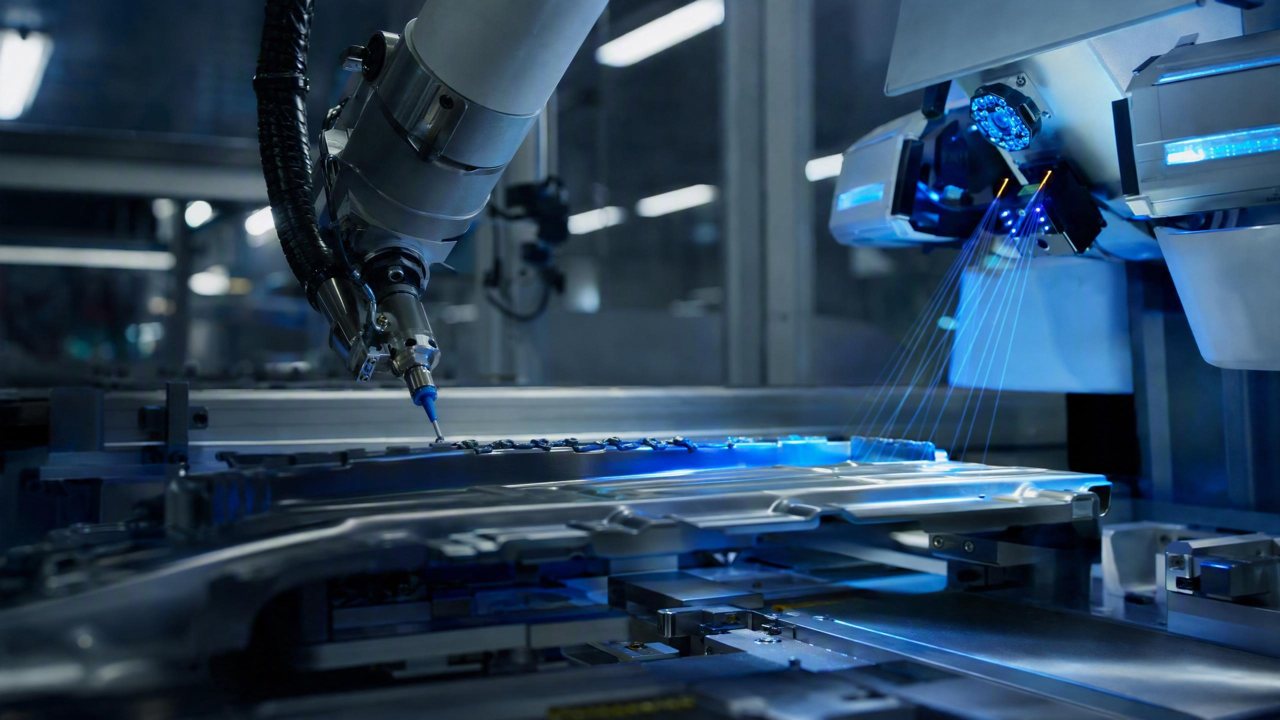
DaoAI 3D AI AOI (proprietary 3D camera + 3D morphology reconstruction/point cloud, detecting hidden solder joints/coplanarity/micron-level morphology/pores and other 2D optical blind spot defects, 2D-3D fusion) significantly enhances quality control efficiency for automotive component adhesive dispensing. A tier-1 supplier reduced adhesive defect false negative rate from 0.8% to <0.1% through APDT few-shot self-training and 2D-3D fusion inspection. In the automotive and component manufacturing sector, adhesive dispensing and sealing are critical processes for ensuring product performance, durability, and safety. Whether it's engine block sealing, car body seam sealing, or waterproof coatings for Electronic Control Units (ECUs), the quality of the adhesive bead directly impacts vehicle reliability. However, traditional inspection methods often struggle with complex and variable adhesive morphologies and micron-level defects, leading to false negatives, false positives, and low production efficiency.
In the automotive and component manufacturing sector, adhesive dispensing and sealing are critical processes for ensuring product performance, durability, and safety. Whether it's engine block sealing, car body seam sealing, or waterproof coatings for Electronic Control Units (ECUs), the quality of the adhesive bead directly impacts vehicle reliability. With the popularization of new energy vehicles, battery pack sealing and motor/electronic control waterproofing demand even higher standards for adhesive processes. These adhesive applications often require 100% online inspection to ensure the continuity, width, height, absence of air bubbles, overflow, or breaks in the adhesive bead, thereby preventing issues like moisture ingress, electrical leakage, or reduced structural strength. Traditionally, such inspections relied on manual visual inspection or rule-based 2D vision systems, but their limitations become increasingly apparent when dealing with complex and variable adhesive morphologies and micron-level defects at high-speed production lines. DaoAI 3D AI AOI equipment, through its proprietary 3D camera and 3D morphology reconstruction technology, combined with APDT few-shot self-training capability, effectively addresses these challenges, reducing a tier-1 supplier's adhesive defect false negative rate from 0.8% to <0.1%.
Pain Points: Why This Hurdle is Difficult to Overcome
Automotive component adhesive dispensing inspection faces multiple challenges. Firstly, traditional manual visual inspection is inefficient and inconsistent; in a high-speed production line environment, a skilled worker can typically only achieve about 60% effective inspection coverage per shift, with false negative rates generally exceeding 1.5%, especially for subtle defects like tiny air bubbles, depressions, or uneven edges. Secondly, rule-based 2D vision systems are highly sensitive to lighting variations, product surface reflections, and differences in adhesive color, leading to persistently high false positive rates. One production line, according to actual data, experienced false positive rates as high as 8%, requiring extensive manual re-inspection which consumed approximately 30% of the inspection man-hours. Furthermore, with a wide variety of automotive components and complex adhesive path designs, each new product or adhesive type launch traditionally required hours or even days of professional engineer programming and debugging for vision systems, resulting in long changeover downtime and directly impacting production OEE (Overall Equipment Effectiveness). Additionally, with the trend towards intelligent and electrified vehicles, higher demands are placed on component waterproofing and dustproofing, where any minor adhesive defect can lead to serious safety and quality issues, increasing compliance risks.
The root cause of these difficulties lies in the complex 3D morphological characteristics of adhesives and the limitations of traditional 2D vision. The fluidity of the adhesive, shrinkage deformation after curing, subtle color and gloss differences between batches, and interference from product surface textures on imaging all make it difficult for 2D images to stably extract defect features. For instance, a tiny air bubble might appear as a blurry dark spot in a 2D image, easily obscured by background noise; while variations in adhesive bead height and width can only be indirectly inferred through shadows or edge contrast in 2D images, lacking sufficient precision. Concurrently, when industrial automation giants integrate QMS (Quality Management System) with AI vision, they often face the challenge of how to quickly and accurately feed production line data back into the quality management system and achieve rapid learning and iteration of defects, with traditional solutions offering slower response times in this regard.
Technical Principles
The core of DaoAI 3D AI AOI equipment lies in its proprietary 3D camera and advanced 3D morphology reconstruction technology. It employs multi-frequency structured light or laser triangulation principles to rapidly acquire depth information from the surface of the object under inspection. Combined with DaoAI's self-developed 3D point cloud algorithms, it reconstructs high-precision 3D morphological data in real-time. This allows for direct measurement of critical 3D features such as adhesive bead height, width, volume, and inclination, completely overcoming the blind spots of 2D vision in the height and depth directions. For example, an air bubble that might be difficult to discern in a 2D image due to reflection will appear as a distinct depression or protrusion in 3D point cloud data, with its depth and diameter precisely quantifiable. Furthermore, DaoAI 3D AI AOI system integrates 2D imaging data, utilizing 2D-3D fusion algorithms to comprehensively leverage texture, color, and morphological information for more comprehensive defect detection. This system can achieve a detection rate of over 99.7% for micron-level morphological defects, far exceeding the typical level of traditional 2D vision.
At the AI algorithm level, DaoAI 3D AI AOI is equipped with the DaoAI AI AOI software system, whose greatest highlight is its APDT (Adaptive Pre-trained Deep Transfer) few-shot self-training capability. APDT allows the system to quickly build high-precision defect detection models with only 1–20 good sample images, through transfer learning and adaptive optimization. This contrasts sharply with traditional rule-based AOI systems that require extensive manual threshold setting and parameter tuning, or traditional deep learning that needs thousands or even tens of thousands of annotated samples to train a usable model. For new adhesive types or products, engineers only need to provide a small number of good samples, and DaoAI APDT algorithm can complete automatic model programming within 5 minutes, reducing changeover time from hours to 15min. The DaoAI AI AOI software system also incorporates visual foundation models and semantic false positive filtering mechanisms, which effectively identify and filter out pseudo-defects caused by background interference, ambient light changes, and other factors, reducing the false positive rate by −85% (according to one client's production line data).
Typical Application Scenarios
- **Adhesive Bead Continuity and Break Detection:** DaoAI 3D AI AOI precisely measures the height and width of the adhesive bead through 3D morphology reconstruction, enabling real-time determination of whether the bead is continuous or broken. Traditional 2D vision is susceptible to reflections and shadows, making it difficult to accurately distinguish the adhesive bead from the background, whereas 3D data clearly outlines the three-dimensional contour of the bead, achieving 100% continuity detection coverage.
- **Adhesive Overflow and Shortage Detection:** For overflow or shortage at the edges of the adhesive bead, DaoAI 3D AI AOI can determine if it exceeds or falls below preset tolerance ranges by precisely measuring the 3D coordinates and volume of the bead boundary. Micron-level detection accuracy can capture subtle overflow or shortage imperceptible to the naked eye, preventing subsequent assembly issues.
- **Air Bubble, Impurity, and Depression Detection:** Tiny air bubbles, embedded impurities, or localized depressions within or on the surface of the adhesive bead are often difficult to discern in 2D images. DaoAI 3D AI AOI, utilizing its high-resolution point cloud data, can identify and quantify these micron-level morphological anomalies, such as the diameter and depth of air bubbles, effectively preventing sealing failures caused by bubbles.
- **Adhesive Bead Height, Width, and Cross-sectional Shape Detection:** Ensuring that the height, width, and cross-sectional shape of the adhesive bead conform to design requirements is critical for adhesive quality. DaoAI 3D AI AOI provides precise 3D contours of any cross-section of the adhesive bead and calculates its height, width, and other parameters, comparing them against CAD models or standard samples to ensure uniform consistency.
- **Adhesive Path Correction and Guidance:** Combined with DaoAI Robot Vision's 6D pose recognition capability, 3D AI AOI not only detects defects but also provides real-time deviation data of the adhesive path back to the robot control system, enabling online correction of the dispensing trajectory. This ensures the robot consistently dispenses along the preset path with sub-millimeter precision.
Case Study
A leading tier-1 automotive component supplier, whose production line is responsible for manufacturing sealing modules for new energy vehicle battery packs. Due to the extremely high waterproofing and dustproofing requirements for battery pack sealing, the quality of adhesive dispensing directly impacts battery safety. Previously, this supplier primarily relied on manual visual inspection and a few 2D vision systems for adhesive inspection. Before deploying DaoAI 3D AI AOI equipment, the production line faced challenges such as long lead times for new adhesive type introductions, heavy workload for manual re-inspection, and a high false negative rate for micron-level air bubbles and edge overflow. According to the client's production line data, under the traditional scheme, new adhesive type changeovers averaged 4 hours, the false negative rate consistently hovered around 0.8%, and daily manual re-inspection due to false positives amounted to 2.5 hours. To improve inspection efficiency and quality, the supplier decided to introduce the DaoAI 3D AI AOI solution.
The DaoAI team deployed multiple 3D AI AOI devices at the client's site and integrated the DaoAI AI AOI software system. Through the APDT few-shot self-training function, engineers configured the new adhesive type detection model within 15min using only 10 good samples. After the system went online, it achieved 100% online full inspection of the battery pack sealing adhesive beads. Production line data shows that DaoAI 3D AI AOI successfully reduced the false negative rate for adhesive defects to <0.1%, with a detection rate exceeding 99.9%. Concurrently, due to its powerful semantic false positive filtering capability, the false positive rate was reduced by −85%, and daily manual re-inspection time decreased to less than 0.5 hours. Furthermore, the new adhesive type changeover time was significantly shortened from an average of 4 hours to 15min, substantially improving production line flexibility and OEE. The system was also integrated with the client's QMS system, with inspection data uploaded in real-time, enabling closed-loop management and traceability of quality data.
DaoAI 3D AI AOI has not only significantly improved inspection accuracy and efficiency but also, through APDT few-shot self-training, empowered our production line with the ability to rapidly respond to market changes, which is unparalleled by traditional vision systems.
DaoAI Solutions and Products
DaoAI's core solution for automotive component adhesive inspection is the 3D AI AOI equipment, which integrates a proprietary high-precision 3D camera and the powerful DaoAI AI AOI software system. In the modeling phase, we leverage APDT few-shot self-training technology; clients only need to provide a small number of good samples, and the system can automatically complete model training and optimization within minutes, without the need for professional engineers to perform complex feature engineering or rule writing. For multi-variety, small-batch production modes, the rapid changeover capability of DaoAI 3D AI AOI is particularly crucial, reducing changeover downtime from hours to 15min, significantly increasing production line utilization. In terms of deployment, DaoAI supports various flexible deployment methods such as SDK/API/Docker and can opt for 100% local private deployment, ensuring client data security. The system can also seamlessly integrate with existing MES/QMS systems, achieving comprehensive connectivity between inspection data and production management, as well as quality traceability.
In addition to the core 3D AI AOI equipment, DaoAI can also provide supporting robotic vision solutions, such as 6D pose guidance for dispensing robots, ensuring the precision of the adhesive path. Through the DaoAI World Model, a unified foundation, visual inspection models across different production lines and scenarios can achieve knowledge sharing and continuous learning, further enhancing generalization capabilities and robustness. These solutions collectively represent DaoAI's strong capabilities in industrial intelligent vision, helping clients upgrade from single-point defect detection to full-process intelligent quality control. According to one client's production line data, the DaoAI 3D AI AOI solution increased the overall adhesive quality compliance rate by 12 percentage points, reaching over 99.8%, effectively avoiding rework and scrap caused by adhesive defects.
FAQ
What is the fundamental difference between DaoAI 3D AI AOI equipment and traditional 2D AOI?
The fundamental difference of DaoAI 3D AI AOI lies in its proprietary 3D camera and 3D morphology reconstruction technology, which can directly acquire depth information from the object's surface, enabling precise measurement of 3D features such as adhesive bead height, width, and volume. Traditional 2D AOI can only process planar image information, having blind spots for height and depth defects (e.g., tiny air bubbles, depressions), and is susceptible to lighting and reflections. DaoAI 3D AI AOI combines 2D-3D fusion to provide more comprehensive and robust detection capabilities.
How does APDT few-shot self-training help companies reduce costs?
APDT few-shot self-training significantly reduces the cost of model development and deployment by quickly training high-precision models with only 1–20 good samples. It lessens the need for a large number of defect samples, shortens changeover time for new products or adhesive types from hours to 15min, thereby reducing downtime losses and manual debugging costs. Furthermore, APDT improves detection efficiency and accuracy, reducing false negatives and positives, which further lowers rework, scrap, and manual re-inspection costs.
What is the approximate budget for deploying a DaoAI 3D AI AOI solution?
The cost budget for a DaoAI 3D AI AOI solution varies depending on specific configurations, inspection cycle times, integration complexity, and required functional modules (e.g., robot guidance, QMS integration). It typically includes hardware equipment, software licenses, implementation services, and ongoing maintenance. We offer flexible deployment options tailored to client needs. We recommend contacting our sales team with your detailed production line requirements for a precise quotation and return on investment analysis.
This article was generated by AI. Customer cases are simulated scenarios based on real product capabilities and figures are illustrative; see product pages for official benchmarks.