
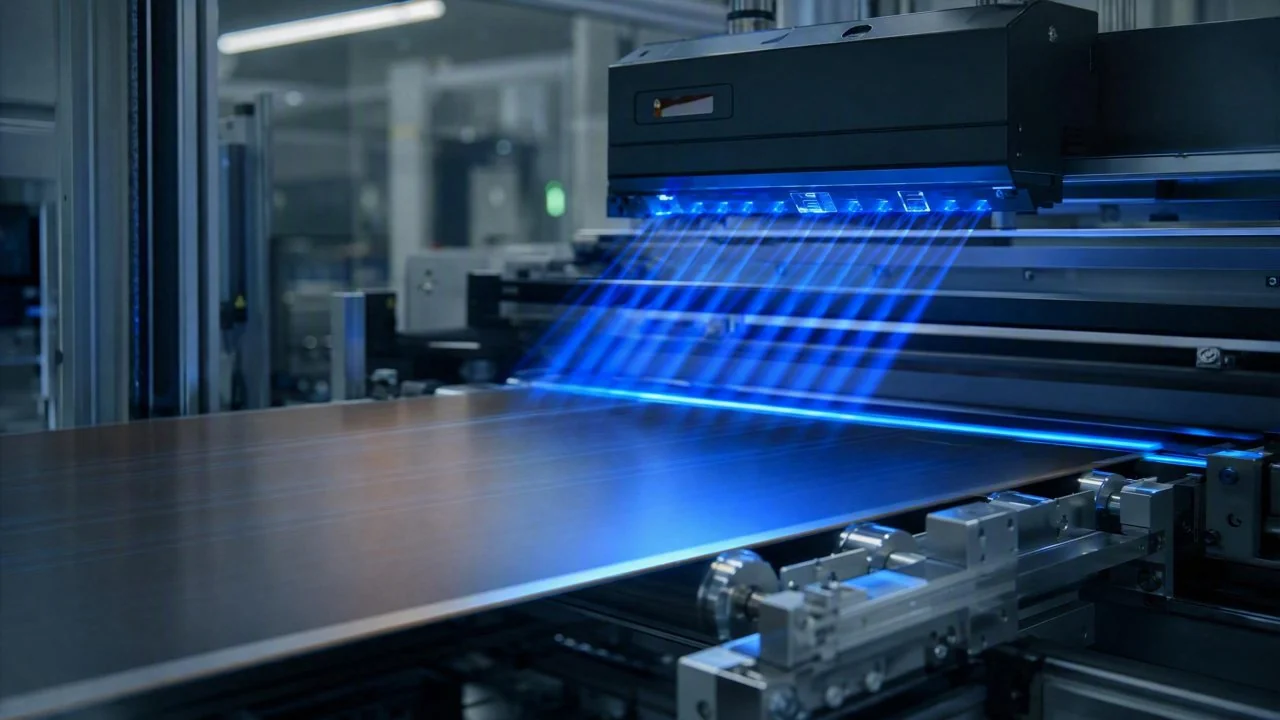
In the online full inspection of new energy battery anode coating, DaoAI 3D AI AOI equipment, leveraging its self-developed 3D camera and 3D morphology reconstruction technology, accurately identifies micron-level defects, reducing labor costs by approximately 70% for a mid-sized battery manufacturer, significantly enhancing production line automation and quality consistency.
In the online full inspection of new energy battery anode coating, DaoAI 3D AI AOI equipment, leveraging its self-developed 3D camera and 3D morphology reconstruction technology, accurately identifies micron-level defects, reducing labor costs by approximately 70% for a mid-sized battery manufacturer, significantly enhancing production line automation and quality consistency. As the core of electric vehicles and energy storage systems, the performance and safety of new energy batteries are highly dependent on the quality of the anode. Anode coating is one of the critical processes in battery manufacturing, directly affecting battery energy density, cycle life, and internal resistance. However, tiny defects during the coating process, such as uneven coating, scratches, pores, foreign matter, edge damage, or abnormal thickness, if not detected and corrected online in time, will lead to huge waste in subsequent processes and even pose battery safety hazards. Traditionally, such inspections often rely on extensive manual visual inspection, which is inefficient and susceptible to subjective factors.
Pain Points: Why This Hurdle Is Difficult to Overcome
In the online full inspection of anode coating, manual visual inspection faces multiple challenges. First, there's the issue of detection accuracy and missed detection rate: coating defects are often tiny and diverse, such as micron-level pores or extremely thin coating scratches, making it difficult for the human eye to maintain consistent judgment standards for extended periods of high intensity, leading to high missed detection rates, which in some production lines can reach 3-5% according to actual measurements. Second, there are huge labor costs and personnel turnover: a high-speed coating line usually requires multiple workers to rotate shifts for visual inspection, which not only incurs high labor costs but also leads to employee fatigue due to repetitive, high-pressure work environments, resulting in high turnover rates and further increasing recruitment and training costs. According to production line data from a mid-sized battery manufacturer, the direct labor cost for inspection positions in the coating section alone amounts to several million RMB annually. Furthermore, there's a contradiction between production line rhythm and data closed-loop: manual inspection speed is limited, making it difficult to match the rhythm of high-speed coating lines, often becoming a production bottleneck. At the same time, manual inspection results are difficult to quantify precisely and trace data, making it impossible to effectively support data closed-loop for process optimization and quality management. This is one of the key bottlenecks in the industrial AI quality inspection implementation process, in addition to model accuracy, including data annotation, edge deployment, and production line integration.
The root cause of these pain points lies in the characteristics of the anode material and the complexity of the coating process. The surface of the anode often appears matte or slightly reflective, and the coating thickness is extremely thin. Traditional 2D optical inspection is susceptible to lighting angles, reflection interference, or insufficient contrast, limiting its ability to identify micron-level morphological defects and resulting in a large number of 2D optical blind spots. For example, pores within the coating or tiny bulges may only appear as blurry shadows or inconspicuous texture changes in 2D images, making them very easy to miss. Moreover, the large width and high speed of the anode place extremely high demands on the stability and real-time performance of online inspection systems. Traditional rule-based AOI struggles to adapt to complex and diverse defect patterns, and its false alarm rate is often high, requiring extensive manual re-inspection, further exacerbating labor costs.
Technical Principles
DaoAI 3D AI AOI equipment fundamentally solves the blind spot problem of traditional 2D optical inspection through its self-developed 3D camera and advanced 3D morphology reconstruction technology. The equipment adopts a multi-frequency structured light projection scheme, combined with a high-resolution camera array, to collect real-time 3D point cloud data of the surface while the anode moves at high speed. Through DaoAI's unique point cloud processing algorithms, micron-level 3D morphology of the anode surface can be reconstructed with high precision. Unlike traditional 2D images which only capture brightness and color information, 3D point cloud data directly contains spatial information such as height, depth, and volume of defects, making the identification of tiny morphological defects such as uneven coating, scratches, pores, and bulges more accurate and robust. For example, a tiny pore that is difficult to distinguish in a 2D image appears as a clear, quantifiable depression or protrusion in the 3D point cloud, and its depth and diameter can be precisely measured.
Compared to traditional manual visual inspection and rule-based AOI, the advantage of DaoAI 3D AI AOI lies in its 2D-3D fusion detection capability and AI-driven intelligent discrimination. The equipment simultaneously collects 2D high-definition images and 3D point cloud data, and performs deep fusion analysis through the DaoAI AI AOI software system. Based on the feature recognition capabilities of the visual foundation model, the system can quickly learn the characteristics of normal anodes from a small number of good samples (1-20 images) and, combined with the APDT positive/few-shot learning mechanism, perform high-precision identification of abnormal morphologies. This fusion detection avoids the limitations of single-dimension detection; for example, 2D images can better identify colored foreign objects, while 3D point clouds excel at capturing morphological defects. In addition, the DaoAI AI AOI software system features semantic false alarm filtering, which can effectively reduce false alarms caused by process fluctuations or environmental interference, reducing the false alarm rate by approximately 85%, significantly reducing the workload of manual re-inspection. In actual production line tests at a mid-sized battery manufacturer, this DaoAI system reduced the missed detection rate to <0.5%, far below the level of manual visual inspection.
Typical Application Scenarios
- **Coating Thickness and Uniformity Detection:** DaoAI 3D AI AOI equipment obtains high-precision height maps of the coating surface through 3D morphology reconstruction, accurately measuring coating thickness and identifying local areas that are too thick, too thin, or uneven. The challenge lies in stable measurement at high anode speeds and micron-level precision requirements.
- **Scratch and Foreign Matter Detection:** 2D-3D fusion detection can effectively identify tiny scratches, indentations, and attached foreign matter on the anode surface. 2D images are used for color and texture identification of foreign matter, while 3D point clouds provide depth and width information for scratches, avoiding missed detections of low-contrast scratches by traditional 2D solutions.
- **Pore and Bulge Detection:** This is a typical blind spot for 2D optical inspection. DaoAI 3D AI AOI equipment can accurately identify micron-level pores, bulges, and depressions within or on the surface of the coating, providing precise 3D dimensions and location information, which is crucial for battery performance.
- **Edge Damage and Burr Detection:** The integrity of the anode edge is vital for subsequent winding and stacking processes. 3D morphology reconstruction can clearly outline the anode edge profile, identifying tiny chipping, burrs, or irregular shapes, effectively preventing short-circuit risks caused by edge defects.
- **Coating Particle and Agglomerate Detection:** Particles or agglomerates in the coating slurry can form local protrusions, affecting battery internal resistance and consistency. The 3D AI AOI equipment can accurately identify and quantify the size and distribution of these tiny protrusions, providing data support for process optimization.
Implementation Case Study
A mid-sized new energy battery manufacturer's anode coating production line had long faced high manual visual inspection costs and an uncontrollable missed detection rate. This production line had 5 coating lines, with each line requiring 2-3 workers per shift, three shifts a day, for online visual inspection. The direct labor cost for these inspection positions alone exceeded 6 million RMB annually. Furthermore, due to eye fatigue and subjective judgment, production line data showed that the missed detection rate for coating defects averaged around 2%, leading to a significant amount of unqualified anodes entering subsequent processes, resulting in substantial material waste and rework costs.
After introducing DaoAI 3D AI AOI equipment, the manufacturer's production model underwent a significant change. The DaoAI team first collected and annotated sufficient on-site data and trained the model using the DaoAI AI AOI software system. After approximately 2 weeks of on-site deployment and debugging, the equipment successfully replaced most of the manual visual inspection positions on the coating line. Post-deployment, the DaoAI system achieved 100% online full inspection of anode coating defects. Production line data showed that the DaoAI 3D AI AOI equipment consistently reduced the missed detection rate for coating defects to <0.5%, far below the level of manual visual inspection. Concurrently, due to the stability and high precision of the AI system, the number of inspection personnel per shift was reduced from 2-3 to 1 person responsible for monitoring and anomaly handling, greatly reducing reliance on manual labor. In this case, the DaoAI 3D AI AOI equipment reduced the manufacturer's inspection labor costs by approximately 70%, saving millions of RMB in labor expenses annually.
"The introduction of DaoAI 3D AI AOI equipment not only freed us from relying on extensive manual visual inspection but also elevated our anode quality control to a new level. Now we can detect defects earlier and more accurately, significantly reducing rework rates in subsequent processes." — Head of Quality Control, a Mid-sized Battery Manufacturer
DaoAI Solutions and Products
DaoAI provides a complete solution for new energy battery anode coating, centered around its 3D AI AOI equipment. This equipment integrates DaoAI's self-developed high-speed 3D camera and powerful edge computing unit, capable of real-time processing of massive 2D images and 3D point cloud data. In terms of deployment and implementation, the DaoAI team offers end-to-end services, from production line integration, data collection, and model training to system operation and maintenance. The DaoAI AI AOI software system supports APDT positive/few-shot learning, requiring only 1-20 good sample images to complete 0-code automatic programming in 5 minutes, significantly shortening the cycle for new product changeovers and defect mode iterations. The system supports 100% local private deployment, ensuring customer data security and non-exfiltration, meeting stringent industry data compliance requirements. Furthermore, DaoAI World Model serves as a unified foundation, enabling cross-scenario generalization of defect patterns and continuous learning from production line feedback, constantly improving the accuracy and robustness of detection models.
DaoAI 3D AI AOI equipment brings significant business value to new energy battery manufacturers through its excellent detection capabilities and intelligent AI algorithms. Production line data from a mid-sized battery manufacturer shows that this DaoAI system reduced inspection labor costs by approximately 70%, lowered the missed detection rate for anode coating defects to <0.5%, and reduced the false alarm rate by approximately 85%, effectively alleviating the burden of manual re-inspection. Through precise online full inspection, it not only improved product quality consistency and reduced scrap rates and rework costs but also provided valuable data support for subsequent process optimization, accelerating the iteration and upgrade of battery technology.
FAQ
What is the fundamental difference between DaoAI 3D AI AOI equipment and traditional 2D AOI?
The core difference of DaoAI 3D AI AOI equipment lies in its self-developed 3D camera and 3D morphology reconstruction capabilities. Traditional 2D AOI only acquires planar image information, which is susceptible to lighting, reflections, etc., and has blind spots for micron-level morphological defects such as pores, bulges, and scratch depths. In contrast, 3D AI AOI can acquire high-precision 3D point cloud data of the object surface, directly measuring spatial information such as the height, depth, and volume of defects. Combined with 2D-3D fusion analysis, this significantly improves the detection rate and robustness for complex defects.
How long does it take to deploy DaoAI 3D AI AOI equipment? Does it require extensive modification to existing production lines?
DaoAI's 3D AI AOI equipment can typically be deployed and debugged on-site within 2-4 weeks, with the exact time depending on production line complexity and integration requirements. We provide comprehensive production line integration services; the equipment is compactly designed, minimizing impact on existing production lines, and can usually be installed directly above existing conveyors. Furthermore, the DaoAI AI AOI software system supports rapid modeling, with new product changeovers or defect pattern learning requiring only 5 minutes of 0-code automatic programming, significantly shortening the go-live cycle and maintenance costs.
What is the cost structure of DaoAI 3D AI AOI equipment? How is the return on investment (ROI) evaluated?
The cost of DaoAI 3D AI AOI equipment primarily includes hardware, software licensing, deployment and implementation, and subsequent maintenance services. The specific quotation varies based on the customer's production line scale, detection accuracy, throughput requirements, and customization needs. When evaluating the ROI, we typically conduct a quantitative analysis from multiple dimensions, such as reducing manual inspection costs, minimizing scrap and rework due to missed detections, improving product quality consistency, and optimizing process data traceability. Please contact our sales team to obtain a customized solution and detailed quotation; we will assist you with the ROI analysis.
This article was generated by AI. Customer cases are simulated scenarios based on real product capabilities and figures are illustrative; see product pages for official benchmarks.