
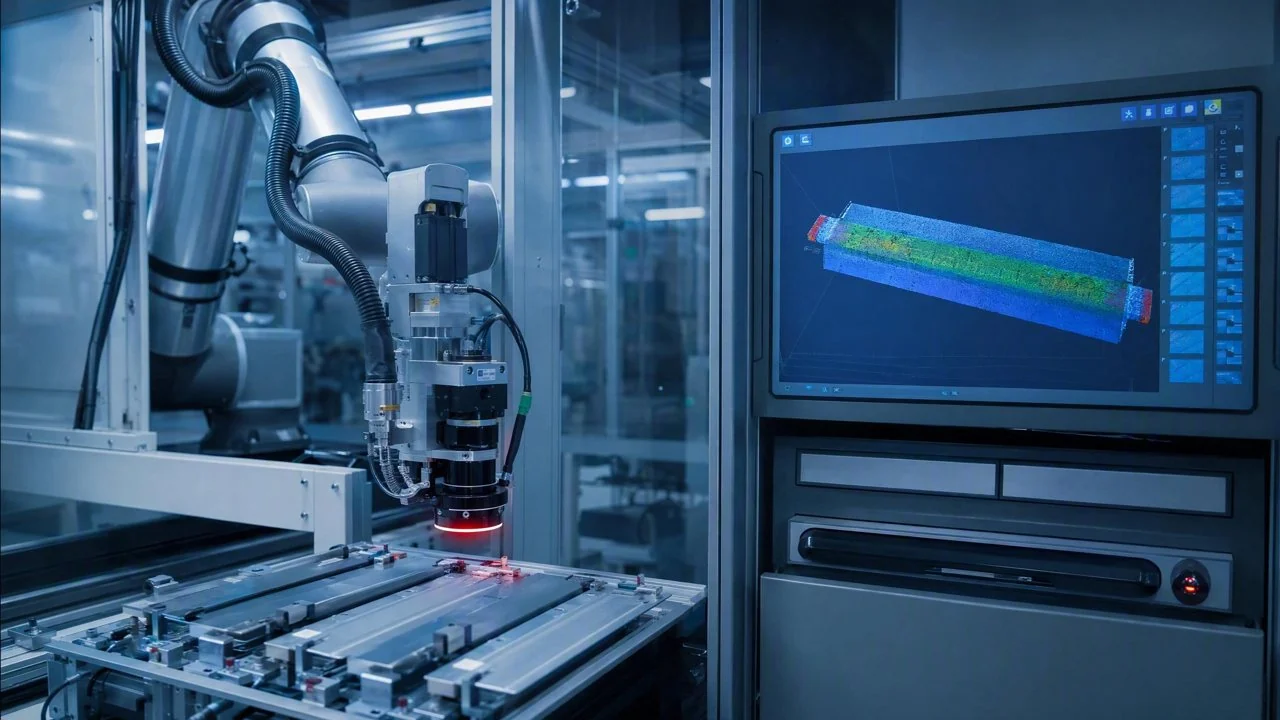
Quality control in new energy battery tab welding is crucial for battery performance and safety. DaoAI's 3D ACI equipment, utilizing proprietary 3D cameras and 3D morphology reconstruction, accurately detects hidden solder joints, coplanarity, micron-level morphology, and pores – defects often missed by 2D optical systems. By integrating 2D-3D fusion algorithms, it reduced the missed detection rate for new energy battery tab welding from the traditional 1.5% to <0.4%, while decreasing manual re-inspection hours by 65%, effectively addressing challenges in data security and complex defect detection.
Quality control in the new energy battery tab welding process is paramount for the performance, safety, and lifespan of electric vehicles and energy storage systems. Even minor defects can lead to internal short circuits, overheating, or thermal runaway. Traditional 2D vision inspection struggles with 3D morphological defects common in tab welding, such as burrs, cold welds, pores, collapse, or discontinuous seams, often resulting in missed detections or false positives. DaoAI's 3D ACI equipment, with its advanced proprietary 3D cameras and 3D morphology reconstruction, combined with 2D-3D fusion algorithms, effectively overcomes the blind spots of traditional 2D optical inspection, ensuring high-quality standards for tab welding. In this particular case, the client placed a strong emphasis on on-premise deployment and data security, which is a core advantage of DaoAI's solution.
Pain Points: Why This Hurdle Was Difficult to Overcome
In the quality inspection of new energy battery tab welding, the client faced multiple pain points. Firstly, traditional 2D AOI solutions had a missed detection rate of up to 1.5% for 3D morphological defects, especially for internal pores, micron-level indentations or protrusions, and burrs hidden on the side of the weld, where 2D images lacked sufficient depth information for accurate judgment. Secondly, due to factors like lighting and material reflectivity, the false positive rate of traditional solutions remained high, leading to a significant number of good products being misidentified, increasing manual re-inspection hours by at least 40% and slowing down overall production rhythm. Furthermore, with the iteration of battery models and adjustments in production batches, traditional rule-based AOI programming for changeovers was time-consuming, typically requiring 2-4 hours, severely impacting the flexibility of multi-variety, small-batch production. Finally, and most critically, the client had extremely high requirements for the security of core production data, wishing no production data to be uploaded to the cloud or third-party servers, a need that traditional cloud-dependent AI solutions could not meet for their on-premise private deployment.
The root cause of these challenges lies in the complexity of the tab welding process and the diversity of defects. Battery tabs, typically made of aluminum or nickel, have complex reflective surfaces, and the thermal effects during welding can lead to irregular weld seam morphologies. 2D vision systems can only acquire surface grayscale or color information, rendering them ineffective for 3D features such as depth, height, and volume. For instance, a tiny internal pore might appear as a blurry shadow in a 2D image, difficult to distinguish from normal textures; a micron-level burr located on the side of the weld seam would be entirely in the 2D camera's blind spot. Moreover, while current industrial multimodal large models can serve complex industrial scenarios, their training and deployment often rely on large-scale data transfer and cloud computing power, which conflicts with the client's strong demand for on-premise private deployment and data security. Balancing advanced AI capabilities with data sovereignty became a key consideration for the client in selecting a solution.
Technical Principles
DaoAI's 3D ACI equipment effectively overcomes these challenges through its core technologies. The heart of the equipment is DaoAI's proprietary high-precision 3D camera, capable of rapidly acquiring high-density 3D point cloud data of the tab weld area. Through advanced 3D morphology reconstruction algorithms, this point cloud data is transformed into highly accurate 3D models, enabling precise capture of the complete geometric information of the weld seam, including height, depth, volume, slope, and surface roughness at a micron level. For example, for hidden weld pores, 3D data can directly measure their volume and depth, rather than relying on indirect inferences from 2D images. For side burrs, the 3D model provides 360-degree morphological information, achieving comprehensive detection. The 2D-3D fusion algorithm in DaoAI's 3D ACI complements the texture and color information from traditional 2D vision with the depth and morphological information from 3D vision, building a more comprehensive defect feature vector to enhance detection robustness and accuracy.
Compared to traditional rule-based AOI and manual inspection, DaoAI's 3D ACI offers significant advantages in detection accuracy and efficiency. Traditional rule-based AOI relies on engineers manually setting thresholds and feature extraction rules, which poorly adapts to complex defects such as irregular burrs or non-standard pores, and incurs high changeover costs. Manual inspection, on the other hand, is subjective, prone to fatigue, inefficient, and cannot perform micron-level quantitative detection. DaoAI's 3D ACI employs deep learning-based AI algorithms, utilizing APDT few-shot self-training technology, requiring only 1-20 good samples to quickly learn defect characteristics, enabling 0-code automatic programming for changeovers in 5 minutes, significantly reducing production line downtime. Crucially, DaoAI's solution supports 100% on-premise private deployment, with all data processing and model inference completed locally, ensuring the client's sensitive production data remains in-house, meeting stringent data security and compliance requirements.
Typical Application Scenarios
- **Tab Weld Burr Detection:** Utilizing DaoAI's 3D ACI's 3D morphology reconstruction capability to precisely identify micron-level burrs or spatter at the weld seam edges. The challenge lies in the small size, irregular shape, and potential location of burrs on the side of the weld, which 2D vision often misses, while 3D data provides complete geometric information for high-precision detection.
- **Cold Weld/Poor Solder Joint Detection:** By analyzing the height, volume, coplanarity, and contact area of the solder joint with the substrate, determine the presence of cold or poor solder joints. For example, weld collapse or insufficient weld fill appear as distinct depressions or height anomalies in 3D morphology, which DaoAI's equipment can quantify for judgment.
- **Weld Pore/Void Detection:** 3D ACI can directly detect the volume and depth of tiny pores and voids inside or on the surface of the weld. This is a typical blind spot for 2D vision, as pores can be masked by surface textures, while 3D data can clearly delineate their 3D structure.
- **Weld Seam Width/Height Consistency Inspection:** Precisely measure the geometric dimensions of the weld seam, ensuring its width, height, and other parameters comply with design requirements, preventing stress concentration or poor contact due to uneven welds. DaoAI's equipment offers sub-millimeter measurement accuracy.
- **Weld Seam Contamination/Discoloration Detection:** Combining 2D-3D fusion algorithms, while inspecting 3D morphology, utilize 2D image color and texture information to identify defects such as oil stains, oxidation, or discoloration on the weld seam surface, achieving more comprehensive quality control.
Case Study
A leading new energy battery manufacturer, a pioneer in the domestic lithium battery sector, has exceptionally high standards for automation inspection precision and data security on its production lines. In the tab welding process, this manufacturer had long struggled with missed detections of complex 3D defects by traditional 2D AOI, leading to approximately 1.5% of defective batteries flowing downstream each month, increasing rework costs and potential risks. Simultaneously, the high false positive rate of traditional AOI placed a heavy burden on manual re-inspection personnel, requiring significant daily time for secondary confirmation. Most critically, the manufacturer was concerned about potential data leakage risks if production data were uploaded to the cloud, thus demanding that all inspection systems support 100% on-premise private deployment. After evaluating multiple vendor solutions, DaoAI's 3D ACI equipment was chosen for its outstanding 3D detection capabilities, few-shot learning efficiency, and commitment to local deployment.
Before deployment, the manufacturer's missed detection rate for tab welding defects was consistently 1.5%, with a false positive rate as high as 8%, and manual re-inspection hours accounted for 65% of the total inspection time. The DaoAI team deployed multiple 3D ACI units at the client's site, integrating them locally via SDK. Through APDT few-shot self-training, a high-precision detection model was trained using only 15 good samples, enabling rapid deployment. Post-deployment, DaoAI's 3D ACI successfully reduced the missed detection rate for tab welding to <0.4%, and the false positive rate decreased by 70%, to just 2.4%. This significantly reduced the volume of manual re-inspections, cutting manual re-inspection hours by 65%. Additionally, the 0-code rapid changeover capability of DaoAI's 3D ACI equipment reduced the previous 3-hour changeover time to 5min, greatly enhancing production line flexibility. The entire system was 100% privately deployed on-premise, with all inspection data stored on the client's internal servers, fully guaranteeing data security.
DaoAI's 3D ACI equipment, with its on-premise private deployment and superior 3D detection capabilities, provides new energy battery manufacturers with a dual guarantee of data security and inspection precision, pushing tab welding missed detection rates to an industry-leading level.
DaoAI Solution and Products
The core of the solution provided by DaoAI to this leading new energy battery manufacturer was the 3D ACI equipment. This equipment integrates DaoAI's proprietary high-precision 3D cameras, capable of real-time acquisition of high-resolution 3D point cloud data of tab weld joints, and performing 3D morphology reconstruction based on this data. Coupled with DaoAI's ACI OS, the equipment leverages the feature recognition capabilities of foundational visual models, and through APDT positive/few-shot learning, achieves the ability to quickly build high-precision detection models from just 1-20 good images, eliminating the need for manual annotation of defect samples and greatly simplifying the modeling process. For the client's high concern for data security, DaoAI provided a Docker containerized deployment solution, ensuring that the entire AI inspection system, along with all its data and models, operates 100% on the client's local servers, keeping data in-house and fully meeting their private deployment requirements. Furthermore, the DaoAI ACI OS features semantic false positive filtering, further enhancing detection accuracy and reducing unnecessary re-inspections. The equipment integrates with the production line's MES system, enabling real-time upload and traceability of inspection data.
Ultimately, DaoAI's 3D ACI solution delivered significant business value to the client. While ensuring data security, the missed detection rate for tab welding defects was substantially reduced from 1.5% to <0.4%, effectively improving product quality and battery safety coefficients. The false positive rate decreased by 70%, leading to a 65% reduction in manual re-inspection hours, saving the client millions of RMB annually in labor costs. The rapid changeover capability shortened downtime from 3 hours to 5min, increasing equipment utilization and production line flexibility. These quantifiable achievements not only optimized production efficiency and reduced operating costs but, more importantly, greatly enhanced the client's product competitiveness through high-precision, highly reliable quality control.
FAQ
What is on-premise private deployment for DaoAI's 3D ACI equipment?
On-premise private deployment for DaoAI's 3D ACI equipment means that all software systems and inspection data are installed and stored directly on the client's own physical servers or data centers, rather than being uploaded to the cloud or hosted by a third party. This ensures the client retains full control over their core production data, complying with strict data security and compliance requirements, especially critical for industrial scenarios sensitive to data privacy. Deployment methods include Docker containerization or SDK/API integration.
How does DaoAI's 3D ACI achieve advanced AI inspection capabilities while ensuring data security?
DaoAI achieves this by combining its proprietary 3D cameras with an on-premise deployed DaoAI ACI OS. Our AI models are optimized to perform inference efficiently on local servers, without the need to upload raw images or training data to the cloud. APDT few-shot self-training technology allows for rapid model generation using a small number of good samples locally, further reducing reliance on external data transfer. All data processing, model training, and inference are completed within the client's firewall, fundamentally eliminating data leakage risks.
What is the estimated budget and time required to deploy DaoAI's 3D ACI equipment?
The budget and deployment time for DaoAI's 3D ACI equipment vary depending on the client's specific needs, production line scale, inspection complexity, and integration difficulty. Hardware configuration, choice of software functional modules (e.g., 2D-3D fusion, APDT, etc.), and whether custom development is required all influence the final quote. Typically, from equipment installation to model go-live, it can range from a few days to several weeks for more complex projects. We recommend contacting our sales team with detailed requirements, and we will provide you with a customized solution, precise quotation, and evaluate the specific implementation timeline.
Full solution for this scenario: the full inspection solution for New-energy batteries · Tab Welding Quality Gate
This article was generated by AI. Customer cases are simulated scenarios based on real product capabilities and figures are illustrative; see product pages for official benchmarks.