
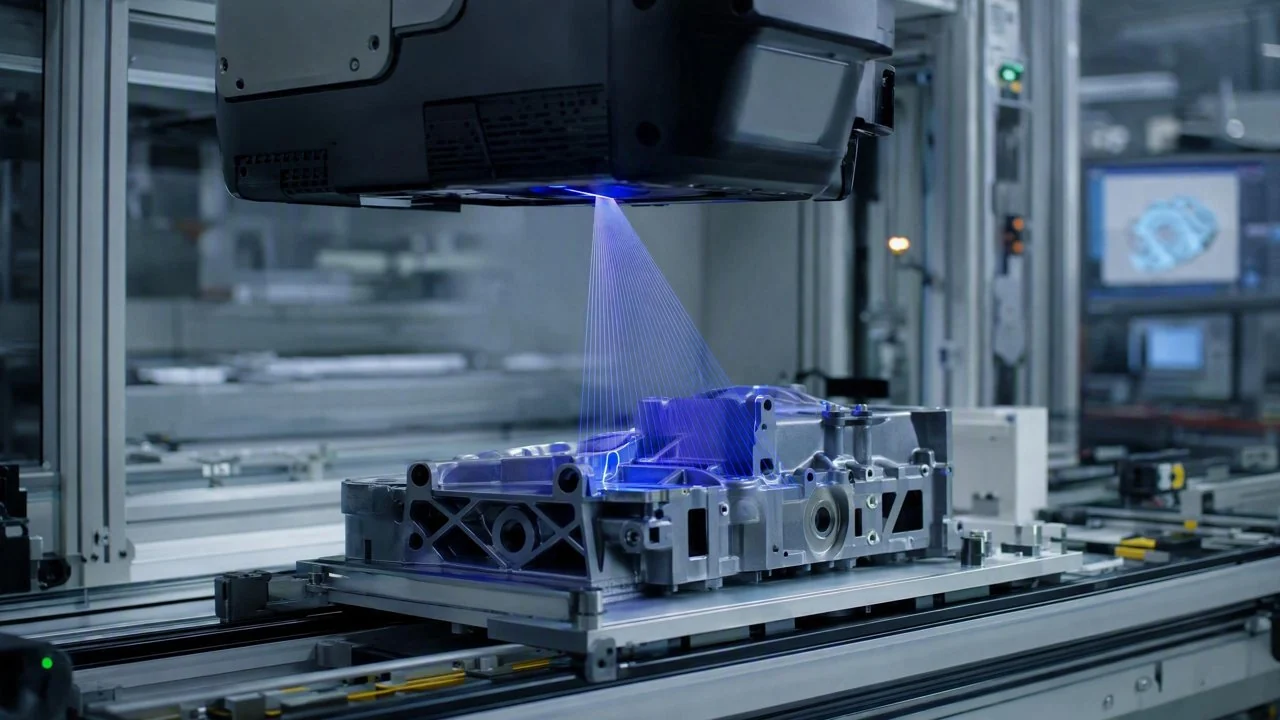
DaoAI 3D ACI equipment (self-developed 3D camera + 3D morphology reconstruction/point cloud, detecting 2D optical blind spot defects like hidden solder joints/coplanarity/micron-level morphology/porosity, with 2D-3D fusion), leveraging APDT few-shot self-training and high-precision 3D inspection, reduced the aluminum die-casting porosity undetected defect rate for a Tier-1 automotive supplier from approximately 2.0% to <0.5%, significantly enhancing product reliability and customer satisfaction.
The automotive / parts industry demands extreme levels of product quality and reliability, especially for critical components like aluminum die castings, where internal defects directly impact vehicle safety and lifespan. In the manufacturing of core components such as engine blocks, transmission housings, and suspension brackets, aluminum die casting is widely used for its lightweight and high-strength advantages. However, due to the complexities of melting, pouring, and solidification, internal defects like porosity, shrinkage, and inclusions are prone to occur. These defects can become stress concentration points during service, leading to fatigue fractures and severe consequences. Traditionally, X-ray inspection has been the primary method for detecting these internal defects, but it suffers from high efficiency, cost, and demands specialized operator expertise. Moreover, when dealing with diverse defect morphologies, manual interpretation is susceptible to fatigue, misjudgments, and missed detections. DaoAI's 3D ACI equipment addresses this pain point by combining advanced 3D imaging technology with APDT few-shot self-training capabilities, providing an efficient and precise solution for automotive parts manufacturers.
Pain Points: Why This Hurdle is Difficult to Overcome
Detecting internal porosity in aluminum die castings presents multiple challenges. Firstly, defects are often hidden and diverse; pores can be located anywhere inside the casting, varying in size from micron to millimeter scale, and exhibiting various shapes. This makes traditional 2D visual inspection almost impossible. Secondly, while traditional X-ray inspection can penetrate materials, quantitative analysis and automated defect classification remain difficult. Manual interpretation of X-ray images is inefficient and prone to errors due to operator fatigue and experience, typically resulting in a false negative rate between 1.5%–2.5% and a high false positive rate, increasing re-inspection workload. For mass-produced automotive parts, inspection time per unit is crucial. Traditional methods often have slow inspection cycles, failing to meet high-speed production line demands, leading to a reduction in line efficiency of approximately 15%−20%.
From a process and imaging perspective, the complex geometry and surface textures of aluminum die castings, along with the random distribution of pores in 3D space, pose significant obstacles to accurate detection. Distinguishing true defects from inherent material features like loose structures or grain boundaries becomes particularly challenging. Furthermore, in industrial AI vision systems, sensor calibration profoundly impacts overall system performance and robustness. Traditional vision systems require frequent and complex sensor calibration and model adjustments when encountering products from different batches or under varying lighting conditions. This is not only time-consuming and labor-intensive but also directly affects the model's generalization capability and detection accuracy, leading to long changeover times, typically 2–4 hours, severely impacting the flexibility of high-mix, low-volume production.
Technical Principles
The core advantage of DaoAI's 3D ACI equipment lies in its self-developed 3D camera and advanced 3D morphology reconstruction technology, which enables the acquisition of complete 3D point cloud data for aluminum die-casting surfaces and internal structures (through integration with X-ray image processing). This allows the equipment to overcome 2D optical blind spots and precisely capture the 3D morphological characteristics of micron-level pores, shrinkage cavities, and other defects, such as their depth, volume, and exact location. Compared to the 2D grayscale information of traditional X-ray images, 3D point cloud data provides richer and more accurate spatial information about defects, forming a solid foundation for subsequent AI analysis. DaoAI's unique 2D-3D fusion technology combines high-resolution 2D images with detailed 3D data, further enhancing defect detection capabilities and discrimination accuracy.
At the algorithmic level, DaoAI's 3D ACI equipment employs APDT (Adaptive Pre-trained Deep Transfer) few-shot self-training technology. This technology enables the equipment to quickly complete defect model training and deployment with just 1–20 good samples, and even with a small number of defective samples. Traditional rule-based AOI requires engineers to spend significant time writing complex rules and is poorly adaptable to new defect types; traditional deep learning models, on the other hand, require massive amounts of labeled data. APDT few-shot self-training leverages pre-trained foundation models, fine-tuning them with a small amount of new data, significantly shortening the model development cycle and reducing changeover time from several hours to under 5 minutes. This not only greatly lowers the threshold and cost of model training but also enhances the equipment's adaptability and flexibility in high-mix, low-volume production scenarios. Through semantic false alarm filtering, DaoAI equipment can also effectively distinguish between true defects and non-defect features like surface textures or process marks, reducing the false positive rate by over 80% and avoiding numerous unnecessary re-inspections.
Typical Application Scenarios
- **Internal Porosity/Shrinkage Detection in Aluminum Die Castings:** DaoAI's 3D ACI equipment, combined with X-ray image processing, utilizes 3D morphology reconstruction to precisely identify and quantify the size, shape, and spatial distribution of internal pores and shrinkage cavities. The challenge lies in the diverse morphology of pores and their potential confusion with casting microstructure.
- **Coplanarity Inspection:** In the inspection of solder joints or pins for automotive electronic control units (ECUs) or sensor modules, the equipment can measure height differences with micron-level precision to ensure welding quality. The challenge is accurate measurement of minute height differences and adaptability to complex geometries.
- **Micron-level Morphology Defect Detection:** For tiny surface defects such as scratches, burrs, or dents, the self-developed 3D camera acquires high-resolution 3D morphological data, enabling the detection of defects that are difficult to find with traditional 2D vision. The challenge is distinguishing true defects from normal product surface textures.
- **Hidden Solder Joint Defect Detection:** In automotive electronic modules with BGA, QFN, and other package types, traditional 2D AOI cannot detect solder joints beneath the package. DaoAI's 3D ACI equipment effectively detects hidden defects like solder voids, cold solder joints, or bridging through 3D point cloud analysis. The challenge lies in solder joint occlusion and the reconstruction accuracy of complex 3D structures.
- **Adhesive/Sealant Integrity Inspection:** For the quality of adhesive sealing in automotive parts, the equipment can detect defects such as adhesive bead width, height, continuity, overflow, or breaks, ensuring sealing performance. The challenge is precise identification of bead edges and adaptability to varied shapes.
Case Study
A leading Tier-1 automotive parts supplier, producing aluminum die-cast components such as engine blocks and transmission housings, previously relied on manual visual inspection combined with sampled X-ray inspection to control porosity quality. Due to a wide variety of products and high production volumes, the traditional inspection scheme faced significant challenges: manual inspection was inefficient and inconsistent, and X-ray interpretation depended on experienced technicians, leading to a line-level undetected defect rate of approximately 2.0%. This directly impacted the qualification rate of downstream assembly lines and increased rework costs by 15%–20%. Furthermore, each new product launch or model changeover required several hours or even a full day for parameter adjustment and rule writing, severely limiting production line flexibility.
To address these pain points, the supplier implemented DaoAI's 3D ACI equipment. During the onboarding process, the DaoAI technical team utilized the APDT few-shot self-training feature, completing the porosity detection model training and deployment within 30 minutes, using only 10 collected 3D point cloud data sets of good parts and a few defect samples. After deployment, the equipment achieved 100% full inspection of all aluminum die castings. Its high-precision 3D detection capabilities and AI intelligent discrimination consistently kept the porosity undetected defect rate below <0.5%, achieving a detection rate of over 99.5%. Simultaneously, semantic false alarm filtering reduced the false positive rate by 85%, significantly decreasing the workload for manual re-inspection. Changeover time was also reduced from the original 3 hours to less than 5 minutes, greatly enhancing line flexibility and production efficiency. The client highly praised DaoAI's 3D ACI equipment for bringing significant quality improvements and cost savings.
DaoAI's 3D ACI equipment, enabled by APDT few-shot self-training, achieves a precise breakthrough in aluminum die-casting porosity detection, reducing the undetected defect rate from 2.0% to <0.5%, bringing unprecedented quality assurance and production efficiency leaps to the automotive parts industry.
DaoAI Solution and Products
DaoAI's core solution for the automotive / parts industry is based on its powerful 3D ACI equipment. This equipment integrates DaoAI's self-developed high-precision 3D camera, capable of micron-level 3D morphology reconstruction for complex objects such as die castings, PCBs, and mechanical parts. By acquiring high-density point cloud data, the equipment can accurately capture hidden defects that traditional 2D vision cannot detect, such as internal pores, minute scratches, and insufficient solder joint coplanarity. Combined with the DaoAI ACI OS, we have achieved APDT few-shot self-training, allowing customers to train and deploy models in a short time with only a few good samples (1–20), significantly lowering the implementation threshold and time cost for AI vision. Furthermore, DaoAI also offers 2D-3D fusion detection capabilities, combining 3D data with high-resolution 2D images to further enhance the robustness and accuracy of defect identification.
Regarding deployment and integration, DaoAI's solution supports 100% local private deployment, ensuring customer data security. Our SDK/API/Docker deployment methods enable integration into existing customer production lines and MES systems, achieving closed-loop data management and quality traceability. For high-mix, low-volume production needs, DaoAI's zero-code rapid changeover function allows line engineers to quickly adjust inspection parameters and models without specialized programming knowledge. Through the unified foundation of the DaoAI World Model, our equipment possesses stronger semantic understanding and cross-scenario generalization capabilities, continuously learning from production line feedback to optimize detection performance, providing customers with long-term stable quality assurance. In this aluminum die-casting porosity detection case, DaoAI's 3D ACI equipment reduced the porosity undetected defect rate by over 75% and shortened changeover time from several hours to 5min, significantly improving production efficiency and product quality.
FAQ
How does DaoAI's 3D ACI equipment effectively detect internal porosity in aluminum die castings?
DaoAI's 3D ACI equipment, utilizing a self-developed high-precision 3D camera combined with X-ray image processing technology, can perform 3D morphology reconstruction of the internal structure of aluminum die castings, generating high-density point cloud data. This enables the equipment to precisely capture the 3D spatial location, size, and shape of pores, overcoming the blind spots of traditional 2D vision, and achieving quantitative detection and intelligent discrimination of micron-level pores, significantly improving detection accuracy and reliability.
What practical value does APDT few-shot self-training technology bring to my production line?
APDT few-shot self-training is one of the core advantages of DaoAI's 3D ACI equipment. It means you only need to provide a small number of good samples (1–20) to complete defect model training and deployment within a short period (typically within 30 minutes). This greatly shortens the preparation time for new product launches or product changeovers, reducing changeover downtime from several hours to under 5 minutes, significantly enhancing production line flexibility and efficiency, especially suitable for high-mix, low-volume production models, lowering the implementation threshold and cost of AI vision.
How are the deployment cost and cycle of DaoAI's 3D ACI equipment evaluated?
The deployment cost and cycle of DaoAI's 3D ACI equipment are influenced by various factors, including the complexity of line integration, required inspection cycle time, diversity of defect types, and integration needs with other systems (e.g., MES). We offer 100% local private deployment to ensure data security. Typically, the entire cycle from equipment installation to model training and line commissioning can be completed within a few weeks. For specific quotes and detailed deployment plans, we recommend scheduling a consultation with our technical experts for an on-site evaluation and customized advice, and we will provide the solution that best meets your needs.
Full solution for this scenario: Automotive / parts industry solutions
This article was generated by AI. Customer cases are simulated scenarios based on real product capabilities and figures are illustrative; see product pages for official benchmarks.