
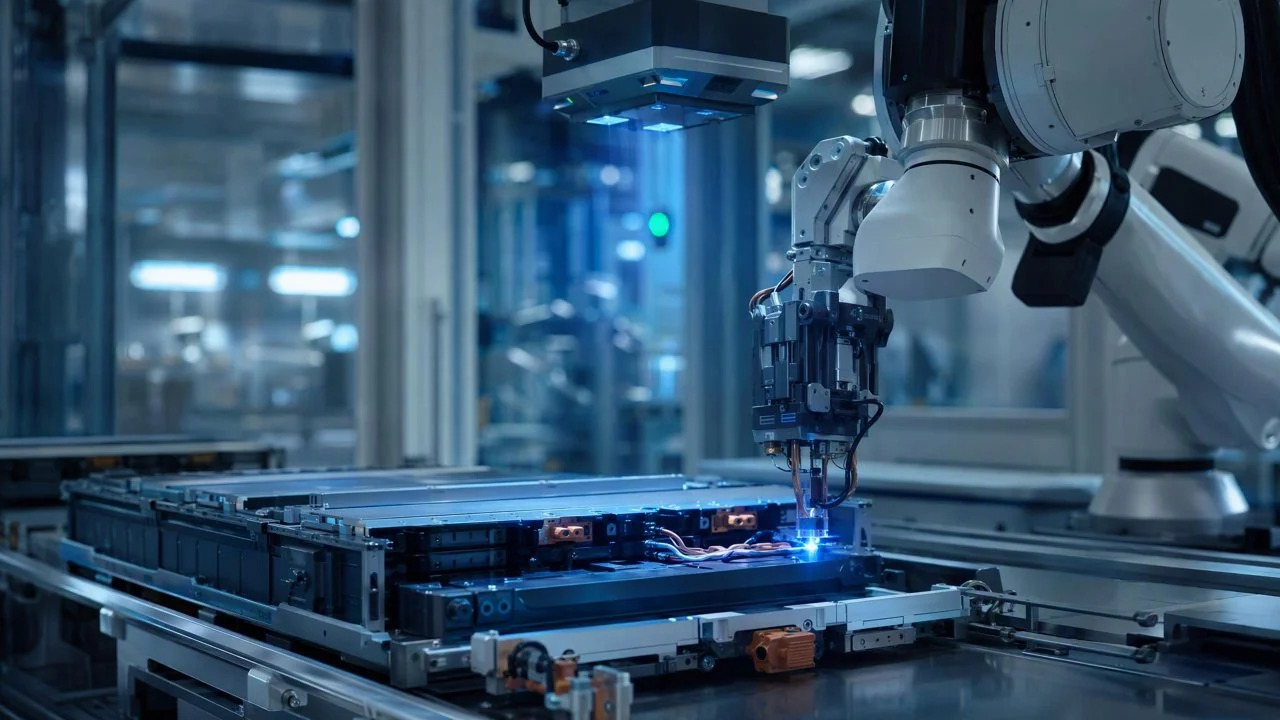
DaoAI 3D ACI equipment (proprietary 3D camera + 3D topography reconstruction/point cloud, detecting hidden solder joints/coplanarity/micron-level morphology/pores and other 2D optical blind spot defects, with 2D-3D fusion) provides “zero-code rapid retooling” capability, reducing production line changeover time for EV battery tab welding inspection from the traditional average of 60 minutes to 5 minutes, significantly enhancing the flexibility and efficiency of high-mix, low-volume production.
As the core component of electric vehicles and energy storage systems, the manufacturing quality of new energy batteries directly impacts product performance, safety, and lifespan. Among various critical processes in battery production, tab welding is a crucial step determining the stability and conductivity of internal cell connections. Battery tabs, serving as the bridge between the cell's positive and negative electrodes and external connections, demand impeccable welding quality. Traditional 2D optical inspection solutions often struggle with 3D morphological defects common in tab welding, such as burrs, cold welds, pores in weld spots, and collapses, leaving significant detection blind spots. Especially in the current new energy market, characterized by high-mix, low-volume, and rapid iteration production models, achieving quick retooling of inspection equipment to adapt to different battery models has become a major challenge for manufacturers. DaoAI 3D ACI equipment, with its unique zero-code rapid retooling capability, offers an efficient solution to this problem.
Pain Points: Why This Hurdle Is Difficult to Overcome
Quality inspection of EV battery tab welding faces multiple challenges, making it difficult for traditional solutions to meet efficiency and accuracy demands. First is the **complexity of defect types**: tab welding defects not only include 2D visible issues like misalignment and short circuits but also a large number of 3D morphological defects that are difficult for 2D optics to identify, such as micron-level burrs, poor contact due to cold welds, internal pores in weld spots, and weld seam collapses or protrusions. These defects are root causes of increased battery internal resistance, localized overheating, and even safety hazards, yet traditional 2D AOI often misidentifies them as good products or misses them entirely. Second is **product model diversity and high changeover frequency**: with market segmentation and technological iteration in electric vehicles, battery models are increasing, requiring frequent switching of different tab specifications on production lines. Traditional AOI equipment relies on manual writing of extensive rules or time-consuming parameter adjustments, leading to long changeover downtime, averaging over 60 minutes, which severely impacts production efficiency and delivery cycles. Third is **high manual re-inspection costs and compliance risks**: for ambiguous defects that traditional 2D AOI cannot accurately judge, a significant amount of manual secondary re-inspection is often required. Data from a mid-sized battery manufacturer shows that this portion of manual re-inspection accounts for over 35% of the total inspection man-hours, and is prone to human eye fatigue and inconsistent judgments, leading to high rates of missed detections and false positives, which in turn brings battery product quality risks and recall risks.
The root cause of these difficulties lies in several factors: the metallic luster of tab welds often produces specular reflections, interfering with 2D vision imaging; defects are minute in size and possess complex 3D structures, exceeding the depth of field and resolution limits of 2D cameras; and traditional rule-based vision algorithms lack adaptability when facing new products, requiring extensive manual intervention. In the context of data-driven and algorithm optimization strategies for AI visual inspection to achieve industrial zero-defect manufacturing, the limitations of these traditional methods are becoming increasingly pronounced.
Technical Principles
The core advantage of DaoAI 3D ACI equipment lies in its proprietary 3D camera and advanced 3D topography reconstruction technology, combined with 2D-3D fusion algorithms, achieving comprehensive and high-precision detection of tab welding defects. The equipment employs structured light or laser triangulation principles, projecting known light patterns onto the surface of the object under test and using high-resolution cameras to capture the deformed light images, precisely calculating the 3D point cloud data of the object's surface. This point cloud data contains precise height, depth, and volume information of the tab weld seam, enabling DaoAI 3D ACI to overcome the limitations of 2D optics in depth of field, shadows, and reflections.
At the algorithmic level, DaoAI 3D ACI equipment integrates the DaoAI ACI OS operating system, which leverages the feature recognition capabilities of visual foundation models to achieve zero-code programming and few-shot learning. For tab welding inspection, users only need to provide a small number (1-20) of good product images, and the system can automatically learn and establish a detection model within 5 minutes, without the need for professional vision engineers to write complex rule codes. This means that when the production line switches to a new product model, there is no need for time-consuming parameter tuning or code rewriting; quick retooling can be completed through simple graphical interface operations. Furthermore, the DaoAI 3D ACI equipment, through 2D-3D fusion technology, combines 2D image texture and color information with 3D point cloud morphological information, forming a more comprehensive feature description. This significantly improves the detection rate for micron-level defects such as burrs, cold welds, and pores, and effectively reduces false positives. Compared to traditional rule-based AOI, which relies on manual threshold setting and is sensitive to lighting and product deformation, DaoAI 3D ACI's self-learning and fusion technology demonstrates stronger robustness and adaptability.
Typical Application Scenarios
- **Tab Weld Seam Burr and Spatter Detection**: Utilizing the high-precision 3D topography reconstruction capability of DaoAI 3D ACI equipment, micron-level metal burrs and welding spatters on weld edges can be detected. These defects might be obscured or blurred in 2D images due to lighting or angle issues, but 3D data clearly presents their height and volume information, ensuring no short-circuit risks.
- **Cold Weld and Weld Spot Collapse Detection**: For cold welds and weld spot collapses, traditional 2D struggles to determine their true connection strength. DaoAI 3D ACI can precisely assess weld penetration and bonding area by analyzing 3D parameters such as weld spot height, flatness, and volume, identifying cold welds or loose connections to ensure electrical conductivity.
- **Weld Seam Pore and Crack Detection**: Tiny pores and cracks within or on the surface of weld seams are common causes of abnormal battery internal resistance and safety hazards. DaoAI 3D ACI, combined with high-resolution 3D scanning, can identify and quantify the size and location of these microscopic defects, compensating for blind spots caused by surface reflections or shadows in 2D images.
- **Weld Spot Coplanarity and Consistency**: In multi-point welding or array welding scenarios, ensuring all weld spots are on the same plane and consistent in morphology is crucial. DaoAI 3D ACI can accurately measure the coplanarity of weld spots and analyze the consistency of each weld spot's morphology, preventing early failure due to localized stress concentration.
- **Weld Seam Width and Height Measurement**: Precisely measuring the width, height, and shape of weld seams is a key parameter for controlling the welding process. DaoAI 3D ACI equipment can provide sub-millimeter level dimensional measurement accuracy, offering reliable data support for process optimization and ensuring weld seams comply with design specifications.
Implementation Case Study
A mid-sized new energy battery manufacturer, primarily producing various models of power batteries and energy storage batteries, frequently needed to switch between different models of tab welding processes on its production lines. Before introducing DaoAI 3D ACI equipment, the factory used a combination of traditional 2D AOI and manual visual inspection for quality control. Due to frequent product model changes, each retooling required significant time for reprogramming and debugging, with an average changeover time of 60-90 minutes. Furthermore, for 2D blind spot defects in tab welding, such as burrs and cold welds, traditional 2D AOI had a high missed detection rate, and the false positive rate was around 8%, leading to a large workload of manual re-inspection, severely slowing down the production line's takt time. In this case, production line data indicated that under the traditional scheme, the missed detection rate for tab welding defects exceeded 1.5%.
After the implementation of DaoAI 3D ACI, the retooling time for tab welding inspection was reduced from 60 minutes to 5 minutes, the missed detection rate was controlled below 0.3%, and the false positive rate was reduced by 85%.
To address this pain point, the manufacturer introduced DaoAI 3D ACI equipment. In the initial phase, the technical team completed equipment integration and preliminary model training within 1-2 days. Through the zero-code programming capability of DaoAI ACI OS, engineers only needed to provide 10 images of good tab products, and the system quickly learned and established a detection model. In subsequent production line switches, the system completed new product retooling configuration in just 5 minutes, an efficiency improvement of over 90% compared to the previous 60 minutes. Actual test data showed that the DaoAI 3D ACI equipment's tab welding defect detection rate increased to over 99.7%, with a missed detection rate controlled below 0.3%, while the false positive rate was reduced by 85%, significantly reducing the need for manual re-inspection. This enabled the manufacturer to maintain high quality while effectively increasing the flexibility and market responsiveness of high-mix, low-volume production.
DaoAI Solution and Products
DaoAI's solution for new energy battery tab welding quality inspection is centered around the 3D ACI equipment, complemented by the DaoAI ACI OS operating system, jointly building an efficient and flexible intelligent inspection system. The DaoAI 3D ACI equipment integrates a proprietary high-precision 3D camera, capable of rapidly acquiring 3D point cloud data of tab weld seams, thereby precisely capturing micron-level morphological defects that traditional 2D vision cannot identify. Through 2D-3D fusion technology, the equipment can simultaneously analyze surface features from 2D images and spatial geometric features from 3D data, achieving more comprehensive defect recognition.
In terms of implementation, DaoAI 3D ACI equipment offers flexible deployment, supporting 100% local private deployment to ensure customer data security remains on-site. Its core DaoAI ACI OS operating system provides “zero-code rapid retooling” and “few-shot learning” capabilities, allowing users to establish and update detection models through a simple graphical interface. For new product models, only a small number of good samples need to be provided, and the system automatically learns and optimizes the model, reducing the time required for retooling from several hours to less than 5 minutes. This represents a significant increase in production efficiency and reduction in operating costs for new energy battery manufacturers who frequently need to switch product models. Furthermore, DaoAI 3D ACI equipment supports integration with existing MES/SCADA systems, enabling real-time upload of inspection data, quality traceability, and closed-loop management, further optimizing production processes and quality control levels. The introduction of this solution allows production lines to adapt more quickly to market changes and achieve flexible production of high-mix, low-volume products.
FAQ
How does DaoAI 3D ACI equipment achieve zero-code rapid retooling?
DaoAI 3D ACI equipment integrates the DaoAI ACI OS operating system, leveraging the feature recognition capabilities of visual foundation models and APDT few-shot learning technology. Users only need to provide 1-20 good product images, and the system can automatically establish a detection model within 5 minutes, eliminating the need for complex coding and significantly reducing new product introduction and production line changeover times.
What 2D optical blind spot defects can DaoAI 3D ACI equipment detect in new energy battery tab welding inspection?
DaoAI 3D ACI equipment, through its proprietary 3D camera and 3D topography reconstruction technology, can effectively detect defects difficult for 2D optics to find. These include micron-level weld seam burrs, internal pores in weld spots, poor contact due to cold welds, weld seam collapses or protrusions, and poor weld spot coplanarity, ensuring welding quality.
How is the cost budget for deploying DaoAI 3D ACI equipment evaluated?
The cost evaluation of DaoAI 3D ACI equipment is influenced by several factors, including specific configurations, detection cycle requirements, integration complexity, and whether customized functions are needed. We offer flexible deployment solutions and support 100% local private deployment. We recommend scheduling a consultation with our technical experts for a detailed evaluation and quotation based on your specific production line needs.
Full solution for this scenario: 3D ACI Equipment industry solutions · New-Energy Battery Module Weld Misalignment Detection
This article was generated by AI. Customer cases are simulated scenarios based on real product capabilities and figures are illustrative; see product pages for official benchmarks.