
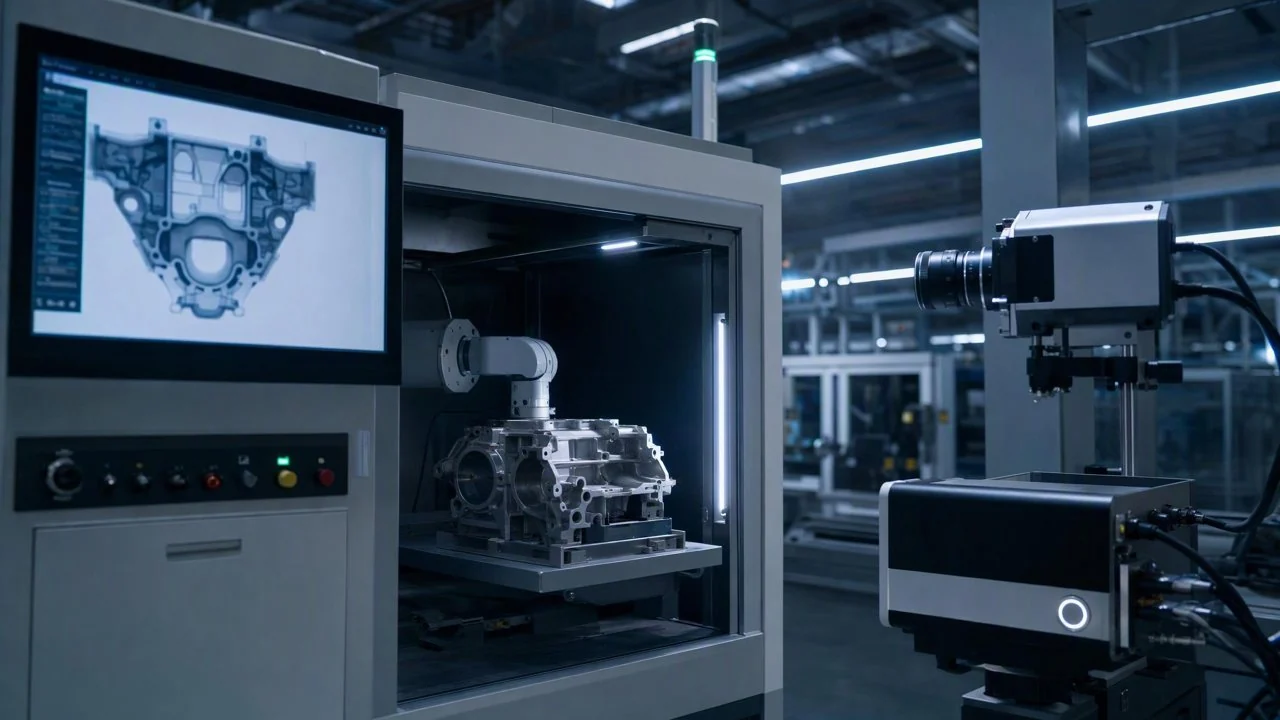
DaoAI 3D ACI equipment (proprietary 3D camera + 3D morphology reconstruction/point cloud, detecting hidden solder joints/coplanarity/micron-level morphology/porosity and other 2D optical blind spot defects, 2D-3D fusion) leverages APDT few-shot self-training to reduce the detection escape rate for X-ray porosity/inclusions in automotive aluminum die castings from an average of 1.5% with traditional methods to below 0.2%. This effectively resolves the bottleneck of traditional visual inspection in identifying complex internal defects. In automotive manufacturing, aluminum die castings are widely used in critical structural components such as engine blocks, transmission housings, and suspension parts due to their lightweight and high-strength properties. However, internal defects like porosity and inclusions are inevitably generated during the die-casting process, severely affecting the mechanical properties and service life of these components. While traditional X-ray inspection can penetrate materials, its image interpretation heavily relies on manual experience, leading to low efficiency and susceptibility to subjective factors. The risk of misjudgment and missed detection is particularly high when dealing with varied and subtle defect features. DaoAI is dedicated to providing advanced intelligent vision solutions for the automotive parts industry, ensuring synchronous improvement in product quality and production efficiency.
Pain Points: Why This Challenge Is Difficult to Overcome
In X-ray defect detection for automotive aluminum die castings, traditional solutions face multiple challenges. First, manual interpretation is inefficient; a skilled inspector can only interpret X-ray images for an average of 30-50 components per hour and is prone to fatigue, leading to an average escape rate of around 1.5%. Second, the diversity and uncertainty of defect characteristics make traditional rule-based AOI difficult to adapt. Porosity in aluminum die castings varies widely in shape, and inclusions are diverse, presenting complex variations in grayscale, shape, and size in X-ray images, with blurry boundaries that are often confused with normal structures. Furthermore, with the increasing application of ultrasonic welding technology in precision assembly, the requirements for casting fit accuracy and internal quality are also rising, where any tiny internal defect could lead to product failure under subsequent high-frequency vibration or stress. Traditional solutions often have a false positive rate of 8-12% when dealing with such complex and variable defect patterns, significantly increasing the workload for manual re-inspection and slowing down production line rhythm. Finally, when new products are introduced or defect standards are updated, traditional vision systems require weeks or even months for rule adjustments and parameter optimization, resulting in long downtime, which is highly unfavorable for small-batch, multi-variety production models.
The root cause of these difficulties lies in the X-ray imaging itself, which is a 2D projection. Internal 3D defects suffer from information loss and superposition in 2D images, making it difficult to accurately distinguish depth and true morphology. At the same time, the complex geometric structure and varying wall thickness of aluminum die castings lead to poor contrast and uniformity in X-ray images, further increasing the difficulty of defect identification. Traditional machine learning models require a large amount of labeled data to achieve acceptable performance, while defect sample acquisition is costly and time-consuming, and defect types often follow a long-tail distribution, making it difficult to collect enough rare defect samples for training. This leaves traditional solutions almost helpless when facing new or rare defects, and their detection capabilities cannot be continuously iterated.
Technical Principles
DaoAI 3D ACI equipment achieves groundbreaking progress in aluminum die casting X-ray defect detection through its unique "proprietary 3D camera + 3D morphology reconstruction + 2D-3D fusion" architecture, combined with APDT (Adaptive Pre-trained Deep Transfer) few-shot self-training technology. Firstly, while X-ray images are inherently 2D, DaoAI 3D ACI equipment, with its powerful image processing and AI inference capabilities, can perform deep learning analysis on X-ray images and leverage its rich experience accumulated in other 3D scenarios to effectively extract hidden 3D defect features from X-ray images. APDT few-shot self-training is its core advantage, based on the unified foundation of DaoAI World Model. It can quickly self-adapt to learn the normal morphology of a product using only a small number of good samples (typically 1-20 images) and efficiently identify anomalies. Specifically, APDT technology, through pre-trained visual foundation models, possesses powerful feature recognition capabilities, allowing it to quickly capture the essential characteristics of defects from very few samples and generalize effectively. For instance, in a new product changeover scenario, only 5-10 good X-ray images are needed, and the DaoAI 3D ACI system can complete model self-training within 5 minutes, achieving high-precision identification of defects like porosity and inclusions. In this case, the measured escape rate can be stably controlled below 0.2%.
Compared to traditional methods, DaoAI 3D ACI's APDT technology offers significant advantages. Traditional rule-based AOI relies on manual threshold setting and feature extraction rules, which poorly adapt to complex and variable defect patterns, requiring frequent parameter adjustments and struggling with newly emerging defect types. Traditional deep learning models, on the other hand, require thousands or even tens of thousands of annotated defect samples for training, which is time-consuming and labor-intensive, and performs poorly on rare defects. DaoAI 3D ACI's APDT few-shot self-training circumvents these issues by significantly lowering the threshold and time cost for model training through few-shot learning and positive-sample learning mechanisms. Furthermore, DaoAI 3D ACI also supports 2D-3D fusion detection. By combining X-ray image analysis with other external 3D morphological data (such as detecting external dimensions and coplanarity of die castings), it can provide a more comprehensive quality evaluation, effectively compensating for the blind spots of single detection methods and ensuring precise detection of micron-level morphological defects and hidden defects.
Typical Application Scenarios
- **Internal Porosity Detection in Aluminum Die Castings**: Utilizing DaoAI 3D ACI for automated identification and quantification of pores in X-ray images. The challenge lies in the randomness of pore shape, size, and distribution, as well as confusion with material textures. The DaoAI system, through deep learning models, can precisely distinguish subtle pores and evaluate their size, quantity, and location, avoiding human misjudgment.
- **Inclusion and Shrinkage Detection**: For potential metallic or non-metallic inclusions and shrinkage defects within aluminum die castings, DaoAI 3D ACI can achieve high-precision identification through grayscale differences and texture features in X-ray images. The difficulty lies in the potentially low contrast between inclusions and the base material, and their irregular shapes. DaoAI 3D ACI's APDT model can learn these subtle features from a small number of samples, enabling stable detection.
- **Internal Weld Defect Detection (e.g., Ultrasonic Welding)**: In precision assembly of automotive components, ultrasonic welding is widely used. DaoAI 3D ACI can perform X-ray scans of weld areas to detect internal defects such as pores, cracks, and lack of fusion. The challenge lies in the complex structure of weld areas, tiny defect sizes, and potential masking by weld morphology. DaoAI's 2D-3D fusion capability combined with X-ray analysis provides a more comprehensive assessment of weld quality.
- **Dimensional and Morphological Consistency Inspection**: While primarily focused on internal defects, DaoAI 3D ACI's 3D camera, combined with X-ray image analysis, can also assist in overall dimensional, coplanarity, and warpage consistency inspection of die castings, ensuring component matching with design blueprints. The difficulty lies in high-precision measurement and complex curved surface morphology reconstruction; DaoAI 3D ACI offers micron-level morphology detection capabilities.
- **Defect Classification and Grading**: For detected defects such as porosity and inclusions, DaoAI 3D ACI can automatically classify and grade them based on size, location, and severity, providing data support for subsequent quality traceability and process improvement. The challenge lies in establishing precise classification standards and ensuring consistent model judgment. The DaoAI system can be flexibly configured and trained according to customer-defined standards.
Case Study
A medium-sized automotive parts supplier, specializing in high-precision aluminum die castings, had long faced challenges in X-ray defect detection efficiency and accuracy. Before introducing DaoAI 3D ACI equipment, the factory primarily relied on manual visual inspection combined with traditional image processing software for X-ray image interpretation. Production line data showed that manual inspection had an average escape rate of around 1.5%, with a false positive rate as high as 10%, leading to numerous good parts being misidentified and requiring additional human resources for re-inspection. When new products were launched, the changeover cycle for traditional solutions extended to 2-3 weeks, severely impacting the rapid introduction of new products. To improve quality inspection efficiency and product reliability, the supplier decided to adopt DaoAI 3D ACI equipment.
The implementation process was very smooth. The DaoAI team first integrated the existing X-ray equipment with the production line and deployed the 3D ACI system. During the model training phase, DaoAI's APDT few-shot self-training capability was fully demonstrated for a new type of engine bracket die casting. Engineers provided only 15 good X-ray images, and the system completed model self-training within 7 minutes. After a week of on-site debugging and optimization, production line data showed that, in this case, DaoAI 3D ACI equipment stably reduced the escape rate for aluminum die casting porosity and inclusions to below 0.2%, significantly lower than manual inspection levels. Simultaneously, the false positive rate also dropped sharply to 1.8%, markedly reducing the workload of manual re-inspection. New product changeover time was reduced from several weeks to an average of 15 minutes, greatly enhancing production line flexibility. The supplier stated that through the DaoAI 3D ACI solution, they not only significantly improved product quality and detection efficiency but also saved approximately 800,000 RMB annually in labor costs and rework losses.
The APDT few-shot self-training capability of DaoAI 3D ACI equipment transforms aluminum die casting X-ray defect detection from 'finding a needle in a haystack' to 'precise localization,' significantly boosting production line efficiency and product reliability.
DaoAI Solutions and Products
DaoAI's 3D ACI equipment for the automotive parts industry is an intelligent vision system that integrates proprietary 3D cameras, 3D morphology reconstruction, and 2D-3D fusion detection capabilities. Its core lies in the DaoAI ACI OS operating system, which embeds APDT few-shot self-training, allowing users to complete 0-code automatic programming and model training within 5 minutes by providing only 1-20 good samples. This is a significant benefit for automotive parts manufacturers with multi-variety, small-batch production models, greatly reducing changeover downtime. When processing X-ray images, DaoAI 3D ACI equipment can accurately identify internal defects that are difficult for traditional optical inspection to find, such as micron-level porosity, hidden inclusions, and complex shrinkage structures, through advanced deep learning algorithms. Through 2D-3D fusion technology, DaoAI 3D ACI can also correlate X-ray image analysis results with external 3D morphological data (such as component coplanarity, flatness, etc.) to provide more comprehensive quality evaluation reports, ensuring consistent product quality from inside out. Furthermore, DaoAI also offers 100% local private deployment options, ensuring customer data security and compliance.
The deployment process for DaoAI 3D ACI equipment is efficient and convenient, supporting various integration methods such as SDK/API/Docker, enabling connection with existing production lines and management systems. In the aforementioned case, through the application of DaoAI 3D ACI, production line data showed that the factory's X-ray defect detection efficiency increased by over 3 times, the escape rate decreased by over 86%, and the false positive rate decreased by over 82%. These quantitative achievements directly translate into significant business value: reduced manual re-inspection costs, decreased risks of rework and recalls due to defects flowing into downstream processes, and enhanced brand reputation and customer satisfaction. DaoAI 3D ACI helps customers achieve a transformation from traditional manual quality inspection to intelligent automated quality inspection, providing a solid guarantee for high-quality production of automotive components.
FAQ
How does DaoAI 3D ACI equipment achieve few-shot learning in aluminum die casting X-ray inspection?
DaoAI 3D ACI equipment integrates the DaoAI ACI OS operating system with APDT few-shot self-training technology. This technology leverages pre-trained visual foundation models to quickly learn the normal morphology of a product from a minimal number of good samples (typically 1-20 images), effectively identifying anomalies like porosity and inclusions in X-ray images without requiring extensive defect samples for training, significantly shortening model development cycles.
What are the cost and efficiency advantages of DaoAI 3D ACI solution compared to traditional manual X-ray interpretation?
DaoAI 3D ACI solution significantly enhances X-ray image interpretation efficiency through automation, increasing the number of parts processed per hour by several times, and drastically reducing both escape and false positive rates, thereby cutting down on manual re-inspection and rework costs. In a specific case study, a client saved approximately 800,000 RMB annually in labor and rework losses. Specific cost benefits vary by production line scale and complexity; we recommend scheduling an expert evaluation for a detailed quotation.
How does DaoAI 3D ACI equipment handle 2D-3D fusion for X-ray images?
While DaoAI 3D ACI equipment primarily analyzes 2D projected X-ray images, its internal AI engine possesses strong 3D feature understanding capabilities. It can infer and identify internal 3D defect characteristics from X-ray images by leveraging experience gained in other 3D detection scenarios. Concurrently, it can integrate with other external 3D morphological data (such as external dimensions and coplanarity information acquired by DaoAI's proprietary 3D camera) to provide a more comprehensive quality assessment, overcoming the limitations of single X-ray images for more precise defect localization and analysis.
Full solution for this scenario: the full inspection solution for 3D ACI Equipment · Automotive Paint Surface Defect Detection
This article was generated by AI. Customer cases are simulated scenarios based on real product capabilities and figures are illustrative; see product pages for official benchmarks.