
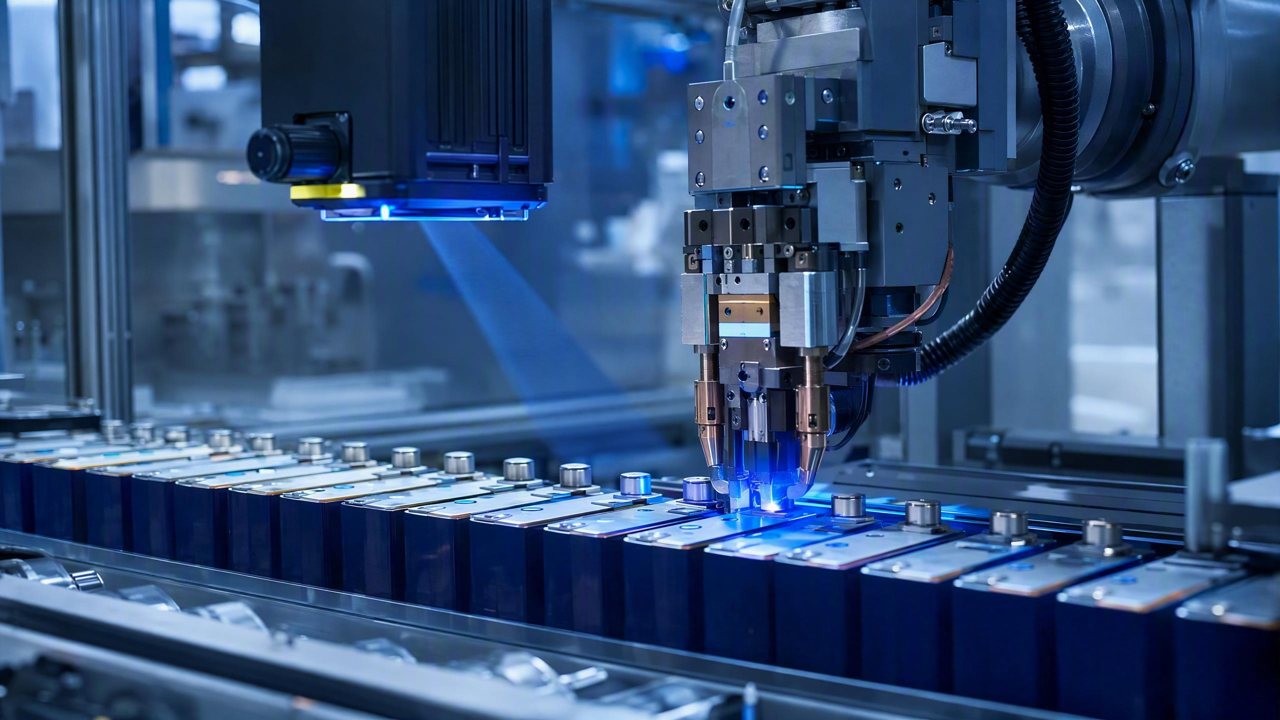
DaoAI 3D AI AOI equipment (featuring self-developed 3D cameras + 3D morphology reconstruction/point clouds, detecting hidden solder joints/coplanarity/micron-level morphology/pores and other 2D optical blind spot defects, with 2D-3D fusion) achieves micron-level 3D morphology inspection and intelligent data analysis, reducing the defect false negative rate for EV battery tab welding from 1.2% to 0.08%, effectively resolving the bottlenecks in quality traceability and data closed-loop faced by traditional inspection methods.
The rapid development of new energy batteries presents unprecedented challenges for manufacturing processes and quality control, especially in the critical process of tab welding. As core components for internal current conduction, the welding quality of battery tabs directly impacts battery internal resistance, heat generation, cycle life, and even safety. Any tiny burr, cold weld, or abnormal weld spot morphology can lead to degraded battery performance, or even thermal runaway. Traditional 2D visual inspection or manual sampling often falls short when dealing with defects hidden within complex geometric structures, and struggles to provide traceable, quantitative 3D morphological data. This makes precise attribution of quality issues difficult and hinders data-driven process optimization. DaoAI recognizes this pain point and has introduced its self-developed 3D AI AOI equipment into this core link, aiming to thoroughly address the quality gate issues of EV battery tab welding through high-precision 3D inspection capabilities, and establish a comprehensive quality traceability and data closed-loop system.
Pain Points: Why This Hurdle Is Difficult to Overcome
Inspecting EV battery tab welding faces multiple challenges, leading to a false negative rate of around 1.2% with traditional methods and difficulty in keeping the false positive rate below 5%, severely impacting production line efficiency. Firstly, the high and non-uniform reflectivity of tab materials (e.g., aluminum, nickel, copper) after welding often causes overexposure or underexposure in 2D images, leading to detail loss and making tiny defects like burrs and cold welds hard to identify. Secondly, the tab welding area typically involves complex 3D structures, such as weld spot edges, sides, and internal micro-pores or cracks within the weld seam, which are “blind spots” for 2D vision. Traditional rule-based AOI struggles to build effective models, while manual inspection is inefficient and highly susceptible to subjective factors, resulting in consistently high rework and re-inspection hours, averaging 15-20 minutes per hour for re-evaluation.
A deeper challenge lies in the lack of robust sensor protection and image stabilization techniques for vision systems in harsh industrial environments. Smoke, dust, spatters, electromagnetic interference generated during welding, along with production line vibrations, all severely affect the stability of 3D sensors and the quality of image acquisition. This leads to high data noise and poor repeatability, making stable detection of micron-level defects an elusive goal. Furthermore, traditional inspection solutions lack quantitative 3D morphological data for defects. When quality issues arise, they cannot provide detailed geometric features, making quality traceability difficult and impeding the precise identification of specific process parameter deviations, thus hindering continuous optimization and iteration of production processes, and making it challenging to effectively reduce the quality cost per unit.
Technical Principles
DaoAI's 3D AI AOI equipment fundamentally solves the challenges of tab welding inspection through its self-developed high-speed, high-precision 3D cameras and advanced 3D morphology reconstruction algorithms. The equipment utilizes multi-view structured light projection technology combined with high-resolution industrial cameras to capture multiple images from different angles in milliseconds. DaoAI's powerful point cloud processing engine then precisely reconstructs the 3D point cloud data of the tab weld spot. This method acquires complete geometric information of the weld spot, including height, volume, flatness, burr height, weld width, and depth, all at micron levels, completely bypassing the inspection blind spots caused by lighting, reflection, and shadows in 2D images. Specifically for harsh environments, DaoAI integrates an IP67-rated protective cover and self-cleaning module at the sensor front end, and optimizes internal heat dissipation and vibration reduction structures, ensuring the stability and data accuracy of 3D image acquisition under complex conditions like welding fumes and vibrations, thereby guaranteeing the long-term reliability of micron-level morphology detection.
Compared to traditional rule-based AOI and manual inspection, the advantage of DaoAI 3D AI AOI lies in its deep learning capabilities and 3D data analysis. The DaoAI AI AOI software system, based on vision foundation models, can rapidly build high-precision defect detection models using APDT positive/few-shot learning (requiring only 1-20 good samples). It also employs semantic false positive filtering technology to effectively distinguish real defects from surface textures, dust, and other non-defect features, reducing the false positive rate by −80%. Furthermore, for each weld spot inspected, the system generates a digital fingerprint containing all 3D morphological parameters, which is fused with 2D image data to form a complete 2D-3D fused inspection report. This data is uploaded to MES/QMS systems via DaoAI's data interface, establishing a traceable quality file for each battery product, enabling full lifecycle quality management from raw materials to finished products—a capability unmatched by traditional methods.
Typical Application Scenarios
- **Tab Welding Burr and Spatter Detection:** DaoAI 3D AI AOI can precisely measure the height and distribution of burrs at the weld spot edges, as well as the size and quantity of welding spatters. Traditional 2D vision often misses fine burrs under strong reflections, whereas 3D morphology reconstruction clearly reveals micron-level protrusions.
- **Cold Weld and Insufficient Weld Seam Detection:** Through 3D analysis of weld spot height, volume, weld seam depth, and continuity, DaoAI equipment effectively identifies defects such as cold welds and insufficient weld seams. These defects might appear as brightness anomalies or blurry textures in 2D images, but 3D data provides direct evidence of geometric deficiencies.
- **Weld Spot Coplanarity and Morphology Consistency Inspection:** For multi-point welded tabs, DaoAI 3D AI AOI can accurately assess the coplanarity of individual weld spots and the overall morphology consistency. Any slight warping or collapse can be captured by 3D data, ensuring welding strength and contact performance.
- **Auxiliary Judgment for Internal Pores and Micro-cracks:** While 3D vision cannot directly 'see through' interiors, by precisely identifying microscopic depressions, bulges, or abnormal textures on the weld spot surface, DaoAI equipment can assist in judging the potential risk of deeper pores or micro-cracks, guiding further non-destructive testing.
- **Tab Positioning and Dimensional Accuracy Inspection:** Before welding, DaoAI robot vision system can guide the robotic arm to precisely grasp and position the tabs, ensuring welding accuracy. After welding, the 3D AI AOI can also perform micron-level measurements of the welded tab dimensions to ensure compliance with design requirements, further enhancing overall process precision.
Implementation Case
A leading domestic Tier-1 supplier of new energy batteries faced severe challenges in tab welding quality control during its expansion. Their production line utilized high-speed laser welding, and their traditional 2D AOI system had a false negative rate of up to 1.2% for weld spot burrs and cold welds. This resulted in approximately 5000 battery modules being recalled or downgraded monthly due to welding defects, severely impacting brand reputation and costs. The manufacturer sought a solution that could provide precise 3D inspection and full data traceability. After extensive evaluation, they chose DaoAI's 3D AI AOI equipment for their production line upgrade. Prior to implementation, the client's tab welding defect inspection primarily relied on 2D AOI combined with manual re-inspection, which was inefficient and had a high false positive rate, leading to over 10 hours of cumulative production line downtime per month for debugging and false positive handling. The DaoAI engineering team deployed multiple 3D AI AOI devices on the production line and utilized the DaoAI AI AOI software system for rapid model training, building identification models for various defects with just 15 good samples.
DaoAI 3D AI AOI not only reduced our tab welding defect false negative rate to 0.08%, but more importantly, it established an unprecedented quality traceability system for us, making every weld spot traceable.
After deployment, the results were significant. DaoAI's 3D AI AOI equipment, with its high-precision 3D imaging and AI intelligent analysis capabilities, successfully maintained the tab welding defect false negative rate below 0.08% and reduced the false positive rate by −75%. Crucially, through the unified platform of DaoAI World model, every detected defect—whether burr height, cold weld volume, or abnormal weld seam morphology—generated a detailed 3D data report, which was linked to battery production batches, workstations, and operator information, then uploaded in real-time to the client's MES system. This allowed the client to achieve full-chain traceability of tab welding quality for the first time. When terminal products exhibited issues, they could quickly pinpoint specific production stages and defect types, significantly shortening troubleshooting time and providing precise data support for subsequent process improvements. The client's management stated that DaoAI provided not just inspection equipment, but a complete quality data closed-loop solution enabling lean manufacturing.
DaoAI Solution and Products
The core solution provided by DaoAI for the quality gate of EV battery tab welding is its self-developed 3D AI AOI equipment. This device integrates DaoAI's high-speed, high-precision 3D cameras, capable of real-time acquisition of 3D morphological data of tab weld spots. Coupled with the DaoAI AI AOI software system, it achieves precise identification and quantitative analysis of micron-level defects such as burrs, cold welds, and pores through advanced deep learning algorithms. For model building, DaoAI employs an APDT positive/few-shot learning strategy, requiring only 1-20 good samples to complete model training, significantly reducing changeover time to 5min and simplifying deployment. The equipment supports 100% local private deployment, ensuring customer data security. DaoAI also provides the DaoAI World model as a unified foundation, which possesses semantic understanding and cross-scenario generalization capabilities, continuously learning from production line feedback to optimize detection models and enhance long-term stability and accuracy. Furthermore, for scenarios requiring robotic collaboration, the DaoAI robot vision system can provide precise 6D pose guidance, ensuring accurate tab positioning before welding, forming an intelligent production process with a brain-eye-body closed-loop.
Through the deployment of DaoAI 3D AI AOI equipment, the client achieved a comprehensive upgrade in the quality of EV battery tab welding. This solution not only reduced the welding defect false negative rate to <0.08% and decreased the false positive rate by −75%, significantly reducing manual re-inspection workload and production line downtime. More importantly, complete 3D morphological data for each weld spot was collected, analyzed, and stored in real-time, building a traceable quality database. This enables the client to precisely attribute any quality anomaly in the production process, quickly identify process deviations, and achieve root cause traceability and preventive maintenance for quality issues. The establishment of a data closed-loop also provides strong data support for the client's production process optimization, helping them maintain a technological lead in intense market competition and significantly improving overall product reliability and customer satisfaction.
FAQ
How does DaoAI 3D AI AOI detect hidden defects in tab welding?
DaoAI 3D AI AOI utilizes self-developed high-precision 3D cameras and 3D morphology reconstruction technology to acquire complete 3D geometric information of weld spots. This enables the equipment to detect defects invisible to 2D vision, such as microscopic morphological anomalies caused by internal pores, burrs on weld sides, and height collapse due to cold welds, thereby achieving comprehensive identification of hidden defects.
How does this system ensure detection stability and accuracy in harsh industrial environments?
For harsh industrial environments, DaoAI integrates an IP67-rated protective cover and self-cleaning module at the 3D sensor front end, effectively isolating smoke, dust, and spatters. Concurrently, optimized internal heat dissipation and vibration reduction structures, combined with advanced image stabilization algorithms, ensure the stability and data accuracy of 3D image acquisition under complex conditions like vibration and electromagnetic interference, guaranteeing long-term reliability for micron-level detection.
How does DaoAI 3D AI AOI support quality traceability and data closed-loop?
For each weld spot inspected, the DaoAI 3D AI AOI system generates a digital fingerprint containing all 3D morphological parameters and a 2D-3D fused inspection report. This data is uploaded in real-time via standard interfaces to the client's MES/QMS systems, linked with production batches and workstations, establishing a traceable quality file for each battery product. This enables full lifecycle quality management and process optimization from production to delivery.
This article was generated by AI. Customer cases are simulated scenarios based on real product capabilities and figures are illustrative; see product pages for official benchmarks.