
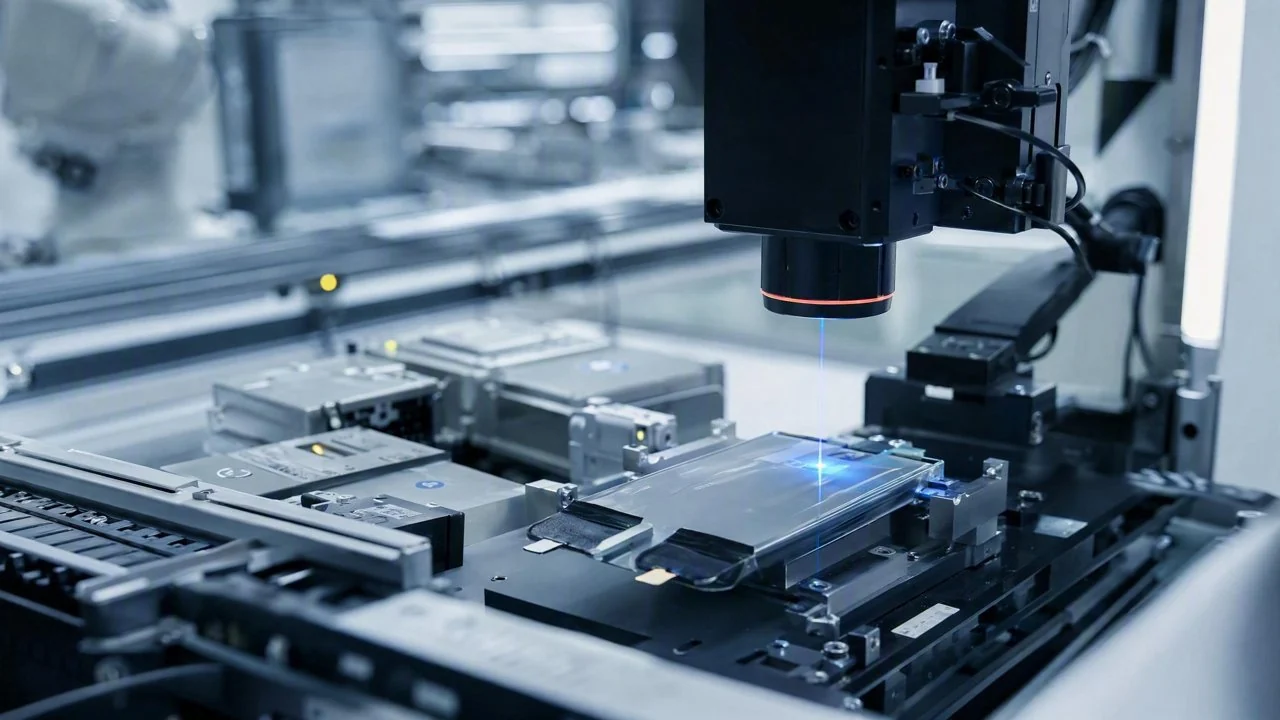
DaoAI's 3D AI AOI equipment, enabled by APDT few-shot self-training, reduced the missed detection rate of burrs and cold solders in new energy battery tab welding quality gates from 0.8% to 0.06%, significantly improving product quality and production line efficiency.
DaoAI's 3D AI AOI equipment (proprietary 3D camera + 3D morphology reconstruction/point cloud, detecting hidden solder joints/coplanarity/micron-level morphology/pores and other 2D optical blind spot defects, 2D-3D fusion), through its APDT few-shot self-training capability, reduced the missed detection rate of burrs and cold solders in new energy battery tab welding quality gates from 0.8% to 0.06%, significantly improving product quality and production line efficiency. As core components of electric vehicles and energy storage systems, new energy batteries demand stringent quality control during manufacturing. The tab welding process, a critical internal electrical connection, directly impacts battery internal resistance, cycle life, and safety. A leading power battery manufacturer utilizes laser welding to connect tabs to busbars, requiring welds free of burrs and cold solders, with full solder joints. However, due to the reflective properties of tab materials, welding spatter, and rapid production line speeds, traditional inspection methods struggle to effectively identify these minute defects, leading to potential quality risks.
Pain Points: Why This Hurdle Is Difficult to Overcome
This leading battery manufacturer faced multiple challenges. First, burrs and cold solder defects in the tab welding area are minute (often tens to hundreds of microns) and irregular in shape, making them highly susceptible to missed detection in complex optical environments. Traditional 2D vision systems, lacking depth information, are powerless against defects hidden deep within weld seams or obscured by shadows, leading to a missed detection rate that once reached 0.8%. Second, the rapid production line cycle, processing hundreds of battery cells per minute, demands that the inspection system complete high-precision judgments in an extremely short time. This made manual re-inspection a huge burden, not only consuming significant human resources but also potentially leading to secondary missed detections due to visual fatigue. Third, the complexity of the tab welding process, with slight variations in material batches and welding parameters, could lead to changes in defect morphology. Traditional rule-based AOI systems required hours or even days for parameter adjustment and model retraining, severely impacting changeover efficiency and production line uptime. Similar to the challenges faced by industrial AI large models in visual intelligence applications in traditional industries, the diversity and unpredictability of defects necessitate a large number of samples for model training. However, in actual production, especially for new or low-frequency defects, obtaining good and bad samples is extremely difficult and costly, further exacerbating the difficulty of deploying and maintaining inspection models.
From a process and imaging perspective, the smooth surface of tab materials (e.g., aluminum, nickel) is prone to specular reflection after laser welding, causing highlights and shadows in 2D images that interfere with defect feature extraction. Meanwhile, tiny burrs generated during welding can adhere to the edge or inside of the weld seam, and cold solders manifest as discontinuous welds, pores, or insufficient penetration. These 3D morphological features are difficult to distinguish in planar images. Traditional 2D AOI often only identifies macroscopic surface defects, remaining completely blind to deep-seated or sidewall defects such as microscopic pores within the weld seam or poor contact due to cold solder. Furthermore, when inspecting new battery structures or materials, the lack of sufficient defective samples for model training makes it difficult for existing systems to adapt quickly, resulting in long deployment cycles and high costs, failing to meet the rapid iteration demands of the new energy battery industry.
Technical Principles
The core of DaoAI's 3D AI AOI equipment lies in its proprietary 3D camera and advanced 3D morphology reconstruction technology, combined with 2D-3D fusion AI algorithms, with a strong emphasis on APDT few-shot self-training capability. This equipment utilizes high-precision structured light projection and multi-view image acquisition to obtain complete point cloud data of the tab welding area within tens of milliseconds, achieving micron-level 3D morphology reconstruction. This allows defects within traditional 2D optical blind spots, such as internal pores in weld seams, depressions caused by cold solders, and sidewall burrs, to be clearly represented as 3D geometric features. Built upon this, DaoAI's AI AOI software system employs advanced deep learning models for feature extraction and defect classification. Addressing the pain point of scarce samples in the new energy battery industry, DaoAI innovatively introduced the APDT (Active Positive Data Training) few-shot self-training mechanism. This mechanism allows the model to quickly establish a baseline using only 1-20 good samples, and then progressively enhance its defect recognition capabilities through active learning and unsupervised/semi-supervised learning, even with a small number of defective samples or no defective samples at all. This means that when changing production lines or encountering new types of defects, customers do not need to spend significant time collecting and annotating defective samples, greatly shortening the model deployment and iteration cycle.
Compared to traditional rule-based AOI and pure 2D AI AOI, DaoAI's 3D AI AOI leverages its deep utilization of 3D information. Traditional rule-based AOI relies on manually set thresholds, resulting in high false positive and false negative rates when facing complex and varied defect morphologies, with high maintenance costs. While pure 2D AI AOI can identify planar features through deep learning, it still struggles with defects lacking depth information (such as internal weld defects, subtle morphological changes). DaoAI's 3D AI AOI, however, uses precise 3D point cloud data acquired by its proprietary 3D camera, combined with texture and color information from 2D images, to achieve comprehensive defect detection. For instance, for cold solders, 2D images might only show color or brightness anomalies, while 3D data can directly quantify the weld penetration, height, and continuity for a more accurate judgment. The DaoAI World Model, serving as a unified foundation, further enhances the model's semantic understanding and cross-scenario generalization capabilities, enabling it to continuously learn from production line feedback and optimize detection performance, achieving a true intelligent manufacturing closed loop. Through this combination of 2D-3D fusion and APDT few-shot self-training, DaoAI has elevated the defect detection rate for new energy battery tab welding to over 99.4%, while simultaneously reducing the false positive rate by 85%.
Typical Application Scenarios
- **Tab Welding Burr Detection:** DaoAI's 3D AI AOI equipment can precisely identify minute metal protrusions (burrs) on the weld seam edge or surface, which can cause internal short circuits in batteries. Through high-precision 3D morphology reconstruction, the equipment quantifies burr height, width, and volume, avoiding missed detections by traditional 2D vision due to reflection or shadows.
- **Tab Welding Cold Solder and False Solder Detection:** For cold solders and false solders characterized by incomplete solder joints, insufficient penetration, or weak connections, DaoAI's equipment analyzes the 3D contour and point cloud density of the weld seam to assess the integrity and reliability of the solder joint. This solves the challenge of 2D images being unable to effectively evaluate the internal connection quality of weld seams.
- **Weld Seam Pore and Crack Detection:** 3D morphological data clearly reveals tiny pores and cracks on the weld seam surface, even if they are hidden deep within the weld or obscured by other structures. DaoAI's AI AOI software system, through meticulous analysis of 3D point clouds, can identify and quantify these defects that significantly impact battery performance.
- **Solder Joint Coplanarity and Positional Accuracy Evaluation:** In the connection between tabs and busbars, solder joint coplanarity and precise positioning are crucial. DaoAI's 3D AI AOI equipment accurately measures the relative height and spatial position between multiple solder joints, ensuring that the geometric precision of the weld meets design requirements and preventing stress concentration or poor contact due to deformation.
- **Weld Seam Width and Height Consistency Inspection:** For laser-welded seams, the consistency of their width and height is an important indicator of welding quality. DaoAI's equipment uses 3D data for cross-sectional analysis of the weld seam, real-time monitoring of weld dimension deviations to ensure the stability of the welding process.
Case Study
A leading domestic power battery manufacturer faced severe challenges with missed detections of burrs and cold solders in their tab welding process. Due to their rapid product iteration and continuous introduction of new battery pack structures, traditional 2D AOI systems required significant human effort for rule adjustment and sample collection during each changeover, severely delaying the mass production of new products. At the same time, high manual re-inspection costs and occasional missed batches not only increased operational expenses but also posed potential risks to their brand reputation. To address these issues, the manufacturer introduced DaoAI's 3D AI AOI equipment, with a particular focus on its APDT few-shot self-training capability. During initial deployment, the DaoAI engineering team used only 15 good tab welding samples to complete basic model training and deployment within hours. For the few new types of burrs and cold solders that appeared in subsequent production, through the APDT mechanism, production line engineers, without specialized programming knowledge, only needed to provide a very small number (1-3) of new defective samples, and the system quickly adapted and learned, enabling rapid iteration of defect models. Before deployment, the combined missed detection rate for burrs and cold solders on this production line was approximately 0.8%, requiring 4 workers per shift for re-inspection; after deployment, thanks to DaoAI's 3D AI AOI's high-precision detection and APDT's rapid iteration capability, the missed detection rate was consistently controlled below 0.06%, and manual re-inspection volume was reduced by 90%, requiring only 1 worker for spot checks and confirmation, significantly freeing up manpower.
The APDT few-shot self-training capability of DaoAI's 3D AI AOI equipment allows us to quickly respond to and deploy detection models when facing new defects, greatly shortening the new product introduction cycle and achieving a leap from 'manual experience' to 'AI intelligence'.
DaoAI Solutions and Products
The core solution provided by DaoAI to this customer is based on the DaoAI 2D / 3D AI AOI equipment. This equipment integrates DaoAI's proprietary high-precision 3D camera and advanced 3D morphology reconstruction module, capable of real-time acquisition of complete 3D point cloud data of the tab welding area. Through 2D-3D fusion algorithms, DaoAI's AI AOI software system can comprehensively and precisely identify and quantify various defects in tab welding, such as burrs, cold solders, pores, cracks, and coplanarity issues. APDT few-shot self-training is a highlight of this solution, enabling customers to quickly train and deploy models with extremely limited sample data through positive/few-shot learning mechanisms. When new defect types or process adjustments occur on the production line, users only need to provide 1-20 good samples or a small number of defective samples, and the system can complete model updates within 5 minutes, without complex code programming, greatly enhancing model adaptability and production line flexibility. Furthermore, the DaoAI World Model, as a unified foundation, ensures the stability and reliability of the model across different battery models and welding processes through semantic understanding and cross-scenario generalization capabilities. Equipment deployment supports 100% local private deployment, with all inspection data processed within the customer's factory, ensuring data security and privacy. DaoAI also provides comprehensive after-sales service and technical support to ensure long-term stable operation of the equipment and continuous optimization of model performance according to customer needs.
By introducing DaoAI's 3D AI AOI equipment, this leading power battery manufacturer achieved a comprehensive upgrade in tab welding quality inspection. The missed detection rate for burrs and cold solders was reduced from 0.8% to 0.06%, and the detection rate increased to over 99.94%, effectively eliminating potential battery safety hazards. Simultaneously, manual re-inspection hours were reduced by 90%, shrinking the original 4-person re-inspection team to 1 person, significantly lowering labor costs. The APDT few-shot self-training capability shortened new product changeover time from days to hours, increasing production line uptime by 15%, bringing significant economic benefits and competitive advantages to the customer. DaoAI is committed to providing efficient, intelligent, and reliable visual inspection solutions for the new energy battery industry, helping customers achieve high-quality, high-efficiency production goals.
FAQ
What is APDT Few-Shot Self-Training, and how does it benefit the new energy battery industry?
APDT Few-Shot Self-Training is a core capability of DaoAI's AI AOI software system, allowing models to quickly establish a detection baseline with only 1-20 good samples. Through an active learning mechanism, it enables rapid model iteration and optimization with very few defective samples. This is crucial for the new energy battery industry, where new products and processes iterate quickly, and defect samples are hard to obtain. APDT significantly shortens model deployment and changeover times, and reduces training costs.
How does DaoAI's 3D AI AOI equipment overcome specular reflection and optical blind spots in tab welding?
DaoAI's 3D AI AOI equipment uses a proprietary high-precision structured light 3D camera. Through multi-view image acquisition and 3D morphology reconstruction technology, it obtains complete 3D point cloud data of the tab welding area. This allows the equipment to identify defects based on geometric features rather than just grayscale or color information, effectively avoiding highlight and shadow interference from specular reflection, and detecting deep-seated or sidewall defects within traditional 2D optical blind spots, such as internal weld pores or sidewall burrs.
How long does it take to deploy DaoAI's 3D AI AOI equipment, and does it support on-premise deployment?
DaoAI's 3D AI AOI equipment typically completes basic deployment within hours to days, depending on production line integration complexity and model training requirements. Thanks to APDT few-shot self-training, initial model training and subsequent iterations are very fast. We support 100% local private deployment, with all data processed on the customer's local servers, ensuring data security and privacy without concerns about data leakage.
This article was generated by AI. Customer cases are simulated scenarios based on real product capabilities and figures are illustrative; see product pages for official benchmarks.