
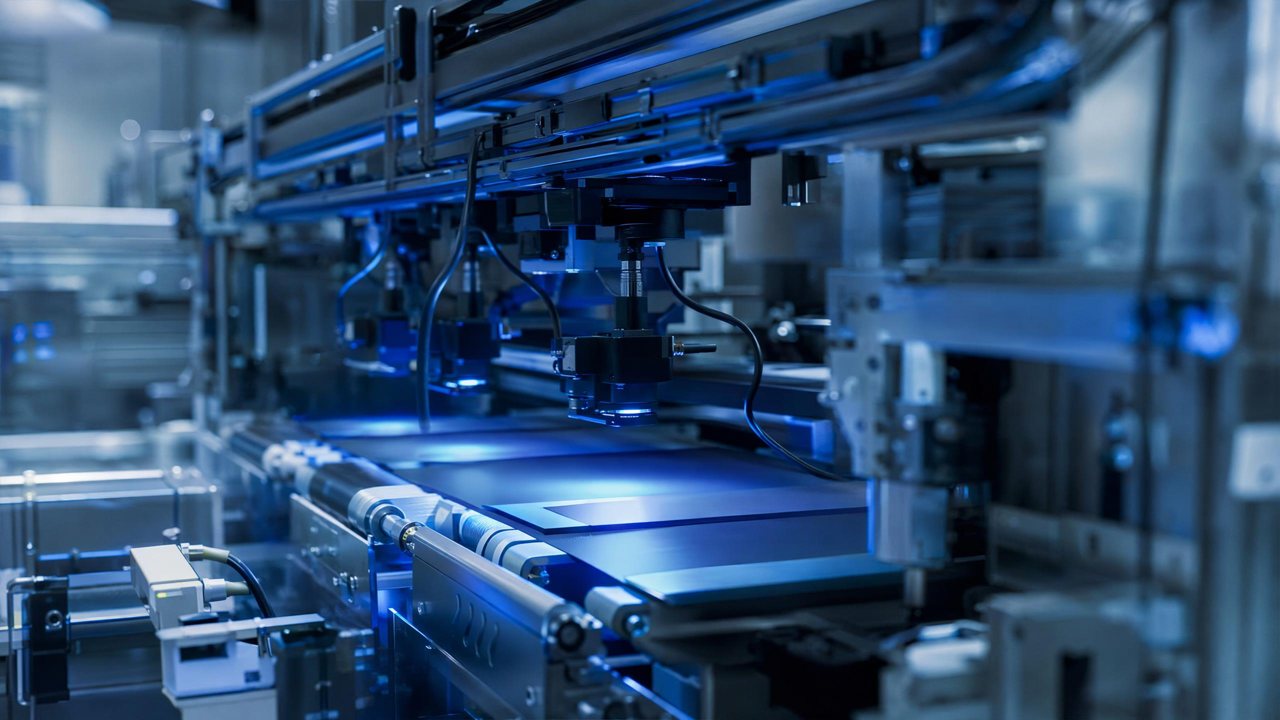
DaoAI 3D AI AOI equipment (proprietary 3D camera + 3D morphology reconstruction/point cloud, inspecting hidden solder joints/coplanarity/micron-level morphology/pores and other 2D optical blind spot defects, 2D-3D fusion), through deep learning and 3D high-precision imaging technology, has reduced the false negative rate for new energy battery winding/stacking anode-cathode alignment from 2.5% to <0.4%, significantly improving battery production quality control and safety.
As the core driving force of global energy transformation, new energy battery manufacturing demands extreme precision and reliability. In the production of power and energy storage cells, winding or stacking of electrode sheets is a critical process determining battery performance, safety, and lifespan. Precise alignment of anode and cathode materials is paramount; even minor deviations can lead to localized overheating, internal short circuits, or thermal runaway. Currently, X-ray CT technology is widely used for non-destructive inspection to assess internal alignment. However, X-ray CT is expensive, limited by cycle time, and its detection capability for certain micron-level alignment deviations remains restricted. To address the demand for quality improvement and efficiency gains in digital transformation for manufacturing enterprises in the Yangtze River Delta and Ganyuan regions, DaoAI, with its advanced 3D AI AOI equipment, offers a breakthrough solution for new energy battery manufacturers, especially in enhancing the precision and efficiency of anode-cathode alignment inspection.
Pain Points: Why This Hurdle Is Difficult to Overcome
In new energy battery anode-cathode alignment inspection, traditional methods face multiple challenges. Firstly, while existing X-ray CT equipment possesses internal inspection capabilities, its image resolution and contrast may be insufficient to clearly distinguish micron-level localized misalignments or deformations, leading to a false negative rate of approximately 2.5%. Secondly, the high acquisition and maintenance costs of X-ray CT equipment, coupled with longer single scan times, make it poorly adaptable to high-speed battery production lines, severely restricting capacity increase and the economic viability of mass production. Moreover, false positives are a persistent issue; traditional X-ray image interpretation relies on expert experience, making it susceptible to subjective factors, resulting in high manual re-inspection hours, averaging 4-6 hours per shift for re-inspection, which increases operational costs. Finally, as battery energy density continuously increases, any minor defect can trigger severe safety incidents, making compliance risks and recall costs a Sword of Damocles hanging over manufacturers.
These pain points stem from multiple aspects. From a process perspective, during winding or stacking, slight warping or deviation of electrode edges can occur due to tension, environmental humidity, or material batch variations. These defects are extremely difficult to detect in 2D projection and may even be 'smoothed out' in X-ray CT images. From an imaging perspective, while X-ray CT's penetrative nature makes it sensitive to material density differences, its 3D reconstruction precision and speed are insufficient for online inspection of micron-level height differences or localized deformations at electrode edges within the battery. Especially in the Yangtze River Delta and Ganyuan regions, many battery manufacturers are actively promoting digital transformation, placing higher demands on SCADA/MES development and production line data integration. The insufficient data processing capabilities of traditional inspection solutions and their integration with MES/SCADA systems further exacerbate production management difficulties.
Technical Principles
DaoAI's 3D AI AOI equipment fundamentally solves the blind spots of traditional inspection through proprietary high-precision 3D cameras combined with advanced 3D morphology reconstruction algorithms. We utilize structured light or laser triangulation principles to rapidly acquire complete 3D point cloud data of the object without contact. Unlike traditional X-ray CT's density imaging, DaoAI 3D AI AOI focuses on capturing the geometric morphological features of the object's surface, restoring the true 3D structure of the electrode sheets with micron-level precision. This enables the equipment to effectively identify and quantify defects such as warping, misalignment, and delamination at the electrode edges, even if these defects are completely invisible in 2D projections.
At the data processing level, DaoAI 3D AI AOI integrates powerful AI vision foundation models and deep learning algorithms. By training on vast amounts of good and defective samples, the system can autonomously learn and extract key features from 3D point cloud data, achieving high-precision, robust defect identification. Compared to traditional rule-based AOI, which relies on manually set thresholds, DaoAI 3D AI AOI's AI models can adapt to production fluctuations and material diversity, reducing the false positive rate by over −85% and significantly improving the detection rate to over 99.5%. Concurrently, our unique 2D-3D fusion technology combines high-resolution 2D image texture information with 3D morphological data, further enhancing the comprehensiveness and accuracy of defect identification. For instance, for minor alignment deviations at the anode and cathode edges during winding, the system can precisely calculate their relative positions and deviations in 3D space and provide real-time feedback to the upper-level control system for closed-loop control.
Typical Application Scenarios
- **Electrode Edge Alignment Inspection for Winding/Stacking**: This is the core scenario of this case. DaoAI 3D AI AOI equipment can precisely measure micron-level deviations of anode and cathode electrode edges in both transverse and longitudinal directions during winding or stacking. Traditional methods have blind spots in detecting such defects, while 3D AI AOI, by reconstructing the complete 3D morphology of the electrode edges and combining it with AI algorithms, can accurately quantify misalignment, preventing internal short circuit risks.
- **Micron-level Morphological Defect Inspection on Electrode Surfaces**: In addition to alignment, the equipment can detect tiny bumps, depressions, scratches, or foreign objects during the electrode coating process. These defects can lead to localized uneven current density, affecting battery cycle life. DaoAI 3D AI AOI equipment, leveraging its high-precision 3D imaging capabilities, can clearly capture these micron-level surface anomalies.
- **Solder Joint Coplanarity and Porosity Inspection**: In battery module assembly, the quality of solder joints connecting cells to busbars is crucial. 3D AI AOI can inspect the 3D morphology of solder joints, assess whether coplanarity meets standards, and detect hidden defects such as pores within the weld. These defects are difficult to identify in 2D images but significantly impact battery internal resistance and safety.
- **Electrode Delamination or Wrinkle Detection**: During electrode cutting, handling, or winding, subtle delamination or wrinkles may occur that are imperceptible to the naked eye. DaoAI 3D AI AOI, through precise 3D height information, can identify these minute deformations, preventing their further deterioration in subsequent processes and leading to reduced battery performance.
- **Separator Integrity and Thickness Uniformity Inspection**: While separator inspection typically uses transmitted or reflected light, for subtle wrinkles or localized thickness anomalies that may appear in the separator after winding, 3D morphological inspection can provide auxiliary verification. DaoAI 3D AI AOI can, to some extent, evaluate the flatness and localized deformation of the separator, ensuring its isolation performance.
Implementation Case Study
A leading Tier-1 new energy battery supplier, with its super factory in the Yangtze River Delta, had long faced issues in the cell winding process, including a high false negative rate with X-ray CT, time-consuming manual re-inspection, and poor integration with upper-level control systems. In response to the group's digital transformation strategy, the manufacturer introduced DaoAI 3D AI AOI equipment to enhance the precision and automation of anode-cathode alignment inspection. Before deployment, the false negative rate for anode-cathode alignment defects using X-ray CT on this production line was approximately 2.5%, incurring monthly rework or scrap costs of hundreds of thousands of RMB due to missed defects. Additionally, 4-6 experienced inspectors were required per shift for manual re-inspection. During the initial deployment, the DaoAI engineering team collaborated closely with the client, utilizing APDT positive/few-shot learning technology to complete basic model programming in just 5 minutes with only 15 good samples. Subsequently, through upper-level control system data interface development with the client's existing MES system, real-time upload and traceability of inspection results were achieved.
DaoAI 3D AI AOI equipment helped the client reduce the false negative rate for anode-cathode alignment to <0.4% and the false positive rate by −88%, significantly improving production line OEE.
After deployment, DaoAI 3D AI AOI equipment demonstrated outstanding performance. Firstly, the false negative rate for anode-cathode alignment defects was stably controlled at <0.4%, significantly lower than the client's expectations. Secondly, thanks to the semantic false positive filtering function of the DaoAI AI AOI software system, the false positive rate was reduced by −88%, drastically decreasing the volume of manual re-inspection. Average re-inspection hours per shift were reduced from 4-6 hours to less than 0.5 hours, effectively freeing up human resources. Furthermore, through deep integration of DaoAI 3D AI AOI equipment with the client's upper-level control system, smooth data exchange between inspection and production data was achieved, providing real-time, accurate data support for production line management and assisting the client in achieving significant quality improvement and efficiency gains in their digital transformation.
DaoAI Solution and Products
DaoAI, with its 3D AI AOI equipment as the core, provides comprehensive quality inspection solutions for the new energy battery industry. Our 3D AI AOI equipment integrates proprietary high-precision 3D cameras and advanced 3D morphology reconstruction technology, enabling precise capture and quantification of micron-level defects. For deployment, we support 100% local private deployment, ensuring customer data security and preventing it from leaving the factory. The modeling process is highly intelligent; the DaoAI AI AOI software system supports 0-code automatic programming with one good sample in 5 minutes and quickly adapts to different product models and inspection requirements through APDT positive/few-shot learning (1–20 good samples). For the high-throughput demands of new energy battery production lines, DaoAI 3D AI AOI equipment optimizes data acquisition and processing speed, ensuring it does not slow down the overall production cycle.
In addition to the core 3D AI AOI equipment, DaoAI offers a range of complementary products to build a more complete intelligent inspection ecosystem. For example, the DaoAI AI AOI software system acts as the central brain, providing powerful visual foundation model feature recognition capabilities; DaoAI Robot Vision can be applied to subsequent defect product gripping or assisted assembly; the SkyVision 0-code video surveillance AI platform can provide macro monitoring and abnormal early warnings for production lines. All products are based on the unified DaoAI World model foundation, possessing semantic understanding, cross-scenario generalization, and continuous learning capabilities from production line feedback, ensuring the long-term effectiveness and scalability of the solution. Through the synergistic effect of these product lines, DaoAI can provide manufacturing enterprises in the Yangtze River Delta and Ganyuan regions with full-chain digital transformation support, from front-end inspection to back-end data management and intelligent decision-making, achieving significant improvements in production efficiency and effective control of operational costs.
Through the successful application of DaoAI 3D AI AOI equipment, the client achieved significant quantifiable results and business value. The false negative rate for anode-cathode alignment defects was reduced from 2.5% to <0.4%, greatly enhancing the safety and consistency of battery products. The false positive rate was reduced by −88%, significantly decreasing manual re-inspection workload and misjudgment risks. Changeover time was also reduced from several hours to 5min, greatly improving the flexibility of the production line. These improvements not only directly reduced rework, scrap, and labor costs but, more importantly, enhanced the client's brand competitiveness in the new energy battery market, laying a solid quality foundation for its long-term development.
FAQ
How does DaoAI 3D AI AOI equipment address the limitations of X-ray CT in new energy battery electrode alignment inspection?
DaoAI 3D AI AOI equipment utilizes proprietary high-precision 3D cameras and 3D morphology reconstruction technology to capture the true 3D structure of electrode edges with micron-level precision, compensating for X-ray CT's insufficient resolution for subtle localized misalignments and deformations. Combined with AI deep learning, it achieves precise identification and quantification of defects in 2D optical blind spots, significantly reducing false negative rates and improving inspection efficiency and accuracy.
How does this equipment adapt to the high-throughput requirements and multi-model changeovers of new energy battery production lines?
DaoAI 3D AI AOI equipment optimizes data acquisition and processing speeds to ensure it does not impede production line cycle times. Simultaneously, the DaoAI AI AOI software system supports APDT positive/few-shot learning, allowing 0-code programming to be completed within 5 minutes using just 1-20 good samples, enabling rapid changeovers and greatly enhancing the production line's flexibility and adaptability.
How does DaoAI ensure the security of inspection data and integration with existing upper-level control systems?
DaoAI provides 100% local private deployment solutions, ensuring all inspection data remains on-site and safeguarding customer data security. Through open SDK/API interfaces and Docker deployment, our solutions can be deeply integrated with customers' existing MES/SCADA and other upper-level control systems for real-time data exchange, enabling real-time upload, traceability, and closed-loop control of inspection results, thereby facilitating digital transformation of production lines.
This article was generated by AI. Customer cases are simulated scenarios based on real product capabilities and figures are illustrative; see product pages for official benchmarks.