
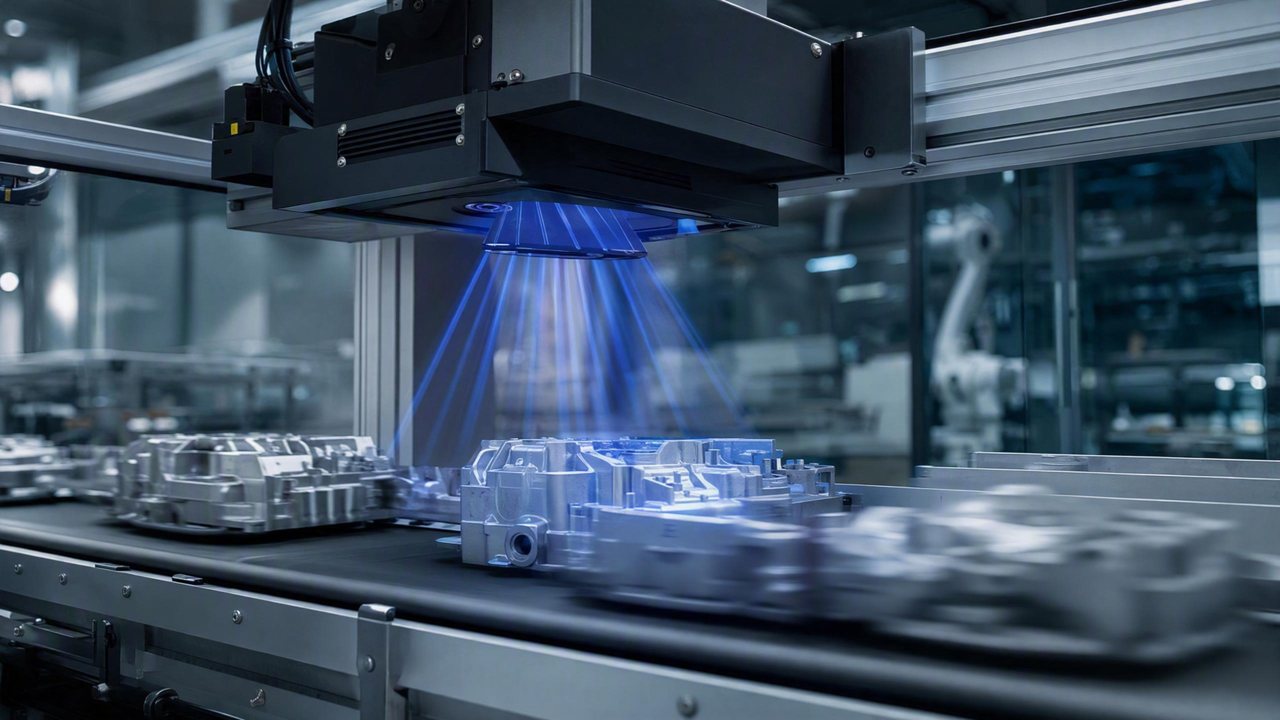
DaoAI's 3D AI AOI equipment (featuring proprietary 3D cameras + 3D morphology reconstruction/point clouds, capable of detecting hidden solder joints/coplanarity/micron-level morphology/porosity and other 2D optical blind spot defects, with 2D-3D fusion) precisely inspects porosity and inclusions in aluminum die castings using 3D detection. This reduces the missed detection rate from a typical 5% in traditional manual sampling to below 0.3%, significantly ensuring the quality of critical automotive components and guaranteeing 100% full inspection capacity aligned with high-speed production line takt times.
Driven by the trend of automotive lightweighting, aluminum die castings are widely used in critical components such as engine blocks, transmission housings, and suspension systems due to their excellent strength-to-weight ratio, thermal conductivity, and malleability. However, the die-casting process inevitably produces internal defects like porosity, inclusions, and shrinkage, which can lead to component failure during subsequent processing and use, severely impacting driving safety. Especially for large or complex die castings, internal defects are often difficult to detect using conventional 2D surface inspection methods. A leading Tier-1 automotive component supplier, a large enterprise with multiple automated die-casting production lines supplying major domestic and international automakers, faced the challenge of achieving 100% full inspection rate without affecting existing production line takt time, while effectively detecting microscopic porosity and inclusions within aluminum die castings.
Pain Points: Why This Hurdle is Difficult to Overcome
The supplier faced multiple challenges in quality control for aluminum die castings: Firstly, while traditional X-ray inspection can detect internal defects, its single-piece inspection speed often fails to meet the demands of high-takt production lines, leading to reliance on sampling. This made it difficult to keep the missed detection rate below 1%, often exceeding 5% during peak production periods. Secondly, X-ray equipment is expensive to acquire and maintain, and its operation is complex, requiring specialized personnel for image interpretation, resulting in long manual re-inspection times. Furthermore, micron-level pores or inclusions, especially those located sub-surface, can appear blurred or be obscured by other structures in 2D X-ray images due to projection effects, making interpretation difficult and leading to high false positive rates. This increased the burden of manual re-inspection, requiring 2-3 quality inspectors per shift for re-evaluation, consuming significant man-hours. From a process perspective, even minor fluctuations in die-casting process parameters can lead to changes in defect types and distribution, making it difficult for a single set of detection rules to cover all scenarios. This series of issues severely hampered the manufacturer's production efficiency and product quality consistency, potentially leading to compliance risks such as customer recalls.
Moreover, current industrial vision systems are progressively moving from mere perception to deeper embodied intelligence, akin to the potential impact of Google's 'Android' model for embodied AI on the industrial vision ecosystem after its withdrawal from robot hardware manufacturing. For industrial vision systems, this means not only 'seeing clearly' but also 'understanding' and 'guiding' subsequent operations. Traditional 2D AOI, when confronted with internal defects in aluminum die castings, lacks a deep understanding of the object's 3D morphology, making it difficult to establish strong correlations between defects and process parameters, thereby hindering defect root cause analysis and production optimization. Relying solely on 2D images does not provide sufficient data dimensions to support more intelligent and generalized detection decisions, which has become a significant bottleneck in the context of accelerating production takt times and shortening product iteration cycles.
Technical Principles
The core advantage of DaoAI's 3D AI AOI equipment lies in its proprietary high-precision 3D camera and advanced 3D morphology reconstruction technology. Unlike traditional 2D X-ray projection imaging, DaoAI utilizes multi-angle structured light projection and a high-resolution camera array for data acquisition. Through complex geometric correction and point cloud fusion algorithms, it can accurately reconstruct the micron-level 3D morphology of aluminum die castings and analyze internal defects using deep learning models. This system can acquire 3D point cloud data of parts, enabling quantitative measurement of 3D features such as volume, depth, and position of defects like porosity and inclusions. For instance, for sub-surface pores, a 2D X-ray image might only show a blurry grayscale variation, whereas DaoAI's 3D system can clearly identify their 3D contours and depth information. This allows DaoAI 3D AI AOI equipment to effectively compensate for the blind spots of 2D optical inspection, achieving high-precision identification of hidden defects.
At the algorithmic level, the DaoAI AI AOI software system integrates advanced visual foundation models, featuring APDT positive/few-shot learning capabilities, requiring only 1-20 good samples to complete 0-code automatic programming within 5 minutes. For the complex surface textures and diverse defects of aluminum die castings, the system uses deep learning networks, trained on a large volume of real defect samples, to learn and identify pores, inclusions, shrinkage, and other defects of different types and sizes. Crucially, the DaoAI AI AOI software system supports 2D-3D fusion inspection, meaning it simultaneously uses high-resolution 2D images and 3D morphological data for comprehensive judgment, effectively improving the detection rate of complex defects and significantly reducing false positives. Compared to traditional rule-based AOI systems, DaoAI's 3D AI AOI equipment eliminates the need for manual setting of tedious thresholds and geometric rules, greatly simplifying programming and maintenance. When encountering new defect types, it can quickly adapt through few-shot learning, achieving stronger robustness and generalization capabilities.
Typical Application Scenarios
- **Internal Porosity Detection in Aluminum Die Castings**: Using 3D point cloud data, precisely identify and quantify the size, position, and depth of micron-level pores within and beneath the surface of die castings, overcoming the blurriness of 2D X-ray projections.
- **Inclusion and Shrinkage Detection**: Through high-precision 3D morphology reconstruction, effectively distinguish between foreign matter inclusions within the material and shrinkage defects caused by uneven cooling, providing a more comprehensive quality assessment.
- **Dimensional and Morphological Consistency Inspection**: Perform sub-millimeter precision measurements of the overall 3D dimensions of die castings and critical feature morphologies (e.g., flatness, hole diameter, chamfers) to ensure product consistency with design drawings.
- **Surface Micro-crack and Scratch Detection**: Combining 2D-3D fusion technology, even tiny surface cracks or scratches can be highlighted in 3D morphological data, while 2D images are used for texture analysis, improving detection rates.
- **Burr and Flash Detection**: At the edges and joints of die castings, DaoAI's 3D AI AOI equipment can precisely identify and quantify small burrs and flashes, preventing problems in subsequent processing or assembly.
Deployment Case Study
A leading Tier-1 automotive component supplier, after evaluating various inspection solutions, ultimately decided to introduce DaoAI's 3D AI AOI equipment, deploying it at a critical inspection station on its high-speed aluminum die casting processing line. This production line primarily manufactures engine cylinder head components, with extremely low tolerance for internal defects, and a production takt time requirement of 10 pieces per minute. Before deployment, the client primarily relied on offline X-ray sampling and manual visual inspection, resulting in a missed detection rate that consistently hovered around 2.5%, with monthly rework and scrap costs due to defective parts flowing downstream reaching hundreds of thousands of RMB. The pressure of manual re-inspection was immense, with an average re-inspection time of 30 seconds per piece, severely slowing down overall production efficiency. The DaoAI team provided a customized 3D AI AOI solution tailored to the client's specific needs, performing on-site integration and debugging. Through the DaoAI AI AOI software system, initial training of the defect detection model was completed in just 8 minutes using only 15 good samples, and optimizations were made for factors such as lighting and vibration in the actual production environment.
"DaoAI's 3D AI AOI equipment not only solved our missed detection problem for aluminum die casting porosity, but more importantly, it achieved complete synchronization with our production line takt time, truly enabling 100% full inspection—something we could only dream of before." — Client Quality Manager
After deployment, DaoAI's 3D AI AOI equipment smoothly integrated with the client's production takt time, with single-piece inspection time consistently below 5 seconds, fully meeting the detection demand of 10 pieces per minute. In actual operation, for microscopic pores smaller than 0.5 mm in diameter and sub-surface inclusions, the detection rate of DaoAI's 3D AI AOI equipment reached 99.7%, successfully reducing the missed detection rate to <0.3%. Simultaneously, the false positive rate was significantly reduced by 75%, from 8% to approximately 2%, reducing manual re-inspection volume by −60% and greatly alleviating the burden on quality inspectors. This not only improved product quality but also significantly reduced production costs and potential quality risks. Through the deployment of DaoAI's 3D AI AOI equipment, the client reduced monthly losses due to quality issues such as scrap and rework, enhancing its competitiveness in the automotive supply chain.
DaoAI Solution and Products
The core solution provided by DaoAI is based on its independently developed 3D AI AOI equipment. This equipment integrates DaoAI's proprietary high-speed, high-precision 3D camera, capable of rapidly acquiring complete 3D point cloud data of the inspected parts. Combined with the DaoAI AI AOI software system, the system analyzes 3D morphological data through advanced deep learning algorithms to accurately identify internal defects such as porosity, inclusions, and shrinkage. In terms of implementation, DaoAI provides end-to-end services from equipment selection, installation and debugging, model training, to production line integration. The DaoAI AI AOI software system supports 0-code automatic programming, making the establishment and maintenance of detection models simple and efficient, with changeover times reduced to within 5 minutes. Furthermore, the DaoAI AI AOI software system supports 100% local private deployment, ensuring that all inspection data remains on-site, safeguarding client data security and production information confidentiality. Through its 2D-3D fusion detection capability, DaoAI's 3D AI AOI equipment effectively addresses the blind spots of traditional 2D optical inspection, providing clients with more comprehensive and reliable quality assurance. In the future, DaoAI will continue to optimize its DaoAI World model to achieve semantic understanding and cross-scenario generalization in more complex scenarios, further enhancing the intelligence level of industrial vision systems.
Through the deployment of DaoAI's 3D AI AOI equipment, the client achieved 100% full inspection of porosity and inclusions in aluminum die castings, effectively eliminating missed detection risks and improving product quality consistency. While perfectly matching the production line takt time, single-piece inspection time was reduced to under 5 seconds, ensuring that capacity was unaffected. The system's detection rate reached 99.7%, with a missed detection rate of less than 0.3%, and the false positive rate was reduced by 75%, significantly decreasing the workload of manual re-inspection and saving the client substantial operating costs each month. DaoAI's 3D AI AOI equipment not only improved inspection efficiency and accuracy but also built a solid quality barrier for the client in the fiercely competitive automotive component market, enhancing its market competitiveness.
FAQ
How does DaoAI's 3D AI AOI equipment ensure 100% full inspection capacity alignment with high-takt production lines?
DaoAI's 3D AI AOI equipment employs proprietary high-speed 3D cameras and optimized algorithms, compressing single-piece inspection time to under 5 seconds, fully meeting high-takt production demands of over 10 pieces per minute. Combined with its high automation and few-shot learning capabilities, it achieves smooth integration with production takt time while ensuring high-precision detection, guaranteeing 100% full inspection and avoiding missed detection risks associated with traditional sampling.
How does this equipment address the challenge of detecting microscopic pores and sub-surface inclusions in aluminum die castings?
The equipment utilizes high-precision structured light projection and 3D morphology reconstruction to acquire complete 3D point cloud data of aluminum die castings. It can accurately identify and quantify the size, position, depth, and other 3D features of micron-level pores and inclusions located internally and sub-surface. Combined with 2D-3D fusion deep learning algorithms, it effectively overcomes the limitations of traditional 2D X-ray projection blurriness and insufficient information, achieving high-precision hidden defect detection.
What are the advantages of DaoAI's 3D AI AOI equipment in terms of deployment and maintenance?
DaoAI's 3D AI AOI equipment features 0-code automatic programming, allowing rapid model training with only a very small number of good samples (1-20 images), reducing changeover time to within 5 minutes. It also supports 100% local private deployment, ensuring data security. Its strong generalization capabilities and robustness reduce reliance on manual intervention, significantly lowering the complexity and cost of deployment and long-term maintenance.
This article was generated by AI. Customer cases are simulated scenarios based on real product capabilities and figures are illustrative; see product pages for official benchmarks.