
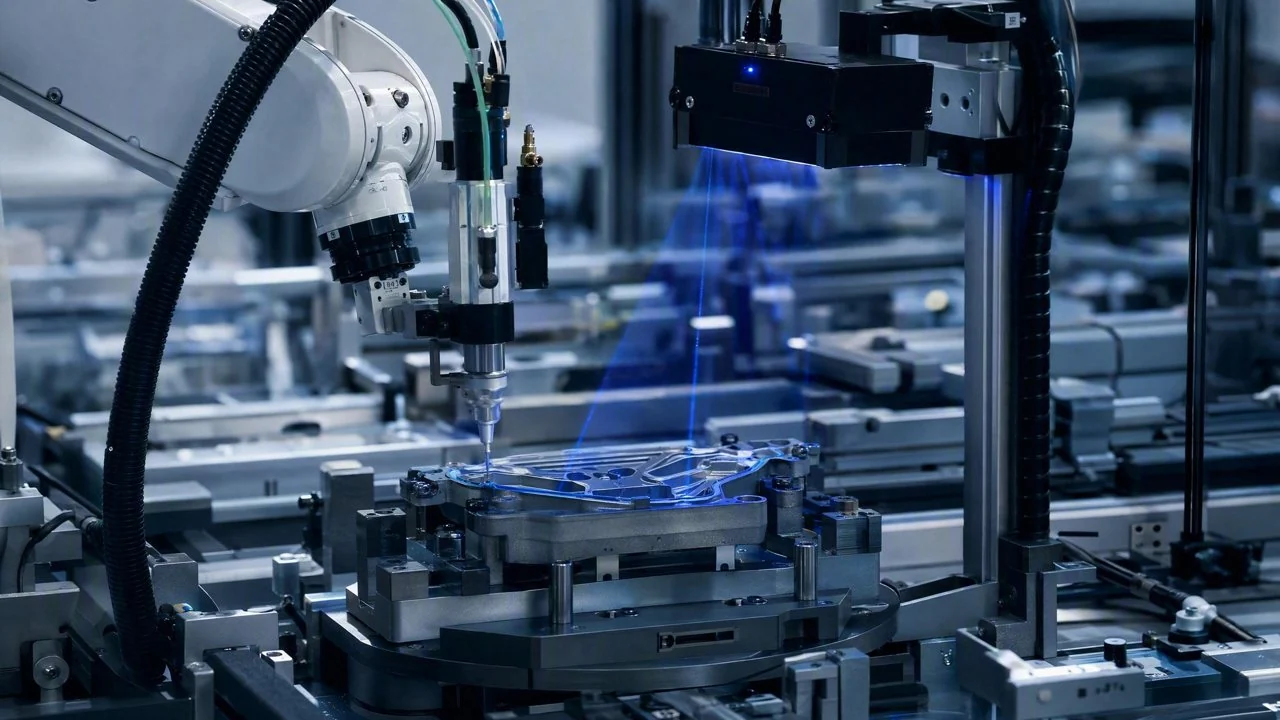
DaoAI 3D AI AOI, utilizing high-precision proprietary 3D cameras and 3D morphology reconstruction, boosts the detection rate of automotive component adhesive/sealant defects to over 99.8%, effectively reducing missed defects to micron levels, thereby significantly mitigating rework and recall risks due to sealing failures.
DaoAI 3D AI AOI, utilizing high-precision proprietary 3D cameras and 3D morphology reconstruction, boosts the detection rate of automotive component adhesive/sealant defects to over 99.8%, effectively reducing missed defects to micron levels, thereby significantly mitigating rework and recall risks due to sealing failures. In automotive manufacturing, adhesive application and sealing are critical processes for ensuring vehicle performance, comfort, and durability. Whether it's engine compartment sealing, body weld corrosion protection, or interior component bonding, the continuity, width, height, and internal structural integrity of the adhesive bead directly impact product quality and driving safety. Traditionally, such inspections relied on manual visual inspection or 2D vision-based AOI systems. However, with the electrification and intelligence of automobiles, component integration is higher, and the demands for sealing reliability have reached unprecedented levels. For example, the sealing integrity of battery packs directly relates to thermal management and safety, where any minor defect could lead to severe consequences. Therefore, 100% online, high-precision, and blind-spot-free inspection of adhesive application quality has become an industry imperative.
Pain Points: Why This Hurdle Is So Difficult to Overcome
Quality inspection of automotive component adhesive/sealant application faces multiple challenges, leading to high missed detection rates and false positives, severely impacting production efficiency and product reliability. Firstly, traditional 2D vision inspection is largely ineffective against 'hidden defects' within the adhesive bead. For instance, internal pores, unbonded areas at the bottom, and tiny discontinuities or overflows at the bead edges are often obscured by surface textures, lighting variations, or product geometry in 2D images, resulting in a missed detection rate as high as 5%. Secondly, the color, reflective properties of the adhesive material, and the complex curvature of the product surface make 2D image acquisition highly susceptible to ambient light and product characteristics, leading to a large number of false positives. Manual re-inspection accounts for up to 30% of labor hours. This high false positive rate not only increases labor costs but also slows down the production rhythm. Thirdly, the automotive industry demands extremely high production efficiency and flexibility. Traditional rule-based AOI systems often require several hours for reprogramming and debugging during product changeovers, resulting in long downtime that severely impacts capacity, especially in mixed-model production scenarios, where changeover downtime can account for up to 15%.
From a process perspective, the adhesive bead is susceptible to irregular shapes, discontinuities, air bubbles, overflow, or insufficient application due to various factors such as nozzle wear, adhesive viscosity, ambient temperature, and application speed. These defects often have 3D characteristics; for example, pores are voids within the adhesive bead, whose depth and volume cannot be captured by 2D images. From an imaging perspective, the translucent or reflective properties of the adhesive bead, as well as the subtle color differences between it and the substrate, lead to insufficient contrast in 2D images, making it difficult to clearly distinguish defects from normal areas. Furthermore, while current industrial large models theoretically possess strong generalization capabilities for factory floor deployment, they still require specialized 3D sensing technology to achieve reliable feature extraction and defect identification for micron-level, high-precision 3D morphology defects. Relying solely on 2D visual features can easily lead to local optima, failing to effectively reduce missed detections.
Technical Principles
The core advantage of DaoAI 3D AI AOI equipment lies in its proprietary 3D camera technology, 3D morphology reconstruction algorithms, and 2D-3D fusion defect detection mechanism. We employ high-precision line laser scanning principles, using multiple industrial cameras to simultaneously acquire laser profile data from different angles. Combined with sub-pixel level feature point extraction and high-precision calibration algorithms, this enables micron-level 3D point cloud data acquisition of the measured object's surface. These point cloud data are processed by DaoAI's unique 3D morphology reconstruction algorithms, which accurately restore the true 3D shape of the adhesive bead, including its height, width, volume, and internal structural features. Unlike traditional image processing-based 2D AOI systems, DaoAI 3D AI AOI directly analyzes 3D morphology data, allowing for precise identification of internal pores, bottom gaps, coplanarity deviations, and micron-level discontinuities and overflows—all defects that are blind spots for 2D optical inspection. For example, pores are identified by their 3D depth and volume characteristics, while overflow is determined by abnormal 3D contours at the adhesive bead's edge.
At the algorithm level, DaoAI 3D AI AOI integrates deep learning with traditional geometric analysis methods. We utilize the DaoAI AI AOI software system, which enables rapid learning and high-precision recognition of various adhesive defects by training with a small number of positive samples (1-20 good products). The AI model performs feature extraction and classification on 3D point cloud data, effectively handling the complexities of adhesive bead morphology, lighting, and background variations. Simultaneously, traditional geometric algorithms are used for precise measurement and threshold judgment of adhesive bead width, height, and volume, ensuring robust and reliable detection. Compared to manual visual inspection, DaoAI 3D AI AOI achieves 100% online inspection, eliminating human fatigue and subjective judgment errors, and reducing the missed detection rate from 5% to <0.2%. Compared to traditional rule-based AOI, DaoAI 3D AI AOI not only detects a wider range of defects but also, thanks to DaoAI's APDT positive/few-shot learning capability, reduces changeover time from several hours to under 5 minutes, significantly enhancing production flexibility and efficiency.
Typical Application Scenarios
- **Automotive Battery Pack Sealant Bead Inspection:** For the sealant beads between battery modules and the pack body, DaoAI 3D AI AOI accurately detects continuity, width, height, overflow, insufficient application, and internal pores. The challenge lies in the complex internal structure of battery packs, where sealant beads are often located in confined areas, with extremely high demands on sealing integrity.
- **Engine Block Gasket Adhesive Application Quality Inspection:** Inspects the adhesive application for engine block gaskets, ensuring uniform distribution within the specified area, without discontinuities, air bubbles, or overflow. Challenges include the often oily or reflective surfaces of engine components and the potential for the adhesive color to be similar to the background.
- **Integrated Inspection of Car Door/Window Frame Sealant Strips:** Performs 100% online inspection of sealant strips for car doors, windows, sunroofs, including coplanarity with the car body, installation position deviation, and morphological defects of the strip itself. The challenge is the long length of the strips, wide inspection range, and the presence of bends and corners.
- **Automotive Interior Component Bonding Adhesive Inspection:** For adhesive application on interior components such as dashboards and center consoles, DaoAI 3D AI AOI ensures bonding strength and aesthetic quality, detecting issues like unapplied, uneven application, or overflow. Challenges include the variety of interior materials, complex light reflection characteristics, and high aesthetic requirements.
Case Study
A leading Tier-1 automotive component supplier, specializing in new energy vehicle battery pack seals, faced significant adhesive application quality challenges before adopting DaoAI 3D AI AOI equipment. Due to the complex shape of battery pack sealant beads and extremely high airtightness requirements, traditional 2D AOI could not effectively detect internal pores and unbonded defects at the bottom of the adhesive bead, leading to a missed detection rate as high as 1.8%. Monthly rework and scrap costs due to sealing failures exceeded 500,000 CNY. Concurrently, a high false positive rate necessitated 3 workers for 8 hours daily for manual re-inspection, resulting in high labor costs and inconsistent inspection results due to human factors. During production line changeovers, traditional AOI required at least 4 hours to re-adjust parameters.
DaoAI 3D AI AOI successfully reduced the missed detection rate for automotive component adhesive application from 1.8% to <0.2%, achieving precise capture of micron-level defects, saving over 400,000 CNY in monthly rework and scrap costs.
After implementing the DaoAI 3D AI AOI solution, the client's production line underwent a remarkable transformation. The DaoAI team deployed multiple 3D AI AOI inspection devices on the production line, leveraging its proprietary 3D cameras and AI AOI software system. By performing 100% online 3D morphology inspection of battery pack sealant beads, the equipment could identify and locate defects such as discontinuities, overflow, insufficient application, and critical internal pores and coplanarity deviations in real-time. Post-implementation, rigorous validation showed that DaoAI 3D AI AOI increased the overall defect detection rate to over 99.8%, reduced the missed detection rate to <0.2%, effectively identifying micron-level internal pore defects that traditional methods could not detect. The false positive rate also significantly decreased by 75%, reducing manual re-inspection time by 80% and freeing up substantial labor. Furthermore, thanks to the few-shot learning capability of DaoAI AI AOI software, engineers could complete model training and deployment for new products in just 5 minutes during product changeovers, significantly boosting production efficiency.
DaoAI Solution and Products
DaoAI provides a comprehensive solution for automotive component adhesive/sealant inspection, centered around its 3D AI AOI equipment. This equipment integrates DaoAI's proprietary high-precision 3D cameras, capable of acquiring high-density 3D point cloud data, and combines advanced 3D morphology reconstruction algorithms to accurately restore the true geometric features of the measured object. On the software front, we utilize the DaoAI AI AOI software system, which is based on visual foundation models and supports APDT positive/few-shot learning. Engineers only need to provide 1-20 good product images to complete model training and deployment within 5 minutes, significantly simplifying the programming and changeover process. This '0-code' automatic programming capability allows clients to operate without specialized vision engineers. DaoAI 3D AI AOI can not only detect surface defects of adhesive application but also deeply analyze its 3D morphology, identifying internal defects inaccessible to 2D vision, such as pores, bottom gaps, and coplanarity deviations. Additionally, we can integrate the DaoAI Robot Vision module to enable real-time path correction for adhesive application robots, forming a brain-eye-body closed loop, further enhancing adhesive application precision and quality stability.
The DaoAI solution supports 100% local private deployment, with all data processed within the client's factory, ensuring data security and privacy. Through smooth integration with existing MES/SCADA systems, DaoAI 3D AI AOI enables real-time uploading of inspection data, quality traceability, and statistical analysis, providing data support for production process optimization. For example, by analyzing defect types and distribution, adhesive application process parameters can be optimized in reverse. Ultimately, this solution not only significantly improved the defect detection rate to over 99.8% and reduced the missed detection rate to <0.2%, but also drastically lowered the false positive rate by 75%, reduced manual re-inspection costs, and increased production rhythm, bringing tangible economic benefits and product quality improvements to the client.
FAQ
How does DaoAI 3D AI AOI identify defects in 2D vision blind spots?
DaoAI 3D AI AOI utilizes proprietary high-precision 3D cameras to acquire 3D point cloud data of the product surface and reconstructs its true morphology using advanced 3D algorithms. This enables the equipment to detect defects with depth and volume characteristics, such as internal pores, unbonded bottom gaps, and micron-level coplanarity deviations within the adhesive bead, which are undetectable by traditional 2D vision.
What are the advantages of DaoAI 3D AI AOI in changeover efficiency compared to traditional AOI?
Traditional rule-based AOI typically requires several hours for parameter adjustment and programming during product changeovers. In contrast, DaoAI 3D AI AOI, powered by the DaoAI AI AOI software system, supports APDT few-shot learning, allowing model training and deployment with just 1-20 good product images within 5 minutes, significantly reducing downtime and enhancing production line flexibility.
What is the deployment method of the DaoAI 3D AI AOI solution, and does it ensure data security?
The DaoAI solution supports 100% local private deployment. This means all inspection data and AI model training are conducted within the client's factory, with data never leaving the premises, strictly ensuring customer data security and privacy. We offer various integration methods such as SDK/API/Docker for smooth integration with existing production line systems.
This article was generated by AI. Customer cases are simulated scenarios based on real product capabilities and figures are illustrative; see product pages for official benchmarks.