
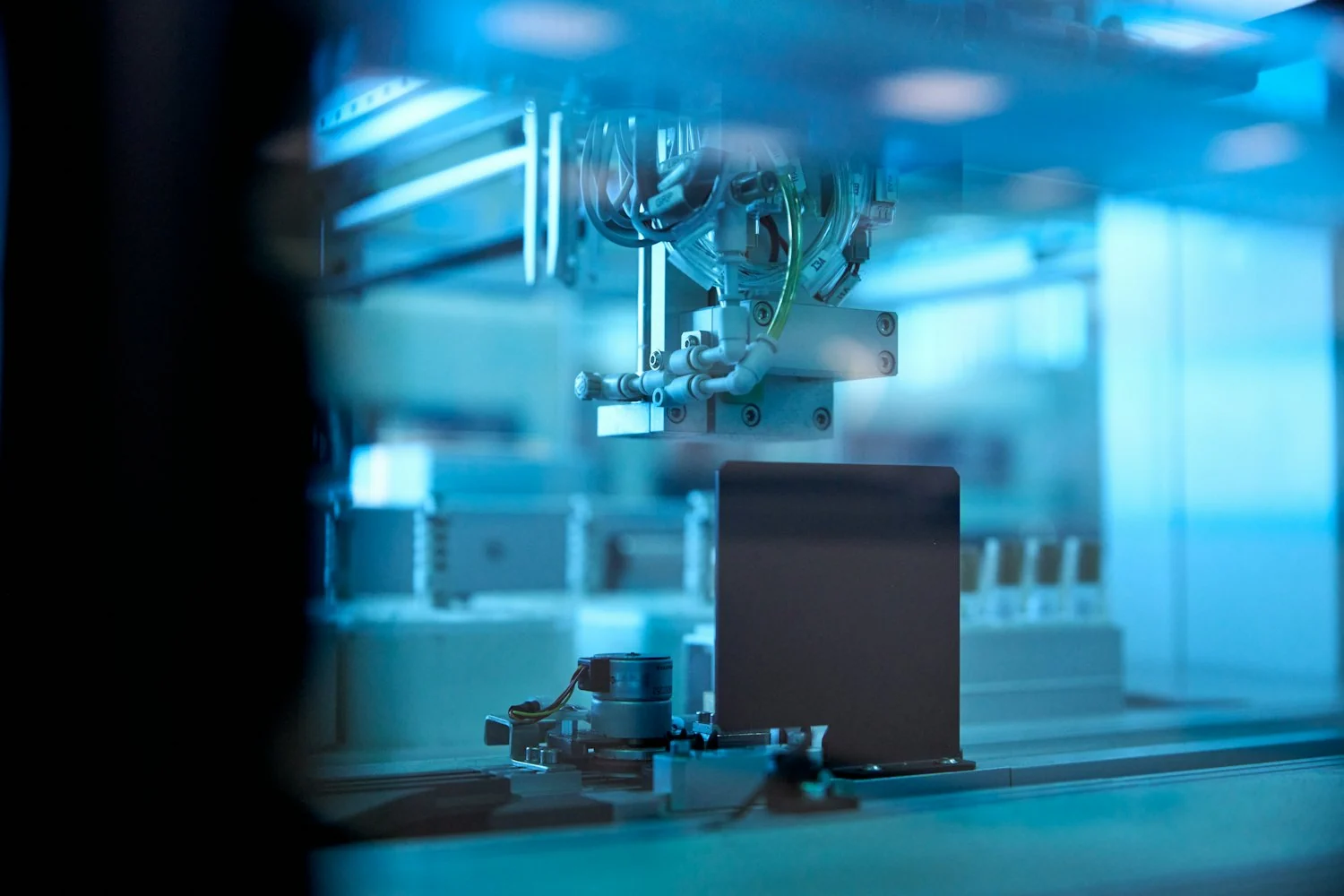
DaoAI 3D ACI equipment (self-developed 3D camera + 3D morphology reconstruction/point cloud, detecting hidden solder joints/coplanarity/micron-level morphology/porosity and other 2D optical blind spot defects, 2D-3D fusion) significantly reduces missed detection risks by precisely reconstructing 3D morphology and identifying defects, increasing the detection rate of internal porosity and inclusions in automotive aluminum die-castings from the traditional X-ray solution's 92% to 99.7%. In the automotive/parts industry, high-quality aluminum die-castings are crucial for ensuring overall vehicle performance and safety. With the widespread adoption of new energy vehicles, lightweighting demands have led to increasing applications of aluminum die-castings in core components such as battery housings, structural parts, and engine blocks. However, internal defects such as porosity, shrinkage, inclusions, and cracks are highly prone to occur during the die-casting process. These defects can lead to component failure during subsequent machining, surface treatment, or even assembly, severely impacting product reliability and user safety. A large automotive Tier-1 supplier, primarily providing high-pressure die-cast aluminum structural components to leading automakers, faces significant challenges in detecting internal defects.
Pain Points: Why This Hurdle Is So Difficult to Overcome
This large automotive parts supplier has long relied on traditional X-ray inspection solutions but still faces multiple challenges. Firstly, the high rate of missed detections: production line data shows that the missed detection rate for tiny pores and non-metallic inclusions with traditional X-ray remains as high as approximately 8%. This directly leads to rework in downstream assembly and customer complaints, and even poses significant safety hazards. Secondly, inspection efficiency bottlenecks: traditional X-ray image analysis relies on manual interpretation or rule-based software, which is time-consuming and prone to errors due to fatigue when dealing with complex geometries and varied defect types, impacting the overall production line takt time. Thirdly, traditional X-ray struggles to achieve precise, micron-level quantification of morphological features, lacking quantitative basis for assessing defect severity and progression. Furthermore, each new product changeover or defect standard adjustment requires significant time and human resources for parameter readjustment and model training, resulting in long changeover downtime and affecting flexible production capabilities.
The root causes of these dilemmas are the randomness, microscopic nature, and three-dimensional distribution characteristics of internal defects in aluminum die-castings. Pores and inclusions can exhibit irregular shapes and be distributed at different depths within the casting. Traditional 2D X-ray projection imaging often compresses 3D information into a 2D plane, leading to loss of depth information, making tiny defects easily obscured by background noise or surrounding structures and thus missed. At the same time, when material density differences are not significant, X-ray also has limitations in identifying inclusions. Manual visual inspection, moreover, is limited by human eye resolution and fatigue, making it unsuitable for high-precision, high-takt inspection demands. Especially in the current trend of industrial quality inspection transitioning towards intelligent zero-defect manufacturing, traditional solutions are struggling to meet the stringent quality requirements and rapid iteration pace of the automotive industry.
Technical Principles
DaoAI's 3D ACI equipment effectively overcomes the shortcomings of traditional inspection methods through its unique technical principles. Its core lies in the self-developed high-precision 3D camera and advanced 3D morphology reconstruction algorithms. The equipment employs multi-view structured light scanning technology combined with high-resolution industrial cameras, capable of acquiring complete 3D point cloud data of the inspected object with micron-level precision. Through accurate 3D morphology reconstruction, even tiny pores or inclusions within the casting can be precisely captured for their position, size, shape, and depth information in 3D space. Unlike 2D images from traditional X-ray, the 3D data provided by DaoAI 3D ACI eliminates the problem of lost depth information, significantly enhancing defect visibility and identifiability. For example, for internal porosity in aluminum die-castings, the system can reconstruct their micron-level morphological features, such as depressions or protrusions, thereby precisely identifying and quantifying defect parameters. In practical applications, DaoAI 3D ACI can achieve a detection rate of over 99.7% for micron-level pores, far exceeding traditional methods.
Compared to traditional rule-based AOI, DaoAI 3D ACI combines deep learning with 3D data processing capabilities. Traditional rule-based AOI relies on engineers setting thresholds and geometric rules, making it difficult to control false positive and missed detection rates for varied, irregular casting defects. In contrast, DaoAI 3D ACI leverages its powerful AI vision foundation models, through learning from massive amounts of 3D defect data, to intelligently identify various complex porosity, inclusion, and other defect patterns. It can even effectively recognize previously unseen defect variations. Furthermore, its 2D-3D fusion technology combines surface texture and internal morphology information for comprehensive judgment, further enhancing the robustness and accuracy of detection. This fusion capability makes DaoAI 3D ACI more comprehensive and reliable than purely 2D or 3D solutions when detecting complex defects, effectively mitigating the missed detection pressure caused by insufficient information dimensions in traditional methods.
Typical Application Scenarios
- **Porosity and Shrinkage Detection in Aluminum Die-Castings:** In the production of critical cast components like automotive engine blocks and transmission housings, porosity and shrinkage are common and often fatal defects. DaoAI 3D ACI equipment can precisely scan the 3D morphology of internal and external surfaces and specific areas of castings, identifying and quantifying micron-level pore depth, diameter, and distribution, as well as shrinkage volume and shape, preventing component strength deficiencies due to internal defects.
- **Non-Metallic Inclusion Identification:** During the die-casting process, non-metallic impurities such as mold debris and oxides may become embedded within the casting. While X-ray has certain advantages for metallic inclusions, for non-metallic inclusions with similar density to the base material, DaoAI 3D ACI, through its high-resolution 3D morphology reconstruction capabilities, combined with AI algorithms, identifies their unique microscopic morphological features, filling the blind spots of traditional methods.
- **Crack and Cold Shut Defect Detection:** Castings may develop fine cracks or cold shuts (areas of incomplete fusion) during cooling. These defects might not be apparent in 2D images, but DaoAI 3D ACI can capture tiny fractures or discontinuous morphologies of these defects in 3D space, enabling early warning.
- **Dimensional and Geometric Tolerance Inspection:** In addition to defect detection, DaoAI 3D ACI can simultaneously perform high-precision dimensional measurements and geometric tolerance inspections, such as flatness, parallelism, and roundness, ensuring castings meet stringent design requirements and achieving multi-functional integrated inspection.
- **Weld Quality Inspection (for subsequent processing):** For some structural components that involve welding in subsequent assembly, DaoAI 3D ACI can be used to inspect weld coplanarity, bead morphology, and potential surface defects such as lack of fusion or porosity, ensuring weld quality.
Case Study
A large automotive Tier-1 supplier, a leading enterprise with many years of manufacturing experience, faced severe internal defect detection challenges on its aluminum die-casting production line. To improve product quality and customer satisfaction, the client introduced DaoAI 3D ACI equipment. Before implementation, the production line primarily relied on manual re-inspection combined with 2D images from traditional X-ray equipment for internal defect detection. Actual data showed that the traditional solution had a missed detection rate of approximately 8% for tiny pores and inclusions, resulting in about 300 non-conforming products flowing to the next process monthly, leading to high rework costs and potential recall risks. After introducing the DaoAI 3D ACI solution, and after one month of trial operation and data optimization, the system demonstrated excellent performance. Production line data indicated that, in this case, the detection rate for porosity and inclusions in aluminum die-castings stably increased to over 99.7%, with the missed detection rate successfully reduced to below 0.3%. Concurrently, due to the automated high-precision inspection of DaoAI 3D ACI equipment, the workload for manual re-inspection was significantly reduced, from 8 hours per day to 2 hours, greatly alleviating the burden on quality inspectors. Furthermore, the APDT few-shot learning capability supported by DaoAI ACI OS operating system shortened the configuration time for new product changeovers and defect standard updates from several days to several hours, significantly enhancing the production line's flexible manufacturing capabilities.
"The precise detection capability of DaoAI 3D ACI equipment has completely changed our understanding of internal defects in aluminum die-castings, not only significantly improving quality but also making zero-defect manufacturing possible."
DaoAI Solutions and Products
The core solution provided by DaoAI to this automotive parts supplier is an intelligent quality inspection system centered around the 3D ACI equipment, combined with the DaoAI ACI OS operating system and the World model. The DaoAI 3D ACI equipment utilizes a self-developed 3D camera to acquire high-precision 3D point cloud data and employs advanced 3D morphology reconstruction technology to achieve millimeter-level or even micron-level precise detection of internal porosity, inclusions, and other 2D optical blind spot defects in aluminum die-castings. Its 2D-3D fusion algorithm comprehensively analyzes surface texture and internal morphology to ensure comprehensive and accurate defect identification. For deployment, DaoAI 3D ACI equipment supports 100% on-premise private deployment, ensuring the security of client data. Modeling and changeover processes are achieved through the APDT few-shot self-learning function of DaoAI ACI OS, requiring only 1–20 good samples to quickly train models, greatly simplifying the configuration process and shortening deployment time. For production line integration, DaoAI provides SDK/API interfaces for integration with the client's existing MES/SCADA systems, enabling data closed-loop and quality traceability. Furthermore, the DaoAI World model serves as a unified foundation, endowing the system with powerful semantic understanding and cross-scenario generalization capabilities, allowing it to continuously learn and optimize from production line feedback, constantly improving detection accuracy and efficiency, truly driving traditional factories towards intelligent zero-defect manufacturing.
By introducing DaoAI 3D ACI equipment, this automotive parts supplier achieved significant quantitative results. Production line data shows that the overall defect detection rate for aluminum die-castings increased to over 99.7%, and the missed detection rate was reduced to below 0.3%, significantly lower than the industry average. This directly reduced downstream rework rates and customer complaints, enhancing brand reputation. Simultaneously, manual re-inspection workload decreased by 75%, greatly optimizing human resource allocation. New product changeover time was shortened from several days to several hours, greatly enhancing the production line's flexible manufacturing and responsiveness to market demands. The implementation of this solution effectively reduced production costs and potential recall risks caused by defects, bringing considerable economic benefits and long-term strategic value to the client.
FAQ
How does DaoAI 3D ACI equipment handle tiny pores and inclusions inside aluminum die-castings?
DaoAI 3D ACI equipment utilizes a self-developed high-precision 3D camera and advanced 3D morphology reconstruction algorithms to acquire complete 3D point cloud data with micron-level precision. This enables the system to accurately capture the 3D position, size, shape, and depth information of internal pores and inclusions, combined with AI vision foundation models, effectively identifying 2D optical blind spot defects and increasing the detection rate to over 99.7%.
What is the approximate cost of deploying and integrating DaoAI 3D ACI solutions, and what is the payback period?
The deployment cost of DaoAI 3D ACI solutions is influenced by equipment configuration, production line integration complexity, and customization requirements. A specific quote requires an assessment based on the client's actual production line conditions. However, considering the significant improvement in detection rate, reduction in missed detections, decreased rework costs, and reduced labor input, an ROI is typically achieved within 6-18 months. We recommend scheduling an expert consultation for a detailed solution and quote.
How does DaoAI 3D ACI equipment quickly adapt to new product changeovers while maintaining inspection accuracy?
The DaoAI ACI OS operating system, integrated with DaoAI 3D ACI equipment, supports APDT few-shot self-learning. This means that for new product changeovers or defect standard adjustments, only 1–20 good samples are needed to quickly train new inspection models, shortening changeover configuration time from days to hours, significantly enhancing production line flexibility while ensuring detection accuracy and efficiency.
Full solution for this scenario: the full inspection solution for 3D ACI Equipment
This article was generated by AI. Customer cases are simulated scenarios based on real product capabilities and figures are illustrative; see product pages for official benchmarks.