
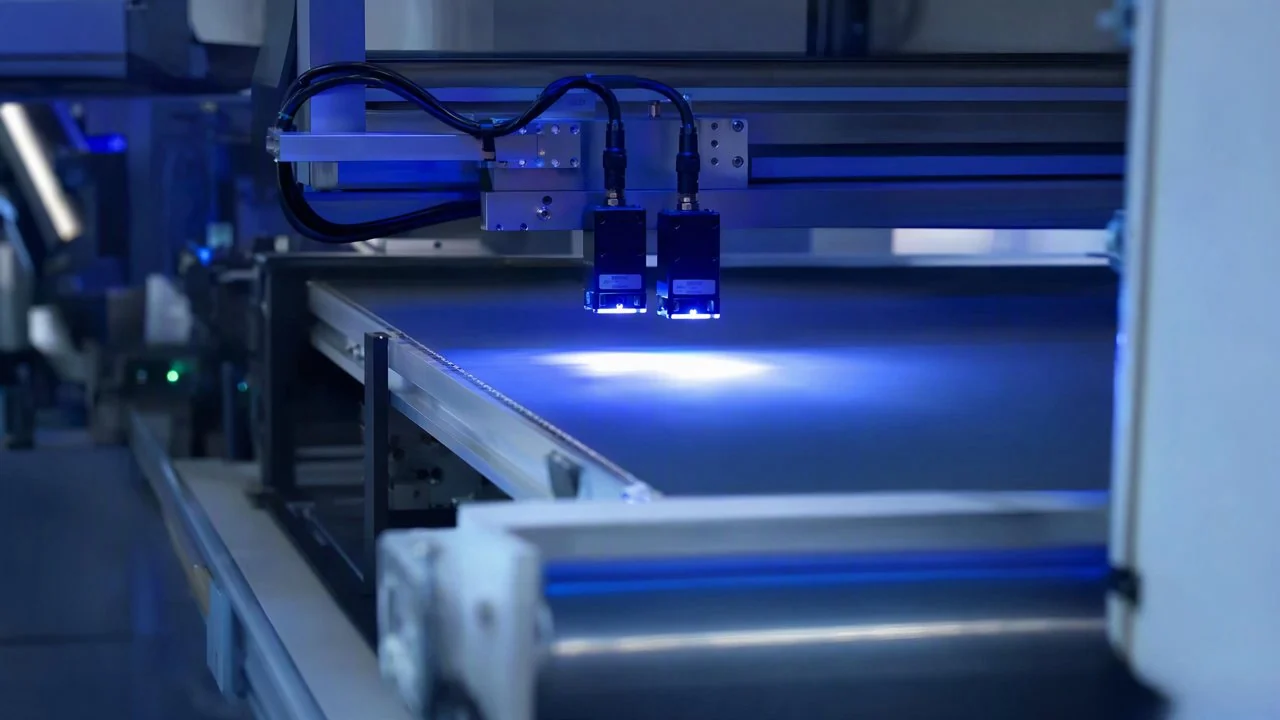
In new energy battery electrode coating inline full inspection, DaoAI 3D ACI equipment, through high-precision 3D morphology reconstruction and intelligent point cloud analysis, elevates quality traceability and data closed-loop capabilities for coating defects to an unprecedented level, dramatically reducing defect localization time from hours to minutes, significantly optimizing production efficiency and product consistency.
In the inline full inspection of new energy battery electrode coating, DaoAI 3D ACI equipment (proprietary 3D camera + 3D morphology reconstruction/point cloud, detecting hidden solder joints/coplanarity/micron-level morphology/porosity and other 2D optical blind spot defects, with 2D-3D fusion) significantly enhances product quality management and production efficiency by providing high-precision 3D morphological data and intelligent analysis, reducing defect localization and quality traceability cycles from traditional hours to minutes. As the core of electric vehicles and energy storage systems, the performance and safety of new energy batteries heavily rely on electrode quality. Electrode coating, a critical process, demands extremely stringent requirements for coating thickness, uniformity, surface defects, etc. Any tiny coating defect, such as uneven coating, scratches, foreign objects, air bubbles, or edge damage, can lead to internal short circuits, capacity degradation, or even thermal runaway, severely impacting battery product reliability and consistency. In actual production, a leading new energy battery manufacturer faces challenges in inline full inspection of electrode coating defects, especially in achieving efficient and precise quality traceability and data closed-loop, where existing solutions struggle to meet their growing demand for refined management.
Pain Points: Why This Hurdle is Difficult to Overcome
In the new energy battery electrode coating process, traditional inspection solutions face multiple challenges, severely restricting the efficiency of quality traceability and data closed-loop. Firstly, **high missed detection rates** are a common issue, especially for micron-level coating thickness non-uniformity, subtle scratches, or low-contrast foreign objects, which traditional 2D AOI struggles to identify effectively. Production line data shows that the average missed detection rate often exceeds 1.5%. Secondly, **high false alarm rates** persist due to ambient light changes, material reflectivity, or normal textures being misidentified as defects. Production line data indicates that traditional AOI's false alarm rate can reach 3-5%, leading to substantial manual re-inspection work, wasting valuable human resources and time. According to one manufacturer's production line data, manual re-inspection hours reached up to 40 hours per week, with re-inspection results being subjective and inconsistent.
The deeper root causes lie in the complexity of the process and imaging. Electrode coating materials (e.g., slurry) inherently possess viscosity and fluidity. During high-speed coating, tiny air bubbles, particles, or indentations are difficult to clearly present their 3D morphological features in 2D images. Traditional 2D optical inspection can only capture surface brightness, color, and other information, being powerless against abnormal changes in coating thickness, flatness, and microscopic morphology, creating numerous "optical blind spot defects." Furthermore, reflective or specular effects on the electrode surface can lead to overexposed or underexposed areas in 2D images, further exacerbating false alarms and missed detections. In today's AI quality inspection trend emphasizing multi-model collaboration and dynamic scheduling, traditional solutions lack a deep understanding of defect 3D features, making it difficult to achieve effective integration and correlation of multi-dimensional data. This results in broken quality traceability chains, hindering the formation of an effective production process optimization closed-loop. One manufacturer's quality traceability cycle typically lasted several hours or even half a day, severely impacting root cause analysis and rapid correction.
Technical Principles
The core advantage of DaoAI 3D ACI equipment lies in its proprietary 3D camera and advanced 3D morphology reconstruction technology, combined with powerful point cloud processing and 2D-3D fusion algorithms. This equipment precisely acquires high-density 3D point cloud data of the inspected electrode surface through multi-angle structured light projection and synchronized high-resolution camera capture, achieving micron-level accuracy. Unlike traditional rule-based AOI that relies on preset thresholds or manual visual inspection, DaoAI 3D ACI can directly quantify 3D morphological parameters such as coating thickness, surface flatness, foreign object height, and scratch depth. This effectively identifies defects within traditional 2D optical blind spots, such as tiny protrusions or depressions smaller than 20 microns. Through intelligent analysis of this 3D data, DaoAI 3D ACI constructs a complete geometric model of the defect, avoiding misjudgments caused by changes in lighting, color, or texture, achieving more precise defect classification and localization. In one case, the DaoAI 3D ACI system successfully reduced the missed detection rate to <0.4%.
Furthermore, DaoAI 3D ACI equipment integrates 2D-3D fusion detection capabilities. It not only uses 3D data for morphological analysis but also combines high-resolution 2D images for detecting traditional features such as color, texture, and contrast. This fusion mechanism enables the equipment to comprehensively capture all visible defects on the electrode surface and confirm defects that are difficult to distinguish in 2D images through their 3D morphology, greatly enhancing detection robustness and accuracy. Compared to traditional methods, the advantage of DaoAI 3D ACI is its ability to provide quantifiable 3D data, offering quality engineers more intuitive and reliable decision-making basis. For example, for uneven coating thickness, traditional 2D AOI can only infer indirectly through brightness changes, while DaoAI 3D ACI can directly measure and display specific thickness deviations, achieving a leap from "finding defects" to "understanding defects."
Typical Application Scenarios
- **Coating Thickness Uniformity Detection**: DaoAI 3D ACI equipment can perform high-precision 3D scanning of electrode coatings, reconstruct surface morphology, and directly measure and analyze the distribution of coating thickness across the entire electrode. Traditional 2D inspection cannot directly measure thickness, only indirectly infer it through color or reflectivity differences, whereas 3D ACI can detect local areas of excessive thinness or thickness with micron-level precision, ensuring battery performance consistency, which is a blind spot for 2D vision.
- **Surface Scratch and Indentation Detection**: Electrodes are prone to tiny scratches or indentations during transfer or winding. These defects may be difficult to detect in 2D images due to lighting angles or material reflections. DaoAI 3D ACI, through its 3D point cloud data, can clearly identify and quantify the 3D geometric features of these surface depressions or protrusions, accurately detecting even depths of only a few microns, effectively preventing battery performance degradation due to mechanical damage.
- **Foreign Object and Air Bubble Detection**: Tiny foreign objects (e.g., dust, fibers) mixed in during coating or air bubbles generated within the slurry may appear as low-contrast spots in 2D images, easily confused with normal textures. DaoAI 3D ACI can identify these using the prominent height of foreign objects or the surface bulges/depressions caused by air bubbles as 3D morphological features, separating them from the background, significantly reducing false alarm rates and ensuring electrode purity.
- **Edge Defects and Damage Detection**: Uneven coating edges, burrs, or localized damage are common defects that significantly impact battery packaging and safety. DaoAI 3D ACI can accurately capture the 3D contour of edges, identifying morphological anomalies beyond standard limits, such as edge bulging, nicks, or irregular burrs, whereas 2D vision often lacks sensitivity to subtle edge deformations.
- **Coplanarity and Flatness Detection**: For flatness requirements before electrode winding, DaoAI 3D ACI can perform high-precision coplanarity analysis on the entire electrode surface, detecting local warping, bulging, or wrinkles. This ability to analyze both macroscopic and microscopic overall morphology is not available with 2D vision and is crucial for improving subsequent cell assembly yield.
Case Study
A leading new energy battery manufacturer, characterized by high capacity and automation in its production lines, has extremely high demands for inline full inspection and traceability efficiency of electrode coating quality. Before introducing DaoAI 3D ACI equipment, this manufacturer primarily relied on traditional 2D AOI combined with manual sampling. Production line data showed that the traditional solution's missed detection rate for coating defects averaged about 1.8%, leading to a consistently high defect rate after battery assembly. More notably, due to the lack of 3D morphological data, tracing the root cause of defects (such as coater parameters, slurry batch) took an extremely long time, averaging 4-6 hours for initial problem localization, and the data chain was incomplete, making it difficult to form effective closed-loop optimization. This not only increased production costs but also delayed new product launch cycles.
After deploying DaoAI 3D ACI equipment, the situation changed significantly. The equipment was integrated into the high-speed coating line, acquiring real-time 3D morphological data of the electrodes and performing intelligent analysis. Production line data shows that after deployment, the **detection rate for coating defects increased to 99.6%**, and the missed detection rate was effectively controlled at <0.4%. More importantly, because DaoAI 3D ACI provided precise 3D coordinates and morphological features of defects, combined with the data management capabilities of the DaoAI ACI OS operating system, immediate uploading and correlation of defect data were achieved. In this case, the quality traceability cycle **reduced from several hours to an average of 15 minutes**, enabling engineers to quickly locate problematic batches and adjust process parameters, forming an efficient quality management closed-loop. Furthermore, since 3D data effectively distinguishes true defects from surface textures, the false alarm rate **decreased by −85%**, significantly reducing the burden of manual re-inspection, with weekly manual re-inspection hours decreasing by −70%.
"The DaoAI 3D ACI system not only improved our inspection accuracy but, more importantly, it completely transformed our approach to defect traceability, shifting quality management from reactive to proactive." — Production Director, a leading new energy battery manufacturer
DaoAI Solution and Products
DaoAI's core solution for new energy battery electrode coating, centered on the 3D ACI equipment and supplemented by the DaoAI ACI OS operating system, collectively builds an efficient, intelligent quality traceability and data closed-loop system. The DaoAI 3D ACI equipment utilizes a proprietary high-precision 3D camera, combined with advanced 3D morphology reconstruction algorithms, to acquire micron-level 3D point cloud data of the electrode surface in real-time. This data not only includes critical 3D information such as coating thickness, flatness, and scratch depth but also, through 2D-3D fusion technology, addresses the shortcomings of traditional 2D vision in detecting optical blind spot defects. In practical implementation, DaoAI engineers customize the optimal camera configuration and scanning strategy based on the customer's production line cycle time and electrode dimensions, ensuring 100% inline full inspection on high-speed production lines. DaoAI ACI OS provides powerful data processing and analysis capabilities, supporting APDT few-shot learning, requiring only 1–20 good samples to complete rapid training and model changeovers for defect models, greatly shortening the time for new product introduction and process adjustments, enabling production line changeover times to be reduced to 5min.
Through the deployment of DaoAI 3D ACI equipment, all detected defect data (including 3D morphology, location, type, severity, etc.) is uploaded in real-time to the DaoAI ACI OS platform and correlated with production batch, process parameters, and other information. This comprehensive data collection and correlation mechanism provides a solid foundation for quality traceability. When downstream product defects are found, engineers can quickly trace back to specific electrodes, coating times, equipment status, and even slurry batches through the system, achieving second-level data query and analysis. DaoAI also supports 100% local private deployment, ensuring data security without leaving the factory. This closed-loop management model, from detection to analysis, then to traceability and optimization, is a key component of achieving intelligent manufacturing, effectively improving the overall quality level and efficiency of new energy battery production.
The implementation of the DaoAI 3D ACI solution has brought significant business value to new energy battery manufacturers. In terms of quality traceability, the shift from hours of vague localization to minutes of precise targeting has greatly improved problem-solving efficiency. In terms of production efficiency, the reduction in false alarm rates has lessened the burden of manual re-inspection, allowing the production line to focus more on producing high-quality products. Ultimately, these improvements translate into lower defect rates, higher customer satisfaction, and stronger market competitiveness. Production line data shows that after the solution's deployment, overall production yield increased by 0.7%, and the cost of rework due to defects per batch decreased by −25%.
FAQ
How does DaoAI 3D ACI equipment achieve quality traceability for new energy battery electrode coating defects?
DaoAI 3D ACI equipment precisely captures 3D data of micron-level defects in electrode coatings using its proprietary 3D camera and morphology reconstruction technology. This data is correlated in real-time with production batches, process parameters, and other information, then uploaded to the DaoAI ACI OS platform, creating a complete digital archive. When downstream product issues are found, the system can quickly trace back to the specific 3D morphology, location, and relevant production information of the defect, shortening the quality traceability cycle from hours to minutes, achieving an efficient data closed-loop.
What are the core advantages of DaoAI 3D ACI solution over traditional 2D AOI for electrode coating inspection?
Compared to traditional 2D AOI, which relies solely on 2D information like surface brightness and color, the core advantage of DaoAI 3D ACI lies in its 3D morphological detection capabilities. It can directly quantify 3D parameters such as coating thickness, surface flatness, and scratch depth, effectively detecting defects in 2D optical blind spots like micron-level protrusions, depressions, or low-contrast foreign objects. This 2D-3D fusion inspection not only significantly reduces missed detection and false alarm rates but also provides richer, more reliable defect data, offering deep insights for process optimization.
How is the cost budget evaluated for deploying DaoAI 3D ACI equipment for new energy battery electrode coating inspection?
The deployment cost of DaoAI 3D ACI equipment is influenced by various factors, including production line speed, required inspection precision, electrode size, integration complexity, and customization needs. We offer flexible hardware and software configuration options, and through the few-shot learning capability of DaoAI ACI OS, we significantly reduce model training and changeover costs. For specific budget evaluation and return on investment analysis, we recommend scheduling a detailed consultation with our expert team, who will provide a customized solution and quotation based on your actual operating conditions.
Full solution for this scenario: the full inspection solution for 3D ACI Equipment · Inline Electrode Coating Inspection
This article was generated by AI. Customer cases are simulated scenarios based on real product capabilities and figures are illustrative; see product pages for official benchmarks.