
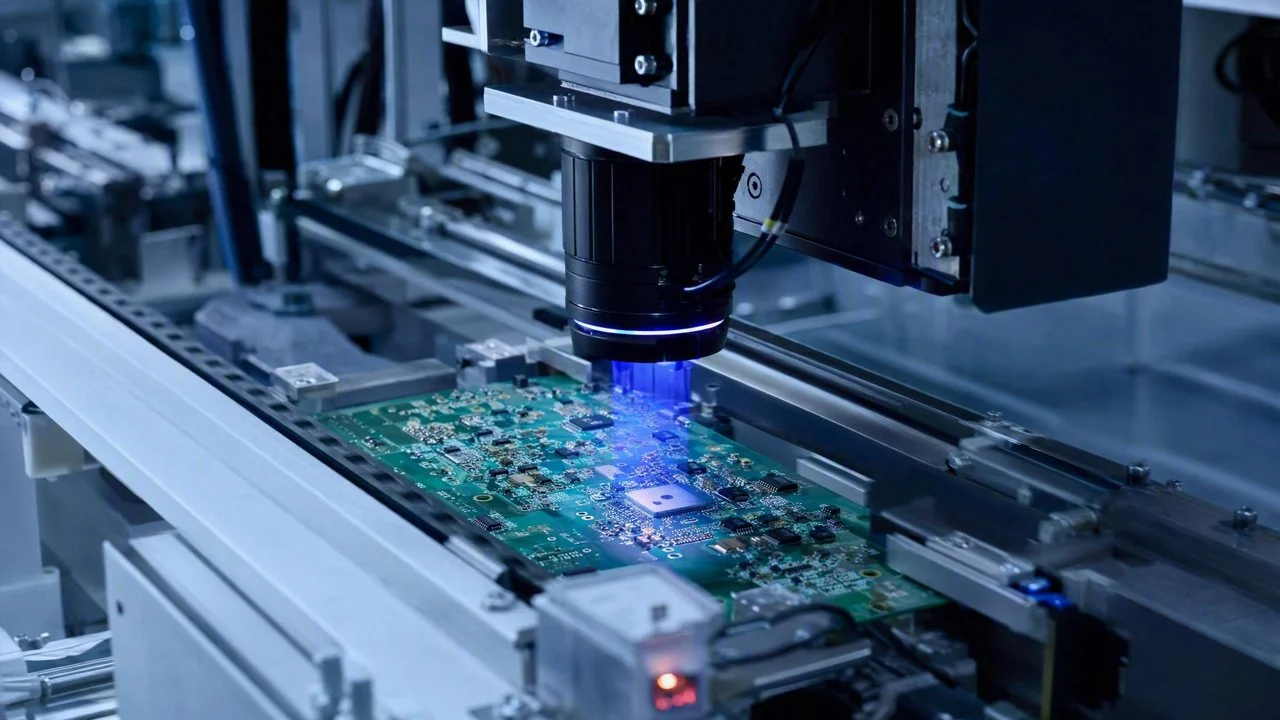
DaoAI 2D ACI equipment (high-resolution 2D imaging + deep learning secondary judgment, targeting surface/print/character OCR/assembly defects, high-speed inline full inspection, micron-level, semantic false positive filtering), with its unique zero-code rapid changeover and high-mix low-volume adaptability, reduces PCBA board-level silkscreen OCR character inspection changeover time from an average of 2 hours with traditional methods to under 5 minutes, while suppressing character omission rates to <0.5%. In the electronics industry, particularly PCBA manufacturing, the acceleration of consumer electronics product iterations and increasing customization demands have made high-mix, low-volume production the norm. This requires production lines to not only possess high-precision inspection capabilities but also to switch rapidly between different product models to ensure production efficiency and quality. Board-level silkscreen and OCR character inspection are critical steps in PCBA production, used to verify component models, production batches, warning labels, and other information, directly impacting product functionality and traceability.
In the electronics industry, particularly PCBA manufacturing, the acceleration of consumer electronics product iterations and increasing customization demands have made high-mix, low-volume production the norm. This requires production lines to not only possess high-precision inspection capabilities but also to switch rapidly between different product models to ensure production efficiency and quality. Board-level silkscreen and OCR character inspection are critical steps in PCBA production, used to verify component models, production batches, warning labels, and other information, directly impacting product functionality and traceability.
Pain Points: Why This Hurdle Is Difficult to Overcome
In traditional PCBA silkscreen/OCR character inspection, manufacturers face multiple challenges. First is **inefficient changeover**, for high-mix low-volume orders with hundreds of SKUs, each product changeover requires engineers to spend hours rewriting rules or adjusting parameters, leading to lengthy equipment downtime, averaging up to 2 hours per changeover, severely impacting overall production rhythm and order delivery capability. Second, **high rates of false negatives and false positives** persist. Traditional rule-based AOI systems struggle to adapt to subtle variations in font, color, background, or lighting, especially when characters are worn, discolored, ghosted, or highly similar to the background. The false negative rate can exceed 2%, while the false positive rate is often even higher, leading to numerous good products being misidentified, requiring significant human effort for secondary re-inspection, adding at least 20% to manual re-inspection hours. Third, **insufficient detection capability for minute defects**. As semiconductor manufacturing moves towards nanometer scales, character sizes on PCBAs are shrinking. Traditional AOI often fails to detect micron-level character defects (e.g., broken strokes, ink dots, character deformation), struggling to meet increasingly stringent quality standards.
The root cause of these dilemmas lies in traditional AOI's reliance on engineers' pre-set fixed rules and thresholds, lacking the ability to 'understand' complex, variable visual information. When encountering new products, fonts, materials, or lighting changes, the maintenance cost of the rule library is extremely high, and it cannot cope with 'atypical' defects. While manual inspection offers some flexibility, it is inefficient and inconsistent due to human eye fatigue and subjective judgment. Against the current trend of nanometer-level precision inspection, these pain points in the PCBA industry urgently need to be addressed through smarter, more flexible AI vision technology to enhance the competitiveness of domestic alternative solutions.
Technical Principles
DaoAI 2D ACI equipment fundamentally resolves the pain points of traditional AOI by integrating high-resolution 2D imaging technology with a deep learning secondary judgment engine. Its core lies in the proprietary APDT (Adaptive Pre-training & Dynamic Tuning) few-shot self-training engine, which is based on advanced visual foundation models, possessing powerful feature recognition and generalization capabilities. Unlike traditional AOI that relies on engineers manually writing complex rules, the DaoAI 2D ACI system only requires 1–20 good sample images for learning, enabling new product model training and deployment within 5 minutes, achieving true zero-code rapid changeover. This 'few-shot learning' mechanism drastically reduces changeover downtime, cutting changeover time by over 95% compared to traditional solutions.
Furthermore, the DaoAI 2D ACI equipment incorporates a semantic false positive filtering mechanism. Traditional rule-based AOI often misidentifies background interference, slight color differences, and other non-defect features as defects, leading to high false positive rates. The DaoAI system, through deep learning, 'understands' the semantics of defects, distinguishing between true defects and harmless visual noise. For example, it can identify a broken character stroke as a defect, while a tiny air bubble on the board is not, thereby significantly reducing false positive rates. Combined with high-resolution industrial cameras, the DaoAI 2D ACI can achieve precise detection of micron-level defects, such as identifying character stroke breaks or ink dots only tens of microns wide, ensuring the highest quality standards for PCBA products. This enables the DaoAI system to provide detection accuracy and efficiency far superior to traditional methods in complex and variable PCBA production environments.
Typical Application Scenarios
- **Component Model/Parameter Silkscreen Verification:** After PCBA placement, inspect silkscreen characters next to solder pads or on component surfaces to verify that models, batches, and parameters match the BOM list. The challenge lies in small character sizes, dense arrangement, and potential uneven background colors or reflections.
- **Production Batch/Serial Number OCR Recognition:** Identify production batch numbers and serial numbers on circuit boards for product traceability and quality management. Challenges include characters that may be slightly obscured, worn, or use special fonts, leading to low traditional OCR recognition rates.
- **Warning Label/Directional Indicator Silkscreen Defects:** Detect whether various warning labels, directional indicators, polarity marks, etc., on the circuit board are complete, clear, without deviation or missing. The difficulty is that these markings are usually smaller and require extremely high integrity.
- **Character Stroke Break/Blur/Missing Detection:** Precisely identify micron-level defects in silkscreen characters such as broken strokes, blurred edges, ink dots, or entirely missing characters. This requires extremely high image resolution and perception of subtle variations.
- **Inner Layer Character Detection for Multi-layer Boards (with X-Ray):** For multi-layer boards, while 2D ACI primarily inspects outer layers, combined with X-Ray assisted detection, it can indirectly verify the printing quality of inner layer characters, ensuring correct internal wiring identification. The challenge lies in the complexity of image penetration and feature extraction.
Case Study
A leading PCBA manufacturer, known for its high-mix, low-volume production model, processes hundreds of different circuit board orders each month. Previously, their board-level silkscreen and OCR character inspection relied mainly on traditional rule-based AOI and extensive manual re-inspection. Each time a new product was launched or a product model switched, engineers had to spend at least 1.5 to 3 hours reconfiguring the AOI rule sets, leading to long production line downtime. This efficiency bottleneck was particularly prominent when facing urgent orders. Simultaneously, traditional AOI had a false positive rate of 8%–10% in complex backgrounds or with slightly worn characters, requiring at least 4 quality inspectors to perform full-time manual re-inspection daily, leading to high labor costs. The manual inspection's false negative rate was also difficult to completely avoid, averaging about 0.8%.
After introducing the DaoAI 2D ACI equipment, the manufacturer's production efficiency and inspection quality significantly improved. The DaoAI 2D ACI system, with its zero-code rapid changeover capability, allowed new product model training and deployment in just 5 minutes. In actual production, at the manufacturer's site, its changeover time was successfully reduced from an average of 2 hours to 4.5 minutes, representing a changeover efficiency improvement of 96%. Concurrently, through deep learning's semantic false positive filtering, the system's identification of character defects became more precise, reducing the false positive rate by 85%, from the original 8% to about 1.2%. This significantly reduced the need for manual re-inspection, requiring only 1 quality inspector for spot checks, saving approximately 600,000 RMB in labor costs annually. The character false negative rate was also suppressed to <0.4%, well below the industry average, ensuring product quality and traceability. The manufacturer stated that the DaoAI 2D ACI equipment not only solved their immediate problems but also enhanced their market competitiveness in the high-mix, low-volume production model.
DaoAI 2D ACI's zero-code rapid changeover reduced PCBA silkscreen OCR inspection changeover time from hours to under 5 minutes, achieving an efficiency leap in high-mix, low-volume production.
DaoAI Solution and Products
DaoAI (WeLinkirt) offers 2D ACI equipment, an intelligent solution specifically designed to address complex defect detection in the electronics/PCBA industry. Its core is the DaoAI ACI OS, which incorporates a visual foundation model, boasting powerful feature recognition capabilities and APDT few-shot self-training functionality. This means customers do not need professional AI engineers; they only need to provide a small number of good sample images (1–20) to automatically program and deploy new product inspection models in 5 minutes using a zero-code approach. This rapid changeover capability is crucial for high-mix, low-volume production lines, significantly reducing downtime and manual debugging costs.
The DaoAI 2D ACI equipment utilizes a high-resolution 2D imaging system combined with deep learning for secondary judgment, capable of precisely identifying micron-level silkscreen character defects such as broken strokes, blurriness, missing characters, and color deviations. Its semantic false positive filtering function effectively distinguishes between true defects and background noise, keeping the false positive rate at an extremely low level. For deployment, DaoAI provides various integration methods such as SDK/API/Docker, supporting 100% on-premise private deployment to ensure customer data security. Furthermore, the DaoAI World Model serves as a unified foundation, continuously learning from production line feedback, optimizing model performance, and achieving cross-scenario generalization, providing customers with an continuously evolving intelligent inspection platform. In PCBA silkscreen/OCR character inspection scenarios, the deployment of DaoAI 2D ACI equipment has not only significantly improved inspection efficiency and accuracy but also substantially reduced manual re-inspection costs and changeover time, creating tangible business value for customers.
The DaoAI 2D ACI equipment, in PCBA silkscreen/OCR character inspection scenarios, reduced changeover time from an average of 2 hours with traditional methods to under 5 minutes through its zero-code rapid changeover capability, an efficiency improvement of 96%. Concurrently, the character false negative rate was suppressed to <0.4%, and the false positive rate was reduced by 85%, significantly cutting manual re-inspection hours and saving customers hundreds of thousands of RMB in labor costs annually. These quantified results directly translate into higher production efficiency, lower product defect rates, and stronger market competitiveness.
FAQ
How does DaoAI 2D ACI equipment achieve zero-code rapid changeover?
DaoAI 2D ACI equipment achieves zero-code rapid changeover through its built-in APDT few-shot self-training engine. Based on a visual foundation model, it only requires 1–20 good sample images to automatically complete the training and deployment of new product inspection models within 5 minutes, eliminating the need for manual rule writing or parameter adjustments, greatly simplifying the changeover process.
What are the core advantages of DaoAI 2D ACI for PCBA silkscreen OCR inspection compared to traditional AOI?
The core advantage of DaoAI 2D ACI lies in its deep learning capabilities. It enables precise detection of micron-level defects and significantly reduces false positive rates through semantic false positive filtering. Most importantly, its zero-code rapid changeover capability shortens the changeover time from hours with traditional AOI to under 5 minutes, significantly boosting efficiency and flexibility for high-mix, low-volume production.
What is the approximate cost of deploying DaoAI 2D ACI equipment?
The cost of DaoAI 2D ACI equipment primarily consists of hardware, software licensing, and implementation services. The exact cost depends on the client's production line scale, inspection requirements, and integration complexity. We offer flexible deployment solutions and support 100% on-premise private deployment. We recommend contacting our sales team, who will provide a customized quote and ROI analysis based on your specific situation.
Full solution for this scenario: the full inspection solution for Electronics / PCBA
This article was generated by AI. Customer cases are simulated scenarios based on real product capabilities and figures are illustrative; see product pages for official benchmarks.