
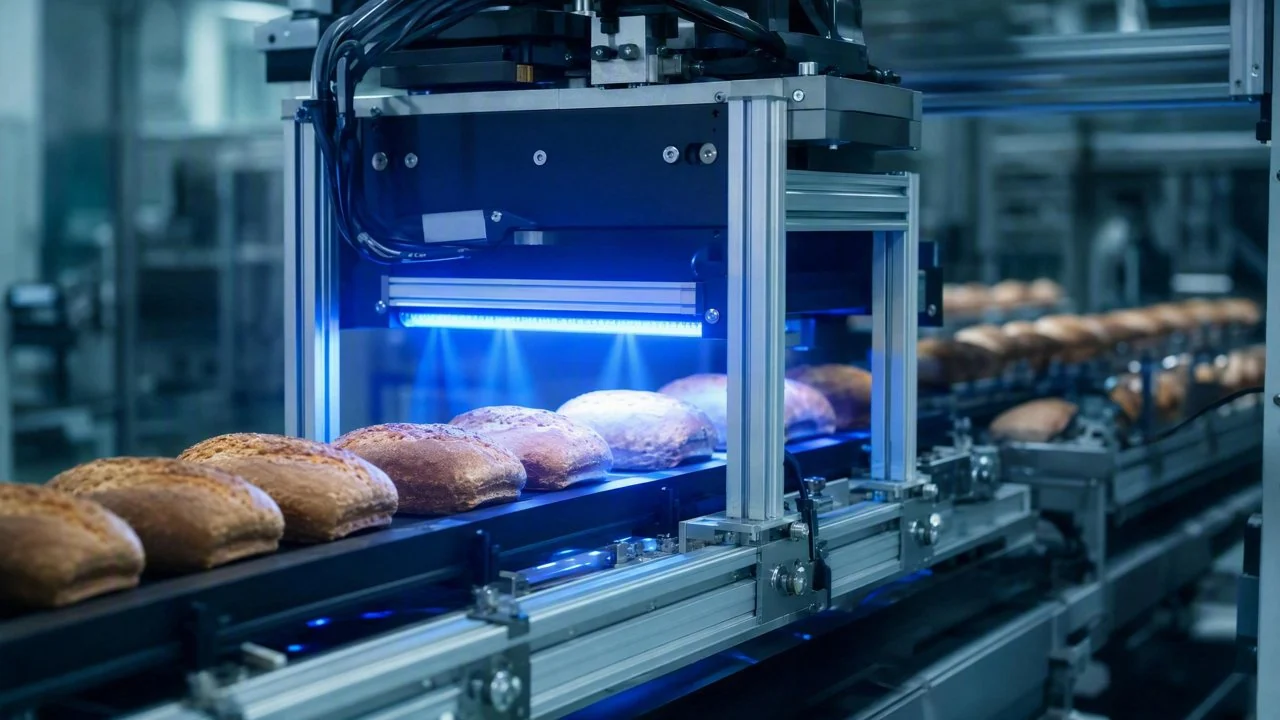
Wemio's 2D ACI device (high-resolution 2D imaging + deep learning secondary image judgment, targeting planar defects such as surface, printing, character OCR, and assembly omissions, high-speed online full inspection, micron-level, semantic false alarm filtering) reduces the false negative rate of appearance defects in baked goods from 5% to 1% through high-precision imaging and intelligent image judgment.
In the food and agriculture industry, the appearance quality of baked goods is one of the important reference factors for consumers to make purchases. Baked goods with appearance defects not only affect sales but also may damage the brand image. A certain baked goods production enterprise produces a variety of products, including bread and cakes. In the production process, the detection of appearance defects in baked goods has always been a difficult problem. Traditional detection methods can hardly meet the requirements of high-speed production lines, resulting in a relatively high false negative rate. Wemio's 2D ACI device, with its high-resolution 2D imaging and deep learning secondary image judgment functions, can conduct high-speed online full inspection of the appearance of baked goods, effectively reducing the false negative rate and improving product quality.
Pain Points: Why Is It So Difficult?
From a quantitative perspective, the enterprise faces multiple dilemmas. First of all, the false negative rate is high. Under the traditional detection method, the false negative rate reaches 5%, which means that one out of every 20 baked goods with appearance defects may flow into the market. Secondly, the false alarm rate cannot be underestimated, reaching 3%. A large number of false alarms lead to an increase in manual re-judgment hours. Each production line needs an additional 2 hours of manual re-judgment time per day. Moreover, the change-over downtime is long. When producing different types of baked goods, the change-over downtime reaches 30 minutes, seriously affecting production efficiency. In addition, the compliance risk is also relatively large. If unqualified products flow into the market, the enterprise may face penalties from regulatory authorities. In terms of unit cost, due to labor costs and losses of unqualified products, the unit cost increases by 0.1 yuan.
From the process level, the production process of baked goods is complex. There are certain differences in color, shape, and size among different types and batches of baked goods, which makes it difficult for traditional rule-based AOI to set unified detection standards. In terms of imaging, the surface of baked goods has certain texture and luster, which is prone to reflection, affecting the imaging quality and making it difficult for traditional methods to accurately identify defects. In terms of materials, the texture of baked goods is soft, and slight deformation may occur during the production process, increasing the detection difficulty. From the rhythm level, the high-speed operation of the production line requires the detection equipment to complete the detection quickly and accurately. Traditional manual visual inspection and rule-based AOI can hardly keep up with the rhythm. Compared with traditional visual inspection, the quality inspection large model can better adapt to these complex situations and has stronger generalization ability and adaptability.
Technical Principle
Wemio's 2D ACI device uses high-resolution 2D imaging technology to clearly capture the appearance details of baked goods. Its deep learning secondary image judgment function uses advanced convolutional neural network algorithms to conduct in-depth analysis of imaging data. First, the model learns a large number of good and defective product samples to extract features. During the detection process, the real-time collected images are compared with the learned features. If the image features match the defective product features, the product is judged as defective. This algorithm can adapt to the appearance differences of different baked goods and effectively improve the detection accuracy. At the same time, the semantic false alarm filtering mechanism can filter out some false alarms based on the semantic information of defects, improving the detection efficiency.
Compared with traditional rule-based AOI, rule-based AOI detects based on preset rules. For the complex and changeable appearance of baked goods, it is difficult to set appropriate rules, prone to false negatives and false alarms. Wemio's 2D ACI device can automatically learn and adapt to different appearance features through deep learning, without relying on preset rules, and has higher detection accuracy. Compared with manual visual inspection, manual visual inspection is slow, prone to fatigue, and greatly affected by subjective factors. The device can achieve high-speed online full inspection, and the detection results are more objective and accurate. For example, when detecting crack defects on the surface of bread, rule-based AOI may have difficulty in accurately judging due to factors such as the shape and length of the cracks, and manual visual inspection may miss the detection due to fatigue. Wemio's 2D ACI device can accurately identify and control the false negative rate within 1%.
Typical Application Scenarios
- Surface defect detection: There may be scratches, breakages, bubbles and other defects on the surface of baked goods. The device can clearly capture these tiny defects through high-resolution 2D imaging. The difficulty lies in that the texture and luster of the surface of baked goods may interfere with imaging, while the imaging and algorithm of Wemio's 2D ACI device can effectively overcome these interferences.
- Printing quality detection: If there are printed patterns or texts on the packaging of baked goods, it is crucial to detect the printing quality. The device can detect the clarity and color consistency of printing. The difficulty lies in that there may be slight differences in printing among different batches. The deep learning algorithm of the device can adapt to these differences and accurately judge the printing quality.
- Character OCR detection: For character information such as production dates and shelf-lives on the packaging of baked goods, the device can perform OCR recognition and detection. The difficulty lies in that the font, size and clarity of characters may be different. Wemio's 2D ACI device can accurately recognize various characters to ensure the accuracy of information.
- Assembly omission detection: If baked goods have supporting packaging or accessories, it can detect whether they are assembled completely. The difficulty lies in that the assembly positions and methods may be diverse. The device can accurately judge whether there are omissions by learning different assembly models.
Implementation Case
A medium-sized baked goods production enterprise with 5 production lines has always adopted a combination of traditional manual visual inspection and rule-based AOI for detection. After introducing Wemio's 2D ACI device, the implementation process was relatively smooth. The technicians installed and debugged the device and trained the operators. Before the implementation, the false negative rate of appearance defects in the enterprise's baked goods was 5%, the false alarm rate was 3%, and the change-over downtime was 30 minutes. After the implementation, Wemio's 2D ACI device reduced the false negative rate to 1%, the false alarm rate by -2%, and the change-over downtime to 5 minutes. The production efficiency has been significantly improved, and the product quality has also been obviously improved.
Wemio's 2D ACI device brings an efficient and accurate solution to the appearance inspection of baked goods.
Wemio's Solution and Products
Centered around Wemio's 2D ACI device, in terms of modeling, the device uses the feature recognition of the visual basic model. One good product can achieve 0-code automatic programming in 5 minutes. The APDT positive sample / few-sample learning function (1-20 good products) can quickly adapt to the detection needs of different baked goods. When changing models, the parameter adjustment can be completed in only 5 minutes to meet the detection requirements of different types of baked goods. In terms of deployment, it supports multiple methods such as SDK / API / Docker, and can achieve 100% local private deployment to ensure that the data does not leave the factory. At the same time, it can be integrated with the enterprise's existing production lines to achieve docking. In addition, the supporting DaoAI ACI OS can provide semantic false alarm filtering function to further improve the detection efficiency.
By using Wemio's 2D ACI device, the enterprise has achieved significant quantitative results and business value. In terms of detection indicators, the detection rate has increased from the original 95% to 99%, the false alarm rate has decreased by 2%, and the change-over time has been shortened from 30 minutes to 5 minutes. In terms of business value, the improvement of product quality has reduced the customer complaint rate and enhanced the brand image. The improvement of production efficiency has reduced labor costs and downtime losses, and lowered the production cost of single products. At the same time, the compliance risk has also been greatly reduced, and the enterprise can better meet regulatory requirements.
FAQ
What is a 2D ACI device?
Wemio's 2D ACI device uses high-resolution 2D imaging and deep learning secondary image judgment technology. It targets planar defects such as surface, printing, character OCR, and assembly omissions, can conduct high-speed online full inspection, and has micron-level accuracy and semantic false alarm filtering function.
What is the cost of using a 2D ACI device?
The cost of the device is affected by various factors, such as the complexity of detection requirements, deployment methods, supporting software, etc. The specific quotation needs to be evaluated according to the actual situation. You can make an appointment to communicate with us to obtain a detailed solution and quotation.
What are the advantages of a 2D ACI device compared with traditional AOI devices?
Compared with traditional AOI devices, Wemio's 2D ACI device can automatically adapt to different appearance features through deep learning, without relying on preset rules. It has higher detection accuracy, can effectively reduce the false negative rate and false alarm rate, and has a shorter change-over time, improving production efficiency.
Full solution for this scenario: Food / agriculture industry solutions
This article was generated by AI. Customer cases are simulated scenarios based on real product capabilities and figures are illustrative; see product pages for official benchmarks.