
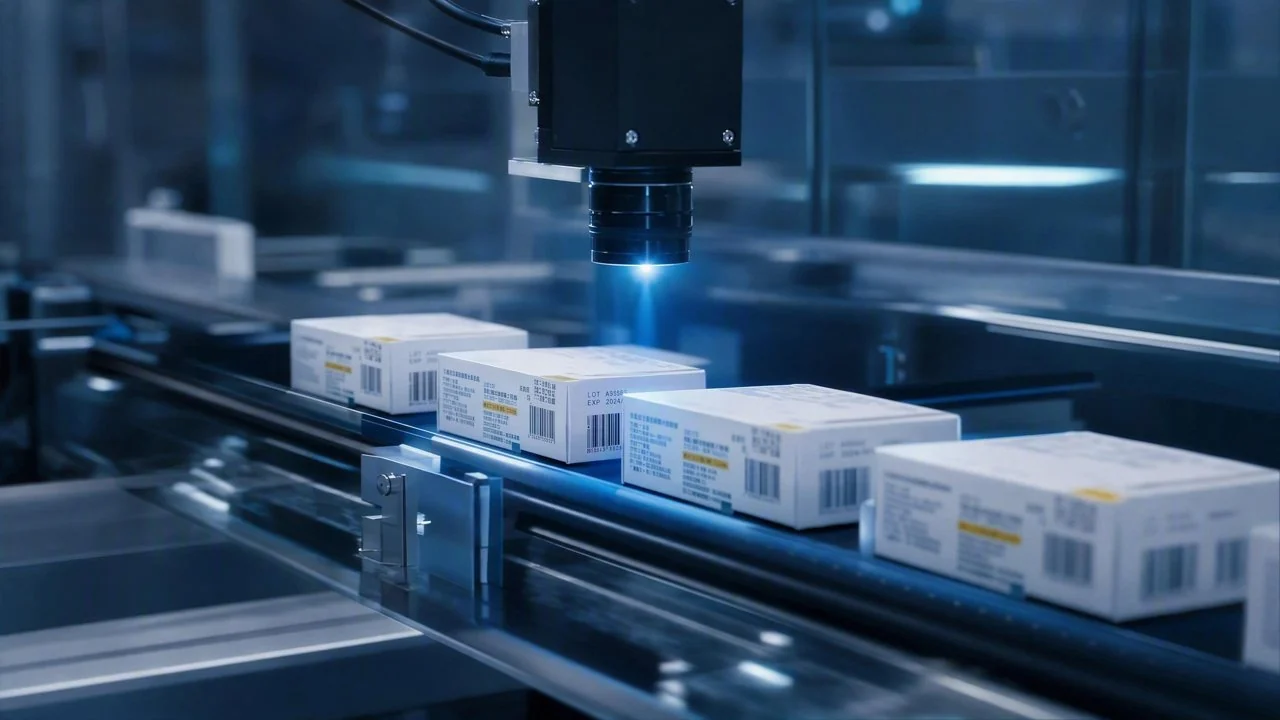
DaoAI / WeLinkirt's 2D ACI equipment (high-resolution 2D imaging + deep learning secondary judgment, for surface/printing/character OCR/assembly defects, high-speed inline full inspection, micron-level, semantic false positive filtering) precisely identifies and detects defects in label characters and serialization codes on pharmaceutical packaging. This reduces compliance risks from high-risk levels to a controllable range, which were previously caused by blurry, incorrect, or missing prints under traditional solutions. It also achieves full-process quality traceability and data closure, ensuring controllable quality and verifiable information for every pack of medicine.
The pharmaceutical industry, a vital component of the national economy, directly impacts public health. In every stage of drug production, especially during packaging and serialization, there are extremely stringent requirements for the accuracy and completeness of label characters (such as batch numbers, expiration dates, production dates) and serialization codes (such as traceability codes, regulatory codes). Any minor character printing defect, blurriness, misalignment, missing print, or serialization error can lead to product recall, market withdrawal, or even severe compliance risks and legal liabilities. A leading pharmaceutical manufacturer, operating high-speed production lines, faces the challenge of 100% inline full inspection of tens or even hundreds of thousands of drug packages, particularly for tiny, irregular character defects, where traditional detection methods often fall short.
Pain Points: Why This Hurdle Is So Difficult to Overcome
In pharmaceutical packaging label OCR and serialization code inspection, traditional solutions face multiple pain points: First, **high leakage and false positive rates coexist**. Manual visual inspection is prone to fatigue and subjective judgment, making it difficult to control the leakage rate below 0.5%, especially for tiny defects or characters on complex backgrounds. While rule-based AOI systems can identify standard characters, their ability to recognize 'soft' defects like font variations, uneven ink, reflections, or background interference is poor, with false positive rates typically exceeding 10%. This leads to a large number of good products being misidentified, increasing unnecessary re-inspection labor. Second, **inefficient changeovers lead to long downtime**. When product batches, packaging specifications, or print content change, traditional rule-based vision systems require engineers to manually adjust thresholds, regions, or templates, taking several hours or even half a day, severely impacting production line rhythm. For example, a pharmaceutical company, on average, performs 3-5 changeovers per week, with each downtime costing hundreds of thousands of yuan. Third, **data silos and broken traceability chains**. Traditional solutions often stop at 'defect detection' and lack real-time data interaction with upper-layer MES/WMS systems, failing to form a complete lifecycle quality traceability data closed loop from production to distribution. If a problem arises, it's difficult to quickly locate the batch or trace the root cause, increasing compliance risks and recall costs. Finally, **challenges in the localization of nanometer-level precision inspection**: In scenarios with extremely high demands for character edges and printing precision, there are nanometer-level challenges for imaging quality and algorithm robustness. Traditional domestic vision solutions often perform inadequately when dealing with complex textures, low-contrast characters, or tiny foreign objects, leading to reliance on imported solutions.
The root cause of these challenges lies in the diversity of pharmaceutical packaging materials (e.g., glossy paper, matte film, transparent plastic), variations in printing processes (e.g., inkjet, laser, thermal transfer), and the high demands of the drugs themselves for cleanliness and stability. These factors collectively result in complex and variable character images, making traditional rule-based visual algorithms ineffective for generalization. Manual visual inspection is even less capable of maintaining high precision over long periods at high production speeds and cannot provide objective, quantifiable data support.
Technical Principles
DaoAI / WeLinkirt's 2D ACI equipment changes pharmaceutical label OCR and serialization inspection by integrating high-resolution 2D imaging with deep learning secondary judgment technology. At the imaging level, the device employs customized industrial cameras and highly stable light sources, capable of capturing high-definition images with micron-level details. This effectively overcomes the imaging challenges of traditional cameras on low-contrast or reflective surfaces, ensuring clear character edges and prominent defect features. Its unique hardware synergistic optimization ensures that image acquisition speed perfectly matches the production line rhythm, enabling high-speed inline full inspection.
At the algorithmic level, the DaoAI 2D ACI is powered by a deep learning engine based on visual foundation models. Compared to traditional rule-based AOI, its core advantage lies in its powerful feature learning and generalization capabilities. It no longer relies on manually set thresholds or rules but automatically extracts deep semantic features of characters by learning from a large number of good samples and a small number of defective samples. Particularly, its APDT (Any-Positive, Deep-Transfer) few-shot self-training technology requires only 1-20 good images to complete model training within 5 minutes, demonstrating high robustness to various fonts, backgrounds, and printing defects. The deep learning's 'semantic false positive filtering' mechanism effectively distinguishes true defects from non-critical visual noise (e.g., slight dust, background textures), reducing the false positive rate by over 80%, significantly reducing re-inspection workload. This engineering depth allows the DaoAI 2D ACI to achieve character recognition accuracy above 99.9%, far exceeding traditional methods, and effectively handles complex defects such as character adhesion, breakage, blurriness, and color variations that are difficult for traditional solutions, ensuring data accuracy for pharmaceutical product traceability.
Typical Application Scenarios
- **Drug Batch Number/Expiration Date OCR Detection:** The DaoAI 2D ACI equipment can precisely identify batch numbers, production dates, and expiration dates on drug boxes and bottles, detecting character integrity, clarity, positional accuracy, and the presence of incorrect or missing prints. The challenge lies in the significant differences in fonts and ink colors across different batches, and potential local reflections or wrinkles.
- **Serialization Code/Traceability Code Recognition and Verification:** High-speed recognition and decoding of 2D traceability codes and 1D barcodes on drug boxes, with real-time comparison against database information to ensure the uniqueness and correctness of the codes, preventing serialization errors or counterfeiting. Challenges include diverse code types, unstable print quality, and image capture and decoding under high-speed movement.
- **Label Printing Defect Detection:** Inspecting the print quality of labels on drug boxes and instructions, including macroscopic defects such as ink spots, scratches, stains, uneven color, and misregistration, as well as micron-level minor damage. The DaoAI 2D ACI can achieve full coverage detection at high production line speeds and filter out non-critical background textures.
- **Bottle Cap/Ampoule Character Detection:** Detecting laser-marked or inkjet-printed characters on bottle caps or ampoules to ensure characters are clear, legible, free of ghosting, and complete. Difficulties include distortion correction for curved surface imaging and reflection issues with glass materials.
- **Packaging Box Seal Integrity and Identification:** Checking the integrity of the seal on the outer packaging box of drugs, and verifying whether correct anti-counterfeiting marks or batch information are printed on the seal. The DaoAI 2D ACI can capture subtle deformations or printing defects at the seal through high-resolution imaging.
Case Study
A leading domestic pharmaceutical group, with a large manufacturing plant processing tens of millions of drug packages monthly on its high-speed packaging lines, previously relied on manual sampling combined with traditional rule-based AOI systems for label OCR and serialization code inspection. However, the limitations of traditional solutions became increasingly apparent: manual sampling had a leakage rate as high as 0.8%, and the traditional rule-based AOI system maintained a false positive rate of about 12%, requiring 2 workers to spend 6 hours daily on re-inspection, severely slowing down overall efficiency. The estimated annual recall risk due to missed detections amounted to several million yuan. To address this pain point, the group introduced DaoAI / WeLinkirt's 2D ACI equipment. During the implementation, the DaoAI engineering team collaborated closely with the client, utilizing APDT few-shot self-training technology to complete production line adaptation and model deployment in just 3 days, significantly shortening the debugging period compared to the several weeks required by traditional solutions. In the initial deployment, by collecting good samples and a small number of defective samples from different batches and print qualities, the DaoAI 2D ACI quickly learned and built a highly robust detection model. After going live, the equipment achieved 100% inline full inspection and integrated with the client's MES system, enabling real-time data upload and traceability. After three months of stable operation, the detection results showed that the DaoAI 2D ACI consistently controlled the leakage rate to <0.05% and reduced the false positive rate to 1.5%, decreasing re-inspection labor by 85%.
The DaoAI 2D ACI equipment significantly improved the detection accuracy and efficiency of our pharmaceutical packaging line, pushing the leakage rate down to <0.05%, truly achieving a leap from 'qualified' to 'excellent', providing solid assurance for our quality traceability system.
DaoAI Solutions and Products
DaoAI / WeLinkirt's 2D ACI equipment, as the core solution, demonstrates its powerful capabilities in several aspects: First, **high-precision detection and semantic false positive filtering**. Leveraging self-developed visual foundation models and deep learning algorithms, the equipment can perform micron-level detection of various character defects and effectively distinguish true defects from non-critical background noise, reducing the false positive rate to a level unattainable by traditional solutions. Second, **rapid changeover and low-code deployment**. Thanks to APDT few-shot self-training technology, clients only need to provide 1-20 good samples, and a new product model can be trained and deployed within 5 minutes, greatly shortening changeover downtime and enhancing production line flexibility. For example, on pharmaceutical packaging lines, changeover time is reduced from several hours with traditional solutions to less than 10min. Third, **data closure and quality traceability**. The DaoAI 2D ACI equipment provides standard API/SDK interfaces for integration with existing client MES, WMS, and other production management systems, uploading detection data in real-time to establish a full-link quality traceability system from raw materials to finished products, providing precise data support for product recalls and problem analysis. Fourth, **100% local private deployment**. To meet the extremely high requirements of the pharmaceutical industry for data security and privacy, the DaoAI 2D ACI equipment supports completely localized deployment, ensuring all data remains on-site and the absolute security of critical client production data. We can also provide the DaoAI ACI OS, which further enhances detection accuracy and generalization through the feature recognition capabilities of visual foundation models.
Overall, the DaoAI 2D ACI equipment not only solves the pain points of character and serialization code inspection on pharmaceutical packaging lines but also, through its advanced AI technology, enables clients to achieve higher-dimensional quality management and intelligent manufacturing. Its stable and reliable performance and flexible deployment methods bring significant business value to pharmaceutical enterprises, helping them maintain a leading position in fierce market competition.
FAQ
What are the application scenarios of DaoAI 2D ACI equipment in the pharmaceutical industry?
DaoAI 2D ACI equipment is primarily used for quality inspection of pharmaceutical packaging, including batch number/expiration date OCR detection, serialization code/traceability code recognition and verification, label printing defect detection, character inspection on bottle caps/ampoules, and packaging box seal integrity checks. It effectively addresses various planar defects such as blurry characters, incorrect/missing prints, and label damage, ensuring product compliance and quality traceability.
How to evaluate the investment cost and ROI period of DaoAI 2D ACI equipment?
The investment cost of DaoAI 2D ACI equipment is influenced by specific configurations, inspection difficulty, complexity of production line integration, and deployment scale. The ROI period needs to comprehensively consider the value brought by reduced leakage rates, decreased false positive rates, savings in manual re-inspection costs, shortened changeover times, and avoidance of potential compliance risks. We recommend scheduling an expert consultation to receive a customized solution and detailed quotation assessment.
How does DaoAI 2D ACI ensure the security and privacy of pharmaceutical production data?
DaoAI 2D ACI equipment supports 100% local private deployment, meaning all inspection data and model training data can be processed and stored on the client's local servers, without any data leaving the factory. This fundamentally ensures the security and privacy of pharmaceutical production data, fully complying with the industry's strict requirements for data compliance.
Full solution for this scenario: the full inspection solution for Pharma / drug · Inline Label OCR & Serial Code Verification
This article was generated by AI. Customer cases are simulated scenarios based on real product capabilities and figures are illustrative; see product pages for official benchmarks.