
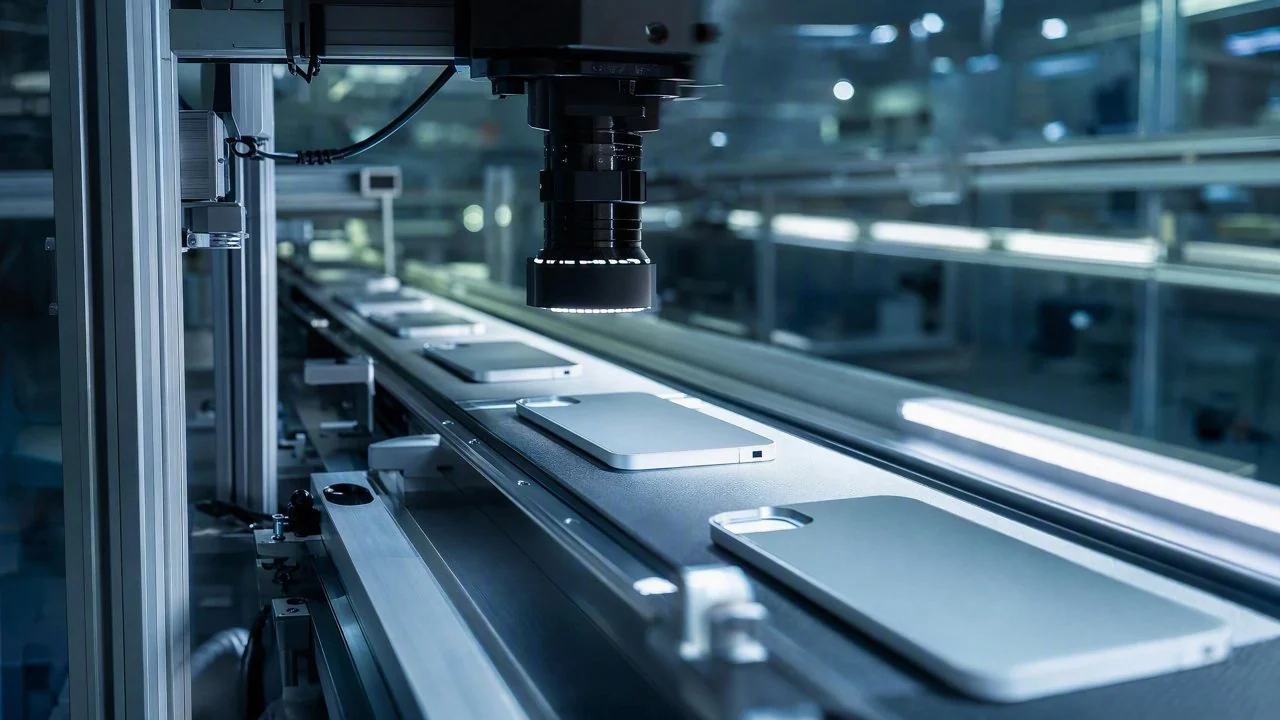
DaoAI 2D ACI equipment (high-resolution 2D imaging + deep learning secondary judgment, targeting surface/printing/character OCR/assembly omissions and other planar defects, high-speed online full inspection, micron-level accuracy, semantic false positive filtering) leverages APDT few-shot self-training to reduce the false positive rate for consumer product body logo silkscreen printing defect detection from approximately 20% with traditional industry solutions to <5%, significantly enhancing production line efficiency and product quality.
The consumer goods industry demands extremely high standards for product appearance quality, especially the precision and consistency of body logos and silkscreen printing, which directly impact brand image and user experience. In areas such as smartphones, smart wearables, and home appliances, printing defects in logos and various markings are common quality issues. These defects include, but are not limited to, blurred characters, broken lines, ink bleed, misalignments, scratches, and smudges. Although minor, they significantly affect the perceived value of the final product. Traditionally, such inspections heavily relied on manual visual inspection or rule-based AOI equipment. However, with accelerating product iterations and increasing personalized demands, small-batch, multi-model production has become the norm, posing higher requirements for the flexibility and adaptability of inspection systems. It is in this context that DaoAI 2D ACI equipment provides consumer goods manufacturers with an efficient and precise online full inspection solution.
Pain Points: Why This Hurdle is Difficult to Overcome
In the quality inspection of consumer product body logo silkscreen printing, traditional methods face multiple challenges. Firstly, there is a high false positive rate, especially when dealing with complex backgrounds, reflective materials, or subtle visual differences. Traditional rule-based AOI equipment often misidentifies normal textures, environmental lighting variations, or minor cosmetic inconsistencies as defects, leading to false positive rates as high as 20%. This results in a large number of good products being sent for manual re-inspection, significantly increasing re-inspection man-hours. Secondly, detection efficiency is low. On high-speed production lines, manual visual inspection struggles to keep up with the takt time, and the false positives from traditional AOI further slow down overall line efficiency. Thirdly, changeover costs are high. Consumer products undergo rapid updates and iterations, and new products or batches often mean minor adjustments to logo designs or silkscreen processes. Each changeover requires hours or even days to reconfigure rule parameters, severely impacting production schedules and flexibility.
The root cause of these dilemmas lies in the inherent complexity of the silkscreen printing process itself. For example, uneven ink thickness, worn printing screens, or tiny irregularities on the substrate surface can all lead to subtle visual differences. These differences might be insignificant to the human eye but are enough to trigger false positives in traditional AOI. Simultaneously, consumer product body materials are diverse, such as matte, glossy, or brushed metal, each with different reflective properties, posing severe challenges to imaging stability. More importantly, in the trend of industrial large language models, how to effectively utilize a small number of samples for rapid model deployment and iteration has become key to enhancing competitiveness. Traditional solutions lack the “semantic understanding” capability for defects, making them unable to distinguish true defects from harmless visual noise, nor can they quickly adapt to new defect types, leading to poor generalization.
Technical Principles
The core advantage of DaoAI 2D ACI equipment lies in its combination of high-resolution 2D imaging technology with advanced deep learning secondary judgment capabilities, with a particular emphasis on its APDT (Adaptive Positive Data Training) few-shot self-training mechanism. The system first acquires images of the product surface using industrial-grade high-resolution cameras, ensuring that micron-level details are clearly visible. Subsequently, the images are processed by the DaoAI ACI OS. Unlike traditional AOI based on fixed thresholds or geometric rules, the DaoAI system utilizes pre-trained visual foundation models for feature extraction, enabling a deeper semantic understanding of images. APDT few-shot self-training allows users to quickly train a detection model for specific logos or silkscreen defects using only 1-20 good samples. This mechanism significantly lowers the barrier and time for model training, eliminating the reliance on a large number of defect samples, which is particularly suitable for the small-batch, multi-model production characteristics of the consumer goods industry. By learning the characteristics of good products, the system can establish a precise “normal” pattern, thereby effectively identifying anomalies. Furthermore, the DaoAI system incorporates a semantic false positive filtering mechanism, further reducing false positives caused by non-defect factors such as environmental lighting or material reflections, making detection results more reliable.
Compared to traditional manual visual inspection, DaoAI 2D ACI equipment achieves high-speed online full inspection, eliminating the instability caused by human eye fatigue and subjective judgment, with detection consistency far exceeding human capabilities. Compared to traditional rule-based AOI, the deep learning algorithms of the DaoAI system possess stronger generalization and adaptability. Rule-based AOI requires manually writing complex rule sets for each defect type, and these rules become invalid when new defect types or process changes occur, requiring significant time for readjustment. In contrast, the DaoAI ACI learns image features to better understand the nature of defects, enabling effective judgment based on learned “normal” patterns even for defects that have not been explicitly defined. APDT few-shot self-training reduces model changeover time from hours or even days to less than 5 minutes, significantly enhancing production line flexibility. DaoAI also supports 100% local private deployment, ensuring customer data security and meeting the strict requirements of consumer goods manufacturers for keeping core process data within the factory.
Typical Application Scenarios
- **Logo Character Blur and Broken Line Detection**: In mobile phone back cover logo printing, DaoAI 2D ACI equipment can accurately identify blurred character edges, broken strokes, or missing parts. The difficulty lies in the tiny characters and potential interference from subtle background textures, which traditional methods often misinterpret. DaoAI, with its high-resolution imaging and deep learning semantic understanding, effectively addresses this.
- **Silkscreen Ink Bleed and Splatter Detection**: For silkscreen text or patterns on products like earbud charging cases or smart watch dials, the DaoAI system can detect ink bleeding into non-printed areas or tiny splatter points. The challenge is that ink bleed can be extremely small and difficult to distinguish from environmental dust. DaoAI's micron-level precision and semantic filtering solve this issue.
- **Pattern Misalignment and Deformation Detection**: In complex pattern silkscreen printing on consumer electronic product casings, such as decorative patterns or specific markings, DaoAI 2D ACI can detect overall misalignment of the pattern relative to the design baseline, or local distortion of lines and graphics. The difficulty lies in requiring precise global positioning and local feature comparison, which DaoAI's feature point matching and deep learning models efficiently accomplish.
- **Surface Scratch and Stain Detection**: Beyond printing defects, the DaoAI system can also detect subtle scratches, oil stains, fingerprints, and other surface foreign matter in the logo area or around silkscreen printing online. The challenge is that these defects can be highly similar to the product's own surface texture or appear differently under varying lighting. DaoAI's multi-angle imaging compatibility and robust AI judgment provide a solution.
- **OCR Character Recognition and Content Verification**: For variable information silkscreen printed on products, such as batch numbers or serial numbers, the integrated OCR function of DaoAI 2D ACI equipment can perform high-precision recognition and cross-reference with database information to ensure correct printed content. The difficulty lies in the diversity of fonts and inconsistent print quality, which DaoAI's deep learning OCR engine can adapt to.
Case Study
A leading smartphone manufacturer, whose high-end models feature precision silkscreen printing for their back cover logos, previously relied on traditional rule-based AOI and manual re-inspection before adopting DaoAI 2D ACI equipment. Due to the diverse back cover materials (glass, ceramic, matte metal) and the small font size of the logo with low contrast against the background, the false positive rate of traditional AOI equipment reached 20-25%. This necessitated an additional 10 man-hours per day for re-inspection, severely slowing down the production line takt time. Moreover, whenever a new model was released or a logo was subtly adjusted, production line changeover downtime lasted 6-8 hours, impacting the speed of new product launches. After evaluating various solutions, the manufacturer ultimately chose the DaoAI 2D ACI system, focusing specifically on its APDT few-shot self-training capability. In the initial deployment phase, the technical team quickly completed model training and deployment on the DaoAI ACI platform using only 15 good product images. After two weeks of trial operation and fine-tuning, the system successfully reduced the false positive rate to <5% while maintaining a defect escape rate of <0.2%. Changeover time was also drastically reduced from the previous 6-8 hours to less than 5 minutes, greatly enhancing production flexibility. DaoAI 2D ACI equipment ensures that this manufacturer can deliver high-quality, defect-free logo silkscreen printed products while maintaining high-speed production.
“The APDT few-shot self-training capability of DaoAI 2D ACI equipment has completely transformed our quality inspection model for small-batch, high-frequency changeover products. Now, we can quickly deploy new models with minimal samples, not only significantly reducing false positives but also achieving unprecedented production line flexibility.”
DaoAI Solutions and Products
The core product provided by DaoAI for consumer product body logo silkscreen defect detection is the DaoAI 2D ACI equipment. This equipment integrates customized high-resolution industrial cameras and lighting systems, ensuring that high-quality images can be captured under various material and lighting conditions. Its software core is the DaoAI ACI OS, which incorporates advanced visual foundation models with powerful feature recognition capabilities. For logo silkscreen defects, DaoAI utilizes an APDT positive/few-shot learning strategy, allowing customers to quickly complete model training by providing only 1-20 good samples. This “0-code automatic programming” feature enables non-specialized personnel to complete model configuration and changeovers in a short time. In practical implementation, the DaoAI team provides end-to-end services from hardware selection, system integration to model deployment and optimization, tailored to the customer's specific production line environment and product characteristics. The system supports Docker containerized deployment, enabling 100% local private deployment to ensure that sensitive customer data remains within the factory, meeting strict data security and compliance requirements. Furthermore, the DaoAI World Model, serving as a unified foundation, with its semantic understanding and cross-scenario generalization capabilities, provides a solid basis for future production line intelligent upgrades and continuous learning, ensuring that DaoAI 2D ACI equipment can constantly adapt to new production challenges and defect types.
By deploying DaoAI 2D ACI equipment, customers achieve significant business value. In the case mentioned, the false positive rate was reduced by 75%, from approximately 20% to <5%, directly reducing a large amount of manual re-inspection man-hours, almost completely freeing up the original 10 hours of daily re-inspection workload. The detection rate remained stable above 99.8%, ensuring product quality. Changeover downtime was shortened from several hours to 5min, greatly enhancing production line flexibility and efficiency. These quantified achievements not only reduced operational costs but also improved product yield and market competitiveness, accelerating the time-to-market for new products. The application of DaoAI 2D ACI equipment in consumer product logo silkscreen detection demonstrates its powerful capability and outstanding value in solving complex visual inspection challenges.
FAQ
How does DaoAI 2D ACI's APDT few-shot self-training differ from traditional deep learning model training?
DaoAI 2D ACI's APDT few-shot self-training primarily enables rapid detection model creation using only 1-20 good (normal product) samples, rather than a large number of defect samples. Traditional deep learning typically requires thousands or even tens of thousands of labeled defect samples to achieve high accuracy. APDT learns the normal characteristics of good products to identify anomalies deviating from the normal pattern, significantly reducing data annotation costs and model training cycles, making it particularly suitable for small-batch, multi-model, rapidly iterating production scenarios in the consumer goods industry.
What is the approximate budget required to deploy a DaoAI 2D ACI system for Logo silkscreen detection?
The budget for DaoAI 2D ACI equipment is influenced by various factors, including line speed, required detection accuracy, inspection area, camera resolution, lighting solutions, and necessary software modules (e.g., APDT, OCR). We offer flexible configuration options to meet diverse customer needs. We recommend scheduling a detailed consultation with our experts. We will provide a customized solution and precise quotation based on your specific application scenario and performance requirements.
If my product material is highly reflective, can DaoAI 2D ACI equipment still detect defects effectively?
Yes, DaoAI 2D ACI equipment has optimized solutions for detecting defects on highly reflective materials. We utilize customized high-brightness, multi-angle, or polarized lighting systems combined with high dynamic range (HDR) cameras to effectively suppress specular reflections and glare, obtaining high-quality images. Furthermore, the deep learning algorithms embedded in the DaoAI ACI OS have stronger robustness to image features, capable of extracting effective information from complex backgrounds and reflective interference, and leveraging semantic false positive filtering to avoid misidentifying reflections as defects, ensuring detection accuracy.
Full solution for this scenario: the full inspection solution for Consumer / general
This article was generated by AI. Customer cases are simulated scenarios based on real product capabilities and figures are illustrative; see product pages for official benchmarks.