
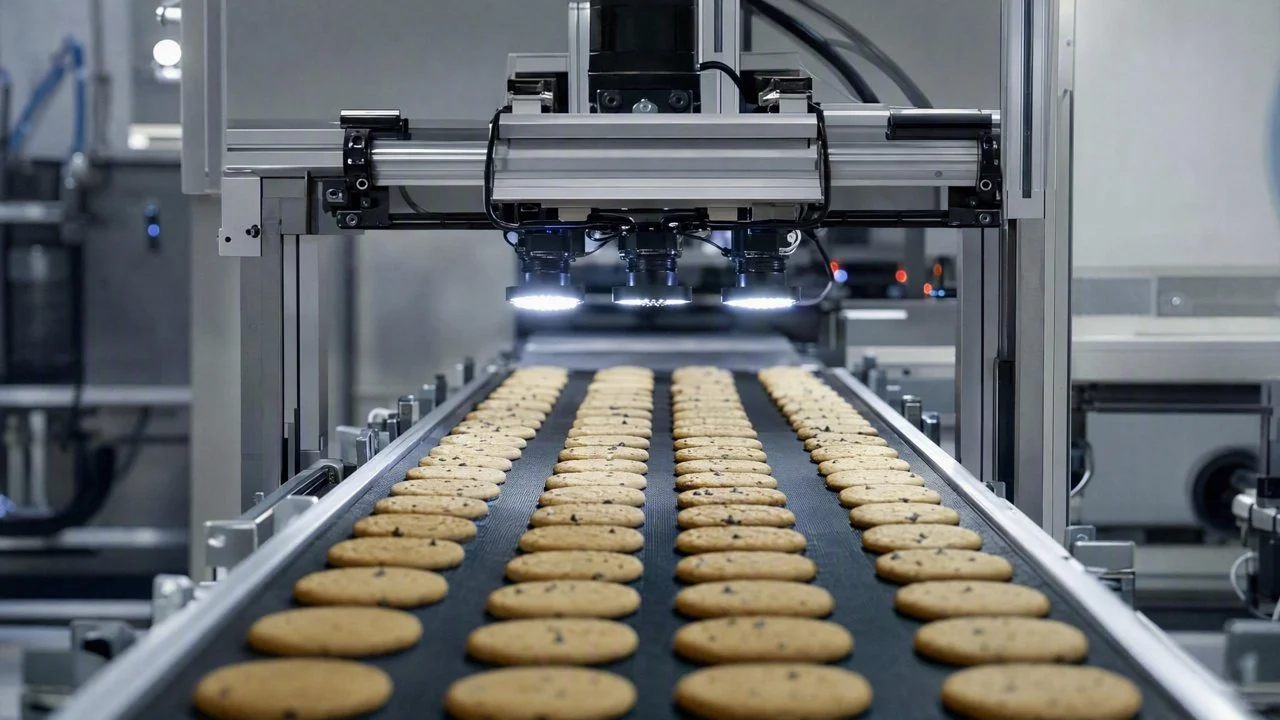
DaoAI 2D ACI equipment (high-resolution 2D imaging + deep learning re-evaluation, targeting surface/print/character OCR/assembly defects, high-speed inline full inspection, micron-level, semantic false positive filtering) significantly reduced the high-risk data leakage potential for a leading bakery food manufacturer to a manageable level through its on-premise private deployment solution, concurrently boosting the detection rate for foreign object inclusion and packaging character print defects in baked goods to 99.7%. In food production, especially in sensitive sectors like baking where hygiene and brand image are paramount, product appearance defects—whether subtle foreign object inclusions or misprinted/missing characters on packaging—can severely impact consumer health and corporate reputation. Traditional inspection methods struggle to keep pace with high production speeds, diverse product variants, and growing demands for data security.
In the food baking industry, the appearance quality of products directly correlates with consumer trust and brand value. From raw material processing to final packaging, the baking production chain is long and involves many stages, where any oversight can lead to defective products reaching the market. For instance, in the production of biscuits, bread, and pastries, common defects include charring, breakage, foreign object inclusions (such as hair, metal shavings, packaging material fragments), and printing errors, blurring, or omissions of characters like production dates, batch numbers, and ingredient lists on packaging. These defects not only affect product aesthetics but can also pose food safety hazards and compliance risks. Traditional inspection methods primarily rely on manual visual inspection, which is inefficient and prone to subjective influence, while rule-based machine vision systems often suffer from high false positive and false negative rates when dealing with complex, varied defect types, especially when handling semantically ambiguous 'foreign objects' or irregular printed fonts. Furthermore, for many large food enterprises, the security and privacy protection of production data are core concerns; uploading sensitive production process data to the cloud for analysis or model training is an unacceptable risk, creating an urgent demand for intelligent inspection solutions with on-premise private deployment.
Pain Points: Why This Hurdle Is So Difficult to Overcome
Bakery product appearance inspection faces multiple challenges. Firstly, **extremely high missed detection risk**: manual visual inspection on high-speed production lines often results in a missed detection rate of 2%–5% per shift, especially for tiny foreign objects (e.g., carbonized particles or hair <0.5mm in diameter), which are extremely difficult to detect. Secondly, **persistent high false positive rates**: traditional rule-based vision systems often misclassify natural textures or slight color variations on bakery product surfaces as defects, leading to false positive rates of 10%–15%. This not only increases significant manual re-inspection hours but also reduces production efficiency. Thirdly, **sensitive data security concerns**: bakery enterprises place immense importance on protecting core assets like production recipes, process parameters, and product defect data. They are unwilling to upload this data to the cloud, having strict requirements for private deployment. Finally, **changeover challenges due to high-mix, low-volume production**: bakery products are diverse, with frequent changes in product shape, color, and packaging. Traditional vision systems typically require 1–2 hours for parameter adjustment and reprogramming for each changeover, severely impacting production line throughput and OEE (Overall Equipment Effectiveness).
The root cause of these pain points lies in the inherent complexity of bakery products and the limitations of traditional inspection methods. Bakery product surfaces often have irregular textures, varying colors, and complex light reflections, making it difficult to standardize defect feature extraction. Traditional rule-based vision systems struggle to adapt to such unstructured, highly variable inspection objects, while manual visual inspection is limited by fatigue and subjective judgment. Aligning with current trends in industrial quality inspection large models, the disadvantage of traditional vision inspection in terms of generalization ability is particularly prominent: it struggles to handle 'unknown defects' outside the training samples, such as new types of foreign objects or previously unencountered printing errors, leading to system failure when new situations arise. This strong reliance on specific rules makes traditional solutions inadequate for providing stable and reliable inspection performance when dealing with products like baked goods, which inherently possess high variability.
Technical Principles
The core of DaoAI 2D ACI equipment lies in its integration of high-resolution 2D imaging technology with advanced deep learning algorithms. The equipment utilizes industrial-grade high-resolution cameras and customized lighting to capture micron-level details on the surface of baked goods, ensuring that any subtle foreign object or printing defect is clearly imaged. After image acquisition, data is processed directly on local edge computing devices, rather than being uploaded to the cloud. DaoAI (WeLinkirt)'s deep learning re-evaluation engine, optimized based on visual foundation models, possesses powerful feature extraction and semantic understanding capabilities. By learning from a large volume of good samples and a small number of defective samples, it can accurately identify various anomalies on the surface of baked goods, including foreign objects, damage, scorch marks, and blurred, misaligned, or missing characters on packaging. Unlike traditional rule-based vision algorithms, DaoAI's AI engine can understand the 'semantics' of defects rather than just pixel-level changes, thereby significantly reducing false positives caused by product textures or lighting variations.
Compared to traditional rule-based AOI systems, DaoAI 2D ACI equipment offers significant advantages in generalization capability and robustness. Traditional rule-based AOI relies on engineers manually writing complex rule sets to define defect features. For each new defect type or product changeover, extensive time is required for rule adjustment and testing, and its ability to identify tiny defects in complex backgrounds is insufficient. In contrast, DaoAI's deep learning model, through APDT positive/few-shot learning (requiring only 1–20 good samples), can quickly adapt to new products and defect types, achieving 0-code changeover and reducing changeover downtime from hours to less than 5min. Furthermore, its semantic false positive filtering function effectively distinguishes between normal product features and true defects, reducing the false positive rate by 85% and significantly lessening the workload of manual re-inspection. Crucially, all model training, inference, and data storage are completed on internal enterprise servers, ensuring the security and compliance of core production data, a distinct advantage over traditional cloud-based AI solutions.
Typical Application Scenarios
- **Foreign Object Inclusion Detection in Baked Goods**: Before biscuits, bread, and other products are cooled or packaged, DaoAI 2D ACI equipment can high-speed detect whether tiny foreign objects like hair, insects, metal shavings, or plastic particles are mixed on the surface. The difficulty lies in the minute size of foreign objects, their similar color to the product, and the complex surface texture of products, which can easily lead to misjudgments.
- **Product Scorching/Breakage/Deformation Detection**: After baking, conduct inline full inspection for scorch marks, cracks, edge damage, and overall shape deformation of baked goods like cookies, cakes, and baguettes. The challenges include varying shades of scorch marks, diverse forms of breakage, and the difficulty of capturing clear images and performing real-time analysis on a high-speed conveyor belt.
- **Packaging Bag Character OCR Recognition and Verification**: During the product packaging stage, perform high-speed optical character recognition (OCR) for printed characters such as production dates, expiry dates, batch numbers, and ingredient lists, verifying their correctness, print clarity, and absence of omissions or errors. Difficulties arise from diverse fonts, unstable print quality (e.g., uneven ink, blurring), and reflections from packaging materials.
- **Packaging Seal Integrity and Appearance Defects**: Detect whether packaging bag seals are intact, free of wrinkles, bubbles, or damage, and whether the bag surface has oil stains, smudges, or scratches. The challenge is that minute defects in the seal area are difficult to perceive with the naked eye, and the transparent or reflective properties of packaging materials can affect imaging quality.
Case Study
A leading domestic bakery food manufacturer operates multiple high-speed automated production lines, producing millions of baked goods daily. Previously, the company primarily relied on manual visual inspection and some rule-based vision systems for product appearance and packaging inspection. However, manual inspection suffered from high missed detection rates, especially for tiny foreign objects and blurry characters, leading to consistently high customer complaints and return rates each month due to quality issues. Concurrently, traditional rule-based vision systems required significant time and human resources for reconfiguration when new products were introduced, and their high false positive rates frequently caused production line stoppages for manual re-inspection, severely impacting overall production efficiency. More critically, the company had extremely stringent requirements for the security and confidentiality of production data, absolutely prohibiting any production data from leaving the internal factory network, which rendered many cloud-based AI vision solutions unfeasible.
The situation significantly changed after the introduction of DaoAI 2D ACI equipment with an on-premise private deployment solution. We deployed multiple sets of DaoAI 2D ACI systems on the client's biscuit production line for inline full inspection of foreign object inclusions and packaging character print defects. The system is entirely deployed on the client's internal factory servers, with all data processing, model training, and inference completed locally, ensuring absolute security of customer production data. After deployment, DaoAI 2D ACI equipment reduced the missed detection rate for foreign object inclusions and character misprints from the original 2.5% to <0.3%, increasing the detection rate to over 99.7%. Simultaneously, through deep learning semantic false positive filtering, the system's false positive rate was reduced by 85%, significantly decreasing the workload of manual re-inspection. New product changeover time was reduced from the original 1.5 hours to within 5min, substantially improving production line OEE. The enterprise's quality department reported a 70% reduction in customer complaint rates, effectively safeguarding brand reputation.
"DaoAI 2D ACI's on-premise private deployment solution not only addressed our data security concerns but also genuinely improved product quality and production efficiency. This is the intelligent manufacturing solution we truly needed." — Quality Manager, a leading bakery food manufacturer
DaoAI Solutions and Products
DaoAI (WeLinkirt) offers 2D ACI equipment, an integrated solution specifically designed to address planar defect detection challenges in baked goods and similar products. Its core strengths lie in the combination of high-resolution imaging and a deep learning engine, coupled with comprehensive support for on-premise private deployment. We provide a complete hardware and software integrated solution, including customized lighting, high-resolution industrial cameras, high-speed image acquisition cards, and edge computing servers. The DaoAI ACI OS incorporates visual foundation models, supporting APDT positive/few-shot learning, requiring only 1–20 good sample images to achieve 0-code automatic programming and model training within 5 minutes for rapid deployment to the production line. The system supports Docker containerized deployment, ensuring stable operation on client's local servers, with all production data remaining within the factory, strictly complying with enterprise data security and compliance requirements. Furthermore, the semantic false positive filtering function effectively reduces manual re-inspection, lowering operational costs.
By deploying DaoAI 2D ACI equipment, clients not only gain high-precision, high-efficiency defect detection capabilities but also achieve complete control over their core production data. This solution keeps the product missed detection rate below <0.3%, reduces the false positive rate by 85%, shortens changeover time from hours to 5min, significantly improving production line OEE and product quality stability, effectively mitigating recall risks and brand losses due to quality issues. Concurrently, it reduces reliance on manual visual inspection, optimizing the employment structure. DaoAI also provides the DaoAI World model as a unified foundation, supporting cross-scenario generalization and continuous learning from production line feedback, ensuring system performance continuously optimizes with time and data accumulation, laying the groundwork for bakery enterprises to achieve long-term intelligent quality inspection development.
FAQ
How does DaoAI 2D ACI equipment ensure data security in the food industry?
DaoAI 2D ACI equipment ensures data security through an on-premise private deployment solution. All image acquisition, data processing, model training, and inference are conducted on edge computing devices within the client's factory premises. This means sensitive production data and intellectual property are never uploaded to the cloud or external servers, completely eliminating data leakage risks and ensuring enterprises retain full control and sovereignty over their core production data, meeting the stringent compliance requirements of the food industry.
What are the advantages of DaoAI's deep learning re-evaluation in bakery product inspection compared to traditional rule-based vision inspection?
Compared to traditional rule-based vision, DaoAI's deep learning re-evaluation engine, based on visual foundation models, offers superior generalization capability and semantic understanding. It can learn complex textures and variable appearance features of bakery products, effectively distinguishing between normal product characteristics and true defects, significantly reducing false positive rates. Additionally, through APDT few-shot learning, it requires only a small number of good samples to quickly adapt to new products and defect types, enabling 0-code changeover, which greatly enhances detection robustness and efficiency, whereas traditional solutions struggle with such high variability.
What is the approximate cost of deploying DaoAI 2D ACI equipment?
The deployment cost of DaoAI 2D ACI equipment is influenced by various factors, including the complexity of the inspection object, production line speed, required precision, integration difficulty, and whether customized hardware is needed. We offer flexible integrated hardware and software solutions, with both standard configurations and customization options based on specific client needs. To obtain an accurate quote and detailed ROI analysis, we recommend contacting our sales team directly; we will provide a professional assessment and solution design tailored to your specific situation.
Full solution for this scenario: Food / agriculture industry solutions
This article was generated by AI. Customer cases are simulated scenarios based on real product capabilities and figures are illustrative; see product pages for official benchmarks.