
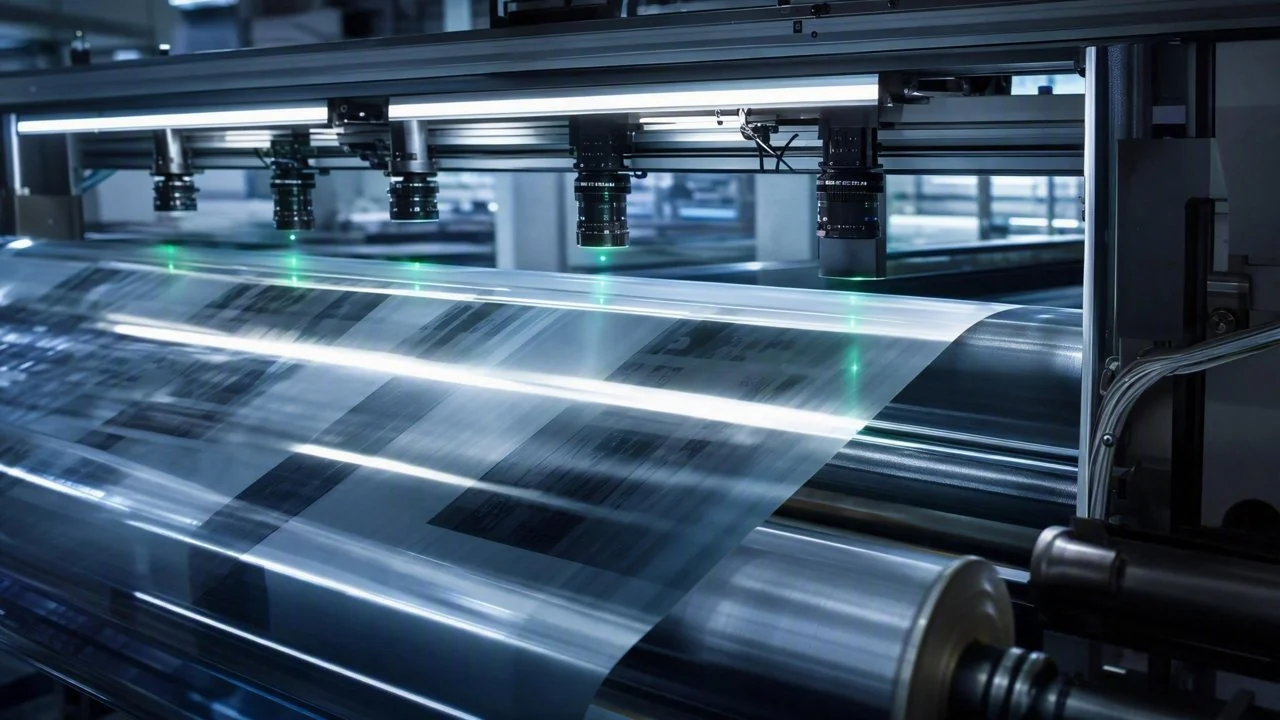
DaoAI 2D ACI equipment (high-resolution 2D imaging + deep learning for secondary judgment, targeting surface/print/OCR/assembly defects, high-speed online full inspection, micron-level, semantic false rejection filtering) replaces manual inspection on printed film roll production lines in the chemical/materials industry, reducing manual re-inspection workload due to false rejections by over 85%, significantly optimizing enterprise labor costs and improving inspection consistency.
In the chemical and materials industry, particularly in the production of printed films and label rolls, the stability and consistency of product quality are paramount. These rolls are widely used in packaging, electronics, medical, and other fields, where even minor surface, print, or character defects can lead to product malfunction or brand damage. Traditional quality inspection heavily relies on manual visual inspection. However, facing high-speed production lines and micron-level defects, manual inspection is not only inefficient and prone to fatigue but also incurs high labor costs and an uncontrollable false rejection rate, becoming a critical bottleneck limiting enterprise profitability. DaoAI 2D ACI equipment emerged in this context, offering an efficient, precise, and economical solution through its high-resolution 2D imaging and deep learning-based secondary judgment, effectively replacing labor-intensive manual re-inspection steps.
Pain Points: Why This Hurdle Is Difficult to Overcome
Quality inspection of printed films/label rolls faces multiple challenges, with the core pain points being the limitations of manual visual inspection and high operational costs. Firstly, **high false rejection rates** are a common issue. Traditional rule-based AOI algorithms often misclassify non-defect features as defects when encountering complex textures, material reflections, or production line vibrations, leading to a large number of good products being wrongly rejected or requiring manual re-inspection. A mid-sized roll material manufacturer reported that their false rejection rate was as high as 15%–20%, severely wasting valuable production resources and human effort. Secondly, **labor costs remain high**. To cope with high false rejection rates, enterprises must employ a large number of experienced quality inspectors for secondary re-inspection to ensure final outgoing quality. The recruitment, training, salaries, and benefits for these inspectors represent a significant expenditure, and maintaining a stable, high-quality inspection team is becoming increasingly difficult in a tightening labor market. Furthermore, **inspection consistency and fatigue issues** are prevalent. Long hours of high-intensity visual inspection can lead to inspector fatigue, causing judgment standards to deviate over time, affecting product quality stability and batch consistency, and even potentially leading to missed defects, posing risks of product recalls. Finally, **inefficient changeovers**. When product types or print content change, traditional AOI systems require significant time for parameter adjustment and rule writing, resulting in long production line downtime, affecting overall production rhythm and flexible manufacturing capabilities.
The root cause of these difficulties lies in the fact that surface defects on printed films/label rolls are often tiny and diverse, such as ink spots, scratches, bubbles, color differences, misregistration, missing prints, blurry characters, etc. These defects present vastly different visual characteristics on various material substrates (e.g., clear film, pearl film, matte film). At the same time, the high-speed operation of production lines (often reaching 100-300 meters/minute) places extremely high demands on imaging systems and processing speed. Traditional vision algorithms struggle to effectively distinguish between true defects and background noise, while human eyes, though capable of some semantic understanding, cannot meet the efficiency, accuracy, and stability requirements of industrial mass production. The industry is actively exploring the application of large visual models in industrial quality inspection to surpass human visual detection capabilities in complex scenarios, and DaoAI 2D ACI is a pioneer in this trend.
Technical Principles
The core advantage of DaoAI 2D ACI equipment lies in its combination of high-resolution 2D imaging technology and advanced deep learning algorithms, achieving a transcendence over traditional inspection methods. First, at the imaging level, we employ industrial-grade high-resolution line scan cameras and precise light source systems to acquire clear images of high-speed moving roll surfaces with micron-level precision, capturing subtle defect features imperceptible to the human eye. Second, at the image processing and judgment level, the DaoAI engine from WeLinkirt is equipped with feature recognition capabilities based on visual foundation models and APDT (few-shot self-training) technology. This means the system does not require a large number of defect samples; it can automatically complete model training with just 1-20 good product images in 5 minutes, achieving 0-code programming. Its deep learning model can learn and understand the semantic features of “good products,” thereby effectively distinguishing true defects from background textures, lighting variations, and other interfering factors. In particular, its built-in semantic false rejection filtering mechanism performs a secondary deep analysis of initial judgment results, filtering out pseudo-defects caused by material characteristics, environmental noise, or non-critical minor variations. For example, slight unevenness in printed base color might be considered good, rather than a color difference defect. This allows DaoAI 2D ACI equipment to reduce its false rejection rate by over 85% compared to traditional rule-based AOI, significantly decreasing the workload of manual re-inspection.
Compared to traditional manual visual inspection, DaoAI 2D ACI equipment offers unparalleled advantages. Manual inspection is limited by human eye resolution, fatigue, subjective judgment, etc., leading to low efficiency, inconsistent inspection standards, and prevalent false and missed detections. While traditional rule-based AOI achieves automation, its reliance on thresholding, edge detection, and other hard-coded rules makes it less adaptable to complex and varied defect forms and environmental conditions, resulting in high false rejection rates, and each changeover requires significant engineer time to adjust parameters. In contrast, DaoAI 2D ACI leverages the powerful generalization capabilities of deep learning to adapt to different materials and printing processes, achieving high-precision, high-consistency online full inspection. Its semantic false rejection filtering function specifically solves the industry’s long-standing problem of high manual re-inspection costs, freeing quality inspectors from arduous re-inspection tasks and allowing them to transition to roles in equipment maintenance and data analysis, thereby greatly optimizing labor structure and costs.
Typical Application Scenarios
- **Surface Defect Detection for Printed Films:** Detects scratches, stains, bubbles, foreign matter, wrinkles, and other surface imperfections on various printed films (e.g., BOPP, PET, PE). Challenges include difficulty in capturing defects on transparent films and motion blur caused by high-speed production lines.
- **Label Print Quality Inspection:** Conducts high-precision inspection for various label types (e.g., self-adhesive labels, shrink sleeve labels) for ink accumulation, missing prints, misregistration, color differences, blurry text, broken lines, and other printing defects. Challenges include complex patterns, diverse colors, and minute defects.
- **Character and Barcode OCR/OCV:** Performs Optical Character Recognition (OCR) and Verification (OCV) for batch numbers, dates, serial numbers, and other characters printed on roll materials, as well as reading and grading one-dimensional/two-dimensional barcodes. Challenges include diverse fonts, deformation, or uneven ink causing recognition difficulties.
- **Interlayer Defect Detection in Laminated Films:** Detects potential interlayer bubbles, delamination, foreign matter inclusions, and other issues that may arise during the lamination process of multi-layer composite films. Challenges include defects possibly existing internally, requiring high-penetration light sources or specific imaging technologies.
- **Label Die-Cut Edge and Dimension Inspection:** Checks if label die-cut edges are neat, free of burrs, and if dimensions comply with specifications. Challenges include minute deviations in edge details and the precision requirements of high-speed online inspection.
Case Study
A leading chemical materials manufacturer in East China, specializing in various high-quality printed films, has an annual output value exceeding one billion CNY. Due to extremely high product quality requirements, this manufacturer had long relied on a large number of manual inspectors for visual inspection and secondary re-inspection of rule-based AOI equipment in the roll material inspection process. Before introducing DaoAI 2D ACI equipment, a typical printed film production line required 8 quality inspectors working three shifts daily for re-inspection. Manual re-inspection accounted for about 18% of the total inspection volume, with a false rejection rate as high as 16%, directly leading to high labor costs and low production efficiency. Facing increasing order volumes and labor cost pressures, the manufacturer decided to seek an intelligent upgrade solution.
Through deep collaboration with WeLinkirt, the manufacturer deployed DaoAI 2D ACI equipment on one of its high-speed printed film production lines. During the implementation, we only used 15 good product samples and completed deep learning model self-training in less than 10 minutes. After deployment, the system was immediately put into production for online full inspection. Before implementation, the production line had a massive manual re-inspection workload due to false rejections, averaging about 200 meters of roll material re-inspected per shift, taking approximately 3 hours. After implementation, the semantic false rejection filtering function of DaoAI 2D ACI significantly reduced the original 16% false rejection rate to less than 2.4%, reducing manual re-inspection volume by over 85%. Now, the manual re-inspection workload per shift has dropped to about 30 meters of roll material, taking less than 30 minutes. This means the production line saves nearly 7 hours of manual re-inspection time daily, and the 6 quality inspectors previously dedicated to re-inspection can be reassigned to other more valuable roles, significantly optimizing labor structure and costs. Concurrently, due to the consistency of machine inspection, product quality stability has also greatly improved.
DaoAI 2D ACI has not only significantly reduced our false rejection rate and manual re-inspection costs but also improved the overall intelligence level and quality stability of our production lines, truly optimizing our labor structure.
DaoAI Solution and Products
DaoAI 2D ACI equipment, as the core solution in this case, derives its powerful capabilities from our self-developed DaoAI ACI OS. This system integrates the feature recognition capabilities of visual foundation models, allowing users to quickly deploy and switch inspection tasks with an extremely simple method of “one good product, 5 minutes, 0-code automatic programming.” In the printed film/label roll scenario, WeLinkirt utilizes APDT few-shot learning technology, requiring only 1-20 good product images to complete model training, greatly shortening changeover time from traditional hours or even days to within 5 minutes. Furthermore, the system’s built-in semantic false rejection filtering mechanism deeply understands image content, effectively distinguishing between normal production variations and true defects, thereby keeping the false rejection rate at an extremely low level, significantly reducing the need for manual re-inspection and directly optimizing labor costs. DaoAI 2D ACI equipment supports 100% local private deployment, ensuring customer data never leaves the factory, meeting the stringent requirements of the chemical materials industry for data security and compliance.
In addition to DaoAI 2D ACI equipment, WeLinkirt also provides the DaoAI World Model as a unified foundation, which possesses semantic understanding, cross-scenario generalization, and continuous learning capabilities from production line feedback, providing a solid foundation for customers' future intelligent upgrades. Through the deployment of DaoAI 2D ACI, this chemical materials manufacturer has not only achieved a leap in inspection efficiency but, more importantly, by significantly reducing the need for manual re-inspection, it has lowered labor costs by over 60%, achieving a transformation from “human wave tactics” to “intelligent quality inspection,” effectively enhancing the enterprise's competitiveness in the market. WeLinkirt is committed to solving the most challenging industrial quality inspection problems for customers through leading AI vision technology, achieving continuous optimization of productivity and value creation.
FAQ
How does DaoAI 2D ACI help companies optimize labor costs?
DaoAI 2D ACI significantly reduces the need for manual re-inspection through its high-precision detection and semantic false rejection filtering capabilities. Work that traditionally required many quality inspectors for secondary screening can now be automated by the equipment, freeing quality personnel from repetitive labor and allowing them to be reassigned to more valuable roles. This significantly reduces human input and related labor expenses, optimizing the labor structure.
What are the main differences between DaoAI 2D ACI and traditional rule-based AOI equipment?
The core advantage of DaoAI 2D ACI lies in its intelligent judgment capabilities based on deep learning and visual foundation models. Compared to traditional rule-based AOI, which relies on hard-coded rules and thresholds, DaoAI can quickly adapt to complex scenarios through few-shot learning (1-20 good samples) and significantly reduce false rejection rates using semantic false rejection filtering. This makes it far superior to traditional AOI in terms of detection accuracy, generalization ability, and changeover efficiency, reducing reliance on engineers.
What is the cost of deploying DaoAI 2D ACI equipment, and what is the typical ROI period?
The cost of deploying DaoAI 2D ACI equipment is influenced by various factors, including equipment configuration, inspection width, integration complexity, and specific project requirements. While the initial investment is higher than manual labor costs, it typically achieves a return on investment within 6-18 months by significantly reducing false rejection rates, decreasing manual re-inspection needs, improving production line efficiency, and enhancing product quality stability. We recommend contacting our sales team for a detailed quote and ROI analysis tailored to your specific production line.
Full solution for this scenario: Chemical / materials industry solutions · False-Alarm Reduction for Printed Film / Label Coils
This article was generated by AI. Customer cases are simulated scenarios based on real product capabilities and figures are illustrative; see product pages for official benchmarks.