
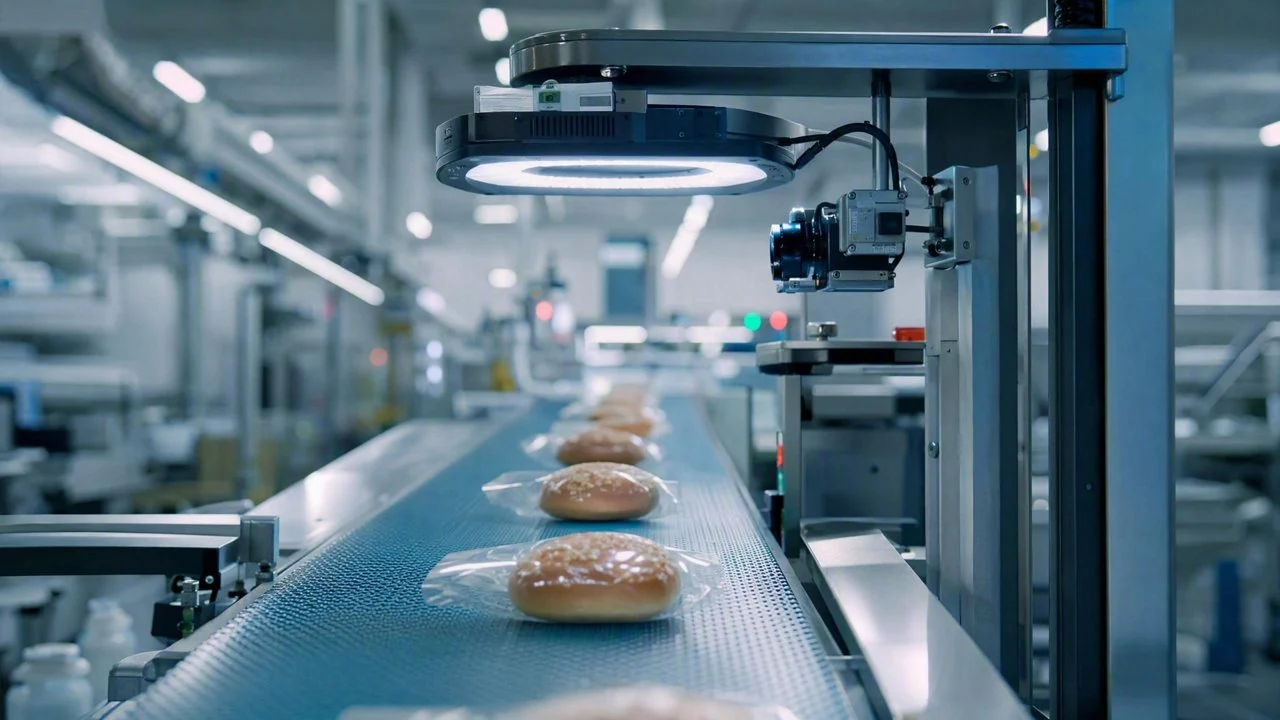
DaoAI 2D ACI equipment (high-resolution 2D imaging + deep learning for secondary judgment, targeting planar defects such as surface/print/OCR/assembly omissions, high-speed online full inspection, micron-level, semantic false positive filtering), by deploying on-premise and combining deep learning with semantic false positive filtering, reduced the appearance inspection false positive rate by 85% for a large bakery enterprise. This simultaneously ensured absolute security of sensitive production data, effectively addressing the dual challenges of data security and false positive control faced by traditional vision solutions.
In the food baking industry, product appearance is the primary factor influencing consumer perception of quality. WeLinkirt's DaoAI 2D ACI equipment (high-resolution 2D imaging + deep learning for secondary judgment, targeting planar defects such as surface/print/OCR/assembly omissions, high-speed online full inspection, micron-level, semantic false positive filtering), by deploying on-premise and combining deep learning with semantic false positive filtering, reduced the appearance inspection false positive rate by 85% for a large bakery enterprise. This simultaneously ensured absolute security of sensitive production data, effectively addressing the dual challenges of data security and false positive control faced by traditional vision solutions. The food industry's increasingly stringent requirements for product appearance, from burnt spots, cracks, and deformation to surface foreign objects, mean that any subtle defect can impact brand reputation and consumer purchasing intent. Particularly in large-scale production, relying on manual visual inspection is not only inefficient and costly but also lacks consistency. For bakery enterprises, production recipes, process parameters, and defect samples are all core business secrets, and any data leakage could lead to immeasurable losses. Therefore, achieving high-precision, high-efficiency automated inspection while ensuring data remains on-site and offline has become a critical consideration for enterprise digital transformation.
Pain Points: Why This Hurdle Is Difficult to Overcome
The pain points in bakery product appearance inspection lie in its complexity and variability, making it difficult for traditional solutions to balance accuracy and efficiency, while data security concerns are also increasingly prominent. The specific difficulties are reflected in the following dimensions:
- **High False Positive Rate and Manual Re-inspection Burden:** Traditional rule-based machine vision systems often misclassify natural variations in baked goods' surface texture and color (e.g., slight color differences due to uneven baking, tiny pores formed by dough fermentation) as defects, leading to false positive rates as high as 15%−20%. This necessitates a large volume of products entering manual re-inspection, significantly increasing production costs and labor input, and slowing down production line throughput.
- **Missed Detection Risk and Brand Damage:** For genuine defects such as burnt spots, cracks, and foreign objects, due to their uncertain shape, size, and position, traditional vision algorithms are susceptible to environmental lighting and product orientation, with missed detection rates potentially lingering between 1%−3%. Should defective products enter the market, it directly damages brand image and can even lead to food safety issues.
- **Data Security and Privacy Compliance:** Bakery production data, including product recipes, process parameters, defect types, and frequencies, are highly sensitive information. Adopting cloud-based or third-party server AI vision solutions poses potential security risks during data transmission and storage, failing to meet enterprises' strict requirements for data sovereignty and compliance. Some enterprises, due to policies or internal regulations, strictly prohibit any production data from being uploaded to external networks.
- **Sensor Calibration and Environmental Adaptability:** The bakery production line environment is complex, with temperature and humidity changes potentially affecting imaging equipment performance. Traditional solutions demand high requirements for sensor calibration and environmental adaptability; once calibration is improper or the environment changes, detection performance can drop sharply, increasing maintenance difficulty and cost. This is precisely what today's industry hot topic emphasizes: the decisive impact of sensor calibration on the overall performance and reliability of physical AI vision systems in industrial applications.
The root cause of these issues lies in the non-standardized nature of baked goods themselves; even good products will have subtle differences between batches. Traditional machine vision relies on preset thresholds and geometric features, making it difficult to distinguish between “normal variation” and “true defects,” especially in high-speed online inspection scenarios where image acquisition challenges and complex post-processing further exacerbate missed detection and false positive problems. Concurrently, concerns about data security lead enterprises to have unusually strict requirements for deployment models when selecting advanced AI vision solutions.
Technical Principles
WeLinkirt's DaoAI 2D ACI equipment fundamentally solves the inherent challenges of bakery product appearance inspection by integrating high-resolution 2D imaging technology with advanced deep learning algorithms, with a strong emphasis on data security. Firstly, at the imaging level, the equipment uses industrial-grade high-resolution cameras and customized lighting modules to capture micron-level details on the surface of baked goods, ensuring that even subtle cracks, burnt spots, or foreign objects are clearly visible. Its unique lighting design effectively suppresses surface reflections and shadows, acquiring high-quality, high-contrast images even with complex surface textures or uneven colors, providing a solid foundation for subsequent AI judgment. Secondly, the core of the WeLinkirt DaoAI 2D ACI system lies in its integrated deep learning vision foundation model. This model, pre-trained on a large dataset of bakery product images, possesses powerful feature recognition capabilities for complex textures, colors, and shapes. It can learn and understand the range of subtle variations in “normal” baked goods, thereby accurately distinguishing between inherent natural product features and true defects during inspection. For example, differentiating between “cracking” during baking and “normal crust texture,” which is difficult for traditional rule-based vision, is achieved by the deep learning model based on semantic context, significantly reducing false positive rates.
Compared to traditional machine vision (rule-based AOI), the advantage of WeLinkirt's DaoAI 2D ACI lies in its adaptability and intelligence. Rule-based AOI relies on engineers manually writing numerous rules and thresholds, requiring meticulous adjustments for each defect type and different product batches, which is time-consuming and labor-intensive, and performs poorly in identifying unknown or variant defects. Rules may become invalid when product models change or process parameters are slightly adjusted, leading to false positives or missed detections. In contrast, WeLinkirt's DaoAI 2D ACI equipment, through APDT positive/few-shot learning technology (requiring only 1–20 good samples), can quickly adapt to new product types or defect patterns, achieving “0-code” automatic programming. More critically, its built-in semantic false positive filtering mechanism conducts a secondary deep analysis of initial judgment results, filtering out “pseudo-defects” that are visually similar to defects but do not actually affect product quality, reducing the false positive rate by 85%. Furthermore, WeLinkirt's DaoAI solution supports 100% on-premise private deployment, with all data processing, model training, and inference completed within the enterprise's internal network, completely eliminating the risk of data leakage and meeting the highest requirements for data security and privacy in the food industry.
Typical Application Scenarios
- **Detection of Burnt Spots and Uneven Browning on Baked Goods:** WeLinkirt's DaoAI 2D ACI equipment precisely identifies localized over-browning, under-browning, or uneven color areas on products like bread, cakes, and biscuits. Through deep learning analysis of color distribution and texture features, it distinguishes between normal browning variations and quality-impacting burnt spots, ensuring consistent product coloration.
- **Crack, Damage, and Deformation Detection:** For common defects during baking such as bread crust cracks, biscuit breakage, and pastry deformation, the WeLinkirt DaoAI 2D ACI system uses high-resolution imaging to capture subtle geometric structural changes. Its semantic false positive filtering function effectively differentiates between natural textures caused by fermentation expansion and genuine cracks affecting product structure.
- **Surface Foreign Object and Mixing Detection:** Foreign objects such as hair, threads, or packaging debris that may appear on the surface of baked goods, as well as color or shape anomalies caused by mixing different batches of products. WeLinkirt's DaoAI equipment uses high-precision image recognition to quickly locate and reject products containing foreign objects or mixed ingredients, ensuring food safety.
- **Character OCR and Packaging Label Omissions:** For date codes, batch numbers, and other printed characters on some bakery products, as well as the integrity and correct positioning of packaging labels. WeLinkirt's DaoAI 2D ACI possesses powerful OCR capabilities, enabling high-speed recognition and comparison of character information, while also detecting label integrity and placement, preventing incorrect or missing information.
- **Assembly Defect Detection (e.g., toppings, decoration):** For baked goods with toppings (e.g., sesame seeds, nuts) or decorations (e.g., chocolate sauce patterns, sugar beads) on the surface, the WeLinkirt DaoAI system can inspect whether the toppings are evenly distributed and complete, and whether decoration patterns are missing or damaged, ensuring the product's visual appeal meets standards.
Case Study
A large domestic bakery food enterprise, operating multiple fully automated production lines, produces hundreds of thousands of various breads and pastries daily. Previously, its appearance inspection primarily relied on manual visual inspection supplemented by traditional rule-based vision systems. However, with increasing output and higher demands for product consistency, the shortcomings of traditional solutions became increasingly apparent: a persistently high false positive rate led to numerous good products being misclassified and sent for manual re-inspection, which not only consumed significant human resources but also slowed down the production line throughput. Concurrently, the enterprise had extremely strict internal regulations regarding the security and privacy of production data, prohibiting any solution that uploaded data to the cloud or third-party servers. Facing this challenge, the enterprise introduced WeLinkirt's DaoAI 2D ACI equipment, with a strict requirement for 100% on-premise private deployment.
The WeLinkirt team deployed the DaoAI 2D ACI system within the client's internal network environment, ensuring all data collection, model training, and inference ran on the client's own servers, guaranteeing data never left the factory. Before deployment, the appearance inspection false positive rate on this production line was as high as 18%, requiring 6 workers per shift for manual re-inspection, and product changeovers (e.g., from toast to croissants) necessitated at least 30 minutes of downtime for rule adjustments. After deployment, WeLinkirt's DaoAI 2D ACI equipment, utilizing APDT few-shot learning, completed new product model training with just 15 good sample images. In actual production, leveraging its deep learning and semantic false positive filtering capabilities, it significantly reduced the false positive rate to 2.7%, a reduction of 85%. This reduced manual re-inspection personnel to just 1, drastically saving labor costs. Simultaneously, product changeover time was shortened to less than 5 minutes, significantly boosting production line efficiency. WeLinkirt's DaoAI 2D ACI equipment not only solved the client's inspection accuracy and efficiency issues but also fundamentally secured their paramount concern—data security and privacy—achieving the triple goals of high efficiency, high precision, and high security.
WeLinkirt's DaoAI 2D ACI equipment, with on-premise private deployment as its foundation, combined with deep learning and semantic false positive filtering, ensures that data security and high-precision inspection are no longer a dilemma for food enterprises.
WeLinkirt Solutions and Products
WeLinkirt's DaoAI 2D ACI equipment is the core of this solution. Its power lies in integrating high-resolution industrial cameras, customized intelligent lighting, and the DaoAI ACI OS. This software system incorporates WeLinkirt's self-developed vision foundation model, possessing excellent feature recognition capabilities, enabling precise identification of planar defects such as burnt spots, cracks, foreign objects, and deformation on the surface of baked goods. In terms of modeling, WeLinkirt adheres to the “0-code” philosophy; through APDT positive/few-shot learning technology, clients only need to provide 1–20 good sample images, and the system can automatically complete model training and programming within 5 minutes, significantly lowering the barrier and deployment cycle for AI vision. The semantic false positive filtering function is another major highlight of WeLinkirt's DaoAI 2D ACI, effectively distinguishing between natural product textures and true defects, reducing the false positive rate to an industry-leading level.
For deployment and integration, WeLinkirt's DaoAI 2D ACI equipment supports various flexible deployment methods such as SDK / API / Docker, and firmly supports 100% on-premise private deployment, ensuring all sensitive production data is processed within the client's local network environment, with no data leaving the factory, completely eliminating data security risks. Additionally, WeLinkirt's DaoAI World model, serving as a unified base, provides the 2D ACI system with powerful semantic understanding and cross-scenario generalization capabilities, allowing it to continuously learn and optimize from production line feedback, constantly improving detection performance. Through WeLinkirt's DaoAI 2D ACI equipment, clients have achieved appearance defect detection rates exceeding 99.4%, a false positive rate reduction of 85%, and product changeover times shortened to 5min, significantly improving production efficiency and product quality while ensuring data security, bringing tangible business value to enterprises, including reduced operational costs, enhanced brand image, and increased market competitiveness.
FAQ
How does DaoAI 2D ACI equipment ensure data security for food enterprises?
WeLinkirt's DaoAI 2D ACI equipment supports 100% on-premise private deployment. This means all image data acquisition, AI model training, and inference computations are performed within the client's internal network environment, eliminating the need to upload data to the cloud or third-party servers. We offer various deployment methods like SDK / API / Docker, ensuring data never leaves the factory or touches external networks, fundamentally preventing data leakage risks and fully complying with the food industry's strict requirements for data sovereignty and privacy.
What are the main advantages of DaoAI 2D ACI over traditional rule-based vision in bakery product inspection?
The core advantage of WeLinkirt's DaoAI 2D ACI lies in its deep learning and semantic false positive filtering capabilities. Traditional rule-based vision struggles to differentiate between natural textures on baked goods and genuine defects, leading to high false positive rates. DaoAI 2D ACI, through APDT few-shot learning (1–20 good samples), quickly adapts to product variations and uses semantic analysis to filter out “pseudo-defects,” reducing false positive rates by over 85%. Additionally, it supports 0-code programming, significantly shortening changeover times.
What is the approximate cost of deploying WeLinkirt's DaoAI 2D ACI equipment?
The cost of WeLinkirt's DaoAI 2D ACI equipment comprises hardware (high-resolution cameras, lighting, industrial PCs, etc.), software licensing, and on-site deployment services. The specific cost varies based on production line speed, required inspection precision, defect types to be detected, and the number of devices needed. We offer flexible configuration options. We recommend contacting our sales engineers to provide detailed requirements and receive a customized quote, ensuring the solution aligns with your budget and business objectives.
Full solution for this scenario: Food / agriculture industry solutions · Produce Ripeness Robotic Sorting: On-Premise Deployment
This article was generated by AI. Customer cases are simulated scenarios based on real product capabilities and figures are illustrative; see product pages for official benchmarks.