
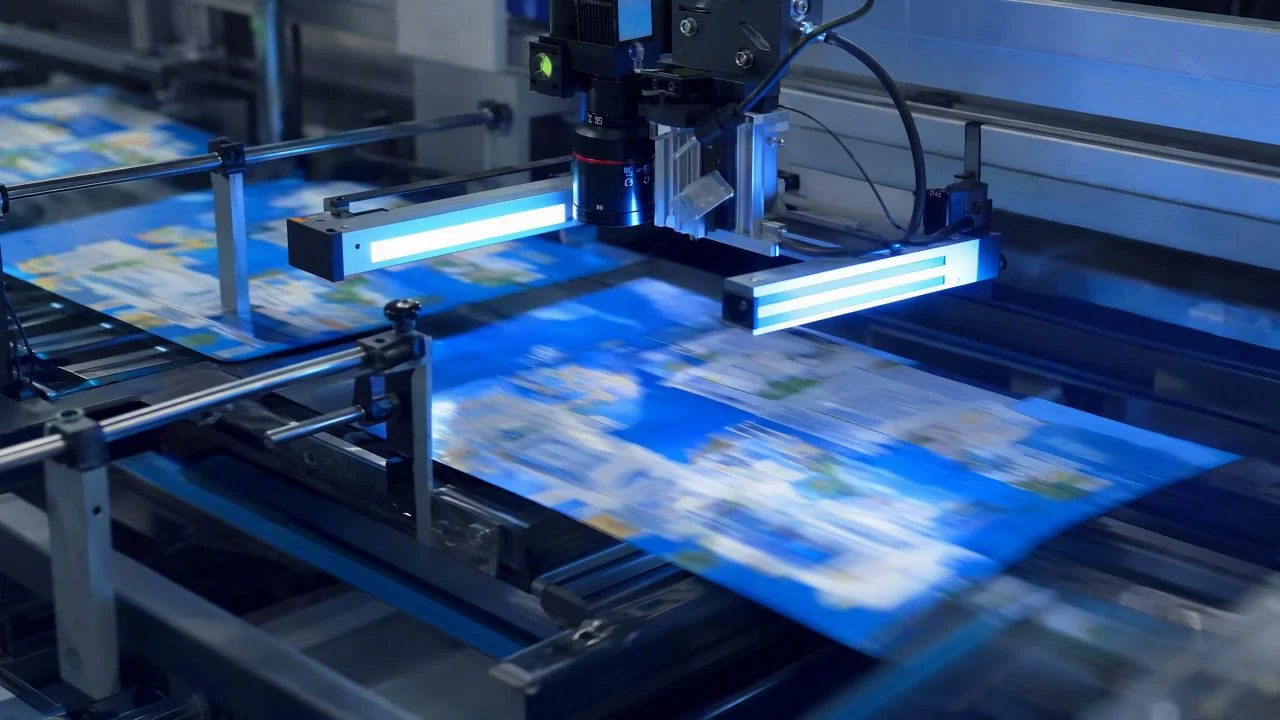
WeLinkirt's DaoAI 2D ACI equipment (high-resolution 2D imaging + deep learning for secondary defect judgment, addressing surface/printing/OCR/assembly omission planar defects, high-speed inline full inspection, micron-level, semantic false positive filtering) has achieved a dual breakthrough in production efficiency and quality control by deeply integrating with production line rhythms, reducing the manual re-inspection workload for consumer product packaging prints from a conventional 15% to <2%.
In the consumer goods industry, especially in packaging printing, product appearance is the first touchpoint where consumers perceive brand value. Packaging boxes, as the 'second skin' of a product, directly influence brand image and market competitiveness. As market demand for personalized and diversified packaging grows, the complexity of printing processes also increases, making the types and quantities of printing defects increasingly difficult to control. A leading consumer goods manufacturer, whose production lines operate at extremely high cadences, producing thousands of packaging boxes per minute, demands unprecedented levels of printing quality inspection. Traditional sampling or low-speed manual full inspection solutions can no longer meet their stringent capacity and quality requirements.
Pain Points: Why This Hurdle Is So Difficult to Overcome
This leading manufacturer faced multiple challenges in packaging box printing quality inspection: First, the **contradiction between undetected defects and false positives**. Traditional rule-based AOI systems, unable to understand the semantics of complex printed patterns, often struggle to set universal rules for subtle color differences, misregistration, ink spots, scratches, and other defects. This typically results in an undetected defect rate of around 2%, while efforts to reduce this rate significantly increase false positives, with a false positive rate of up to 15% meaning a large number of good products are incorrectly rejected, adding unnecessary re-inspection costs. Second, the **immense burden of manual re-inspection**. The high volume of data generated by high-cadence production lines and the high false positive rate mean quality inspectors spend a significant amount of time on secondary confirmation, requiring an average of 3-5 experienced inspectors per shift, severely slowing down overall line efficiency and leading to high labor costs and staff turnover risks. Furthermore, the **conflict between production cadence and inspection capacity**. Current production line cadences can reach 500-800 units/minute, but traditional inspection equipment, while ensuring a certain level of accuracy, often cannot keep up with such high-speed production, making inspection a bottleneck that severely limits further capacity improvement. Moreover, while drawing inspiration from the advantages of short-wave infrared imaging technology in semiconductor wafer inspection, such as high resolution and penetration, applying such complex imaging directly to general packaging printing faces challenges due to the diversity of printing materials and cost considerations. The core problem WeLinkirt needs to solve is how to achieve similar high-precision, robust detection within the visible light spectrum.
Technical Principles
The core of WeLinkirt's DaoAI 2D ACI equipment lies in its combination of high-resolution 2D imaging technology with an advanced deep learning secondary judgment engine. At the imaging level, we employ industrial-grade high-resolution cameras, coupled with a customized lighting system, capable of capturing micron-level printing details and potential defects on the packaging box surface. This provides high-quality raw data, laying the foundation for subsequent AI analysis. At the algorithm level, WeLinkirt's equipment is powered by the self-developed DaoAI ACI OS. This system leverages the feature recognition capabilities of visual foundation models and utilizes APDT positive/few-shot learning technology, requiring only 1-20 good product images to complete 0-code automatic programming and model training within 5 minutes. This enables the WeLinkirt equipment to quickly adapt to the inspection needs of different batches and patterns of packaging box prints. Crucially, its deep learning secondary judgment mechanism can semantically understand and contextually analyze initial judgment results, effectively filtering out 'visual noise' or 'good product variations' caused by the printing process itself, thereby reducing the false positive rate by a significant 85% while ensuring an undetected defect rate of over 99.5%. Compared to traditional rule-based AOI, which relies on manually set thresholds and features, is susceptible to lighting, material, and pattern changes, and struggles with complex texture defects; and manual inspection, which is limited by eye fatigue, subjectivity, and slow speed, WeLinkirt's DaoAI 2D ACI equipment achieves a qualitative leap with its self-learning, high-precision, and high-speed inline inspection capabilities.
Typical Application Scenarios
- **Color Deviation and Misregistration**: Detecting whether the printed pattern's colors meet standards and if multiple color blocks are precisely aligned in multi-color printing. The difficulty lies in distinguishing subtle color differences and misregistration errors within complex patterns; WeLinkirt's ACI accurately identifies these defects through multi-channel color analysis and geometric deformation detection.
- **Ink Spots, Scratches, and Foreign Objects**: Identifying the presence of excess ink spots, scratches from the printing process, or tiny foreign objects on the packaging box surface. These defects are minute and occur against complex background patterns, leading to many false positives with traditional methods. WeLinkirt's equipment uses its micron-level resolution and semantic understanding to effectively differentiate defects from background textures.
- **Character Print Quality and OCR Recognition**: Inspecting the clarity, completeness, and correctness of batch numbers, expiration dates, barcodes, QR codes, and other characters, performing accurate OCR recognition and verification. Challenges include character deformation, blur, or partial absence; WeLinkirt's DaoAI 2D ACI employs robust character recognition algorithms, maintaining high accuracy even under low contrast or slight damage.
- **Hot Stamping/Lamination/Embossing Defects**: For special packaging processes like hot stamping, lamination, and embossing, detecting surface defects such as bubbles, wrinkles, missing prints, or damage. The reflective properties and three-dimensional structures of these special materials pose challenges for traditional 2D imaging. WeLinkirt's equipment, through optimized lighting and deep learning models, effectively handles defect detection on these complex surfaces.
- **Die-Cutting and Creasing Defects**: Inspecting whether the die-cut edges of packaging boxes are smooth and burr-free, and if creasing lines are clear and accurately positioned. These defects directly affect the box's formation and aesthetics. WeLinkirt's equipment can perform high-precision edge detection and geometric dimension measurement, ensuring products meet design specifications.
Case Study
A leading consumer goods manufacturer, a globally renowned supplier of daily chemical products, has long faced a conflict between high production capacity and high-quality inspection on its packaging box printing lines. Their original quality inspection process heavily relied on manual sampling and traditional rule-based AOI equipment, resulting in an undetected defect rate of around 1.8% and a false positive rate as high as 15%−18%. This required significant manual input for re-inspection daily, averaging 4 quality inspectors per shift, totaling approximately 24 person-hours/day. This not only incurred substantial labor costs but, more importantly, because the inspection speed could not match the production line cadence, the line had to operate below its designed capacity or sacrifice some inspection coverage. After introducing WeLinkirt's DaoAI 2D ACI equipment, we first conducted two weeks of on-site data collection and model training. Through APDT few-shot learning, using only 10 good product images, we quickly completed model building for their various packaging box printing defects. Upon deployment, the equipment achieved high-speed inline full inspection at a 1:1 ratio with the production line cadence, meaning full coverage inspection of 750 packaging boxes per minute. After one month of trial operation and optimization, at the manufacturer's site, WeLinkirt's DaoAI 2D ACI equipment consistently kept the undetected defect rate at an extremely low level of <0.4%, while reducing the false positive rate from the original 15% to <2.5%, reducing the manual re-inspection workload by 85%. This improvement shifted the quality inspectors' focus from heavy re-inspection to anomaly analysis and process optimization, significantly enhancing work efficiency and employee satisfaction.
WeLinkirt's DaoAI 2D ACI equipment has enabled our production line to achieve true 100% full inspection, at a speed that fully keeps up, and with a false positive rate we never dared to hope for. This is not just a quality improvement; it's a revolution in our production model.
WeLinkirt Solutions and Products
The 2D ACI solution provided by WeLinkirt centers on its core equipment – the DaoAI 2D ACI device – integrating software, hardware, and services. This equipment incorporates high-resolution industrial cameras, customized lighting, and high-speed image acquisition cards, ensuring clear image capture even during high-speed movement. On the software front, the DaoAI ACI OS offers an intuitive user interface and powerful AI modeling capabilities, supporting 0-code rapid programming, making it easy for non-specialists to operate. Through APDT few-shot learning technology, customers only need to provide a small number of good product samples, and the system can automatically complete model training within minutes, greatly reducing deployment and changeover times. For multi-variety, small-batch production models, WeLinkirt's DaoAI 2D ACI equipment supports rapid changeovers, with average changeover times controllable within 5min, minimizing downtime losses. Deployment is flexible, supporting SDK/API/Docker, and allowing for 100% on-premise private deployment to ensure customer data security. In addition to the core 2D ACI equipment, WeLinkirt's DaoAI World model, as a unified foundation, enables semantic understanding and cross-scenario generalization, continuously learning from production line feedback to enhance the robustness and accuracy of detection models. WeLinkirt can also provide robotic vision solutions, such as 6D pose recognition for automated gripping and placement of packaging boxes, further improving automation levels.
By deploying WeLinkirt's DaoAI 2D ACI equipment, the customer realized multifaceted business value. First, **significantly improved quality**: the undetected defect rate was reduced to <0.4%, ensuring product quality consistency and brand reputation. Second, **substantially increased efficiency**: manual re-inspection workload was reduced by 85%, freeing up significant human resources, while the production line could operate at full speed, increasing overall capacity. Furthermore, **effective cost control**: reduced costs associated with rework, scrap, and customer complaints due to defective products, while optimizing human resource allocation. Finally, **data-driven quality management**: the equipment generates detailed inspection reports and defect statistics in real-time, providing valuable data for production process optimization and quality traceability. WeLinkirt's DaoAI 2D ACI equipment not only solved current quality inspection challenges but also built a future-oriented intelligent quality inspection system, providing a solid guarantee for the customer's continued development.
FAQ
How does WeLinkirt's DaoAI 2D ACI equipment ensure inspection accuracy and synchronized cadence on high-speed production lines?
WeLinkirt's DaoAI 2D ACI equipment integrates high-resolution industrial cameras and customized lighting systems to capture clear images even during high-speed movement. Combined with self-developed deep learning algorithms, it processes image data and makes defect judgments at extremely high speeds. Its core advantage lies in the lightweight and optimized AI models, ensuring that while maintaining micron-level detection accuracy, it can fully match production line cadences of hundreds or even thousands of items per minute, achieving 100% inline full inspection without bottlenecks.
Compared to traditional rule-based AOI, what are the advantages of WeLinkirt's DaoAI 2D ACI in detecting complex printing defects?
Traditional rule-based AOI relies on preset rules and thresholds, struggling to adapt to complex and varied printing patterns and defect types, often leading to high false positives or high undetected defects. WeLinkirt's DaoAI 2D ACI utilizes deep learning technology, possessing strong feature learning and semantic understanding capabilities. It can automatically learn defect characteristics from a small number of good product samples, effectively distinguishing between good product variations and true defects, significantly reducing false positive rates while improving the detection rate for complex defects such as subtle color differences and misregistration.
What is the cost structure and approximate budget for deploying a WeLinkirt DaoAI 2D ACI solution?
The cost of deploying a WeLinkirt DaoAI 2D ACI solution primarily includes hardware equipment (high-resolution cameras, lighting, industrial PCs, etc.), DaoAI ACI OS licensing, and on-site integration and service fees. The specific budget will vary based on factors such as production line speed, inspection area, complexity of defect types, and deployment model (on-premise or cloud). We offer customized solutions, and we recommend contacting our sales team for a detailed quote and return on investment analysis tailored to your specific needs, ensuring an optimized solution.
Full solution for this scenario: Consumer / general industry solutions
This article was generated by AI. Customer cases are simulated scenarios based on real product capabilities and figures are illustrative; see product pages for official benchmarks.