
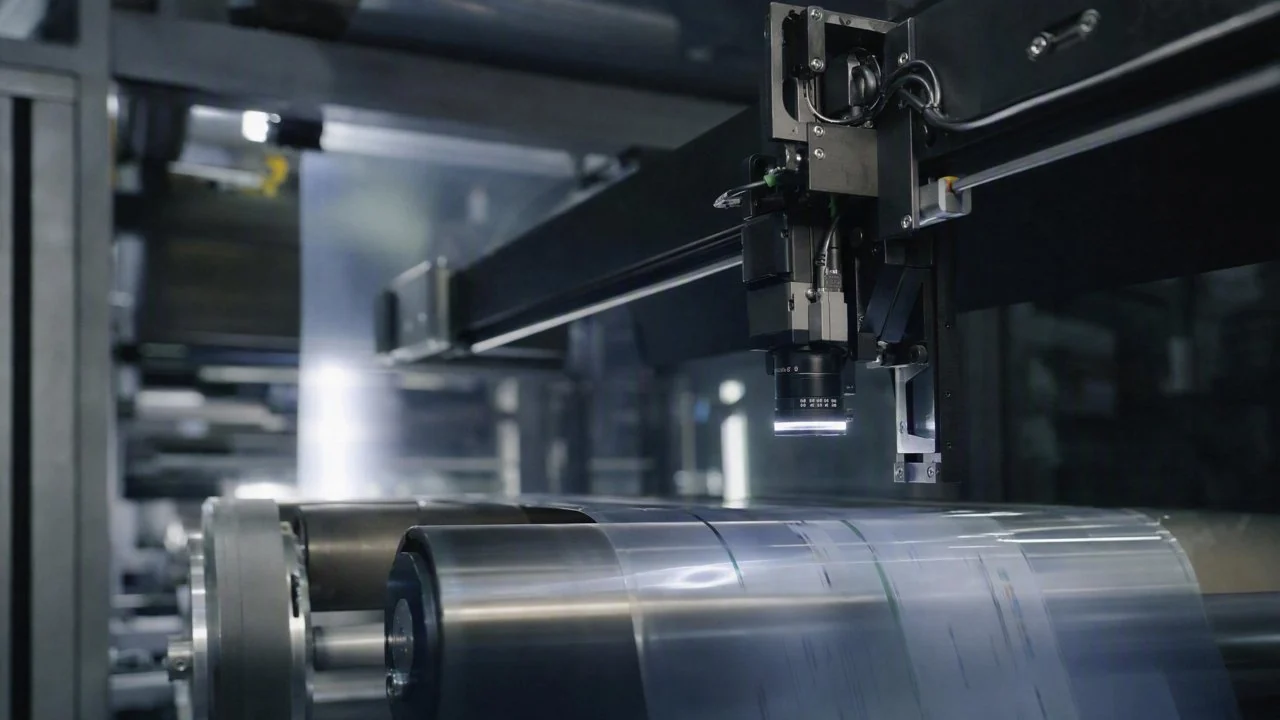
The chemical/materials industry faces significant defect detection challenges in printed film/label roll production. DaoAI 2D ACI equipment (high-resolution 2D imaging + deep learning secondary judgment, targeting surface/print/OCR/assembly defects, high-speed inline full inspection, micron-level, semantic false reject filtering) leverages APDT few-shot self-training to reduce false reject rates for printed film rolls from 15% typical in traditional solutions to <0.8%, substantially improving production line efficiency and product quality.
In high-speed production environments, 100% inline full inspection of printed film rolls for surface, print patterns, character recognition, and potential assembly defects is crucial for ensuring product performance and customer satisfaction. These products are widely used in food packaging, medical labels, and industrial protection, where their aesthetic quality directly impacts brand image and functionality. Traditional detection methods often struggle with diverse defect types and high production speeds, especially for micron-level defects, leading to persistently high false reject rates that severely impact production efficiency and costs.
Pain Points: Why This Hurdle is Difficult to Overcome
Defect detection for printed film/label rolls faces multiple challenges. Firstly, **high false reject rates**: traditional rule-based AOI systems are sensitive to ambient light, material textures, and minor smudges, leading to false reject rates typically ranging from 10-20% or even higher. This means a large number of good products are incorrectly rejected or require manual re-inspection, resulting in wasted resources and production halts. Secondly, **heavy manual re-inspection burden**: to cope with high false rejects, companies must deploy significant human resources for secondary visual inspection, which not only increases labor costs but also introduces the risk of missed defects due to human fatigue and subjectivity. Thirdly, **inefficient new product changeovers**: whenever a new model, pattern, or material of printed film is introduced, traditional AOI systems require hours or even days for reprogramming and debugging, severely delaying time-to-market. Furthermore, the high-speed operation of roll materials demands extremely high throughput and stability from the inspection system. In industrial digital twin applications, if front-end detection data is not precise enough, the real-time performance and accuracy of virtual models will also be significantly compromised, hindering effective production optimization.
The root causes of these difficulties lie in the material properties of printed films and the diversity of defects. Printed films often have complex surface characteristics such as reflectivity, translucency, or matte finishes, and defects are numerous, including ink spots, scratches, bubbles, missing prints, color variations, and blurred characters. These defects are visually subtle and difficult to distinguish using simple thresholds or geometric features. Traditional rule-based algorithms struggle with generalization, are helpless against unprogrammed defect types, and lack robustness against background noise. Manual inspection, on the other hand, is limited by the resolving power of the human eye and fatigue from prolonged work, making it impossible to guarantee 100% consistency and accuracy. DaoAI 2D ACI equipment effectively overcomes these traditional challenges by combining high-resolution imaging and deep learning.
Technical Principles
The core technology of DaoAI 2D ACI equipment lies in its unique combination of high-resolution 2D imaging system and deep learning secondary judgment, particularly the APDT (Adaptive Pre-trained Deep Transfer) few-shot self-training mechanism. This equipment utilizes customized industrial cameras and lighting modules to capture micron-level details, ensuring even subtle printing defects are clearly visible. At the image processing level, the DaoAI Wemio engine employs advanced deep learning algorithms to build highly robust 'good product models' by learning from a large volume of good product data.
Unlike traditional rule-based AOI systems, the APDT few-shot self-training capability of DaoAI 2D ACI equipment is a significant advantage. It allows users to provide only 1-20 good product samples, and the system can complete model self-training and deployment within 5 minutes, enabling rapid adaptation to new products or defect types. This few-shot learning mechanism drastically shortens changeover times, reducing the debugging period from hours or even days typical of traditional solutions to mere minutes. Furthermore, the deep learning model possesses powerful semantic understanding capabilities, enabling it to distinguish true defects from non-defect features such as background textures and environmental noise, thereby effectively filtering false rejects. For example, for minor bubbles or ink spots on printed film, the DaoAI system can accurately identify them as defects, while recognizing subtle textures inherent in the material or normal printing marks as good products, reducing the false reject rate by more than 94%, ultimately achieving a false reject rate below 0.8%.
Typical Application Scenarios
- **Printed Pattern Defect Detection**: Targeting missing prints, misalignments, color differences, smudges, ink spots, scratches, and other defects on printed films. DaoAI 2D ACI equipment captures pattern details with high-resolution imaging, and the deep learning model can identify various complex pattern defects, even subtle color variations or ink spots, overcoming the limitations of traditional rule-based algorithms sensitive to pattern complexity.
- **Character and Barcode OCR/OCV**: Inspecting the print quality, completeness, and clarity of batch numbers, dates, serial numbers, and other characters on printed films, as well as barcode and QR code recognition and grading. The challenge lies in diverse fonts, complex backgrounds, and blurry prints. DaoAI's OCR algorithms possess strong robustness, adapting to various challenging conditions to ensure information readability.
- **Surface Foreign Objects and Scratches Detection**: Detecting dust, fibers, oil stains, scratches, and indentations on the printed film surface caused during production. These defects are often tiny and irregularly shaped, making traditional methods prone to numerous false rejects. DaoAI 2D ACI equipment, through semantic false reject filtering, effectively distinguishes true defects from background noise, ensuring high detection rates.
- **Dimension and Position Accuracy Inspection**: Performing high-precision measurements of critical dimensions and positions, such as printed patterns, label edges, and cutting lines. In high-speed production, DaoAI Wemio can achieve micron-level measurement accuracy, ensuring products comply with design specifications and preventing subsequent processing issues due to dimensional deviations.
Case Study
A leading chemical materials manufacturer, whose core business includes producing high-precision printed film rolls for food and pharmaceutical packaging, previously relied on traditional rule-based AOI systems combined with manual visual inspection for quality control. However, due to the wide variety of products and complex print patterns, the traditional AOI system's false reject rate was as high as 15%, requiring 8-10 quality inspectors daily for re-inspection. Moreover, each time a product model changed, the AOI system required 4-6 hours for reprogramming. This resulted in high labor costs and material waste, significantly slowing down production rhythm and new product launch speed. To address this pain point, the manufacturer introduced DaoAI 2D ACI equipment, specifically leveraging its APDT few-shot self-training capability.
DaoAI 2D ACI equipment, with its APDT few-shot self-training capability, reduced printed film roll false reject rates by over 94%, shortening new product changeover time to under 5 minutes.
During the implementation, the DaoAI team first evaluated the production line and deployed the 2D ACI equipment. In the model training phase, using only 10 good product samples, the system completed the defect identification model for the first product model within 5 minutes through APDT few-shot self-training. After deployment, at the manufacturer's site, the equipment achieved 100% inline full inspection of printed film rolls, significantly reducing the false reject rate from 15% to <0.8%. This meant the volume of daily re-inspected rejects decreased by over 94%, and the manual re-inspection burden was drastically reduced, with quality inspectors decreasing from 10 to 2, primarily responsible for spot checks and anomaly handling. Concurrently, new product changeover time was shortened from the original 4-6 hours to under 5 minutes, greatly enhancing production line flexibility and efficiency. The client stated that DaoAI 2D ACI equipment not only solved the long-standing false reject issue but also brought significant economic benefits and a competitive advantage to the enterprise.
DaoAI Solution and Products
DaoAI 2D ACI equipment, as the core solution, provides strong support for defect detection of printed film/label rolls in the chemical/materials industry through its high-resolution 2D imaging system and deep learning secondary judgment capabilities. Its core advantage lies in APDT few-shot self-training, allowing customers to provide only 1-20 good product images to complete model training and deployment within 5 minutes, achieving 0-code rapid changeover. This capability significantly lowers the deployment threshold and maintenance costs of AI vision, especially suitable for multi-variety, small-batch, and frequent changeover production scenarios. DaoAI's semantic false reject filtering function can accurately distinguish true defects from background noise, ensuring a false reject rate below 0.8%, thereby significantly reducing manual re-inspection burden and material waste. Furthermore, the equipment supports 100% local private deployment, ensuring all inspection data remains on-site, safeguarding customer data security and privacy. By integrating with existing MES/SCADA systems, DaoAI 2D ACI equipment can achieve real-time upload of inspection data and quality traceability, building a digital closed loop for the production process.
The implementation approach for the DaoAI Wemio solution includes: first, customizing the configuration of high-resolution cameras, lighting, and motion control systems according to the customer's production line characteristics and inspection requirements. Second, guiding customers through few-shot good product data collection and APDT model training via an intuitive graphical interface. Finally, deploying the trained model to edge computing devices to achieve high-speed inline full inspection on the production line. The entire process does not require professional AI engineers; on-site customer engineers can easily operate and maintain it. Through the application of DaoAI 2D ACI equipment, customers have not only achieved a false reject rate reduction of more than 94% but also significantly improved production efficiency and product quality, with an estimated annual saving of millions of RMB in labor and material costs, and a significantly shortened return on investment period. DaoAI is committed to helping customers achieve intelligent manufacturing upgrades through advanced AI vision technology.
FAQ
What is APDT few-shot self-training, and how does it differ from traditional AI training?
APDT few-shot self-training is a core capability of DaoAI 2D ACI equipment, allowing the system to automatically learn and build robust defect detection models in a short time (5 minutes) using only a very small number (1-20) of good product samples. Unlike traditional AI training, which requires extensive defect and good product data and takes days or even weeks, APDT significantly reduces the barriers and time costs of data collection and model training, making it particularly suitable for industrial scenarios with multiple varieties, small batches, and frequent changeovers.
How does DaoAI 2D ACI equipment reduce false reject rates?
DaoAI 2D ACI equipment reduces false reject rates by combining high-resolution 2D imaging with deep learning secondary judgment. The deep learning model possesses powerful semantic understanding capabilities, enabling it to distinguish non-defect features such as product textures and minor smudges from true defects. By precisely learning good product characteristics, the system effectively filters out background noise that traditional rule-based algorithms often identify as defects, thereby keeping the false reject rate at a very low level, such as <0.8% in this case.
What is the budget required to deploy DaoAI 2D ACI equipment, and what is the typical payback period?
The deployment budget for DaoAI 2D ACI equipment varies depending on specific configurations (e.g., number of cameras, lighting type, inspection width, integration complexity). A customized quote is typically provided based on the client's actual needs. The payback period is usually short, as the equipment significantly reduces manual re-inspection costs, lowers scrap rates, and improves production line efficiency and product quality. We recommend contacting DaoAI's sales engineers with your specific requirements for a detailed solution, accurate budget estimation, and assistance in calculating your return on investment.
Full solution for this scenario: the full inspection solution for Chemical / materials
This article was generated by AI. Customer cases are simulated scenarios based on real product capabilities and figures are illustrative; see product pages for official benchmarks.