
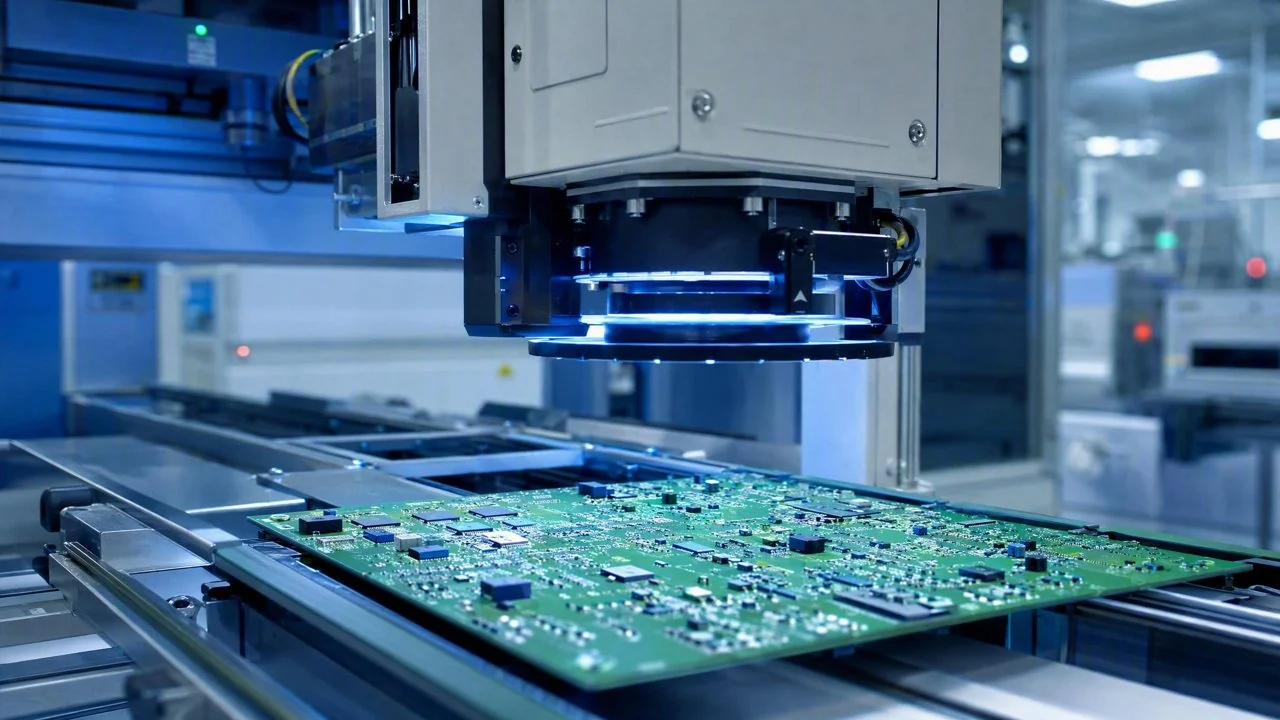
WeLinkirt's DaoAI 2D ACI equipment (high-resolution 2D imaging + deep learning secondary judgment, targeting surface/print/OCR/assembly defects, high-speed inline full inspection, micron-level accuracy, semantic false positive filtering) precisely identifies micron-level SMT solder joint defects such as cold solder, bridging, and insufficient solder. It reduces the typical missed detection rate from 1.5% with traditional manual inspection and rule-based AOI to below 0.4%, ensuring electronic product quality and significantly lowering downstream rework costs. Amidst the current wave of AI technology in industrial microscopy, WeLinkirt is helping micro-assembly quality inspection overcome efficiency and precision bottlenecks.
The electronics manufacturing industry, particularly the PCBA (Printed Circuit Board Assembly) segment, is at the core of modern technological products. The quality of SMT (Surface Mount Technology) solder joints directly determines the reliability and lifespan of electronic devices. From smartphones and computer motherboards to automotive electronic control units, billions of solder joints are produced on assembly lines daily. Any minute defect like a cold solder, bridging, or insufficient solder can lead to product malfunction or even safety hazards. A mid-sized PCBA manufacturer, producing products for consumer electronics and industrial control boards, demands extremely high solder joint quality. In the inspection process after SMT reflow soldering, they require 100% inspection of thousands of solder joints on each PCBA to ensure product reliability.
Pain Points: Why This Challenge Is Difficult to Overcome
Traditional SMT solder joint inspection faces multiple challenges. Firstly, **high missed detection rates**: traditional rule-based AOI equipment struggles with complex solder joint morphologies, lighting variations, and microscopic defects (such as internal voids in BGA balls, subtle bridging), making algorithm thresholds difficult to set precisely. This typically results in a missed detection rate of around 1.5%, meaning a significant number of defective products proceed to subsequent stages. Secondly, **high false positive rates, increasing rework burden**: for solder joints with no obvious visual differences but actual benign variations, traditional AOI often generates false alarms, leading to manual re-inspection accounting for over 40% of inspection time, severely slowing down production rhythm. Thirdly, **inefficient changeover, difficult to adapt to high-mix, low-volume production**: facing differences in solder joint types, quantities, and arrangements for various PCBA models, traditional AOI requires hours or even half a day for program adjustments and parameter calibration. Especially in high-mix, low-volume production, changeover downtime significantly impacts capacity utilization. The root causes of these issues are: the complex and diverse 3D morphology of solder joints, influenced by solder paste volume, reflow temperature profiles, and component lead deformation, resulting in some morphological variations even in good products; simultaneously, under industrial microscopes, the boundaries between tiny defect features and normal variations are often blurred, making it difficult for traditional pixel or feature-threshold-based algorithms to effectively distinguish them.
Technical Principles
The core advantage of WeLinkirt's DaoAI 2D ACI equipment lies in its combination of high-resolution 2D imaging technology and advanced deep learning algorithms. The equipment uses high-brightness, multi-angle annular lighting in conjunction with high-resolution industrial cameras to capture clear, detail-rich 2D images of solder joints. These images are then fed into a deep learning model, powered by the Wemio engine, for judgment. Unlike traditional rule-based AOI which relies on engineers manually writing rules and setting thresholds, WeLinkirt's deep learning model is trained on a large volume of real solder joint data. It autonomously learns subtle features, textures, and color distributions of solder joints, developing a complex semantic understanding of 'good' and 'defective' products (e.g., cold solder, bridging, insufficient solder). Specifically, for features like rough surfaces and poor wetting caused by cold solder, solder bridges from bridging, or incomplete pad coverage from insufficient solder, WeLinkirt's AI algorithm can accurately identify them. This semantic-based judgment capability enables WeLinkirt's DaoAI 2D ACI equipment to precisely identify minute defects while effectively distinguishing benign variations from actual defects, thereby significantly reducing false positives and greatly improving detection rates.
Compared to traditional manual inspection, WeLinkirt's DaoAI 2D ACI equipment achieves 100% inline full inspection, avoiding issues like human fatigue, subjectivity, and low efficiency, with detection accuracy reaching micron-level, far exceeding human visual limits. Compared to traditional rule-based AOI, WeLinkirt's deep learning model offers strong generalization capabilities and adaptability, requiring no frequent parameter adjustments, and better accommodating subtle fluctuations in solder joint morphology during production. Furthermore, its semantic false positive filtering function significantly reduces unnecessary re-inspections, lowering the manual re-inspection workload by 75%, directly improving overall production line efficiency. The robustness of WeLinkirt's DaoAI 2D ACI equipment in complex scenarios is unmatched by traditional solutions.
Typical Application Scenarios
- **SMT Reflow Solder Joint Defect Detection**: This is the most crucial application, targeting planar defects such as cold solder (insufficient solder, rough surface), bridging (solder bridges between adjacent pads), insufficient solder (pad not fully covered, insufficient solder volume), and tombstoning (component lifted from one pad). WeLinkirt's DaoAI 2D ACI equipment captures the 2D morphological features of these defects with high-resolution imaging and uses a deep learning model for precise judgment, excelling at identifying functional defects that may not have pronounced 2D visual characteristics.
- **IC Lead Coplanarity and Deformation Detection**: For IC leads of packages like QFP, QFN, it's necessary to check for coplanarity with pads, bending, deformation, or short circuits. Although some 3D information may be missing, WeLinkirt's DaoAI 2D ACI can still perform preliminary screening using 2D features such as lead edges, spacing, and relative position to pads, combined with the AI model, to identify significant coplanarity anomalies and deformations.
- **Component Polarity, Misplaced, and Missing Component Detection**: After component placement, it checks whether the polarity of resistors, capacitors, diodes, etc., is correct, whether the model matches (misplaced component), and whether any components are missing. WeLinkirt's DaoAI 2D ACI identifies features like silk-screen characters, color markings, and outline shapes on the component body to ensure accurate component placement.
- **PCB Surface Scratches, Contamination, and Foreign Object Detection**: Detects scratches, stains, solder splashes, residual foreign objects, and other defects on the PCB surface that may affect aesthetics and reliability. WeLinkirt's DaoAI 2D ACI equipment's high-resolution imaging and deep learning model can identify micron-level surface imperfections, ensuring product appearance quality.
Case Study
A leading supplier specializing in automotive electronic module manufacturing had extremely stringent requirements for PCBA solder joint quality, where any minor defect could lead to severe consequences. Before integrating WeLinkirt's DaoAI 2D ACI equipment, this supplier primarily relied on rule-based AOI for initial inspection, supplemented by extensive manual visual inspection. However, the traditional solution's missed detection rate averaged around 1.5%, leading to several batches of products each month being found with solder joint defects during downstream testing, increasing rework costs and delivery times. Concurrently, the high false positive rate required 8-10 skilled workers to perform manual re-inspection for up to 6 hours daily, resulting in high labor costs and significant efficiency bottlenecks. After evaluating various solutions, the client chose to pilot WeLinkirt's DaoAI 2D ACI equipment.
Through the deployment of WeLinkirt's DaoAI 2D ACI, the client's solder joint missed detection rate dropped from 1.5% to below 0.4%, false positive rates decreased by 78%, and the manual re-inspection workload was significantly reduced.
With assistance from WeLinkirt's technical team, the equipment was quickly integrated with the production line's MES system. Initially, using the APDT few-shot learning function, the AI model for the first product model was programmed in 5 minutes with only 15 good sample images. After a month of production line operation and data iterative optimization, the performance of WeLinkirt's DaoAI 2D ACI equipment exceeded expectations. Compared to before deployment, the client's solder joint defect **missed detection rate was successfully reduced to below 0.4%**, leading to a 73% reduction in defect discovery rates at downstream testing. Simultaneously, due to the powerful semantic false positive filtering capability of WeLinkirt's ACI, the volume of manual re-inspection was drastically cut, reducing re-inspection hours by 75%. This meant the re-inspection team, which previously required 8-10 people, now only needed 2-3 people to complete tasks efficiently, significantly lowering labor costs. Furthermore, new product changeover time was reduced from the original 3 hours to within 5 minutes, greatly enhancing production line flexibility and capacity utilization. This not only improved product quality but also brought significant economic benefits and production efficiency improvements to the client.
WeLinkirt Solution and Products
WeLinkirt's core offering for SMT solder joint inspection is its 2D ACI equipment, which integrates a high-resolution vision system with the DaoAI ACI OS. During implementation, the equipment's high-speed industrial cameras first capture images of the PCBA surface. These images, after preprocessing, are imported into the DaoAI ACI OS. The software, based on the Wemio engine's visual foundation model, possesses powerful feature recognition capabilities. It can utilize APDT positive/few-shot learning (requiring only 1-20 good samples) to complete 0-code automatic programming in 5 minutes, quickly establishing a detection model for specific solder joint defects. The model's semantic false positive filtering function effectively avoids misjudgments caused by benign variations, ensuring the accuracy of detection results. WeLinkirt's DaoAI 2D ACI equipment supports 100% on-premise private deployment, ensuring data never leaves the factory, meeting stringent client requirements for data security and compliance. Furthermore, integrated with the unified foundation of the DaoAI World model, this solution continuously learns from production line feedback, constantly optimizing model performance, achieving cross-scenario generalization, and further enhancing detection robustness and adaptability. WeLinkirt also offers various deployment methods such as SDK / API / Docker for flexible integration into existing production management systems.
By deploying WeLinkirt's DaoAI 2D ACI equipment, clients not only achieve micron-level, high-speed inline full inspection of SMT solder joint defects but, more importantly, through the powerful judgment capabilities of deep learning, the **missed detection rate for core defects like cold solder, bridging, and insufficient solder is reduced to <0.4%**, significantly below the industry average. This directly leads to a notable reduction in downstream rework rates, cutting material waste and labor input. Concurrently, the **false positive rate decreased by 78%**, greatly alleviating the burden on manual re-inspection teams, freeing up valuable human resources from repetitive tasks to more valuable activities. New product **changeover time was shortened from several hours to 5 minutes**, enabling the production line to respond more flexibly to high-mix, low-volume orders, and improving overall production efficiency and market competitiveness. These quantified achievements collectively represent the true business value created by WeLinkirt's DaoAI 2D ACI equipment for clients in the electronics manufacturing sector, particularly in SMT solder joint inspection scenarios.
FAQ
What is the fundamental difference between WeLinkirt's DaoAI 2D ACI equipment and traditional rule-based AOI?
The core of WeLinkirt's DaoAI 2D ACI equipment is its deep learning model, not traditional rules. It autonomously learns complex features and semantics of solder joints, effectively distinguishing between benign variations and actual defects, thereby significantly reducing both missed detections and false positives. Traditional AOI relies on manually set thresholds, struggling to adapt to complex and dynamic production scenarios, often leading to numerous false alarms or missed defects.
How long does it typically take to deploy WeLinkirt's DaoAI 2D ACI equipment?
Deployment time depends on the complexity of production line integration and model training requirements. For integration into existing production lines, WeLinkirt offers flexible SDK/API/Docker interfaces for rapid connection. For model training, the APDT few-shot learning feature allows model programming within 5 minutes. Actual deployment typically completes within a few weeks, subject to on-site assessment of client conditions.
What is the budget for WeLinkirt's DaoAI 2D ACI equipment?
The cost of WeLinkirt's DaoAI 2D ACI equipment is influenced by various factors, including equipment configuration (camera resolution, lighting type), software licensing model, deployment services, and whether custom development is required. We offer flexible solution combinations to meet the needs of clients of different scales and requirements. We recommend contacting our sales team for a detailed, customized quote and a return on investment analysis based on your specific production line needs.
Full solution for this scenario: the full inspection solution for Electronics / PCBA
This article was generated by AI. Customer cases are simulated scenarios based on real product capabilities and figures are illustrative; see product pages for official benchmarks.