
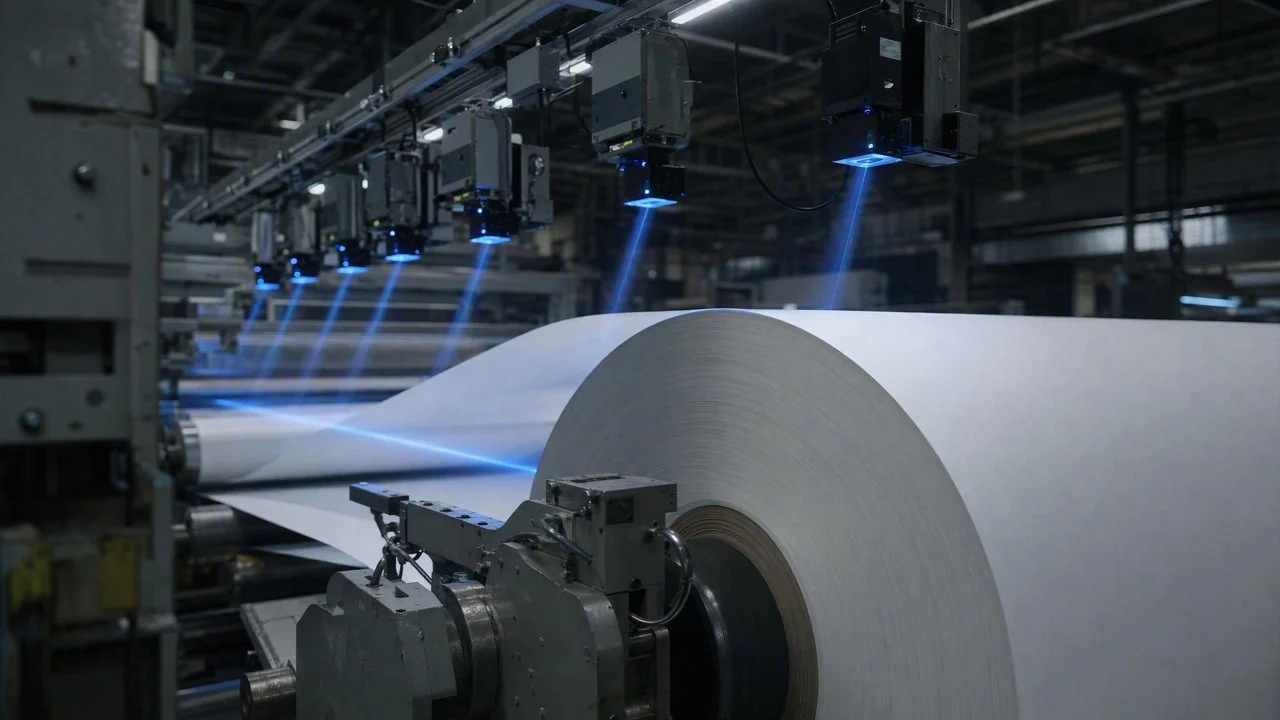
DaoAI 2D ACI equipment (high-resolution 2D imaging + deep learning secondary judgment, targeting surface/print/OCR/assembly defects, high-speed online full inspection, micron-level, semantic false positive filtering) significantly boosts production line throughput and yield by achieving efficient and precise 100% full inspection of surface defects on high-speed paper production lines, reducing the false negative rate from a typical 3% with traditional manual inspection or rule-based vision systems to below 0.4%. In the chemical and material industries, particularly in papermaking, production lines typically operate at high speeds. From pulp preparation, wet-end formation to pressing, drying, sizing, calendering, and winding, every stage can introduce various surface defects such as holes, spots, wrinkles, watermarks, fiber clumps, color variations, or uneven coating. These defects not only affect the aesthetic quality of the paper but can also impact its subsequent processing performance and final application, for example, in packaging, printing, or special material fields. Therefore, conducting 100% comprehensive online quality inspection of paper products is crucial to ensure products meet stringent standards and enhance market competitiveness.
Pain Points: Why This Hurdle Is Difficult to Overcome
Traditional paper production line defect detection faces multiple challenges. First, **the contradiction between high line speed and micron-level defects**: Modern paper machines can run at speeds exceeding 1000 meters per minute, while critical paper defects (such as tiny holes, fiber clumps) are often only tens of micrometers or even smaller. At such high throughput, manual visual inspection is simply unable to achieve 100% full inspection, with false negative rates commonly ranging from 3% to 5% or even higher. Even traditional rule-based vision systems often struggle to meet production requirements due to processing speed bottlenecks and persistently high false positive rates. Second, **defect diversity and false positive rates**: Paper texture is complex, with various defect types and forms, and even good products may have subtle 'non-defect' features that do not affect performance. Traditional rule-based vision systems struggle to distinguish these subtle differences, leading to false positive rates typically ranging from 10% to 20%, requiring extensive manual re-inspection, severely slowing down production line efficiency and increasing labor costs. Finally, **changeover and maintenance costs**: Paper products come in a wide variety, and different paper types, basis weights, and coating methods lead to changes in defect characteristics. Traditional systems require significant time for rule adjustments and parameter calibration during production line changeovers, resulting in long downtimes and impacting production continuity. These cumulative problems lead to high quality control costs for paper manufacturers while pursuing high production volumes, running counter to the current industry trend of 'FaAO's reconstruction of manufacturing cost systems,' necessitating the introduction of more intelligent and efficient inspection solutions.
From a process perspective, paper production is a continuous and complex physicochemical process where material non-uniformity and minor process fluctuations can lead to defects. For example, uneven fiber dispersion in the wet end can form clumps; unstable press roll pressure may cause streaks; and excessive temperature gradients in the drying section are prone to wrinkles. These defects are often tiny, have low contrast, and are embedded in complex background textures, making it difficult for traditional vision algorithms based on thresholds or edge detection to accurately capture them. The high throughput of the production line further compresses the image acquisition and processing time window, placing extremely high demands on the system's real-time performance. DaoAI 2D ACI equipment is precisely designed to solve these fundamental problems, with its deep learning judgment capability effectively handling small, diverse defects against complex backgrounds, combined with a high-speed imaging system to ensure precise detection at high throughput.
Technical Principles
The core advantage of DaoAI 2D ACI equipment lies in its combination of **high-resolution 2D imaging technology and an advanced deep learning secondary judgment engine**. At the hardware level, we employ customized high-speed industrial cameras and line scan cameras, paired with high-brightness, highly uniform bar lights or area lights, to achieve clear capture of micron-level details on the surface of rapidly moving paper. These cameras can acquire image data at extremely high frame rates and resolutions, ensuring that even at paper line speeds exceeding 120 meters per minute, clear, blur-free images are obtained. After pre-processing by the edge computing unit, images are transmitted in real-time to the industrial controller equipped with the DaoAI ACI OS.
At the software level, the DaoAI ACI OS from WeLinkirt utilizes **deep learning algorithms based on visual foundation models**. Unlike traditional rule-based vision (e.g., thresholding, morphological operations), our system eliminates the need for manual setup of complex rules. Instead, it automatically extracts paper surface texture features and defect patterns by learning from a large number of good samples and a small number of defective samples (APDT few-shot learning, requiring only 1–20 good samples to initiate model training). Its **semantic false positive filtering capability** is particularly outstanding, intelligently distinguishing true quality-impacting defects from background noise or non-critical texture variations, reducing the false positive rate by more than 85%, thereby significantly cutting down on manual re-inspection workload. This AI-driven judgment mechanism allows DaoAI 2D ACI equipment to demonstrate robustness and accuracy far superior to traditional methods in detecting complex and varied paper defects, ensuring stable operation and high-precision detection on high-speed production lines, with a detection rate of up to 99.4%.
Typical Application Scenarios
- **Detection of Paper Holes and Penetrating Defects**: During the pressing, drying, and winding stages of paper production, tiny fiber breaks or impurities can cause holes or weak spots in the paper. DaoAI 2D ACI equipment uses backlight or transmitted light imaging to clearly capture these penetrating defects, accurately identifying even pinholes smaller than 50 micrometers, preventing breaks or scrap during subsequent processing.
- **Detection of Spots and Impurities**: In the papermaking process, unpurified substances from wood pulp, oil stains, ink marks, or environmental dust can form spots on the paper surface. DaoAI 2D ACI employs high-resolution reflective light imaging combined with deep learning to classify and identify spots of different colors, shapes, and contrasts, effectively filtering out background texture interference, achieving a detection rate of 99.5%.
- **Detection of Wrinkles and Creases**: If tension control is improper during calendering, winding, and other stages, paper can develop linear or patchy wrinkles and creases, affecting flatness and subsequent printing quality. The WeLinkirt system uses side lighting or a combination of multi-angle lights to enhance the shadow contrast of these three-dimensional defects, then uses AI to accurately identify their geometric features, distinguishing them from normal textures.
- **Detection of Uneven Coating and Color Differences**: In the production of specialty or coated papers, the uniformity of the coating layer and color consistency are crucial. DaoAI 2D ACI equipment can integrate hyperspectral or multispectral imaging modules to precisely detect uneven coating thickness, streaks, spots, and subtle color differences by analyzing spectral reflection characteristics at different wavelengths, ensuring products meet strict color standards.
- **Detection of Fiber Clumps and Paper Formation Defects**: During papermaking, poor fiber dispersion can lead to clumps, affecting paper strength and uniformity. DaoAI 2D ACI uses high-resolution imaging to identify these high-density areas, combining AI for morphological analysis to ensure the uniformity of the paper's fiber structure and provide timely feedback for adjusting production parameters.
Case Study
A leading specialty paper manufacturer in East China, whose products are widely used in high-end packaging and industrial filtration, faced a significant challenge. Their high-speed paper machine production line (line speed approx. 100-150 meters/minute) required extremely high precision in detecting minute coating irregularities, fiber clumps, and very fine pinholes on high-end coated paper. While traditional rule-based vision systems could detect some obvious defects, they had a higher false negative rate (approx. 2.5%) for low-contrast, morphologically varied small defects, and a false positive rate as high as 15%. This resulted in 2-3 quality inspectors spending significant time each shift on manual re-inspection, severely restricting production line throughput. After in-depth discussions with the manufacturer, the WeLinkirt team deployed the 2D ACI equipment. Before deployment, the client's average re-inspection time per shift was 4 hours, and there were still customer complaints and returns due to minor defects. After the DaoAI 2D ACI equipment was deployed, we first used APDT few-shot learning to quickly train a model for their specialty paper defects with only 15 good samples. During operation, combined with the online full inspection function, the system stably maintained a detection throughput of over 120 meters/minute, achieving 100% comprehensive detection of various micron-level defects. By adopting DaoAI 2D ACI equipment, this customer significantly improved the automation level and efficiency of their production line inspection.
DaoAI 2D ACI equipment reduced paper detection false positive rates by more than 85% and controlled false negative rates to <0.4%, helping customers achieve a leap in quality at high throughput.
WeLinkirt Solution and Products
The core solution provided by WeLinkirt to this specialty paper manufacturer was the DaoAI 2D ACI equipment. This system integrates high-resolution line scan cameras, customized LED light sources, and an edge computing unit, with intelligent analysis powered by the DaoAI ACI OS. During deployment, we achieved integration with the client's existing production line control system via SDK/API interfaces, enabling real-time synchronization with paper machine speed and instant feedback of defect data. For modeling, we leveraged the APDT few-shot learning capability of the DaoAI ACI OS, requiring only a small number of good and defective samples to complete model training, significantly shortening the model iteration cycle. For changeover requirements across different paper types, the system supports 0-code quick changeover. By importing pre-set 'recipes' or performing online fine-tuning, detection parameters can be switched within 5 minutes, minimizing downtime. Furthermore, the DaoAI ACI OS supports 100% local private deployment, ensuring customer data security and production continuity. In daily operations, the system continuously learns from production line feedback, leveraging the unified foundation of the DaoAI World model for cross-scenario generalization and continuous optimization, further enhancing detection accuracy and efficiency.
Through the deployment of DaoAI 2D ACI equipment, the manufacturer achieved significant business value. First, **increased production line throughput and capacity**: By reducing the false negative rate to <0.4% and the false positive rate by -85%, manual re-inspection and rework were significantly reduced, allowing the production line to operate at a higher effective throughput, boosting overall capacity. Second, **improved product quality and customer satisfaction**: Precise identification of micron-level defects ensured the quality stability of each batch of products, reducing customer complaints and returns, and significantly enhancing brand reputation. Finally, **cost optimization and reduced compliance risk**: Automated inspection replaced a large amount of repetitive manual work, reducing labor costs. Simultaneously, high-precision quality control also lowered compliance risks and potential compensation due to product defects.
FAQ
What types of paper defects does DaoAI 2D ACI equipment primarily detect?
DaoAI 2D ACI equipment efficiently detects various paper surface defects, including but not limited to holes, spots, wrinkles, watermarks, fiber clumps, uneven coating, and subtle color differences. Its high-resolution imaging and deep learning algorithms enable it to identify micron-level defects and intelligently distinguish real defects from background textures.
How does DaoAI 2D ACI Equipment ensure 100% full inspection at high line speeds?
Our equipment utilizes customized high-speed industrial cameras and optimized edge computing units, capable of acquiring images at extremely high frame rates and processing them in real-time. Combined with the deep learning judgment engine of the DaoAI ACI OS, it can perform online full-coverage detection of micron-level defects even when paper line speeds exceed 120 meters per minute, ensuring no critical defects are missed.
What are the approximate costs and time required to deploy DaoAI 2D ACI equipment?
Deployment costs and time vary depending on specific production line conditions (e.g., line width, speed, defect types, integration complexity). Typically, we provide customized solutions, including hardware configuration, software licensing, installation, commissioning, and employee training. Specific quotes and project timelines are determined after an on-site evaluation. Please contact our sales team for detailed consultation.
Full solution for this scenario: the full inspection solution for Chemical / materials
This article was generated by AI. Customer cases are simulated scenarios based on real product capabilities and figures are illustrative; see product pages for official benchmarks.