
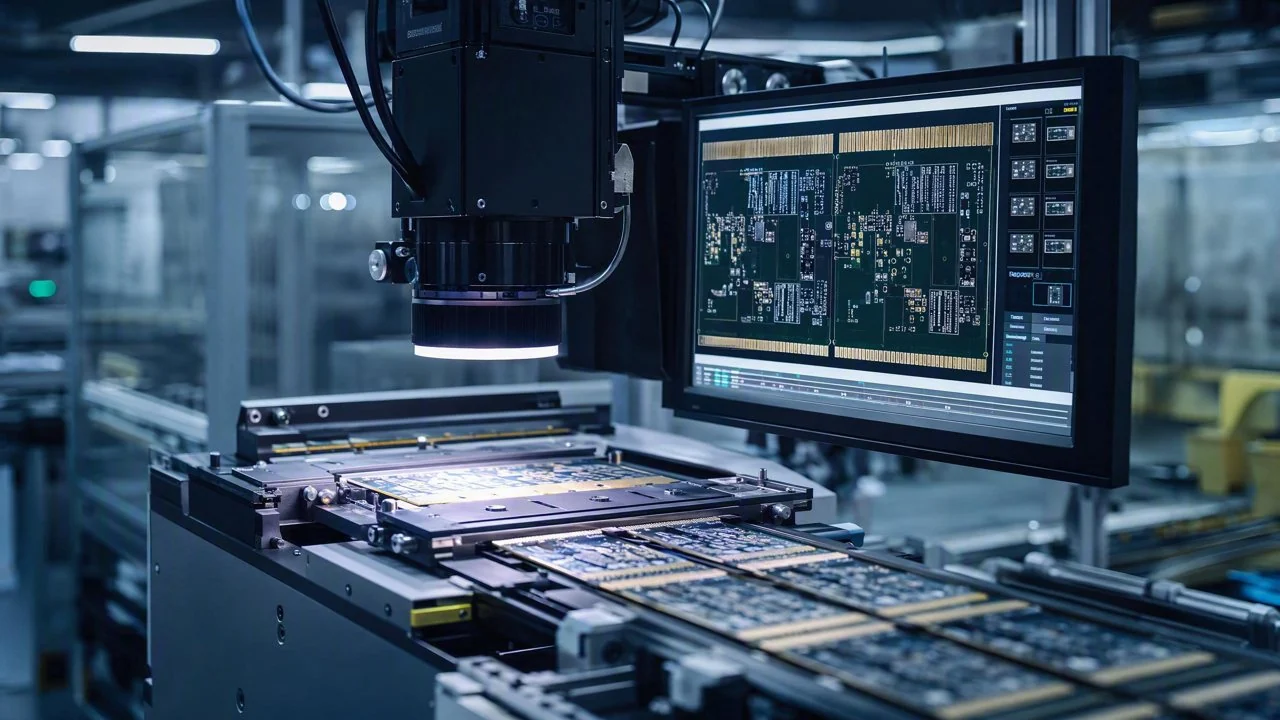
In electronic manufacturing, DaoAI's 2D AI AOI equipment (high-resolution 2D imaging + deep learning secondary judgment, targeting planar defects like surface/print/OCR/assembly omissions, high-speed inline full inspection, micron-level, semantic false positive filtering) utilizes APDT few-shot self-training to reduce the false positive rate for PCBA gold finger scratches and oxidation defects from 20% in traditional solutions to below 5%, significantly boosting production efficiency and product quality.
In the field of electronic manufacturing, especially for critical components involving high-frequency data transmission and plugging durability, such as gold fingers, their surface quality directly impacts the performance and reliability of the final product. Gold fingers, as the interface between the PCBA board and external connectors, are often exposed or subject to wear during production, making them prone to surface defects like scratches, oxidation, and corrosion. These micron-level defects, if not detected and removed in time, can lead to poor contact, signal attenuation, or even system failure, posing significant potential risks to downstream assembly and end-users. A leading PCBA manufacturer, specializing in high-end server and communication equipment motherboards, has extremely stringent requirements for the surface integrity of gold fingers. Facing increasing order volumes and a multi-variety, small-batch production model, traditional inspection solutions proved inadequate in terms of both precision and efficiency.
Pain Points: Why This Hurdle Was Difficult to Overcome
This manufacturer faced multiple challenges in gold finger defect inspection: First, **high false positive rates**. Traditional rule-based AOI equipment often misidentified normal phenomena such as subtle textures, color variations in the gold plating, dust, or minor stains on the gold finger surface as scratches or oxidation, leading to false positive rates as high as 20%. This resulted in a large number of good products being sent for manual re-inspection, severely slowing down the production tempo. Second, **inefficient new product changeovers**. Whenever a new PCBA model was introduced, the gold finger's shape, length, and arrangement might change. Traditional AOI required hours or even days of rule adjustments and parameter optimization, causing prolonged production line downtime and impacting delivery schedules. Third, **complex and diverse defect types that are difficult to quantify**. Gold finger scratches varied in depth, length, and direction; oxidation manifested as uneven color and spots. These subtle variations in defect morphology made it difficult to standardize manual visual inspection criteria and led to fatigue-induced omissions. Drawing parallels with the current trend of AI quality inspection large models in the display panel industry for cost reduction and efficiency improvement, the PCBA sector urgently needs to adopt smarter and more efficient inspection methods to address similar challenges.
The root cause of these difficulties lies in the complex optical properties of gold finger materials (highly reflective, sensitive to ambient light) and the randomness and diversity of defects. This made it challenging for traditional image processing algorithms based on thresholds and edge detection to effectively distinguish between genuine and false defects. Furthermore, manual visual inspection was limited by human eye resolution, subjective judgment, and fatigue during long working hours, failing to guarantee consistent and stable detection. On high-speed production lines, the lack of a solution that could quickly adapt to new products, precisely identify minute defects, and effectively filter false positives was the core challenge for this manufacturer.
Technical Principles
The core advantage of DaoAI's 2D AI AOI equipment lies in its combination of high-resolution 2D imaging technology with deep learning secondary judgment capabilities, particularly its breakthrough in APDT (Auto-Programmed Deep Learning Training) few-shot self-training technology. The equipment captures micron-level images of the gold finger surface using high-precision industrial cameras, employing advanced optical systems to ensure image clarity and consistency, effectively suppressing reflection interference. These images are then fed into the DaoAI AI AOI software system, which incorporates feature recognition capabilities based on foundation vision models. APDT technology allows users to train and program the model automatically within 5 minutes, requiring only 1-20 good samples (typically 1-5 samples in this case). This is enabled by its pre-trained general-purpose vision model, which can understand high-level semantic features in images, thereby quickly learning normal and abnormal patterns with very few samples, achieving precise identification of defects like gold finger scratches and oxidation. The semantic false positive filtering function of the DaoAI engine further distinguishes “fake defects” caused by normal textures, ambient light shadows, or minor stains, significantly reducing the false positive rate.
Compared to traditional rule-based AOI, DaoAI's 2D AI AOI equipment eliminates the need for manual writing of complex rules and parameters, avoiding the drawbacks of rules failing to cover all defect types, sensitivity to ambient light, and high false positive rates. Compared to manual visual inspection, DaoAI's solution eliminates human subjectivity, fatigue, and the risk of missed detections, achieving 100% inline full inspection and maintaining a detection rate above 99.5%. Its deep learning algorithms can identify subtle scratches and early signs of oxidation that are difficult for traditional AOI to catch. Furthermore, the APDT few-shot self-training feature reduces new product changeover time from hours to minutes, significantly improving production line flexibility and efficiency. For instance, in practical applications, DaoAI's 2D AI AOI reduced the false positive rate for gold finger scratches and oxidation defects by 75%, greatly decreasing the workload of manual re-inspection.
Typical Application Scenarios
- **Gold Finger Surface Scratch Detection:** During PCBA production, plugging, testing, or handling, micron-level scratches may appear on the gold finger surface. DaoAI's 2D AI AOI equipment, through high-resolution imaging and deep learning models, can precisely identify and classify scratches of varying degrees, including fine hairline scratches, which is critical for ensuring connection reliability.
- **Gold Finger Oxidation/Corrosion Detection:** The gold plating may oxidize or corrode in humid environments or upon contact with chemicals, manifesting as uneven color, spots, or darkening. DaoAI's vision model can learn these subtle color and texture changes, detecting early signs of oxidation to prevent defective products from leaving the factory and ensure long-term reliability.
- **Character OCR and Barcode Recognition:** Batch numbers, model numbers, or barcodes may be printed on or near the gold finger area. DaoAI's 2D AI AOI equipment possesses powerful OCR and barcode recognition capabilities, simultaneously checking the integrity, accuracy, and readability of characters, ensuring product traceability.
- **PCBA Surface Foreign Object/Solder Splash Detection:** In addition to gold fingers, the PCBA board surface may also have foreign objects like solder splashes, dust, or fibers. The DaoAI solution can be extended to cover foreign object detection across the entire board surface, preventing short circuits or other functional failures.
- **Connector Pin Coplanarity and Flatness (with 3D Vision):** While this article primarily focuses on 2D AOI, for 3D morphological defects such as the coplanarity and flatness of gold finger connector pins, DaoAI's 3D AI AOI equipment can offer a more comprehensive solution, utilizing self-developed 3D cameras for 3D morphology reconstruction to ensure optimal pin condition before assembly.
Case Study
A renowned Tier-1 electronics supplier in South China, whose primary business is providing high-performance server motherboards to leading global cloud computing vendors, had long relied on traditional rule-based AOI and extensive manual re-inspection for gold finger detection. With frequent introductions of new motherboard models, each changeover and model debugging session required over 4 hours, and the false positive rate reached as high as 20%. This meant at least 5 inspectors were dedicated daily to re-inspection, severely impacting production efficiency and costs. After adopting DaoAI's 2D AI AOI equipment, the situation improved significantly. By utilizing APDT few-shot self-training technology, when introducing new products, the supplier only needed to provide 3-5 images of good gold fingers, and the DaoAI system could complete model training and deployment within 5 minutes, reducing changeover downtime by over 97%. After implementation, the missed detection rate for gold finger scratches and oxidation defects was reduced to <0.5%, and the false positive rate also dropped from 20% to approximately 4%, resulting in an 80% reduction in manual re-inspection volume.
"DaoAI's APDT few-shot self-training technology has completely transformed our new product introduction efficiency. What used to take hours of debugging now takes minutes, and the inspection accuracy far exceeds expectations, ensuring greater product quality."
DaoAI Solutions and Products
DaoAI's 2D AI AOI equipment provides customers with an end-to-end intelligent inspection solution. Its core is the DaoAI AI AOI software system, which integrates advanced APDT few-shot learning capabilities and semantic false positive filtering technology. In the gold finger inspection scenario, we first acquire images with high-resolution 2D cameras. Then, using the APDT mode, engineers only need to upload a small number of good sample images, and the DaoAI system automatically learns normal features and builds an efficient defect detection model. This process greatly simplifies the modeling difficulty, eliminating the need for professional AI algorithm engineers; production line operators can quickly get started after simple training. The DaoAI system supports 100% local private deployment, ensuring customer data security without leaving the factory, meeting the stringent data privacy requirements of large enterprises. Furthermore, the system flexibly integrates into existing production line management systems (MES/SCADA) via SDK/API/Docker, enabling data interoperability and intelligent decision-making. For more complex defects, such as 3D morphological issues, DaoAI's 3D AI AOI equipment can serve as a complement, offering more comprehensive inspection capabilities.
Through the deployment of DaoAI's 2D AI AOI equipment, this customer achieved significant business value. The **detection rate for gold finger scratches and oxidation defects increased to over 99.5%, with a missed detection rate controlled at <0.5%**. Thanks to APDT few-shot self-training and semantic false positive filtering, the **false positive rate decreased from 20% to 4%**, leading to an **80% reduction in manual re-inspection hours**. New product **changeover time was reduced from over 4 hours to 5 minutes**, greatly enhancing production line flexibility and uptime. These improvements not only lowered operating costs, improved product quality and customer satisfaction, but also enabled the manufacturer to respond more quickly to market demands, strengthening its competitiveness in the high-end electronics manufacturing sector.
FAQ
What is APDT few-shot self-training, and how is it applied to gold finger inspection?
APDT (Auto-Programmed Deep Learning Training) is DaoAI's proprietary few-shot self-training technology, allowing users to automatically complete deep learning model training and programming within minutes by providing only a small number (typically 1-20) of good samples. In gold finger inspection, this means engineers don't need to collect numerous defect samples; they just upload a few images of good gold fingers, and the system quickly learns normal features and accurately identifies anomalies like scratches and oxidation, greatly simplifying model deployment and new product changeover processes.
What are the significant advantages of DaoAI's 2D AI AOI equipment compared to traditional AOI?
The core advantages of DaoAI's 2D AI AOI equipment lie in its deep learning capabilities and APDT few-shot self-training. Traditional AOI relies on complex rule programming, has limited ability to identify subtle and diverse defects, and suffers from high false positive rates. DaoAI's equipment, by learning semantic features from images, can more accurately identify true defects and significantly reduce false positives through semantic false positive filtering. Meanwhile, APDT technology reduces new product changeover time from hours to 5 minutes, greatly enhancing production line flexibility and efficiency, and maintaining a detection rate above 99.5%.
What is the budget and timeline for deploying DaoAI's 2D AI AOI equipment?
Deployment budget and timeline depend on specific production line scale, inspection requirements, integration complexity, and desired equipment configuration. DaoAI offers flexible deployment solutions, from software SDK to complete equipment sets, supporting 100% local private deployment. We recommend contacting our sales and technical team through official channels, providing detailed production environment and inspection requirements. We will then tailor the most cost-effective solution for you, along with a detailed quotation and project implementation timeline estimate.
Full solution for this scenario: Electronics / PCBA industry solutions · Gold Finger Scratch & Oxidation Detection
This article was generated by AI. Customer cases are simulated scenarios based on real product capabilities and figures are illustrative; see product pages for official benchmarks.