
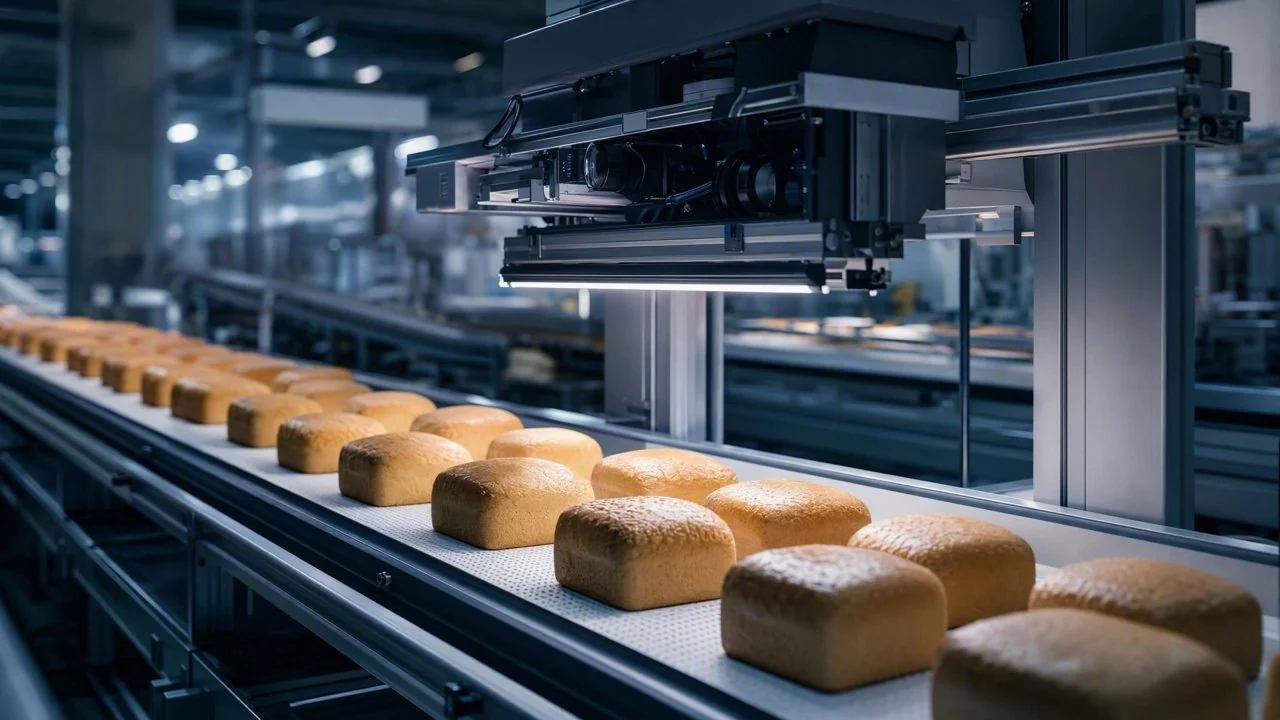
DaoAI 2D ACI equipment (high-resolution 2D imaging + deep learning secondary judgment, for surface/printing/character OCR/assembly defects, high-speed online full inspection, micron-level, semantic false positive filtering) reduced the false positive rate of appearance defects in a large bakery enterprise's products from a traditional 20% to <5% through high-precision imaging and deep learning judgment, significantly improving the accuracy and efficiency of quality traceability.
The bakery industry, as a crucial component of the food industry, sees product appearance quality directly influencing consumer purchasing intent and brand image. In today's market, which pursues lean production and upgraded consumer experience, the detection of appearance defects in bakery products is particularly critical. A leading bakery manufacturer, producing millions of various pastries and breads daily, has extremely low tolerance for appearance defects in its high-end product series. Traditionally, this manufacturer relied primarily on manual visual inspection to screen for problems such as burnt spots, cracks, collapses, foreign objects, deformities, and packaging printing errors on product surfaces. However, with increasing order volumes and product diversification, the bottlenecks of manual inspection—low efficiency, inconsistent results, high labor costs, and difficulty in achieving data traceability—have become increasingly prominent. Especially when dealing with sudden quality issues, the lack of precise historical data support makes root cause analysis and rapid response challenging. DaoAI addresses this pain point by introducing its 2D ACI equipment, aiming to provide a high-precision, intelligent online full inspection solution for bakery product production in the food/agriculture industry.
Pain Points: Why This Hurdle Is Difficult to Overcome
The bakery manufacturer faced multiple challenges under the traditional inspection model: Firstly, **high rates of missed detections and false positives** persisted. During peak periods, due to visual fatigue and subjective judgment differences, the manual visual inspection's missed detection rate for subtle defects like the depth of burnt spots or size of cracks could exceed 5%, while the false positive rate for normal color variations or baking textures reached up to 20%, leading to the rejection of numerous qualified products and unnecessary losses. Secondly, **quality traceability was difficult and time-consuming**. When consumer complaints were received or batch quality issues were discovered, the lack of detailed online inspection data prevented rapid identification of specific production times, shifts, equipment parameters, or even raw material batches. This resulted in long traceability cycles, averaging 3-5 days to initially pinpoint the problem scope. Thirdly, **a missing closed-loop for quality control data**. Traditional paper records or manual data entry were not only inefficient but also created severe data silos, making real-time integration with MES/ERP systems difficult. This prevented the formation of a complete data closed-loop from production to inspection to feedback, hindering the optimization of production processes and the advancement of automation. The current industry trend, where AI large models enable the automotive manufacturing industry to achieve both high defect detection rates and shortened new vehicle development cycles, also inspires the food industry's urgent need for automated and data-driven quality inspection. Bakery products are diverse in type and form, and the non-linear changes during baking (e.g., expansion, browning) result in varied defect manifestations. Traditional rule-based machine vision struggles to adapt, while manual visual inspection is limited by human visual capabilities and subjectivity, making it difficult to provide stable and reliable quality assurance.
From a process perspective, the complexity of bakery products lies in the irregularity of their surface texture, color, and shape. For example, natural cracks on bread crusts can appear very similar to cracks caused by production defects, and normal color changes from caramelization can be difficult to distinguish from burnt spots caused by overbaking. These subtle differences pose significant challenges for traditional machine vision systems based on thresholds or edge detection, often leading to a high volume of false positives. While manual visual inspection can understand these 'semantic' differences, its high labor costs and instability make it unsuitable for large-scale, high-throughput production needs. DaoAI's 2D ACI equipment is specifically designed to address these 'why it's difficult' problems.
Technical Principles
The core of DaoAI's 2D ACI equipment lies in the tight integration of its high-resolution 2D imaging system and deep learning secondary judgment. At the hardware level, we employ industrial-grade high-resolution line scan or area scan cameras, combined with customized annular, coaxial, or multi-angle composite light sources, to ensure comprehensive, high-contrast image acquisition of bakery product surface features. For instance, for burnt spot detection, specific wavelengths of light are used to enhance the contrast of caramelized areas; for cracks, low-angle scattered light might be used to highlight their 3D morphology. These images capture every detail of the product at micron-level precision, laying the foundation for subsequent intelligent analysis. The raw image data captured by DaoAI's 2D ACI equipment is then fed into its built-in deep learning inference engine. This engine is based on an advanced Convolutional Neural Network (CNN) architecture and optimized through DaoAI's APDT few-shot self-training technology. This means that even with only 1-20 good product images, the system can quickly learn normal appearance features and accurately identify various anomalies including burnt spots, cracks, foreign objects, deformities, printing offsets, and missing characters. Compared to traditional rule-based AOI systems, DaoAI's 2D ACI equipment can effectively differentiate between 'normal variations' and 'defects.' For example, it can semantically distinguish between natural textures formed by bread crust expansion and cracks caused by baking, significantly reducing false positives. Its semantic false positive filtering function is precisely based on a deep understanding of product visual features, rather than simple pixel difference comparisons.
Compared to traditional manual visual inspection, DaoAI's 2D ACI equipment offers unparalleled advantages. Firstly, it achieves 100% online full inspection, with detection speeds reaching hundreds of pieces per minute, far exceeding human efficiency, and unaffected by fatigue, ensuring highly consistent inspection results. Secondly, its micron-level detection accuracy can uncover subtle defects imperceptible to the human eye, such as foreign particles with diameters less than 100 micrometers. Most critically, DaoAI's 2D ACI equipment can link each inspection result (including defect type, location, severity) in real-time with product batch numbers, production timestamps, and production line stations, building a complete quality traceability chain—something unachievable with manual inspection. Furthermore, the system supports 0-code rapid model changeovers. For the bakery industry's multi-variety, small-batch production model, detection model deployment for new products can be completed in just 5 minutes, greatly shortening downtime and enhancing production flexibility.
Typical Application Scenarios
- **Bread/Pastry Surface Burnt Spots and Cracks Detection:** DaoAI 2D ACI equipment uses multi-angle lighting and high-resolution imaging to capture subtle color changes and geometric features on the product surface. The deep learning model can differentiate between normal browning and burnt spots caused by overbaking, as well as natural expansion textures and structural cracks. The challenge lies in the non-uniformity and diversity of baked product surface morphologies.
- **Biscuit/Cookie Foreign Object and Deformation Detection:** In the post-baking cooling stage, DaoAI 2D ACI equipment can perform a comprehensive scan of the biscuit surface to identify foreign objects like hair or metal shavings, and detect edge chips, collapses, or uneven thickness deformations. The difficulty lies in the tiny size of foreign objects, which may have colors similar to the product, and deformation judgment requiring precise 3D information (though this equipment is primarily 2D, it can infer indirectly based on shadows or edge features).
- **Packaging Bag Print Defects and Character OCR:** For printed content on bakery product packaging bags, such as production dates, batch numbers, and ingredient lists, DaoAI 2D ACI equipment can perform high-speed OCR recognition and verification, detecting misprints, omissions, blurriness, missing characters, or offsets. Challenges include the reflective properties of different packaging materials, the variety of print fonts, and image stability during high-speed movement.
- **Filling Integrity and Surface Flatness (2D Projection):** For some open-faced bakery products (e.g., tarts, pizzas), DaoAI 2D ACI equipment can image from above. By analyzing the 2D projected area of the filling, its distribution uniformity, and surface height differences (inferred indirectly through shadows or texture variations), it detects underfilling or overflow. The difficulty lies in the diversity of filling colors and the accuracy of recognizing subtle surface undulations.
Implementation Case Study
A large chain bakery brand, with dozens of production bases, faced severe appearance quality control challenges when launching a new high-end French bread product at one of its main factories in East China. This product demanded extremely high standards for crust crispness, caramel color, and crack morphology. Traditional manual visual inspection was not only inefficient (requiring 4-6 QC personnel per production line) but also led to significant quality fluctuations between batches due to subjective standards. The false positive rate reached 20%, resulting in over 300,000 RMB worth of qualified products being rejected monthly due to misjudgment. More critically, once a consumer complaint arose, tracing the root cause often took several days, severely impacting brand reputation and rapid response capabilities. After DaoAI's 2D ACI equipment was introduced, a detailed on-site survey and data collection were conducted at the production line. Utilizing the APDT few-shot learning capability of the DaoAI Wemio engine, the initial model was trained and deployed in just 30 minutes with only 15 good product images. In the initial phase, the system operated in parallel with manual inspection. Through continuous feedback learning and optimization, DaoAI's 2D ACI equipment achieved precise detection of core defects such as burnt spots, cracks, and foreign objects on the French bread within just two weeks. Its high-resolution imaging combined with deep learning's semantic false positive filtering effectively distinguished between normal product textures and actual defects, significantly reducing misjudgments.
“DaoAI's 2D ACI equipment not only solved our long-standing manual inspection pain points, but more importantly, it built a data closed-loop for us from production to quality control to traceability, truly realizing an intelligent upgrade of quality management.” — QC Director of a bakery manufacturer.
After implementation, the factory only required 1 operator to monitor the equipment and handle exceptions, significantly reducing labor costs. More importantly, DaoAI's 2D ACI equipment linked each inspection result (including defect type, location, severity) in real-time with the product batch number, production timestamp, and production line number, uploading this data to the factory's MES system, thereby achieving **full-process traceability of quality data**. When quality issues arose, the QC department could retrieve all relevant batch inspection data within minutes, quickly pinpointing the problematic segment, reducing the average traceability time from 3-5 days to less than 1 hour. Furthermore, by analyzing long-term inspection data, the manufacturer also discovered correlations between specific defects and certain production parameters (e.g., oven temperature, humidity), providing valuable data support for process optimization and forming a **quality control data closed-loop**, further enhancing product quality stability. DaoAI's 2D ACI equipment helped the manufacturer achieve a dual improvement in production efficiency and product quality.
DaoAI Solutions and Products
DaoAI provides a complete solution for bakery product appearance quality inspection, centered around its 2D ACI equipment. This equipment integrates our self-developed high-resolution industrial cameras, customized lighting modules, and the powerful DaoAI ACI OS. The software system incorporates the feature recognition capabilities of visual foundation models, enabling 0-code automated programming with just one good sample in 5 minutes, greatly simplifying model deployment and changeover processes. Its APDT positive/few-shot learning technology (requiring only 1–20 good samples) allows for rapid establishment of recognition models for new products or defect types, reducing reliance on large quantities of defect samples. The semantic false positive filtering function ensures detection accuracy, effectively distinguishing between normal product variations and true defects. DaoAI's 2D ACI equipment supports 100% local private deployment, ensuring the security and privacy of customer production data, with all data remaining on-site, meeting the strict compliance requirements of the food industry. Furthermore, the DaoAI Wemio engine supports flexible integration into existing production lines and MES/ERP systems through various methods such as SDK/API/Docker, enabling data interoperability. Through the DaoAI World universal foundation model, the system possesses semantic understanding, cross-scenario generalization, and continuous learning capabilities from production line feedback, allowing it to self-optimize and continuously improve detection performance as production environments change.
In terms of implementation, the DaoAI team provides end-to-end services, from preliminary demand analysis, on-site environment assessment, equipment selection, system integration, to post-maintenance. We not only provide high-performance hardware but also prioritize continuous optimization of software models and deep collaboration with customers, ensuring that DaoAI's 2D ACI equipment integrates into customer production processes. For example, for the complex surfaces of specific bakery products, we conduct professional imaging solution design, selecting the most suitable camera and lighting combination to capture optimal image quality. Simultaneously, by continuously collecting production line feedback data, the DaoAI ACI OS can constantly learn and iterate, ensuring the robustness and adaptability of the detection model, reducing the missed detection rate to <0.5%. DaoAI is committed to leveraging technological innovation to help bakery enterprises achieve intelligent and data-driven quality management, enhancing overall competitiveness.
FAQ
What are the main differences between DaoAI 2D ACI equipment and traditional machine vision or manual inspection?
DaoAI 2D ACI equipment combines high-resolution 2D imaging with deep learning secondary judgment, achieving micron-level, high-speed online full inspection. Compared to traditional rule-based machine vision, it significantly reduces false positives by semantically filtering out normal product variations from actual defects. Compared to manual inspection, it eliminates subjectivity and fatigue, provides highly consistent and traceable data, and greatly improves detection efficiency and accuracy, reducing the missed detection rate to <0.5%.
What is the budget required to deploy DaoAI 2D ACI equipment? What factors influence the quotation?
The budget for DaoAI 2D ACI equipment is influenced by various factors, including production line speed, complexity of the objects to be inspected, required detection accuracy, camera and lighting configurations, whether integration with existing MES/ERP systems is needed, and the scope of local deployment. We provide customized solutions, and we recommend scheduling a detailed consultation with our engineers to obtain an accurate quotation and ROI analysis.
How does DaoAI 2D ACI equipment ensure compliance and data security in the food industry?
Our 2D ACI equipment supports 100% local private deployment, ensuring that all production and inspection data remain on-site, fully complying with the strict data security and privacy protection requirements of the food industry. Furthermore, the system provides a complete quality traceability chain, accurately linking inspection results with production batches, offering reliable digital evidence for food safety compliance.
This article was generated by AI. Customer cases are simulated scenarios based on real product capabilities and figures are illustrative; see product pages for official benchmarks.